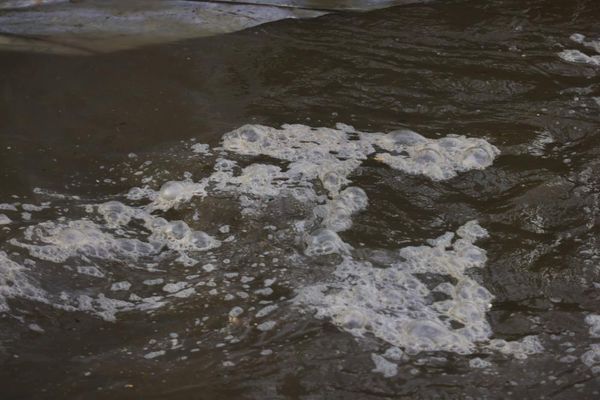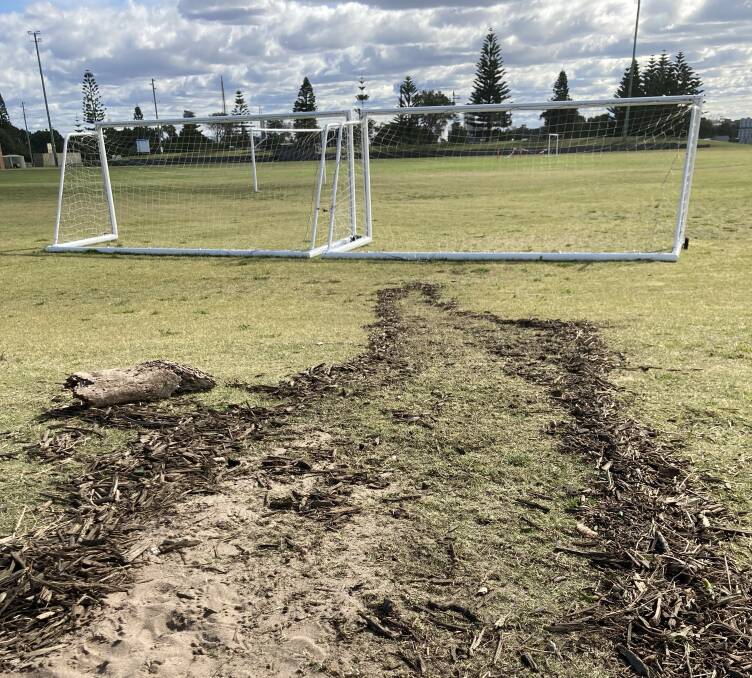
JUST days after one section of Stockton foreshore was declared safe after City of Newcastle completed a $3.9 million seawall to protect properties and roads, a new erosion threat has emerged.
For the first time, the ocean's relentless march has reached Fullerton St sports complex, Corroba Oval, home to Stockton's soccer and Little Athletics clubs.
Resident John Davidson described the continual threat along the erosion-prone coastline, with insufficient sand to buffer it from large swell, as "like trying to plug a hole in a dam wall with your finger".
He said there were fears the northern end of south Stockton beach would end up as bad as the southern end that has been stripped to a thin ribbon of sand.
The high tide mark is just 25 metres from Corroba Oval and about 300 metres downhill to the only road in and out of the peninsula suburb.
"We all remember the drone video from a few years ago [view below] that really demonstrated how bad the erosion at the south end of the beach was," he said.
"We need mass sand and we need it now."
Stockton Landcare coordinator Paul Johnson said the situation was "impossible", because for decades the suburb had been fighting an enemy destined to win - erosion caused by the Newcastle harbour breakwaters trapping the north drift sand at Nobbys.
Over the past four years Mr Johnson's group has watched as 35 metres of beachfront, buffering Corroba Oval from the ocean, disappeared into the sea.
"As soon as they tell us they have fixed one bit, a new problem appears further up or down the beach," he said.
"It's never ending sad tale and unfortunately, as disturbing as it is, the ocean reaching Corroba Oval was inevitable."
For more than a decade Landcare volunteers have worked to stabilise the dunes in an effort to halt the erosion and protect the oval, but all the work has been destroyed.
Mr Johnson said the beach had "disappeared at a rate of knots" over the past few years and there were no dunes left to work with.
Experts estimate the beach is being stripped annually of about 145,000 cubic metres of sand.
With no sand to check the sea's progress, research has shown wave energy 500 metres off Stockton beach has intensified more than 100 times from 1816 to 2018.
As the seabed continues to drop, massive volumes of water - like never seen before - are hitting the coastline and stripping more and more sand.
It's estimated that between 1.8 million and 4.5 million cubic metres of sand is needed to renourish the beach from the breakwater to the Hunter Water land north of Corroba Oval.
FURTHER READING- Save Our Stockton
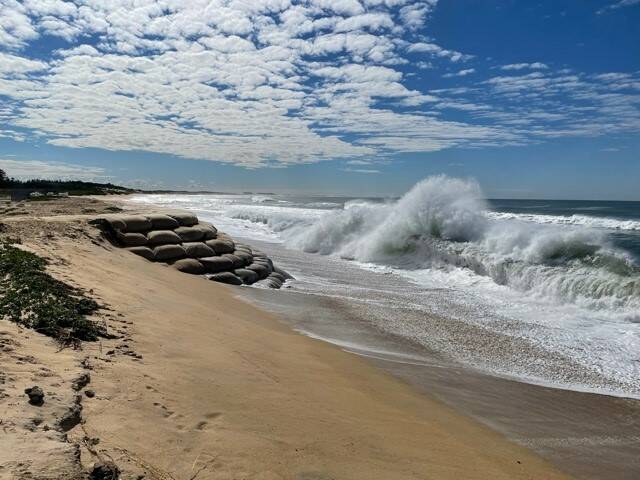
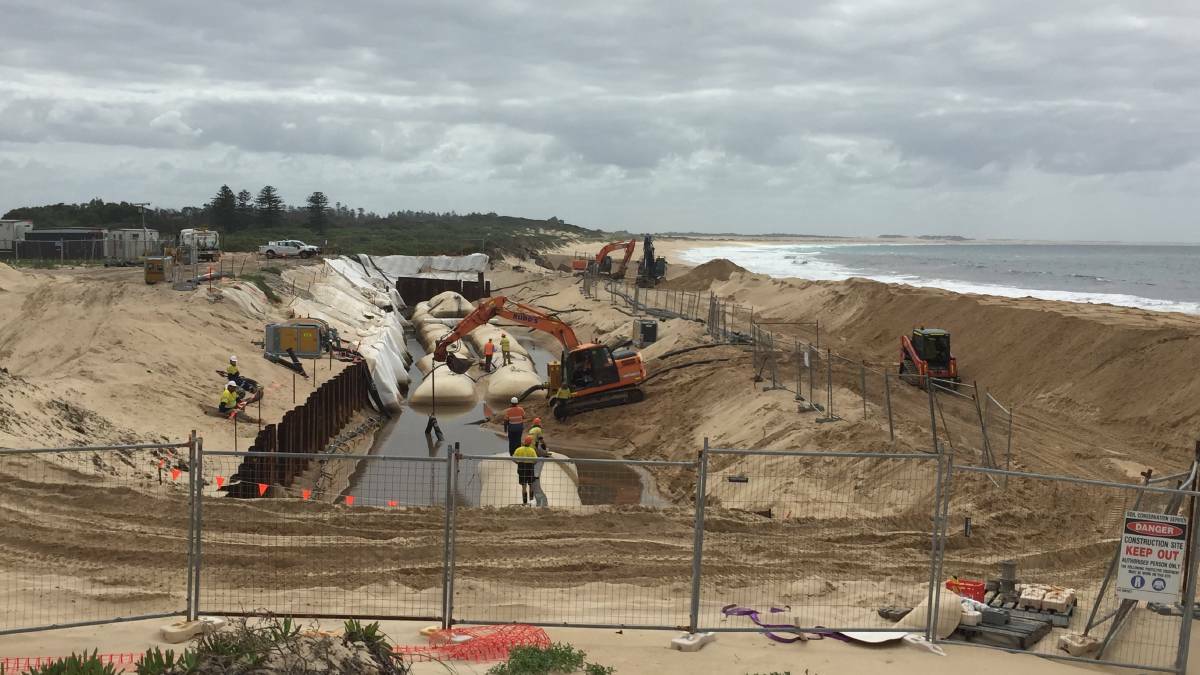
Mr Johnson said the 100-metre sandbag seawall installed by Hunter Water in 2019 to stop rubbish from an old council tip spewing into the sea due to erosion was being outflanked at either end.
"The forward dune in front of Corroba is completely gone, washed into the sea, and the big swell just goes straight over the top of what is left," he said.
"People joke that Stockton will be an island one day soon, it's getting closer every day."
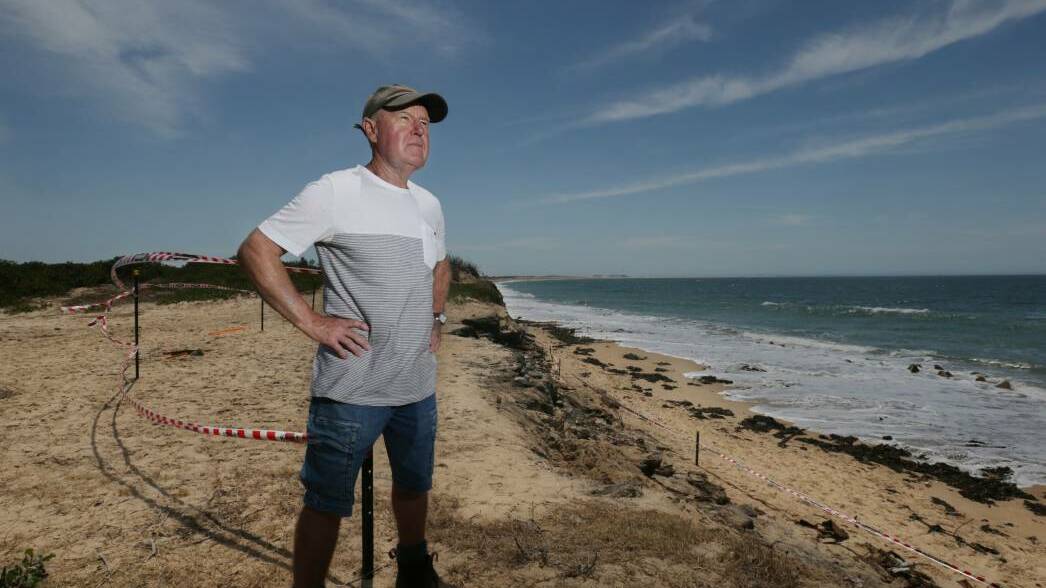
The latest threat has emerged south of the temporary $2.7 million seawall, as large swell topped what is left of the dunes on Thursday morning and travelled downhill to Corroba Oval.
At the other end of the wall, erosion has gauged at least 25 metres into what is left of the dunes.
This is one of the narrowest areas of the peninsula and about 400 metres to the Hunter River.
Hunter Water's spokesman said on Thursday night that coastal engineers were investigating.
He said if additional protection was required, Hunter Water would work to protect the ends of the seawall to prevent the landfill, that closed in the 1970s, becoming exposed.
After the tip was uncovered by erosion in 2018, council workers wearing Hazmat suits and masks were forced to comb a two-kilometre stretch of beach collecting mounds of household rubbish and pieces of asbestos.
Hunter Water's spokesman said City of Newcastle was "aware of the risks associated with the potential inundation of Corroba Oval".
"The land directly to the south of the temporary seawall is owned by Crown Lands and managed by City of Newcastle," he said.
City of Newcastle's spokeswoman confirmed council was responsible for Corroba Oval and said the land south of the seawall was Crown Land.
She said mass sand nourishment was the only long-term strategy identified for Stockton beach.
"City of Newcastle has been working to provide resilient dune vegetation within this area for over 20 years in conjunction with the local Stockton Landcare Group," she said.
"This is part of our Dune Preservation and Restoration Program so we can continue the work to rehabilitate the dunes in front of Corroba Oval."
Stockton Landcare volunteers abandoned the site in March because there are no dunes left to work with.
Mr Johnson said the group was working at Little beach, in Newcastle Harbour, as it had the only remaining dune system along the south Stockton coastline.
In coming months, as conditions allow, council said it planned to undertake beach scraping and other works, between Griffith Avenue and Corroba Oval, in an attempt to protect the sports complex.
Long time Stockton residents Lee Burgmann and Shelly Skey were on their regular morning walk on Thursday when they noticed a section of Corroba Oval had been inundated.
"It's not something we have ever seen before," Ms Skey said.
"We walk there all the time and we've never seen the water come up that far, it's really worrying. You have to wonder how long before it floods the oval."
Newcastle University's Conjoint Associate Professor in Earth Sciences Ron Boyd said it was "unfortunately not surprising".
Associate Professor Boyd said "end effects" from seawalls were well documented and further erosion around hard structures on the beach was inevitable.
He said erosion hotspots would continue to appear along the coast until mass sand nourishment was achieved.
While the southern end of Stockton beach has been stripped to a thin ribbon of sand, from Fern Bay north the beach is growing every year.
"It's a simple equation, as 145,000 cubic metres of sand departs south Stockton each year the situation can only get worse," he said.
"Every year we have much less protection and without sand it will only continue to get worse. The issue is in this area is the saltwater will kill the grass and destroy the fields."