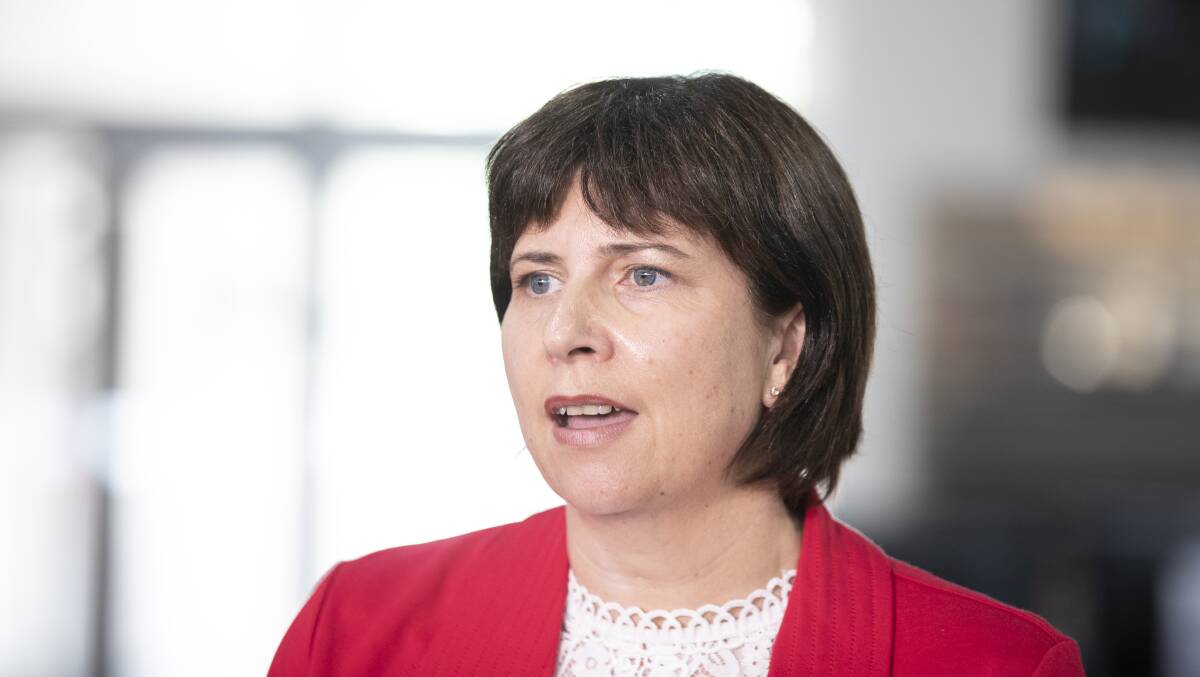
Canberra health staff will have their choice about whether to be vaccinated, according to the service's chief executive, Bernadette McDonald.
She said vaccination for staff would not be mandatory in the first phase of the roll-out, which begins in less than a week.
Frontline healthcare workers will be the first in the ACT to get the vaccine but the decision has been made to leave it up to them whether they receive it. They will get an email telling them how to book their vaccination at the specially-created Garran Surge Centre at the Garran Oval.
Residents of Yass and Queanbeyan who work in the ACT may also be eligible for vaccination in the ACT, according to Dr Kerryn Coleman, the territory's chief health officer.
It's not clear how many that would involve, given that the first stage involves aged care residents. It would involve ACT health care workers who live outside the ACT.
The hospitals in the two towns are working with the ACT's health system for storage and delivery of vaccination.
In Canberra, the Garran centre has been used as a testing place for coronavirus since it opened in July, but it will double up as vaccination site from next week. It will have separate entrances for testing and vaccinations.
The first shipment of vaccine landed in Sydney on Monday.
ACT Health Minister Rachel Stephen-Smith said on Monday that the ACT would receive about 1000 doses of the Pfizer vaccine for the first couple of weeks of the territory's vaccine rollout. How much it received after that would depend on supply and demand.
Storage sites for the vaccine in the ACT have been kept secret because of security concerns. In the United States, there has been at least one case of an anti-vax sceptic destroying vaccines.
Ms Stephen-Smith said about 4000 people were expected to be vaccinated in the first stage of the rollout, "a1", including frontline workers and residential aged care and disability care residents.
Frontline workers would account for high-risk healthcare workers like those at COVID-19 testing clinics and in emergency departments, those handling pathology samples, staff in COVID wards, staff in respiratory clinics, workers at residential aged care and disability care facilities and relevant paramedics.
It would also account for quarantine and border workers who had contact with people as they moved through Australia's borders.
Some frontline workers, like Border Force workers, were yet to be notified about their ability to get the vaccine, but would soon be informed and would have to follow the same booking process as healthcare workers.
The second stage of the rollout, dubbed "1b", was expected to start in March.
Officials said it would include vaccinations for the following people: those over 70, other healthcare workers, Aboriginal and Torres Strait Islander people over 55, adults with an underlying medical condition, and critical workers.
The third stage, called "2a", would include those aged between 50 and 69, as well as Aboriginal and Torres Strait Islander people aged between 18 and 54, and other critical and high-risk workers.
Canberra's remaining adult population - so, people under 50 who aren't Aboriginal or Torres Strait Islander - could be vaccinated from July, while children could get a coronavirus jab from September.