More than a week after a mass shooting at a toddler’s birthday party in Stockton, California, killed four people and injured 17 others, law enforcement has yet to make arrests or name any suspects. It may take investigators months to figure out what led to the tragedy, authorities said.
As investigators parse through the aftermath of the shooting, they have found at least 50 shell casings and believe at least five firearms were used in the attack, San Joaquin sheriff Patrick Withrow told reporters during a press conference on Tuesday.
“There’s not a lot of meat on the bone, unfortunately,” Withrow said of the information he had to share. “As you can imagine, we have a lot to process … to determine how many actors got involved in this and how many people were actually shooting.”
Withrow also acknowledged the reports and rumors that the shooting had been tied to a gang dispute and emphasized that no motives had been determined. The events that led up to the shooting remain unknown, he said, and likely won’t be determined anytime soon.
“This is not going to be, ‘in a week or two we’ve got an answer and we start arresting people’,” Withrow continued. “This is going to take months to process all this and figure out who did this.”
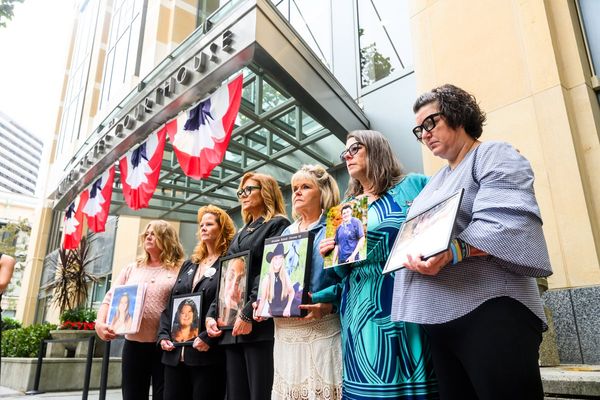
As investigators sort through the dozens of bullet cases, a litany of photo and video evidence and more than 50 tips, city officials and victims’ advocates are pushing to keep the victims, survivors and witnesses of the shooting at the forefront of the media conversation and ensuring that suspicions around the cause of the shooting doesn’t overshadow or distract from the immense pain – both physical and emotional – this shooting has caused.
“I’ve been watching all the media reports and conversations and there’s so much out there,” Stockton’s vice-mayor, Jason Lee, told reporters during a Tuesday press conference where he spoke alongside a local faith leader, a violence-prevention advocate and the father of 14-year-old Amari Peterson, one of the shooting victims. “But the thing that is singularly most important to me at this moment is making sure these families get the closure that I was able to get when the person responsible for killing my brother and for shooting me were brought to justice.”
“This makes me feel like I’m in a nightmare. I’m in the twilight zone,” Patrick Peterson, Amari’s father, told reporters. “Ever since this happened, me, my wife, my kids, we haven’t been able to eat, sleep or think correctly. I don’t even know what time it is. I barely know what day it is.”
“Every day, my son is on my mind. I feel like he was stripped away from me for nothing,” he continued.
Lee, who was shot and injured at 15 and lost his brother to gun violence four years after that, also called out the persistent underinvestment in and defunding of violence-prevention programs operating in the city. In October, Stockton’s city council voted against applying for a $58m grant that would have gone toward turning a former youth outreach center into a resource hub for the city’s teenagers and young adults. This move on top of decades of underinvestment in violence-prevention programs has contributed to the city’s current challenges with violence, the vice-mayor said.
“We need to look at ourselves,” he said. “We gave $190m to the police department, which is essential, but we put $2m to prevention services. What is that going to do when we know the city has had all of the challenges we’re talking about today?”
Focusing on victims like Amari Peterson; eight-year-olds Journey Rose Reotutar Guerrero and Maya Lupian; and 21-year-old Susano Archuleta is especially necessary as conversations in the news media and on social media have largely focused on salacious details around alleged gang affiliations and conflicts that may have led to the shooting, said Tinisch Hollins, the California director for Crime Survivors Speak (CSS), a national non-profit that supports people harmed by crime.
CSS has a Stockton chapter, whose members have been providing on-the-ground resources for victims and survivors of the 29 November shooting.
“There’s such a hyper-focus on the perceived gang that there’s been a criminalization of the victims to the point where the governor and attorney general haven’t even been to Stockton,” Hollins said.
Though California governor Gavin Newsom posted about the shooting on X and sent his staff to Stockton, he has not come to the city in person. This is a departure from high-profile shootings of years past like one in Monterey Park in 2023 and Gilroy in 2019, that speaks to a broader disparity in reactions to shootings of Black and Latino people living in underserved communities, some in the community argued.
“It was surprising to me. [Newsom] showed in Monterey Park and Gilroy, so I would suspect that a mass shooting where the victims were 21 and under would warrant the presence of the governor,” Hollins said. “I think that is racism, 1,000% that is racial bias. These are Black and brown children and because of the intersection with this gang involvement and them being victims of color, there is a glaring disproportionate response.”