The government and a bipartisan parliamentary group for sports promotion have decided not to establish special legislation to control the use of emblems and mascots of the 2020 Tokyo Olympics and Paralympics, it has been learned.
The government and the group, led by Deputy Prime Minister and Finance Minister Taro Aso, mulled the establishment of a legal framework to prevent commercial exploitation of the Games, but decided to shelve the plan on the ground that unnecessary legal control could dampen enthusiasm for the Olympics and Paralympics.
The host nations of the Games in recent years have established special laws to protect intellectual property relating to the Olympics and Paralympics. But Japan will handle intellectual property related to the Games under the existing legal framework, including the Trademark Law and the Unfair Competition Prevention Law.
The International Olympic Committee bans unauthorized use of Olympic logos and unauthorized Games-related advertisements, and asks host nations to establish legislation to strictly prevent any commercial piggybacking on the event.
The special legislation for the 2012 London Games strictly prohibited any unauthorized expressions that implied an association with the Olympics. The 2016 Rio de Janeiro Games even banned noncommercial association.
Under such circumstances, the Tokyo Organizing Committee of the Olympic and Paralympic Games requested the parliamentarian group in September last year to look at establishing special legislation. The group considered the legislation in cooperation with the Cabinet Secretariat with a lawmaker-initiated law in mind.
However, according to a senior member of the parliamentarian group, the group, ministries and agency concerned reached a common understanding that unauthorized association to the Games can be handled under the Trademark Law and the Unfair Competition Prevention Law.
"It is widely understood in Japanese industry and society that copyright infringement is illegal," a senior Cabinet Secretariat official said.
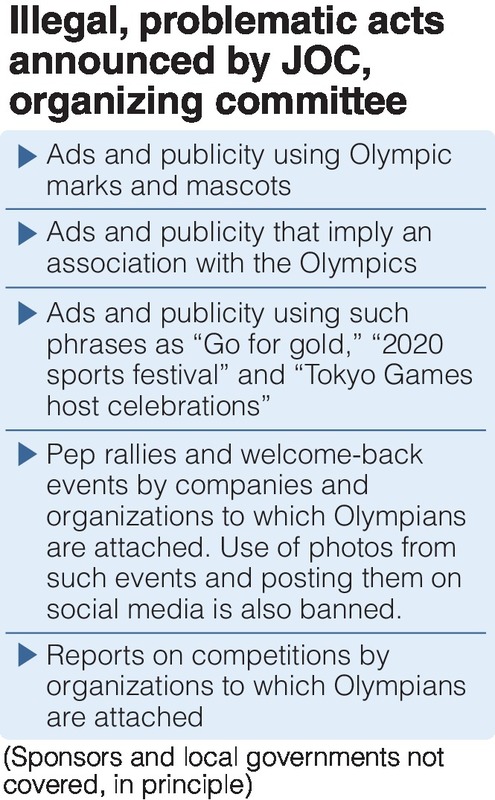
The current laws do not perfectly fulfill the criteria set by the organizing committee and the Japanese Olympic Committee. Therefore, the government and the parliamentarian group will suggest mapping out guidelines to stipulate what constitutes a breach of the law with regard to intellectual properties related to the Games, and the government will help publicize the content of the guidelines.
Behind such moves are the increasing number of objections to various restrictions in connection with the Olympics. For the Pyeongchang Winter Olympics held last month, the JOC banned schools and organizations attached to Olympians from organizing events open to the press. The consternation that erupted as a result of the restriction influenced the JOC's decision after the Games to allow schools to hold related events open to the media.
Japan Chamber of Commerce and Industry Chairman Akio Mimura expressed opposition to new legislation during a Thursday press conference. "It is proper management of the Olympics to protect the benefits of sponsors. But from the people's perspective, establishing new legislation [to protect sponsors] doesn't feel right," Mimura said.
Read more from The Japan News at https://japannews.yomiuri.co.jp/