Nissan Motor Corp. on Thursday announced a net loss of 671.2 billion yen in consolidated financial results for the year ended March 2020, compared to a net profit of 319.1 billion yen in the previous fiscal year.
It was the first net loss in 11 years, since the company was directly affected by the Lehman shock in the year ended March 2009. The loss was also close to the level reached in the year ended March 2000, when former chairman Carlos Ghosn took drastic steps to rebuild the company.
Aiming to revitalize itself, Nissan revealed a mid-term management plan in which one of the pillars is a 300 billion yen reduction in fixed costs, including personnel expenses.
Sales were 9.87 trillion yen, down by 14.6% from the previous fiscal year. The company posted an operating loss of 40.4 billion yen, compared to 318.2 billion yen in operating profit the previous fiscal year. In addition to prolonged sluggish sales in area such as North America and Europe, a decline in demand caused by the spread of the coronavirus aggravated its performance. Nissan did not reveal its earnings forecast for the year ending March 2021, saying that the future remains unclear.
Considering the effects of the virus, Nissan announced in April that net profit for the year ended March 2020 would be down by around 150 billion yen to 160 billion yen, compared to the 65 billion yen estimate as of February. The reason the amount in the red increased so sharply is an additional 603 billion yen included in the mid-term plan, such as an allowance for restructuring preparations.
The plan covers the next four years up to fiscal year 2023, during which time the company will shift away from the expansion policy of the Ghosn period. In addition to the closure of its plant in Indonesia -- after the company decided in March to withdraw the production of vehicles there -- Nissan expressed a plan to proceed with the process of shutting down its plant in Barcelona, which is only operating at about 30% of capacity.
As a result, Nissan will reduce its annual global production capacity to 5.4 million units, down from 7.2 million units in fiscal year 2018. Other measures include reducing the number of models to be introduced by 20%, as it aims to cut fixed costs by 300 billion yen from fiscal year 2018. The magnitude of personnel cuts has not yet been disclosed.
By strengthening the alliance with Renault SA and Mitsubishi Motors Corp., Nissan plans to focus management resources on its three core markets of Japan, North America and China while reducing its operations in Europe, which have continued to be in the red. The company also set management goals of 6% of market share as well as a 5% rate for operating profit to sales at the end of fiscal year 2023.
Regarding funds for the time being, the automaker revealed it has secured an unused credit line of 1.3 trillion yen and provided for financing of a total of 712.6 billion yen in April and May.
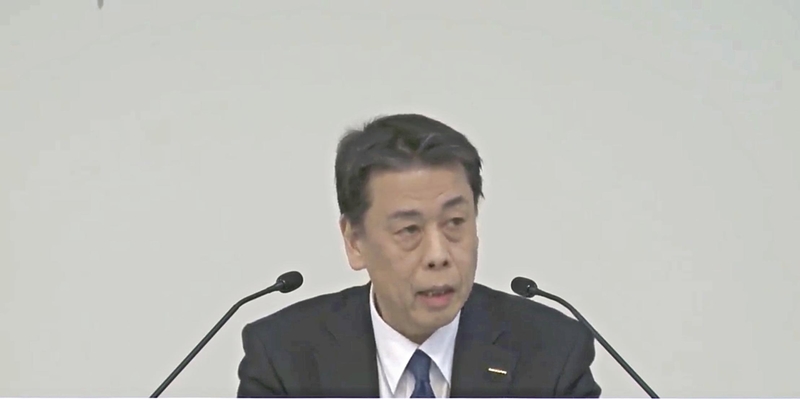
Taking responsibility for the massive deficit, top executives including President and Chief Executive Officer Makoto Uchida declined all performance-linked bonuses. "Although the business environment is extremely severe, we will overcome this crisis so we can survive," Uchida said in an online financial settlement briefing.
Read more from The Japan News at https://japannews.yomiuri.co.jp/