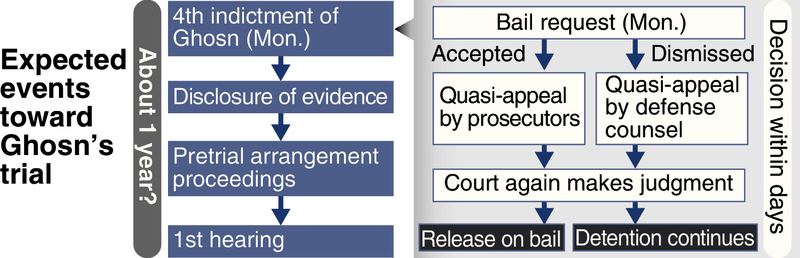
The legal battle between former Nissan Motor Co. Chairman Carlos Ghosn's lawyers and prosecutors continues to escalate, following the fourth indictment of Ghosn on Monday.
Prosecutors are confident of proving Ghosn's guilt based on a large volume of evidence procured through Nissan's cooperation over Ghosn's alleged misuse of Nissan funds via the so-called "Oman route."
Ghosn's lawyers, meanwhile, are ready to fight to the bitter end, with stonewalling among the tactics they are using.
Nissan's full support
"We could solve the nature of the incident in which Ghosn used his 'friends' in the Middle East to look after his interests," a senior prosecutor said, summing up the string of Ghosn-related cases.
The special investigation squad of the Tokyo District Public Prosecutors Office believes that the collapse of U.S. investment bank Lehman Brothers in the autumn of 2008 triggered two cases of aggravated breach of trust that were carried out in the Middle East, according to sources.
Ghosn, who incurred a huge valuation loss on a personal investment, allegedly leaned on his acquaintances in Oman and Saudi Arabia.
Large amounts of a Nissan fund known as the "CEO reserve" were sent to acquaintances who helped Ghosn get out of his predicament. The special investigation squad suspects that the wire transfers indicate Ghosn's misuse of Nissan funds for his private purposes and has proceeded with the probe into the purpose of the wire transfers, the sources said.
Investigative authorities have difficulty collecting evidence overseas without jurisdiction to investigate there. It was Nissan's "complete cooperation" that supported their investigation. Nissan dispatched lawyers to Middle East countries in question to gather materials related to accounting and emails. These were presented to the special investigation squad.
Those connected to Nissan who were involved in the wire transfers of the CEO reserve told the special investigation squad that they were "unwarranted expenditures," according to the sources.
The special investigation squad, which arrested Ghosn in November last year, soon encountered an unexpected headwind. Understating executive remuneration in a company's annual securities report has been criticized as a violation of procedural law. Some overseas media reported that the arrest was the result of a Nissan coup to oust Ghosn.
To avert such criticism, it was indispensable for prosecutors to find a crime in which Ghosn allegedly violated substantive law. Two indictments of Ghosn for misuse of Nissan's funds via the "Saudi Arabian route" in January and the Oman route this time are said to be the result of prosecutors and Nissan sharing the same intention.
Wanted: Fair trial
Ghosn's side will continue to thoroughly contend that the spate of cases are part of a "Nissan plot."
The legal team formed in February of criminal defense lawyers who have helped their clients be acquitted in many cases includes Junichiro Hironaka and Takashi Takano.
In the case of Ghosn underreporting his executive remuneration in securities reports, Nissan was also indicted as the corporate body in charge of submitting the reports. The legal team then demanded of the Tokyo District Court that Ghosn's trial be conducted separately from Nissan's, saying, "It runs counter to a fair trial to hold the hearing along with Nissan, which is hand in glove with prosecutors."
It is also hard to say that prosecutors' proof is rock-solid. There have been no cases in the past in which investigative authorities could establish the criminality of understating executive remuneration in corporate securities reports. Therefore, there has been no fixed judicial ruling regarding such points as whether executive remuneration can be considered as a "substantive matter" whose false reports on securities reports is prohibited, as well as to what extent future remuneration should be stated on such reports.
When it comes to the cases of the Saudi Arabian and Oman routes, prosecutors have yet to interview those acquaintances, according to sources. It is also unclear how the court would deem the credibility of testimony from Nissan since it completely cooperated with prosecutors.
Hironaka is known as a "razor," said to be proficient at pinpointing weak points in prosecutors' proof.
"Since prosecutors have sought the criminal responsibility of a world-famous executive, they can't afford to fail, considering the impact," said Katsuhiko Kumazaki, a lawyer who is a former chief of the special investigation squad. "The special investigation squad is expected to thoroughly collect objective evidence that supports the charges of the indictments and pursue strictly fair investigations not based on prejudice, an aspect that surely will be a point of contention at trial."
Read more from The Japan News at https://japannews.yomiuri.co.jp/