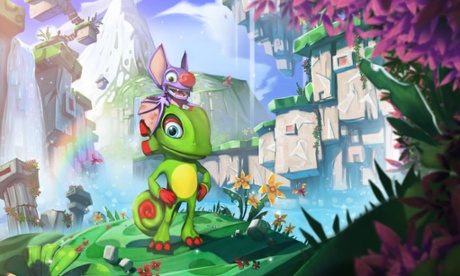
On Friday, Midlands-based game developer Playtonic launched a Kickstarter funding project for its opening title, Yooka-Laylee. The studio was looking for £175,000 – enough to fund an initial release on PC and Mac, with a console version to follow. The company reached that target within 40 minutes. A few hours later, it hit £1m.
“It’s so unexpected, we’re overwhelmed,” says studio head Gavin Price. “We’ve not really slept much in the last few days. With £175,000 we knew we could definitely launch on PC and then follow up on console, using the funds from initial sales to keep us going. All our fans wanted a console version – so that was very important. The whole campaign has been based on feedback from the community.”
There is, of course, some vital background history here. Playtonic was set up by six veteran developers from the legendary UK studio Rare, responsible for some of the most revered and successful titles on the Nintendo SNES and N64 consoles. These guys worked on Donkey Kong Country and then masterminded the seminal 3D platforming hit Banjo-Kazooie – to which Yooka-Laylee is a spiritual successor. Their forthcoming game follows the eponymous lead characters – a chameleon and a bat – through a colourful 3D world, highly reminiscent of those 90s classics. It’s a love letter to the sort of games that developers Chris Sutherland, Steve Mayles and Steven Hurst used to make together.
But with Rare now owned by Microsoft and concentrating on the Kinect Sports titles, the group left to re-discover that creative energy. They knew there was still some affinity and nostalgia for the Banjo-Kazooie series: when Playtonic was officially announced earlier this year, the company’s Twitter account gained 40,000 followers in a matter of hours. So Kickstarter funding for their first game always seemed like a good idea.
“We wanted to work in a particular way on games of a particular style – this was the only solution to do that,” says Price. “Fans were asking us to do it. So we thought, let’s do this as a big event and let’s make sure it allows us to deliver the game we want. We’re really happy with what we have planned for it.”
But despite building a large, highly vocal community around the game, the reaction to the Kickstarter has still left the team somewhat stunned. “We all stayed in the office and watched the page go live. We thought it would take 20 minutes for people to digest the page, read through it all and then make a pledge. But straightaway the number started shooting up. We thought: ‘What’s going on?’. One of the lads went out – he was like: ‘I can’t watch, I can’t watch.’ Then we got a call from him saying: ‘I’m coming back! I’m bringing my daughter!’ He just wanted to be with the team.”
Now, from the reasonably modest target of £175,000, the ambition has widened slightly. The company had in place a selection of stretch goals – additional game features that could be added if funding surpassed the target – most of those were ticked off within 24 hours of the launch, including local two-player co-op and four-player competitive modes. At £1m, the studio confirmed that it would be able to simultaneously launch the game on PC, Mac, Wii U, PS4 and Xbox One.
From here, according to Price, it’s all going to be about adding polish rather than major new features. One thing we’ve seen from several high-profile Kickstarter projects is the addition of ambitious new features, which slow down development and ratchet up costs. Double Fine’s Broken Age adventure, eventually released in two parts, has been a widely discussed example of Kickstarter hubris.
“We didn’t want to fall into the Kickstarter trap of adding more stuff to the game, which adds risk and bloats it,” he says. “We weren’t thinking about it from a business perspective, it was as fans of Kickstarter itself. We don’t like it when other people over-promise. If you take our stretch goal to add an orchestral score – that doesn’t add risk to the project. Any more that we add will just be giving specific features to the fans, we don’t want to make our lives worse by adding stuff that may well mean we miss our release date. We’re going to try to do the opposite of what a lot of people have done on Kickstarter – if a stretch-goal feature is vital to the game, then why wasn’t it in there to begin with? It’s important to learn from the lessons of others. We’ve had a lot of first-time Kickstarter backers, it’s our responsibility to show off the platform.”
With launch slated for October 2016, Playtonic may well find itself in the nostalgic platform adventure market with its old employer: Rare is highly likely to announce a new Banjo-Kazooie title (or at least a game in the same genre) at this Junes’s E3 event in Los Angeles. Although it seems diplomatic relations are still good.
“The creative director of Rare shared a link to our Kickstarter on Facebook,” says Price. “I’ve also had [senior Rare designer] Gregg Mayles jokingly offering to sell me unused Banjo-Kazooie assets. We’ve had tons of support from loads of our old colleagues. And I’m looking forward to what they announce this year, as well.”
At the time of writing, the Yooka-Laylee project had reached just under £1.4m. The biggest UK games success on the platform was Elite: Dangerous, which closed at £1.5m in January 2013. “It would be a sort of honour to beat that,” says Price. “But really, by the time Yooka-Laylee launches, the Kickstarter will have been forgotten. All that will matter is how good the game is.”