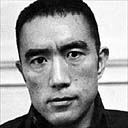
Death haunts these two plays by Yukio Mishima which the Ninagawa Company has brought to the Barbican BITE season - hardly suprising when you remember Mishima's legendary samurai-style suicide in 1970. However, it is Ninagawa's seductively elegaic style as much as Mishima's austerely dramatic substance that makes this an impressive evening.
Within seconds of its opening I realised I had seen Sotoba Komachi before, at the Edinburgh Festival in 1990: the image of an old bag-lady haunting a twilit park full of passionate lovers and cascading camellias brought memories flooding back. In this updated Noh story, the heroine aged 99 tells a young poet that death awaits those who dub her beautiful, and inevitably we see the cycle of destruction repeated. In Ninagawa's hands Mishima's self-conscious literary re-creation becomes something magical.
Haruhiko Jo as the wizened heroine, told she was once lovely, testily snaps: "Was? I still am." And, as we flash back to her youth, the Faure Requiem gives way to Strauss waltzes and the sight of Imperial Army officers dancing with porcelain beauties. The play becomes a meditation on mortality, decay and evanescence. And it adds to the sense of eerie illusion when we realise that both the waltzing women and the shadowy parkbench females are all played by men.
Mishima's preoccupation with death and spiritual decline emerges even more strongly in Yoroboshi. He deals with two sets of parents, natural and adoptive, staging a courtroom battle for possession of their son: a situation with echoes of Brecht's The Good Woman of Sezuan. The catch is that the son is here a war-blinded 20-year-old who dismisses the competing parents as slaves and fools, and who, in his sightlessness, has a vision of a degenerate world coming to its necessary end.
Written in 1960, the play clearly anticipates Mishima's hara-kiri protest at Japan's spiritual decadence; and Ninagawa's production skilfully highlights the parallels. Tatsuya Fujiwari as the hero is both a mixed-up maniac and a white-suited homoerotic figure who arouses everyone's protective love. And, as a blood-red sunset lights up the courtroom windows, apocalyptic Wagnerian chords invade our senses. In a final dramatic coup we even hear Mishima's own death-speech from Japanese army headquarters. In Ninagawa's hands, the play becomes an elegy by and for Mishima; and even if in the west we have to take Mishima's disruptive cultural impact on trust the production, in its move from formal courtroom symmetry to grandly explosive climax, eloquently gives one a measure of his mythic status.
In Ninagawa, Mishima has clearly found the perfect interpreter.
Until Saturday. Box office: 020-7638 8891.