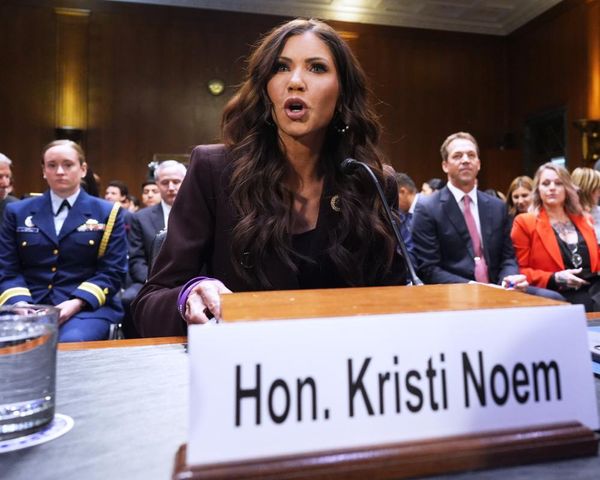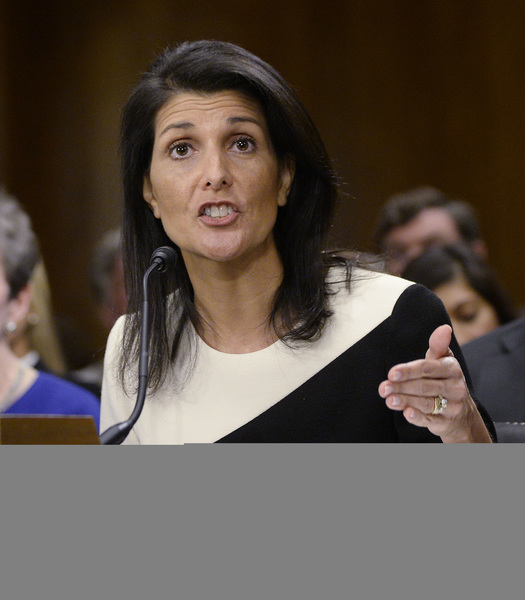
WASHINGTON _ Nikki Haley, Donald Trump's pick for U.S. ambassador to the United Nations, used her Senate confirmation hearing Wednesday to attack the world body for what she called its bias against Israel, a position that put her in sync with most of Congress.
Haley said she "absolutely" supports President-elect Trump's promise to move the U.S. Embassy in Israel from Tel Aviv to Jerusalem. Few countries have done so because Jerusalem is disputed by Israelis and Palestinians, both of whom want it as their capital.
The two-term Republican governor of South Carolina _ at 44 she is the nation's youngest governor _ acknowledged to the Senate Foreign Relations Committee that she lacks experience in international diplomacy, but argued her work in state government had prepared her for tough negotiations.
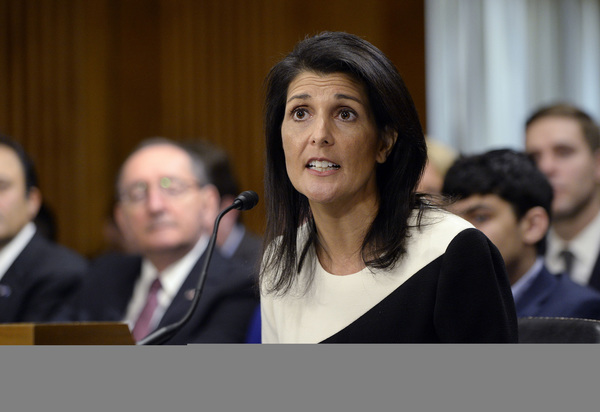
Trump has spoken harshly of the U.N., and Haley's role may be secondary in an administration that has signaled plans to upend U.S. foreign policy in many parts of the globe.
As has now become common with Trump's top aides, Haley appeared at times to break with the president-elect _ and with Rex Tillerson, Trump's pick for secretary of state _ when she repeatedly criticized Russia.
"We can't trust them," she said of authorities in Moscow. "The problem is there are no boundaries with Russia," she added.
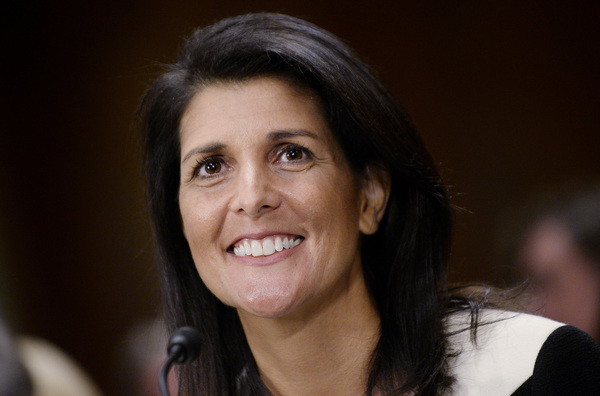
Haley said "we are not OK" with Russia's seizure of Crimea, its military operations in Ukraine and its military intervention in support of President Bashar Assad in Syria.
"But we need their help in fighting ISIS," another name for Islamic State, she said.
The Obama administration says Russian forces have attacked insurgent groups seeking to oust Assad but have provided no help to the U.S.-led coalition fighting Islamic State in Syria and Iraq.
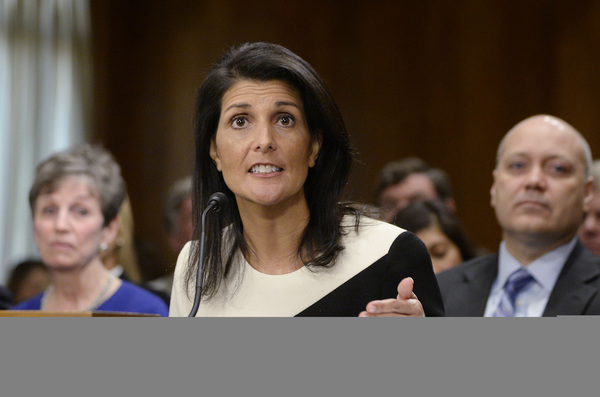
Asked about adding new sanctions against Russia, as many in Congress have demanded, Haley declined to advocate tougher measures without further consultation.
In contrast with Tillerson, Haley acknowledged that Russia committed "war crimes" in Syria by bombing civilian targets. And unlike Tillerson, she said U.S. policy toward Russia "came up" when she met with Trump.
In response to a question, she said she considered the extrajudicial killing of more than 6,000 alleged drug dealers in the Philippines to be a human rights abuse, saying she would speak against it.
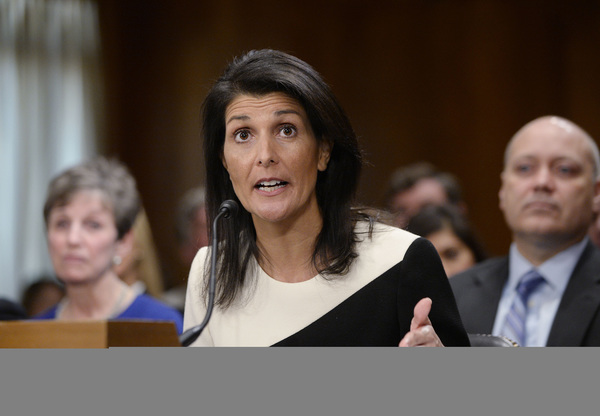
"I'm prepared to speak up against anything that goes against American values," Haley said. "We have always been the moral compass of the world."
The questioning was triggered in part by Tillerson's refusal at his confirmation hearing last week to condemn several governments with documented human rights abuses, including Russia, China, Saudi Arabia and the Philippines, saying he needed more information.
Haley, the daughter of Indian immigrants, said she opposed a national registry of Muslim Americans, an idea that Trump floated last year during the presidential campaign.
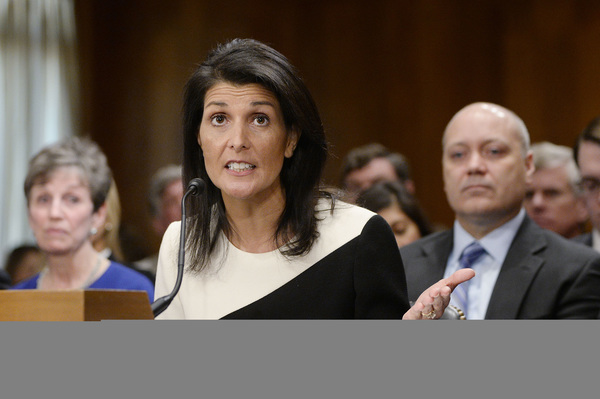
Her focus on Israel in her opening remarks was not a surprise. As governor, she drew national notice when she signed into law a bill that blocked efforts to boycott, divest and sanction Israel, the first state law of its kind in the U.S.
Trump, and many members of Congress, harshly criticized President Barack Obama's decision not to veto a U.N. Security Council resolution last month that condemned Israel's continued settlement expansion in lands claimed by the Palestinians.
After the U.S. abstained, the measure passed 14-0. Most of the world views the settlements as illegal and a major obstacle to peace.
Haley was born Nimrata Randhawa in South Carolina, attended Clemson University and served in the state Legislature before she was elected governor in 2010. She was re-elected in 2014 and cannot run for a third term.
Her parents, both professors, emigrated from Punjab, India, to South Carolina via Canada.
Haley was widely praised for her sensitive response to the mass murder of nine black members of a church in Charleston in 2015 by a self-described white racist, who was sentenced to death earlier this month.
As the state grieved, Haley led bipartisan calls for the removal of the Confederate battle flag from the state Capitol and its grounds, a symbolic move that helped heal some of the tensions.
During last year's presidential primaries, she initially was critical of Trump, asking voters to resist "the siren call of the angriest voices." She endorsed Sen. Marco Rubio, R-Fla., before he withdrew.