UONUMA, Niigata ― The person she loves is no longer in this world. And there is nothing she can do because her beloved lived over 200 years ago. He is said to have left behind about 1,000 carved sculptures in Niigata Prefecture, with the greatest among them being housed in Saifukuji Temple in Uonuma in the prefecture. This is where the love story of modern-day tour guide Suiko Nakajima and the master carver began.
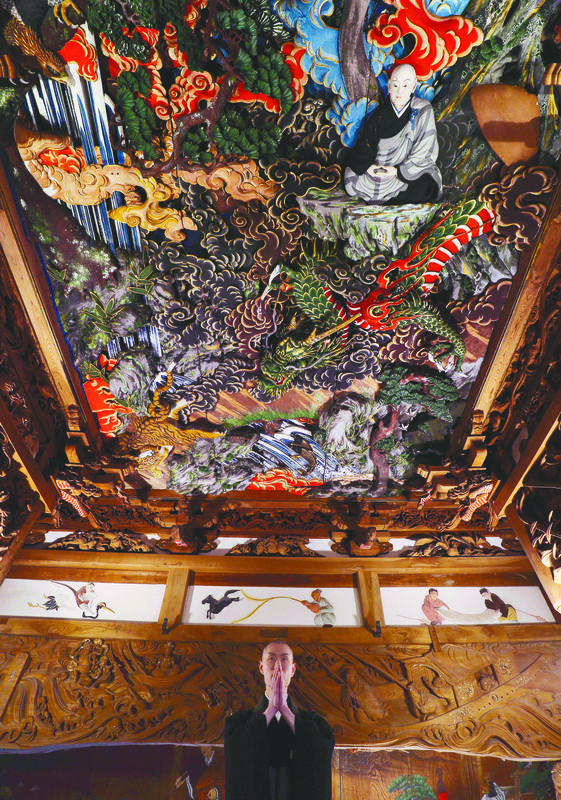
The great artwork, "Dogen Zenji Mouko-chobuku no Zu" (Zen master Dogen taming fierce tiger), depicts a tiger flinching before a behemoth dragon, Zen master Dogen sitting in meditation, billowing clouds, sinuous pine trees, carp climbing up a waterfall and various intricately depicted animals. The exquisitely crafted and beautifully colored openwork carving took my breath away.
The artwork covers the entire ceiling of Kaisando hall, a prayer room where successive chief priests of Saifukuji are enshrined.
It illustrates a scene in which a walking stick thrown by Dogen when he encounters a tiger on a mountain path morphs into a dragon.
The artist behind the masterpiece is Ishikawa Uncho (1814-83), who was born in the Edo period (1603-1867) and died in the Meiji era (1868-1912) and is referred to as the "Michelangelo of Echigo," Niigata Prefecture's old name.
"I'm stunned by its magnificence," Nakajima said, speaking of the wood carving. "I make a new discovery every time I see it."
Born in Zoshigaya in Edo (present-day Toshima Ward, Tokyo), Uncho rose to fame as a carver in his 20s. He liked drinking and was offered a job in Echigo in his early 30s, accepting on the condition that "he would be given good sake and a chisel throughout his life." He continued to create carvings and other objects in various places around Echigo until he died.
Nakajima has been working as an exclusive tour guide of Uncho's artworks for eight years. She had worked as a bus guide in Tokyo before moving to her husband's hometown of Uonuma upon marriage. Thereafter, she became a tour guide for the local community.
A bus tour to see Uncho's artworks began in 2013, the year before the 200th anniversary of his birth. Nakajima was asked by the Muikamachi Tourism Association, which organized the tour, to serve as an exclusive guide.
"Before that, I was not interested in his works at all, so I simply explained them as instructed in the guidebook," she said. "Then [after being asked to be an exclusive guide] I became motivated for the first time to study up on Uncho."
She visited Saifukuji and looked at his pieces seriously. "I was full of questions at first. I wondered how he could carve like this," Nakajima said. "Afterward, excitement welled up gradually ... I was captivated by his art as if I had fallen in love."
She then began to visit various places to see Uncho's artworks -- she has viewed his works hundreds of times.
Ryugen Hirasawa, vice priest of Saifukuji, said: "[The temple] was a playground during my childhood; although every one of the carvings is great, the place itself was like a different dimension."
Before the "Uncho boom" in 2014 the shrine had always attracted many visitors, but after the 200th anniversary of his birth, interest in his work erupted.
Nakajima went to the homes of supporters of the temple to find out if any of them had works by Uncho stored away. Then she compiled what she heard about him on these occasions into a book.
Composed in a letter format, the book, titled "Watashi no Koishita Uncho-sama" (My love dear Uncho), was published by Gendai Shokan, and represents a very long love letter to the artist whose face she has never seen.
The koshihikari variety of rice grown in the Uonuma region of Niigata Prefecture has a reputation for being particularly tasty. What is the secret?
"Koshihikari [in general] has a tendency to grow in height, but if it grows too tall, it falls over. Here, the soil is moderately rich so that doesn't happen," explained the head of the production department at Uonuma Soyu Noen farm in Minami-uonuma.
"Also, it is said that water from thawed snow contains a lot of minerals. When there is large temperature difference, it locks in the flavor," he added.
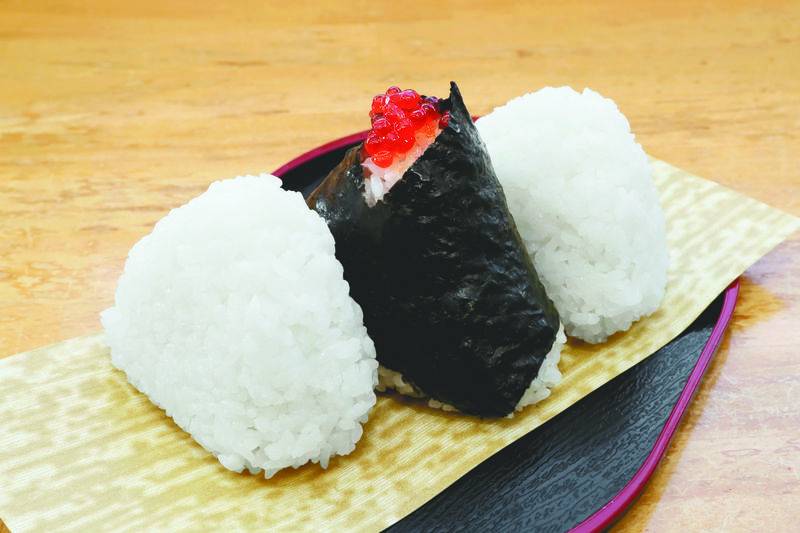
The farm directly manages a rice ball shop "Onigiriya" to highlight the deliciousness of its rice.
Eleven types of onigiri, including salted or filled with sujiko salmon roe, are available, ranging from 120 yen to 270 yen.
Special onigiri, such as ones filled with salted salmon, are also served on weekends. They have curry and rice bowl tuna soaked in soy sauce on top, although it is the rice that is the star. The fluffy rice ball was really tasty.
Read more from The Japan News at https://japannews.yomiuri.co.jp/