A mood of self-restraint hung over the entire Japanese archipelago on Friday, after the government announced that it would expand the state of emergency for the ongoing coronavirus outbreak to cover the whole nation.
In prefectures that are newly under a state of emergency, the number of customers in nightlife districts and tourist spots further decreased, and people there are beset by anxiety, having no idea what the consequences will be.
The state of emergency is currently set to end on May 6. For another 19 days, the whole nation will battle to contain the virus.
'Only half again'
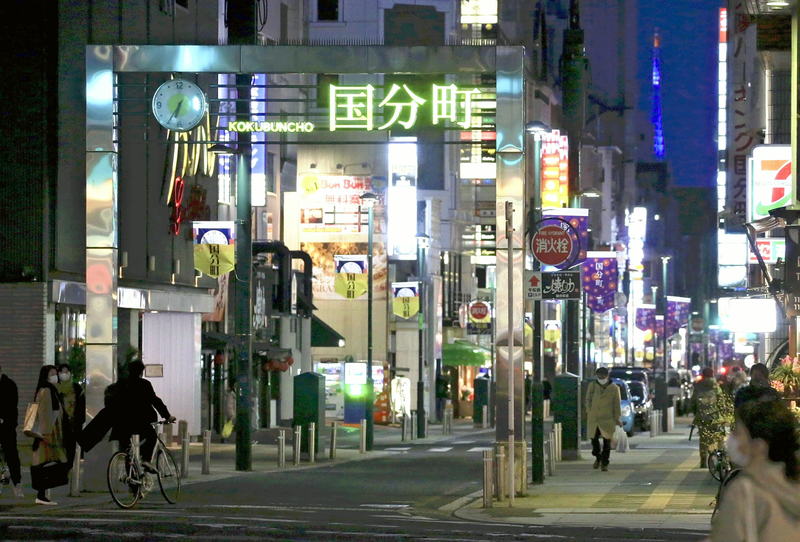
The Kokubuncho area in Sendai is known as the largest nightlife district in the Tohoku region. On Friday night, most eating and drinking establishments were closed, and the district was in deep silence, even though the day was a "hanakin" -- happy Friday -- when a large number of people usually go out to enjoy drinking.
A 44-year-old man who runs an izakaya pub in the district decided to close the establishment between April 17 and May 6.
"The situation in the wake of the Great East Japan Earthquake was better than this, because many of my customers came to cheer me up. I wonder how I can earn a living from now on," he said.
Sake-no-Sokuhai, a company that distributes liquor products to restaurants and bars, has closed one of its two shops. In March, the company's sales halved, and it fears that its sales in April could fall by nearly 70%.
A 38-year-old employee of the company said pensively: "There are only a few people who come here to enjoy drinking. I'm full of sadness."
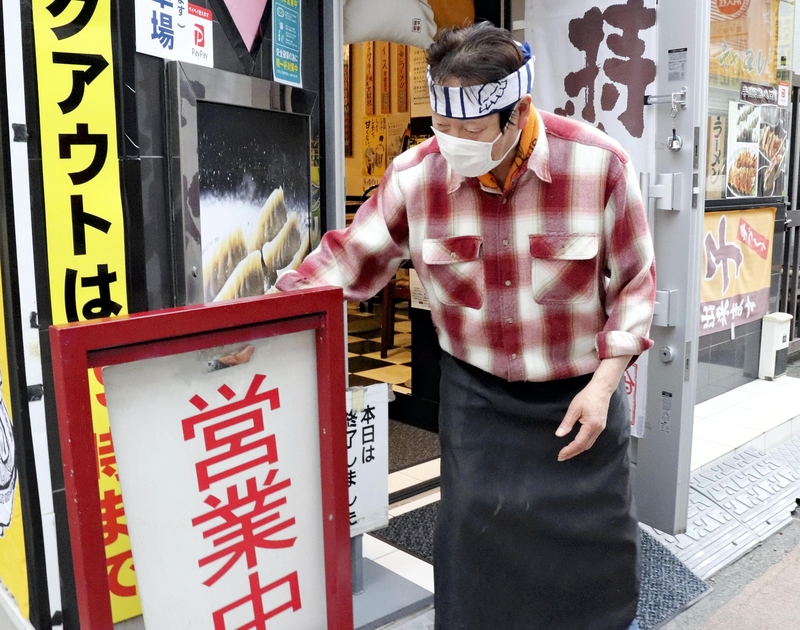
The Miyajimacho-dori area in Utsunomiya is known as Gyoza-dori street, because there are many restaurants and takeout shops selling gyoza dumplings. The number of passersby was much lower here too on Friday.
Utsunomiya Minmin Honten, the flagship store of a gyoza restaurant chain, reduced the number of seats from 35 to 15 at the start of April, and offers only take-out service on weekends.
A 40-year-old manager of the restaurant said, "The number of customers had halved since the latter half of March, and it halved again today. I can do nothing now but endure."
Temples face trouble
In Ishikawa Prefecture, the number of infected people as a proportion of the total population is the second-highest after Tokyo.
A 78-year-old man who has run a fruit and vegetable shop for more than 40 years in the Ohmicho-ichiba marketplace in central Kanazawa anxiously said: "Tourists haven't come and local residents also haven't come. It's the first time I've experienced this kind of situation. If the emergency declaration further reduces customers, I may have to temporarily close my shop."
Tourist spots all over the nation have closed or ceased services one after another.
Ninna-ji temple, a world heritage site in Ukyo Ward, Kyoto, announced Friday that it had suspended public entry into the precincts for the time being.
In Nara Prefecture, Horyuji temple, another world heritage site, also decided to suspend visits by the public to all buildings on its grounds from April 23 to May 6. This is its longest closure since the end of World War II. An official of the temple said, "In such a situation, we particularly want people to worship here to pray for the end of the outbreak, but ..."
Business as usual
In the midst of all this, some places look the same as usual.
At a pachinko parlor along National Highway Route 24 in Nara City, about 30 cars were parked outside. Their car registration plates indicated that they were from cities in other prefectures, such as Osaka and Kobe.
A 47-year-old man from Kobe who was playing pachinko at a parlor in Kawai, Nara Prefecture, said: "The inside of this pachinko parlor is almost empty. Supermarket stores are much more crowded, so I wonder if they are more risky than here."
Officials of the pachinko parlor said that it was not scheduled to close.
Residents of Ibaraki Prefecture have been worried by similar cases of people from other prefectures crossing the border to come and play pachinko.
In Moriya, a city in the prefecture about 35 kilometers from central Tokyo, a large number of people have come to pachinko parlors from the Tokyo metropolitan area since April 7, when the government declared a state of emergency for Tokyo and six other prefectures. Local residents worry about infections with the new coronavirus.
Moriya Mayor Nobuhisa Matsumaru commented, "I expect that the expansion of the state of emergency will reduce the inflow of people from outside this prefecture."
Tottori Prefecture has had only one confirmed infection. Renga-tei, a restaurant serving Western-style cuisine in Tottori City, has remained open while limiting the number of customers entering at one time.
The owner of the restaurant, 44, said: "As there is only one infected person in this prefecture, the situation here is different from other regions. I judged it possible to continue business by taking sufficient preventive measures."
Read more from The Japan News at https://japannews.yomiuri.co.jp/