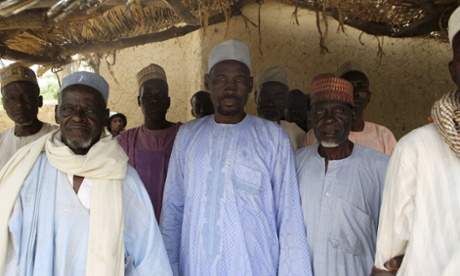
On a dusty street lit only by the glow of mobile phones, three men lounged on a red woven prayer mat. “No light, no electricity – that’s normal for us in Nigeria. The big issue for us now with these elections is security,” said Umar Iya, a lecturer at Yobe state university in the north of the country, which like many others has closed since becoming a target of Islamists Boko Haram.
Violence by Boko Haram was cited by President Goodluck Jonathan’s ruling party as the main reason for delaying the presidential and parliamentary polls, initially set for 14 February. Iya, who moved to the relative safety of Yola last month, says it’s the reason he and his friends will be voting this week.
He repeats a slogan going around in the mai shayi joints – popular male-only tea houses and gossip hotspots – dotted across the capital of Adamawa, one of three states plundered by Boko Haram over the last six years.
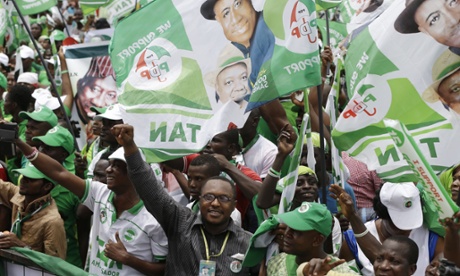
“Akasa, atsara, araka, ajira,” a Hausa saying from northern Nigeria, is loosely translated as “cast your vote, protect it, escort it, wait for it (the results)”, reflecting fears the ruling party may try to rig the results in what is the most tightly-contested election since the end of military rule in 1999.
Concerns deepened further this week after the country’s police chief said voters should not stay behind to watch the sorting and counting of votes, despite being legally allowed to do so.
Across the three northern states where more than 1,000 civilians have died in Boko Haram violence this year, the mood ranged between defiance and fear.
“We are going to make sure our ballots count,” said Salihu Mohammed, sipping tea at another outdoor tea shop, adding that on Saturday he would be voting for the main opposition candidate Muhammadu Buhari. In 2011, Buhari’s loss triggered riots in northern Nigeria that left at least 800 dead. Some fear a repeat of such violence as the former military ruler once again faces Jonathan in the polls.
Special polling centres have been set up for around 1.5m displaced by the militant insurgency. In Yola, which has been flooded by those fleeing, a list of names was taped onto the walls of one secondary school being used as a centre for refugees. “Discuss with vivid examples the theme ‘war is destructive’,” an assignment scrawled on a blackboard said.
Turai Mujeli, a teacher who fled from Maiduguri, Boko Haram’s spiritual home, had come to collect her voter’s card. “It really hurts me that we’ve had to leave everything behind and that’s why I’m going to vote. But I can’t lie – it is at the back of my mind that Boko Haram are going to use the elections to announce themselves somehow, so yes, I’m scared,” she said quietly.
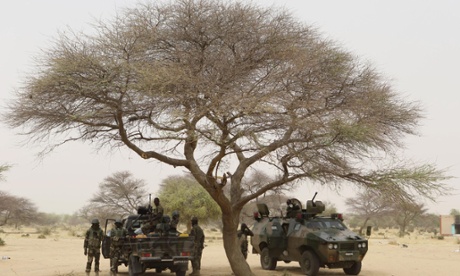
A four-country coalition has in recent weeks flushed Boko Haram from dozens of towns in their grip, but the sect continues to operate in remote villages strung across the north’s vast desert terrain. A Nigerian government spokesman told the Associated Press on Wednesday that hundreds of civilians were abducted as Boko Haram retreated from Damasak this month. He said he could not specify how many were taken captive but local reports say as many as 500 people were seized.
Elsewhere across the country, people have bunkered down. Long queues have formed in petrol stations, supermarkets and banks in the capital Abuja, whose streets were otherwise unusually empty.
“I really don’t see much point in voting. I’m just here to collect some money to tide me over the next weeks because we don’t know what could happen,” said Tobi Fagbule, a customer withdrawing cash from an ATM.
Cars have been banned across the country on election day, and the military has closed the land and sea borders. Government spokesperson Mike Omeri said the moves were to prevent a repeat of previous unrest. “It’s to minimise rigging and violence. If only those who are supposed to be accredited can move, it’s easier to monitor,” he said.