Get all your news in one place.
100’s of premium titles.
One app.
Start reading
Reuters
Reuters
Environment
Alexis Akwagyiram

Nigeria's twin town ponders cause of multiple births

Identical twins Taiwo Adejare and Kehinde Adejare pose for a picture in Igbo Ora, Oyo State, Nigeria April 4, 2019. Picture taken April 4, 2019. REUTERS/Afolabi Sotunde

IGBO ORA, Nigeria (Reuters) - In a dusty school playground in southwest Nigeria, the rows of children lined up to return to their classrooms are dotted with the faces of identical twins.

Sights like this can be seen everywhere in Igbo Ora, where a banner welcomes visitors to the "twins capital of the world".

Identical twins Taiwo Ahmed and Kehinde Ahmed pose for a picture in Igbo Ora, Oyo State, Nigeria April 4, 2019. Picture taken April 4, 2019. REUTERS/Afolabi Sotunde

Twins are common in the Yoruba ethnic group that dominates this part of Nigeria. A 1970s study by a British gynaecologist found that around 50 sets of twins were born out of every 1,000 births in the southwest - one of the highest rates of twin births in the world.

In Yoruba culture twins are so common that they are traditionally given specific names. They are called either Taiwo or Kehinde depending on whether they were born first or second.

But even for Yoruba people, Igbo Ora is considered to be exceptional. Among the nearly 100 secondary school children assembled at the end of their break there were nine sets of twins.

Identical twins Kehinde and Taiwo Kolawole pose in Igbo Ora town, Oyo State, Nigeria April 4, 2019. Picture taken April 4, 2019. REUTERS/Afolabi Sotunde

"There are so many twins because of the okra leaf that we eat," said 15-year-old Kehinde Oyedepo, one of the twins, repeating a view commonly held in the town.

The leaves are used to make a stew that is popular in Igbo Ora.

Others have pointed to the popularity of Amala - a local dish made from yams and cassava flour. One theory is that yams prompt the production of gonadotropins, a chemical agent that stimulates the production of eggs.
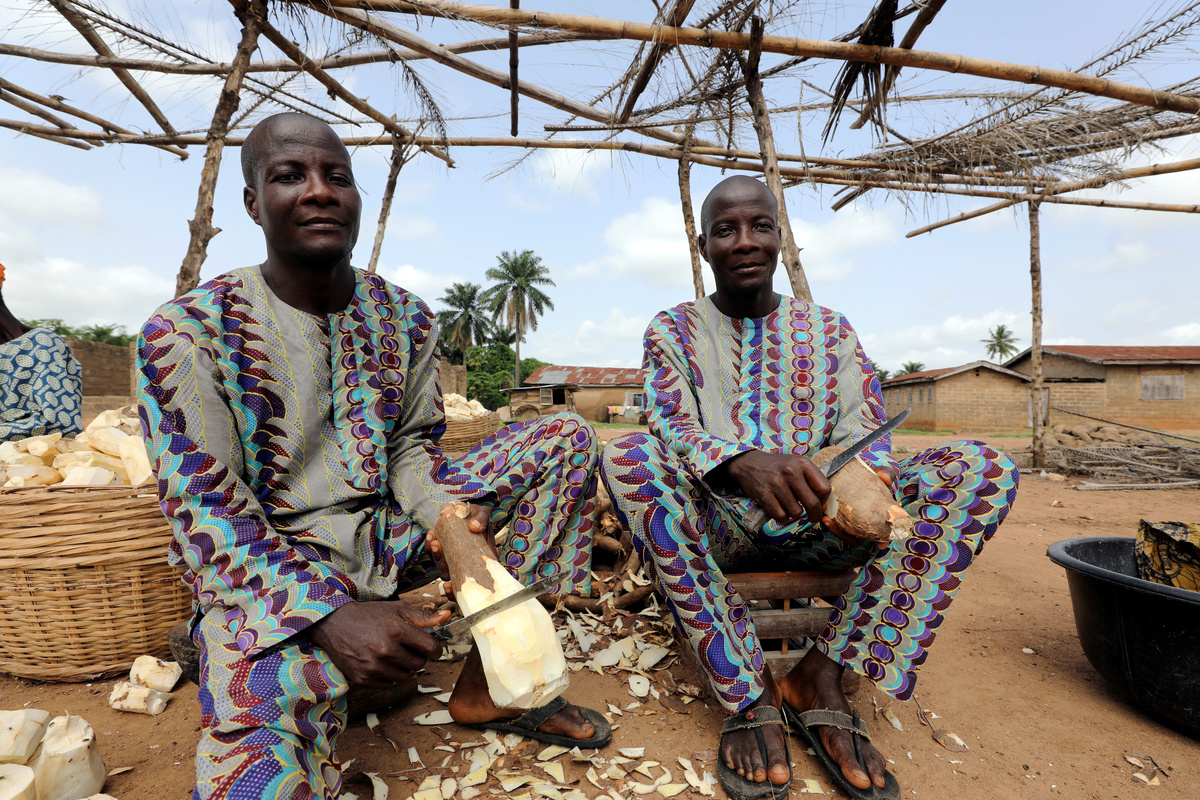
Twins Kehinde and Taiwo Aderogba peel cassava tuber at a processing centre in Igbo Ora town, Oyo State, Nigeria April 4, 2019. Picture taken April 4, 2019. REUTERS/Afolabi Sotunde

Ekujumi Olarenwaju, an obstetrician gynaecologist based in Lagos, around 100 miles (160 km) away, believes the causes of the phenomenon lie elsewhere because the same kind of yam is eaten elsewhere in the world without the same result.

"Thus far scientifically, no one can say this is the reason," said Olarenwaju. "One of the plausible reasons is the hereditary aspect of it because maybe over the years they inter-marry, they now have that gene being pooled and concentrated in that environment," he said.

But the women who sell piles of okra leaves at a town market are quick to disagree.

Non-identical twins Afeez and Lateef Azeez pose in Igbo Ora town, Oyo State, Nigeria April 3, 2019. Picture taken April 3, 2019. REUTERS/Afolabi Sotunde

They said local traditions over how the leaves are consumed were crucial. For example, a stew made from the leaves should be eaten immediately and never stored.

Oyenike Bamimore, who sells the bread, said she was living proof that the diet was the cause. "Because I eat okra leaves a lot, I gave birth to eight sets of twins," she said.

Nine sets of twins gather after a midday break at the Methodist school in Igbo Ora, Oyo State, Nigeria April 3, 2019. REUTERS/Afolabi Sotunde

(Reporting by Alexis Akwagyiram; Additional reporting by Seun Sanni, Afolabi Sotunde and Angela Ukomadu; Editing by Giles Elgood)


Suliat Ogunjimi carries non-identical twins Afusat Ganiyu and Ganiyatu Adesope in Igbo Ora, Oyo State, Nigeria April 3, 2019. REUTERS/Afolabi Sotunde
Non-identical twins Taiwo Oyedepo and Kehinde Oyedepo walk along the corridor of their school in Igbo Ora town, Oyo State, Nigeria April 3, 2019. REUTERS/Afolabi Sotunde
A Muslim woman carries her four-day-old male twins wrapped in blue towels outside the door of her home in Igbo Ora, Oyo State, Nigeria April 3, 2019. REUTERS/Afolabi Sotunde
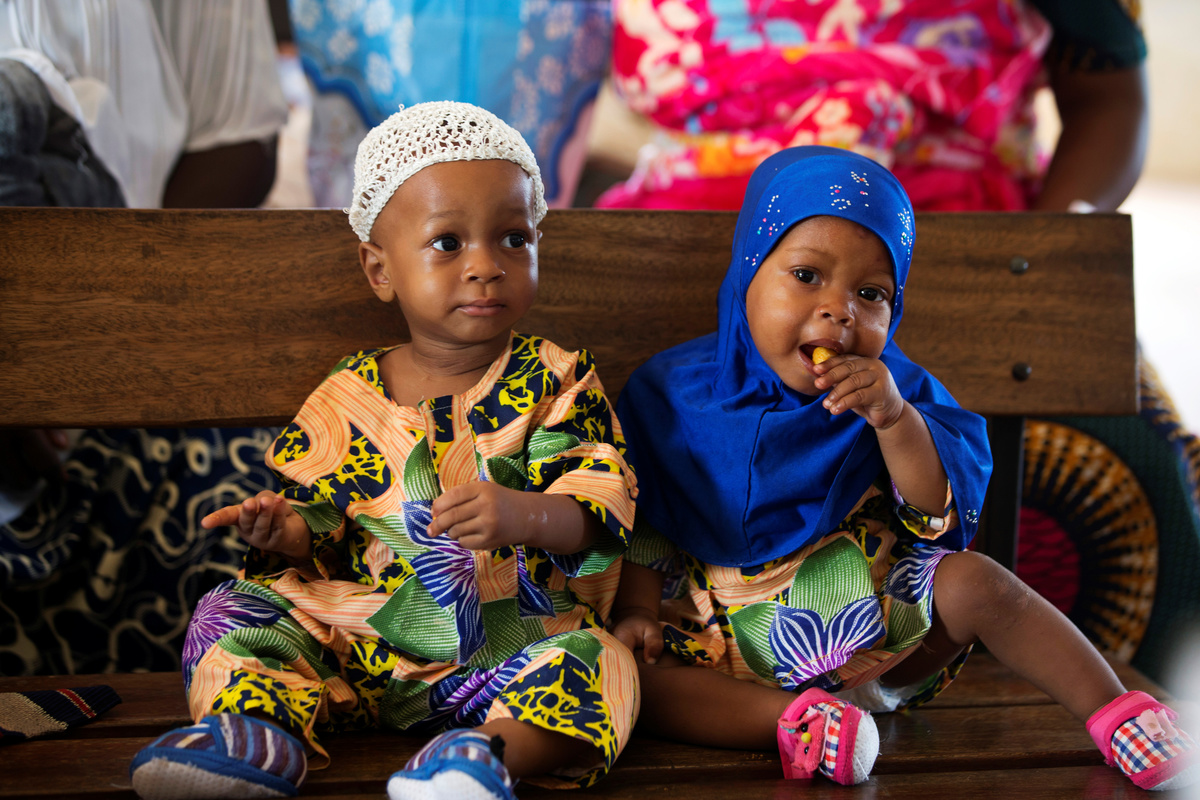
Non-identical twins Kehinde Akinbola and Taiwo Akinbola snack while waiting to receive their immunisations at the hospital in Igbo Ora, Oyo State, Nigeria April 4, 2019. REUTERS/Afolabi Sotunde
Non-identical twins Taiwo, Kehinde Daniel pose for a photograph in Igbo Ora, Oyo State, Nigeria April 3, 2019. REUTERS/Afolabi Sotunde
Sixty-seven year-old, non-identical twins Kehinde and Taiwo Adamson pose in Igbo Ora town, Oyo State, Nigeria April 3, 2019. REUTERS/Afolabi Sotunde
Two sets of non-identical twins Taiwo, Kehinde, Abigail and Deborah Daniel pose for a photograph in Igbo Ora, Oyo State, Nigeria April 3, 2019. REUTERS/Afolabi Sotunde
Sign up to read this article
Read news from 100’s of titles, curated specifically for you.
Already a member? Sign in here
Related Stories
Top stories on inkl right now
One subscription that gives you access to news from hundreds of sites
Already a member? Sign in here
Our Picks
Fourteen days free
Download the app
One app. One membership.
100+ trusted global sources.