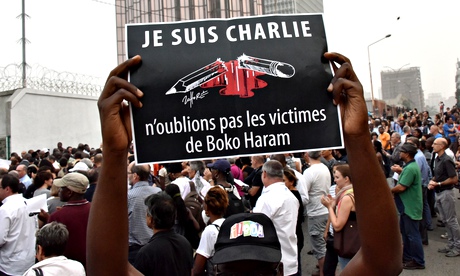
The question raised in your headline (Why did the world ignore Boko Haram’s Baga attacks?, theguardian.com, 12 January) implies the usual western conspiracy and/or neocolonial design, which is often used by some of my fellow Africans to explain away our failure to sort out our own problems. While we strongly condemn the terrorist attacks in both France and Nigeria, the question about Boko Haram should be aimed directly at the Nigerian authorities and the African Union, who have the primary responsibilities for maintaining peace and security in Nigeria and the continent respectively.
On paper at least, Nigeria and Africa are fulfilling their responsibilities, as demonstrated by the April 2014 report by the Stockholm-based International Peace Research Institute, which showed that whereas military spending continues to fall in the west, it is rising everywhere else, especially in Africa, where the figures “increased by 8.3% in 2013, reaching an estimated $44.9 billion”.
In practice, however, despite its huge defence spending, Nigeria has failed to tackle Boko Haram, thanks to endemic corruption, poor equipment and indiscipline. To underscore the point, a Nigerian court has recently condemned several military personnel to death for refusing to confront the Boko Haram terrorists. Contrast the dismal response by Nigeria to Boko Haram with France’s prompt and effective counterattack against the Paris terrorists, which saw all them killed within 48 hours.
It’s this firm action by France, not racism or neocolonialism, which drew the world’s media – as well as some 50 world leaders walking arm-in-arm, including David Cameron, Angela Merkel, the Palestinian leader Mahmoud Abbas, and the Israeli prime minister Binyamin Netanyahu – to Paris on 11 January. Nigerian authorities must show a similar resolve if they want to attract and deserve world attention and help.
Sam Akaki
Director, Democratic Institutions for Poverty Reduction in Africa (Dipra)
• I read in dismay your article (Nigeria rocked by three more bomb attacks, 12 January). This horrific act of terrorism, though undoubtedly shocking, is only part of the growing trend of Islamic extremism in Nigeria. Many persecuted Christians in the country are experiencing unprecedented levels of exclusion, discrimination and violence, unable to worship in freedom as churches are routinely targeted, and bombed.
This trend is not unique to Nigeria. The stark reality revealed in the report released recently by Open Doors is that the increase of Islamic extremism across sub-Saharan Africa, the Middle East, and in Asia, is having a significant impact on the future of the global church. The World Watch List report tracks trends, scale and causes of persecution against Christians globally. Forty out of the worst 50 countries show Islamic extremism as the main driver of persecution.
In the past year alone, Nigeria has moved up from number 14 to 10 on the country rankings. So though something like this event is particularly shocking, we can expect more of it unless we act now as an international community – much more intentionally than we currently are. It’s rising fast and affects all of us – those of no faith, those with a different faith, and ordinary Muslims who are also appalled by this attack. Surely we must recognise that we are in extraordinary days and act accordingly?
Lisa Pearce
CEO, Open Doors UK and Ireland
• Thank you for continuing to report on the dreadful situation in northern Nigeria (‘Imagine a fear that makes you let go of your child’s hand’, 15 January). I went to school in Maidugari. I spent my younger days in a beautiful country where I felt safe (even during the civil war) and have fond memories of us packing a cool box into the Land Rover and going for a picnic by Lake Chad. We swam in the Wikki warm springs at Yankari game reserve and gazed at the stars in the clear night skies by the Sahara desert. This is not some imagined recollection of a scene from a Merchant Ivory film but the reality of what Nigeria was like many years ago.
I attended the government girls secondary school and, although the school was predominately Muslim, as a white Christian I experienced no prejudice whatsoever. I learned about the history of the magnificent ancient empires of Ghana, Mali and Songhai, and was able to experience a rich and diverse culture. What’s happened to the country I grew up in?
Islam has not evolved from a religion into a rogue army. Boko Haram are a band of criminals trying to justify their actions. Their barbaric behaviour has nothing to do with the teachings of the prophet Muhammad. I hope the international community will recognise that this situation needs urgent intervention.
United Nations peacekeeping force, where are you?
Jane Badstevener
Southsea, Hampshire