Afternoon summary
- Sky and Channel 4 have offered to move the date of the proposed TV debate between David Cameron and Ed Miliband following Cameron telling MPs at PMQs that he objected to it being held on 30 April. A Downing Street source said a few minutes ago that they could not comment because they had not yet received the offer. (I told them they should read this blog!)
- Yvette Cooper, the shadow home secretary, has condemned Ukip’s immigration policy as “chaotic and confused”. (See 3.43pm.) And a fresh split has apparently oppened up between Nigel Farage and his immigration spokesman, Steven Woolfe, after Woolfe used an interview to disown, or clarify, Farage’s claim that people with life-threatening illnesses would be prevented from coming to Britain. (See 3.18pm.)
That’s all from me for today.
Thanks for the comments.
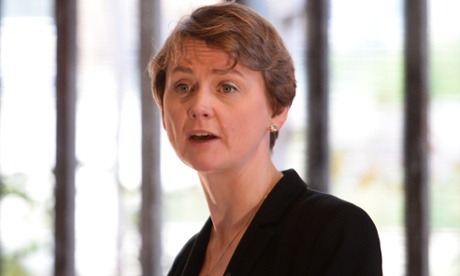
Cooper says Ukip's immigration policy is 'chaotic and confused'
Yvette Cooper, the shadow home secretary, has put out her response to Nigel Farage’s immigration plans. Here it is in full.
Last week, Ukip set a net migration target of 50,000. Today, Nigel Farage says targets are unworkable and Ukip will have no caps at all. Then on the same day he says net migration will be 27,000.
The Tories and Ukip have got themselves in a ridiculous tangle on their immigration promises. The Tories’ net migration target is in tatters and they are arguing over whether to keep it. Now it seems Ukip are just as chaotic and confused.
Nigel Farage’s slippery approach is just designed to exploit concerns about immigration and increase division rather than ever setting out practical policies to control and manage immigration in a sensible way to make the system fair.
Ukip’s rightwing plans to cut employment rights will lead to more undercutting by agencies and employers who exploit cheap migrant labour and illegal workers. And their plans to pull out of Europe will make it harder to tackle illegal immigration and criminals entering the UK - as they oppose the European arrest warrant which deports 1000 suspected foreign criminals a year, and border controls could have to move back to Dover from Calais, with all the problems of tackling illegal immigration that brings.
At the same time their net migration plans appear to mean no overseas students at all - despite the fact that they bring billions into Britain.
Nigel Farage isn’t serious about solving problems, or getting the best deal for Britain, he can’t even work out what his policy is.
(Actually, Cooper is wrong about the Ukip plans involving no overseas students. Ukip has said that it would take them out of the main immigration figures, so that universities could still take students from abroad.)
Sky and Channel 4 offer to change date of Cameron/Miliband TV debate
Sky and Channel 4, which are to host the debate between David Cameron and Ed Miliband on 30 April (the week before the election) have put out a statement in response to David Cameron’s comments at PMQs. (See 2.22pm.)
They are offering to change the date.
Sky/C4 statement on Miliband v Cameron leaders' debate. They're offering to change date to ensure Cameron can attend: pic.twitter.com/IGroIplvwM
— BuzzFeed UK Politics (@BuzzFeedUKPol) March 4, 2015
This morning Nigel Farage ditched a plan proposed by Ukip’s immigration spokesman, Steven Woolfe, for a cap on immigration. As Asa Bennett at Huffington Post reports, Woolfe subsequently used an interview to disown, or clarify, Farage’s claim that people with life-threatening illnesses would be prevented from coming to Britain. Woolfe told Radio 2:
If someone came to our borders and was on there, you know at the border control and they announce that they’ve got a cancer or tumour we are not going to turn them away Jeremy. What sort of nation are we to do that? That isn’t going to happen.
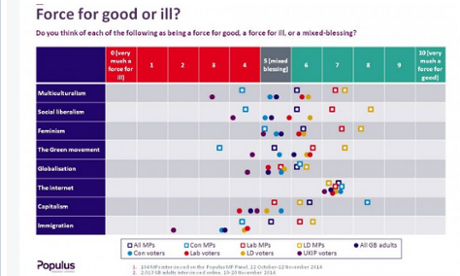
This chart is interesting (if you can read it). It helps to explain why immigration is so important to Ukip. Its supporters are much more likely to see immigration and multiculturalism as a bad thing than the supporters of other parties.
Here’s a Guardian video of Nigel Farage talking about his immigration policy.
Here are some other verdicts on PMQs.
David Cameron had the confidence of a man scenting victory at today’s PMQs. The latest polls, showing the Tories ahead, meant he was in boisterous, remorseless form. Ed Miliband sought to pin him down on his failure to meet his promise to reduce net migration to “tens of thousands” a year (of which he once declared: “If we don’t deliver our side of the bargain, kick us out in five years”) and his refusal to commit to the TV debates. But Cameron simply blustered through it at all. Miliband’s arguments were by far the stronger but at no point did the PM appear truly uncomfortable.
The reality of today’s PMQs was that it was as much about what Cameron refused to say as it was about the bluster of what he deigned to say. He also failed to rule out a rise in tuition fees, which remind us that after five years of slash and burn, we still don’t really know what a future Tory government might look like. What other nasties do they have hidden? Will the media poke around Tory plans with the same vigour they (rightly) apply to Labour’s. I shan’t hold my breathe, but it’s worth asking regardless.
He also quotes this tweet from Conor Pope, which is rather good.
Must try this Cameron contract stuff with my landlord. "Yes, it says I can't have a pet - but look, I don't smoke in the flat. PROMISE KEPT"
— Conor Pope (@Conorpope) March 4, 2015
Lunchtime summary
-
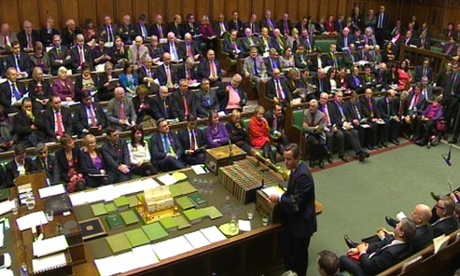
David Cameron has come close to ruling out taking part in the TV leaders’ debates proposed by broadcasters. He has always expressed reservations about the debates taking place during the election period, but at PMQs today he implied that he would not attend the debate scheduled with just him and Ed Miliband for 30 April. Asked if he would attend, he replied:
I have been very clear. I have said get on with the debates before the election campaign. I think we should start now.
Miliband said he would be at the debate on 30 April, and he asked if Cameron would be there. Cameron refused to give that assurance. Later Labour sources said that, since Cameron said he was committed to debates five weeks ago, there has not been a single meeting of the Labour and Conservative negotiating teams. A Labour source said:
Behind the scenes Cameron’s team are doing everything they can to scupper the negotiations and sink the debates.
-
Miliband has said that Cameron’s record on immigration shows that voters cannot trust him on anything. Challenging Cameron at PMQs to admit that he had failed to meet his promise to cut net migration below 100,000, Miliband said:
Your promise on immigration makes the deputy prime minister’s promise on tuition fees look like the model of integrity. If you can break so spectacularly a solemn promise on a fundamentally important issue, why on earth should anyone believe any of your election promises this time?
Cameron said the strength of the economy was to blame.
There are two reasons for high migration: one is the growth of our economy and the other is that our benefit system allows people to access that benefit system straight away. I say let’s keep the strong economy, let’s change the benefit system. You want to keep the benefit system and trash the economy.
-
Cameron has challenged Labour to commit itself to renewing Trident. The Tories would do this if they won the election, he said.
But it is concerning that almost three quarters of Labour candidates oppose the renewal of Trident and I think now is the time for Labour to rule out any agreement with the SNP. Because no one wants to see some grubby deal between the people who want to break up the United Kingdom and the people who want to bankrupt the United Kingdom.
The SNP has said that it would insist on Trident being abandoned as a condition for supporting a minority Labour government.
-
Nigel Farage, the Ukip leader, has claimed that the party’s decision to abandon its policy of having a firm 50,000 cap on annual net migration amounts to a U-turn. Instead, Ukip would create a migration control commission to keep it down, he said. He said:
There is no U-turn, there is a change of emphasis.
-
The TUC has criticised the Treasury’s decision to sell the government’s stake in Eurostar. Frances O’Grady, the TUC general secretary, said this was “short-sighted”.
The French and Belgian governments understand its value, which is why they have held on to their shares. And once again passengers’ interests have been put last, and private shareholders first.
The more we keep selling off the family silver, the less control British people have over essential services we all rely on. Slicing up our services between shareholders all over the world means that the profits are likely to get sucked out of the UK economy instead of being re-invested to make sure British people are getting a gold standard.
- Britain’s defence chiefs should be prepared to resign en masse if the next government tries to impose any further cuts on the armed forces, a former head of the RAF has said. As the Press Association reports, Air Chief Marshal Sir Michael Graydon said the current service chiefs could face a “very, very difficult decision” if they are confronted with the prospect of further cutbacks after the general election in May. Speaking at a meeting of the UK National Defence Association (UKNDA) campaign group, he warned that they could not carry on pretending they had the resources they needed. Asked directly if they should tender their resignations if they were ordered to make further cuts, he said: “Yes”.
Updated
PMQs - Verdict from the Twitter commentariat
This is what political journalists and commentators are saying about PMQs on Twitter.
Those suggesting Miliband won
I can't think anyone can call today's PMQs anything other than a total walkover for @Ed_Miliband. Not often one can say that.
— Iain Dale (@IainDale) March 4, 2015
David Cameron embarrassed himself by refusing even to pretend to answer either of EdM's questions #PMQs
— John Rentoul (@JohnRentoul) March 4, 2015
Not a clear win for Mr Miliband today - Mr Cameron should have been on the canvas, not just on the ropes. #PMQs
— Owen Bennett (@owenjbennett) March 4, 2015
An astonishingly one-sided #PMQs - very very rare that Miliband sweeps board with Cameron like that
— Alex Stevenson (@Alex__Stevenson) March 4, 2015
Those suggesting Cameron won
Jesus now Ed is on to TV debates. This is weak, weak, weak from Labour after a strong show last time #pmqs
— josh lowe (@JeyyLowe) March 4, 2015
Those calling it a draw
0-0 #PMQs .....all we learned was that Cameron is more likely to dance naked down Whitehall than be at those TV debates
— Rob Merrick (@Rob_Merrick) March 4, 2015
This #PMQs miliband 1 : Cameron 1
— Adel Darwish (@AdelDarwish) March 4, 2015
First half win for Cameron on sticky wicket, but Miliband scores points on debates. 3-3
— Tim Shipman (@ShippersUnbound) March 4, 2015
Other comments
Rare sighting: Nick Clegg spotted on front bench at PMQs.
— James Landale (@BBCJLandale) March 4, 2015
Clegg started heckling Miliband as soon as the Labour leader compared Cameron's immigration pledge to Lib Dem tuition fees #PMQs
— Isabel Hardman (@IsabelHardman) March 4, 2015
Challenge for Miliband is to criticise Cameron for breaking a promise without appearing anti-immigration. #PMQs
— George Eaton (@georgeeaton) March 4, 2015
Not sure voters will be impressed by Cameron listing a random series of pledges the Tories have kept. #PMQs
— George Eaton (@georgeeaton) March 4, 2015
Not sure why Miliband going so heavy on immigration, seeing as they also saw immigration in hundreds of thousands. Just plays to UKIP? #PMQs
— Paul Brand (@PaulBrandITV) March 4, 2015
Watching Labour try to outflank the Conservatives on immigration is utterly, utterly depressing. #PMQs
— Stephen Daisley (@JournoStephen) March 4, 2015
David Cameron's done that "Hands up!" trick at #pmqs before. Here's Simon Hoggart on how it went down: pic.twitter.com/Z6rpCUoZxA
— Stephen Bush (@stephenkb) March 4, 2015
Only 10 Labour MPs put their hands up when Cameron asked how many would use Ed's pic in leaflets. Can't believe they fell for that #PMQs
— Tom Newton Dunn (@tnewtondunn) March 4, 2015
Cameron asks how many MPs are going to put Ed M on their leaflets. Scot Nats all put their hands up #pmqs #GE2015
— James Chapman (Mail) (@jameschappers) March 4, 2015
Not sure which more disingenuous: EM's questions on immigration or DC's answers on the TV debates. Politics, eh? #pmqs
— Jeremy Cliffe (@JeremyCliffe) March 4, 2015
Suspect that if poll crossover continues to elude Tories, could soften on debates. Will need a gamechanger if still 32%-32% by April. #pmqs
— Jeremy Cliffe (@JeremyCliffe) March 4, 2015
Seriously unconvinced there's any point whatsoever to #pmqs at this point in the electoral cycle.
— Gaby Hinsliff (@gabyhinsliff) March 4, 2015
PMQs - Verdict
PMQs - Verdict: Paul Flynn may not be entirely right when he said David Cameron was worse than ever at dodging the question today, because at the start of the exchanges Cameron did give an answer to the question about whether he had met his migration target that was semi-reasonable. But then Cameron abandoned all attempts to engage with Miliband and resorted to listing his achievements like Soviet commissar, and citing tabloid trivia. I suppose he will head off for lunch thinking it could have gone worse, but it was demeaning. Ed Miliband exposed Cameron’s failure on immigration pretty effectively, using the “did he mean it?” line that he he used before to make this an issue of trust too. It was a comfortable Miliband win.
The interesting question, though, is what else could Cameron have said? Perhaps the best strategy would have been to apologise. Something along the lines of:
Look, I’m sorry I made that pledge. It was made in a good faith, but it turned out to be a mistake, and it raised unrealistic expectations. For once I should have listened to Nick Clegg. But no government gets everything right, and it’s silly to pretend that they do. I’m still committed to cutting net migration, and I’ve got a plan for that, but we’re going to produce a more realistic target.
But, of course, he couldn’t say that, partly because of the “kick us out if we fail” line in the Contract with Britain (election rhetoric never seems wise five years on) and partly because Theresa May has committed the party to keeping its net migration target. It would have been easier for Cameron today if the party had dropped it (he could have said the target was a mistake, which was why was writing it), but I suppose that’s the last thing the Tories wanted to do in a week where Ukip are launching their immigration target.
One final point. Cameron has always said that he is not keen on holding debates during the election campaign, but today he seemed to go further.
I’ve been very clear. I say get on with the debates before the election campaign. I think we should start now.
That sounds like an explicit refusal to take part in the debates proposed by the broadcasters.
Updated
PMQS is over. On a point of order, Labour’s Paul Flynn suggests Cameron should be sent on a course to learn the meaning of the words question and answer, and the link between the two. Today Cameron was worse than ever at not answering, he says. His comments were completely irrelevant, he says.
John Bercow says Flynn has made his point.
I’ll post a verdict soon.
John Woodcock, the Labour MP, asks Cameron if he will accept the recommendations in the report into deaths at Furness hospital.
Cameron says the government will accept many of those recommendations. It is important not to sweep these matters under the carpet, he says.
Sir Gerald Howarth, a Conservative, says Cameron should abandon his natural reticence and tell voters that Labour ruined the economy.
Cameron says he has not felt reticent today. The economy is turning round, things are getting better, and we should not let Labour wreck it.
Cameron says he is happy to support a campaign to improve the Cotswolds railway because it would help him.
Ed Balls is heckling, and Cameron says Balls told us he was a long, slow burn. (This is a reference to Balls talking about his love life on LBC.) But the only thing in ashes is Labour’s economic credibility, he says.
Cameron says Labour promised a price freeze on energy even when prices are coming down. That shows the damage Labour are doing.
Mark Hunter, a Lib Dem, asks if Cameron supports a campaign for nursery staff to have training to prevent deaths from choking.
Cameron says he will talk to colleagues to see if more can be done to help with this.
Labour’s Meg Munn says schools with outstanding academic results can go for years without their child protection procedures being inspected. Shouldn’t child protection be made a more central part of the inspection process.
Cameron says he will consider this. Inspections used to take place too often, he says. Boards of governors can always trigger an inspection.
Cameron says Labour’s tuition fees policy hits universities, helps richer students rather than poorer ones and will not improve access. It will also be paid for by a tax hitting people like senior nurses, he says. It is an example of the chaos Labour would bring.
Oliver Colvile, a Conservative, asks about a development opportunity in Plymouth. A decision needs to be made before the government goes into election purdah.
Cameron says he thinks a decision should be able to be taken before the end of the month. If the decision is approved, funding is available. He is committed to it, he says.
Guy Opperman, a Conservative, asks about Cameron’s plan for the north east.
Cameron says youth employment has risen more in the UK in the last 12 months than in the whole of the rest of the EU combined.
Labour’s Julie Elliott asks Cameron if he agrees with a business minister who said prosecuting people who do not pay the minimum wage is the right thing to do.
Cameron says people who do not pay the minimum wage should be prosecuted.
Updated
Labour’s Barbara Keeley asks Cameron if he will debate with Miliband.
Cameron says he wants to get on and hold the debates now, not in the election campaign.
Liam Fox, the Conservative former defence secretary, says Cameron is a statesman, unlike Miliband. Will he confirm that he will never get involved in a “shabby deal” to get rid of the nuclear deterrent.
Cameron says he is committed to renewing Trident, and will do so in the next parliament. But three quarters of Labour candidates are not committed to Trident. Labour should now rule out a “grubby deal” with the SNP over Trident.
Labour’s Diana Johnson asks how the police can tackle sex abuse when their budgets are being cut.
Cameron says making child sex abuse an issue of national importance will mean that more resources get allocated to this
David Ward, a Lib Dem, asks Cameron if he thinks his behaviour at PMQs increase the standing of parliament in the eyes of the public.
Cameron says the exchanges are robust, but at least it provides accountability.
Labour’s Katy Clark asks why the government is closing a tax office in north Ayrshire.
Cameron says Labour were the friends of the tax avoiders. It took a Conservative government to sort it out.
Simon Wright, a Lib Dem, asks about a school issue in his constituency.
Cameron says he will look at this.
Labour’s David Winnick says the Tories are the party of the rich.
Cameron says 1,000 people are getting a job every day under this government. Labour should welcome that, he says.
My snap PMQs verdict
Snap PMQs Verdict: Cameron’s bluster machine was on overdrive, and it probably saved him from a total drubbing, but his hyperactive question-dodging could not disguise the fact that Miliband had him bang to rights.
Updated
Miliband says the broadcasters propose a debate on 30 April between him and Cameron. He will be there. Will Cameron?
Cameron says they are debating now, but Miliband cannot talk about living standards. Let’s have the debate now.
Miliband says, if Cameron wants an extra debate, he will have one. Will Cameron be there?
Cameron says Miliband has given up on the seven-party debates. He probably watched the Green press conference. We all thought it was a car crash. Miliband probably thought it was a masterclass.
Miliband says Cameron stance makes Nick Clegg look good.
Cameron says he has a copy of his document with him. He starts quoting from his pledges, saying they have been achieved. The Tories cheer every time he does this. Eventually John Bercow shuts him up.
Miliband says you cannot believe the promises you get from Cameron on immigration.
It is not worth the paper it is written on.
The jeering gets louder. Bercow asks MPs to remember what people think.
Miliband says Cameron promised net migration in the tens of thousands. Will he admite he broke that promise.
Cameron says he cut net migration from outside the EU, but not from within it. And he has a plan to deal with that. He lists more kept promises. And he says he promised 400,000 apprentices. He has broken that promise. He has created 1m. On the subject of leaflet, Miliband has to stand on a box to be pictured for Labour leaflets. How many Labour MPs want Miliband on their leaflets?
Ed Miliband says Cameron made a no ifs, no buts promise before the election. Can he remind us what it was.
Cameron says net migration has fallen from outside the EU, but increased from within the EU, because of growth.
Miliband quotes what Cameron said about immigration in his Contract with Britain. Cameron said if we don’t deliver, kick us out. Did he mean it?
Cameron says there are two reasons for high immigration: a strong economy, and the benefits system. He wants to keep the economy, but change welfare. Miliband wants to keep welfare, but trash the economy.
Andrew Turner, a Conservative, asks about a business investment on the Isle of Wight.
Cameron says it’s an excellent development. It will provide 550 students with workshops and learning opportunities, and more than 200 apprenticeships.
Labour’s Kalid Mahmood says George Osborne was asked six times on the Today programme if he had discussed tax avoidance with Lord Green. Will Cameron confirm if he or Osborne discussed this?
David Cameron says he dealt with this two weeks ago. It is the same Lord Green that Labour gave a job to.
Cameron at PMQs
PMQs is about to start.
Q: You say there won’t be a cap. But you also expect net migration to be below 50,000. Aren’t you trying to have it both ways?
Farage says there is an obsession with floors, ceilings etc. He thinks, if you talk about caps, the public will not believe you. Ukip has not abolished the cap. But it has a plan to deal with immigration. It wants to turn an issue that is divisive and make it positive.
Ukip's Q&A
Nigel Farage and Steven Woolfe are now taking questions.
Paul Nuttall, the Ukip deputy leader, is chairing. He calls Gary Gibbon from Channel 4 first. There is some jeering, because of the Channel 4 drama about Ukip’s first 100 days in power.
Q: You seem to have watered down your policy. Are you worried your immigration stance looked toxic?
(This provokes more jeering.)
Farage says he is concerned about the way Ukip is portrayed. He is concerned about it being portrayed as anything other than an open, inclusive party.
(Sadly, the BBC has now dropped its live feed. But we’ve got PMQs coming up.)
Ukip would not deport EU citizens who are here already, he says. We work with them, and welcome them. Some are even standing as Ukip candidates.
They can definitely stay. Ukip’s policy is ethical and fair, he says.
Woolfe says “if”, and then he correct himself, “when Ukip comes to power, when Ukip wins this election” ... Ukip would offer citizenship to immigrants here for five years.
Woolfe says, when you see migrants queuing up at Calais, it is hard not to want to help them.
But, if you do help them, you would be helping the traffickers who are provding funds to groups like Islamic State.
That is why there must be no amnesty for illegal immigrants, he says.
And there would be an extra 500 enforcement staff, he says. Ukip has shown how this would be funded.
Woolfe says Ukip would maintain the UN principles governing asylum.
At the moment it takes far too long to process asylum seekers, he says. Ukip would speed this up, to allow people to start working more quickly.
People who were not true asylum seekers would be repatriated.
Woolfe says Ukip would abolish any rules giving EU citizens preference. EU and non-EU citizens would be treated the same.
Immigrants would have to have health insurance for themselves and their families for the five years they are here before they can apply for citizenship.
Woolfe says Ukip would introduce one single passport queue at customs for British citizens, and one queue for the rest of the world. That would enable a proper count to be made of people coming in and out.
And Ukip would hire an extra 2,500 border staff - not just 1,000 more, as Labour are promising.
Woolfe says Ukip has thought long and hard about its policy.
It would set up a migration control commission to decide how much migration is needed.
And for five years there would be a ban on unskilled net migration.
Woolfe says many people in the UK share that tolerant attitude.
But other parties do not share that tolerant attitude, he says. He says a Labour adviser said there was a political purpose behind mass migration. Perhaps Labour wanted more votes, or perhaps they wanted to anger the right.
But when people like Gillian Duffy complained, Labour called her a racist, because she did not share their dogma.
Woolfe says Cameron said he should be kicked out if he did not meet his net migration target. But he didn’t, Woolfe says.
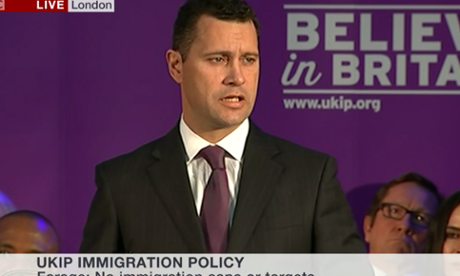
Steven Woolfe, Ukip's immigration spokesman, speaks
Steven Woolfe, Ukip’s immigration spokesman, is speaking now.
(Sky and BBC News are not covering the Ukip launch anymore, but there is a feed on the BBC website.)
Woolfe says his grandmother was an Irish immigrant.
And he says, when his mother brought a black boyfriend home, his grandmother gave him a warm welcome. He is glad they did, because that man became his father.
Updated
Farage says his family were migrants. In modern parlance, they were refugees. They were protestants from France.
But they came over a period of 100 years, he says.
He writes about this in his Telegraph piece.
I feel so passionately about this because my ancestors were migrants – technically, asylum seekers. One side of my family were French Huguenot refugees. The “wave” of immigration behind my ending up here numbered around 50,000 people. This was the largest immigrant group in Britain between 1066 and 1945.
Farage says immigrants should have to have health insurance. And they should not claim benefits until they have contributed for five years.
This is a common sense solution, he says.
Ukip is the only party talking honestly about this issue, the number one concern for most people, he says.
He says this policy would be more ethical. Currently we are discriminating against skilled people from countries like New Zealand and India.
Nigel Farage's immigration speech
Nigel Farage is delivering his immigration speech in London now.
He says Ukip wants an Australian-style points system.
We have to build a home every seven minutes to cope with immigration, he says.
Immigration has depressed wages, he says. The minimum wage has become the maximum wage.
It has been a boon for the rich, who can have cheaper nannies and gardeners.
But for most people immigration has not brought those benefits, he says.
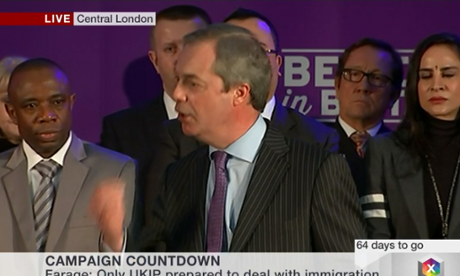
Farage rejects claims that dropping Ukip's net migration target amounts to a U-turn
In an interview for BBC News Nigel Farage said his party’s decision to drop the 50,000 net migration target was not a U-turn.
It isn’t a U-turn. We’ve looked at the figures very closely - 27,000 people would have qualified under the Australian-style points system to come into this country. I can’t see us getting anywhere near 50,000.
Asked whether people should listen to him or Steven Woolfe, the immigration spokesman who was promoting the 50,000 target only last week, Farage said:
I sat with him yesterday. Policies evolve, they develop, they move on. I don’t want the emphasis from today to be what our cap is.
Andrew Mitchell pays £80,000 to 'plebgate' police officer
The police officer in the Andrew Mitchell “plebgate” affair has accepted damages of £80,000, the Press Association reports.
The conclusion of Pc Toby Rowland’s defamation case against the MP was announced at the High Court in London today.
Last November Andrew Mitchell, who vehemently denied using the word “pleb”, lost a high-profile action against News Group Newspapers, publishers of the Sun.
A judge then declared he had reached the “firm conclusion” that Mitchell had used the “politically-toxic” word in September 2012 when he was not allowed to cycle through the main Downing Street vehicle gates.
Pc Rowland’s lawyer, Jeremy Clarke-Williams, told Mr Justice Warby that since that judgment Mitchell “has abandoned the other defences he had raised to my client’s claim and consequently terms of settlement have been agreed”.
The solicitor added: “The payment of £80,000 damages by Mitchell sets the seal on Pc Rowland’s vindication, as well as providing compensation for the injury to his reputation and the distress caused to him and his family over many months.”
Neither Mitchell nor Pc Rowland was in court.
Today's Guardian seat projection - Conservatives 277, Labour 271
Here’s today’s Guardian seat projection.
Conservatives: 277
Labour: 271
SNP: 51
Lib Dems: 25
Ukip: 4
Greens: 1
Ed Balls, the shadow chancellor, has just put out this statement about George Osborne’s Today interview.
George Osborne was asked six times whether he discussed allegations of tax evasion at HSBC with Lord Green, the bank’s former chairman, and six times he refused to answer.
What has George Osborne got to hide? People will draw their own conclusions from his total failure to answer.
The chancellor also struggled to explain why, since the government received these files in May 2010, only one person has been prosecuted out of 1100 names.
David Cameron and George Osborne must now come clean about their discussions with Lord Green - both while he was a Tory minister and before they appointed him.
Huffington Post’s Asa Bennett says this is not the first time Nigel Farage has dumped existing Ukip policy unceremoniously.
Ukip's migration cap joins the flat tax and their 2010 manifesto in the "dumped by @Nigel_Farage" list pic.twitter.com/yE1x9jMRUe
— Asa Bennett (@asabenn) March 4, 2015
Farage claims Ukip's immigration policy would lead to higher wages in the UK
Nigel Farage claims Ukip’s immigration policy would lead to higher wages in the UK.
The effects of #UKIP's immigration policies on wages is simple supply and demand. End the open door and wages could rise in accordance.
— Nigel Farage (@Nigel_Farage) March 4, 2015
George Osborne's Today interview - Summary
Here are the main points from George Osborne’s Today interview.
-
Osborne claimed he could not have discussed HSBC’s involvement in tax dodging in Switzerland with the former HSBC boss Lord Green when he was a Tory trade minister because Osborne did not know then about the evidence suggesting the bank colluded with this. This only came to light recently, he said.
The information that has been published recently has only recently come to light. Until that point, the allegations had been that individuals with bank accounts at HSBC had been evading tax and HMRC was, rightly, investigating it. The new information is that, potentially, the allegation is that HSBC Swiss colluded in this – this is new information.
He said he was aware, when Green was appointed, that some of HSBC’s Swiss customers were being investigated for tax evasion. But those were individual matters, not corporate matters, and it would not have been right for him to ask about tax investigations affecting individuals. But Osborne at times sounded evasive when asked about what he discussed with Green, and Labour’s Margaret Hodge has accused him of not telling the full truth about his knowledge of affairs at HSBC. See 8.52am.
- Osborne said that HSBC was “a very important bank” for the UK, employing 50,000 people, and that he wanted it to succeed.
- He confirmed that he was considering toughening the law on tax dodging.
- He said he supported Tory plans to retain cutting net migration below 100,000 a year as an “ambition”.
-
He claimed Ukip’s immigration policy was “chaotic”.
What you’ve heard from our political opponents today, those who are contesting in this general election, is a completely chaotic alternative and they are making it up as they go along ... Nigel Farage seems to be making it up as he goes along inasmuch as you follow his policies, one moment he’s talking about a cap and then he ditches it live on air, which is a novel approach to policy-making.
- He said the IFS report today on living standards marked “a major milestone today in the British recovery, with incomes back to where they were before the crisis”.
-
He said the IFS had debunked false Labour claims about the coalition’s record.
They say, first of all, that incomes have recovered to their pre-crisis levels so the country is not poorer than it was. They actually confirm in this independent report that the richest paid the most towards dealing with our economic problems, not the least, as you often hear. And they also say that, rather than inequality increase which, again, is often said, in fact, inequality has fallen in our country.
-
He said the sale of the government’s stake in Eurostar for £750m was “good value for money for the taxpayer”.
I’ve taken some of the quotes from PoliticsHome.
Nigel Farage's interviews - Verdict from the Twitter commentariat
Here’s some Twitter comment on Nigel Farage’s morning interviews.
From the Sun’s Tom Newton Dunn
Re previous tweet, Farage abandoning an immigration target has gifted the down and out Tories a way back into the debate. He may regret it.
— Tom Newton Dunn (@tnewtondunn) March 4, 2015
From Matthew Goodwin, the academic and Ukip expert
Farage: "There's something in immigration debate that is about more than money" <-cultural narrative where main parties totally absent
— Matthew Goodwin (@GoodwinMJ) March 4, 2015
From ConservativeHome’s Mark Wallace
Last June, @Nigel_Farage was attacking the power of quangos...today he's proposing putting one in charge of our borders.
— Mark Wallace (@wallaceme) March 4, 2015
From the Times’s Ann Trenaman
Farage's goal to return immigration figures to .'normal ' is a rather inspired moment in history of fantasy politics
— ann treneman (@anntreneman) March 4, 2015
From Sunder Katawal from the British Futures thinktank
Farage on immigration http://t.co/OcMkbddI4R (Telegraph). Nb: UKIP says they would increase Commonwealth immigration from current levels
— Sunder Katwala (@sundersays) March 4, 2015
First advice from Farage Migration Control Commission? Aussie net migration is triple that of UK, proportionately http://t.co/fpk89U7eP5
— Sunder Katwala (@sundersays) March 4, 2015
@AndrewSparrow UKIP's skilled Indians/unskilled Romanians soundbite says we're *too tough* on non-EU immig now. That entails net mig >100k
— Sunder Katwala (@sundersays) March 4, 2015
UKIP's policy entails net mig still > 100k as currently measured (tho they'd sensibly reclassify students)as want Commonwealth up & students
— Sunder Katwala (@sundersays) March 4, 2015
Australian net migration is 212k/year, 1% of total population of 23m. Triple British rate http://t.co/1nU3LFd54p
— Sunder Katwala (@sundersays) March 4, 2015
Updated
Labour accuses Osborne of concealing truth about his knowledge of HSBC and tax dodging
Labour figures were unimpressed by George Osborne’s response to the questions about why he did not discuss HSBC tax dodging Swiss customers with Lord Green, the former HSBC boss who served as a Conservative trade minister.
The most significant is probably the one from Margaret Hodge, who is accusing Osborne of concealing the truth about his knowledge of HSBC and its involvement in tax dodging.
From Alex Belardinelli, Ed Balls’ head of communications
George Osborne on @BBCr4today once again repeatedly unable to say whether he discussed allegations of tax evasion at HSBC with Lord Green
— Alex Belardinelli (@abelardinelli) March 4, 2015
From Barry Sheerman MP
Osborne all over the place on lack of prosecutions following @HSBC revelations! @BBCr4today
— Barry Sheerman MP (@BarrySheerman) March 4, 2015
From Margaret Hodge, chair of the public accounts committee
Osborne refusing to say if he talked to Lord Green about HSBC tax evasion or avoidance. Why won't they come clean? Clear to me they knew.
— Margaret Hodge (@margarethodge) March 4, 2015
From Jon Ashworth MP
Why can't Osborne give a straight answer re whether he spoke to Lord Green re HSBC instead he really was wriggling around @BBCr4today
— Jonathan Ashworth MP (@JonAshworth) March 4, 2015
From Chris Williamson MP
Surely nobody listening to the interview with George Osborne on Today prog this morning could in all conscience vote Conservative on 7 May
— Chris Williamson (@ChriswMP) March 4, 2015
Here’s the Spectator’s Isabel Hardman on George Osborne’s Today interview.
Hahah, Osborne criticises Farage for ‘a novel approach to policymaking’ by dumping immigration cap live on air.
— Isabel Hardman (@IsabelHardman) March 4, 2015
…which is pretty much what Theresa May did on the, er, Today programme, when she started talking about net migration target as a ‘comment'
— Isabel Hardman (@IsabelHardman) March 4, 2015
Osborne claimed that he backed the Tory plan to set a target for getting net migration below 100,000 in his Today interview, but in private his views are said to be rather different. (See 8.25am.) The Times has been running a good series on immigration this week, and this is what Rachel Sylvester and Alice Thomson reported in a story on Monday (paywall).
For the government, the question of inflows and outflows of people has also been the rock in the road of good coalition relations. Immigration has caused more tension within Cabinet than almost any other policy since 2010 — among Conservative ministers as much as, if not more than, between Tories and Liberal Democrats.
This is one of the few areas on which George Osborne — a liberal free marketeer who believes immigration is good for the economy — has very different views to Mr Cameron, who is in favour of tougher controls. “George does not want the Treasury briefing against the Home Office but his instincts are very different to David’s,” a friend says.
Q: Theresa May wants to keep the target of getting net migration below 100,000. Is that a good idea.
Of course, says Osborne. David Cameron supports that too.
He says his opponents (ie, Ukip) have a chaotic policy. They are making it up as they go along.
And that’s it.
I’ll post a summary soon.
Q: Lord Green, the trade minister, was aware of what was going on at the Swiss branch of HSBC. Did you know about that?
Osborne says he only knew what the public knew: that information had been handed over to HMRC.
Green was a business adviser to Labour. And his appointment was vetted.
Q: Did you ask him about it?
Osborne says ministers should not be able to look into individuals’ tax affairs.
Q: That’s a red herring. It is not about his tax affairs. It is about what he knew about HSBC.
Osborne says the information recently published has only just come to late.
Previously the allegations were just about individual customers evading tax.
The idea that the bank colluded in this is something that only came to light recently, he says.
Britain needs successful companies. HSBC needs to deal with this problem.
Q: Only one person has been prosecuted for tax evasion in relation to the HSBC Swiss accounts. Doesn’t the law need to be better enforced?
Osborne says it is an important constitutional principle that ministers do not see people’s tax affairs, or tell the prosecuting authorities what to do.
The authorities have gone through this data.
He says he trusts their judgment.
Q: You must be the only person in the country who does.
Osborne says the prosecuting authorities say they have the resources they need.
But he is looking at changing the law to toughen it up.
Q: You are flogging off the family silver (Eurostar). Is there no end to selling stuff to foreigners?
Osborne says this is a good deal. The government had a minority stake anyway. It is getting much more for it than people expected.
The government is extending high-speed rail, he says.
You can only afford that if you are getting your priorities right.
Q: But is there no bit of strategic infrastructure you won’t sell?
Osborne says Britain benefits from being an open economy, open to investment.
For example, it is good that Chinese investors are building nuclear power stations here.
Q: But living standards are below their all-time peak in 2009-10.
Osborne says the financial crash did enormous damage to the economy. But, compared to most other Western countries, we have grown faster, and created more jobs.
Incomes have reached their pre-crisis level, he says.
They should be higher in 2015-16 than they were in 2010-11.
But, he says, he is the first to admit there is more to be done.
George Osborne's Today interview
John Humphrys is interviewing George Osborne.
Humphrys says Osborne was smiling as he summarised the IFS living standards report.
Osborne says we have reached a milestone today. But we must not put the progress achieved at risk.
Q: If you are in a lower-income household, you are still feeling poor. Most of us are buying less food and other things than before the recession.
Osborne says it is true that the poor suffer most when the economy turns down.
But the IFS today has laid to rest a number of myths.
First, they say income has recovered to pre-recession levels.
Second, they say the rich have paid the most.
And, third, they say inequality has fallen.
Britain is fundamentally in a better position than it was five years ago, he says.
Nigel Farage's morning interviews - Summary
And here are the key points Farage has been making in his morning interviews. (He did not just do Today.) I’ve taken some of the quotes from PoliticsHome.
-
Farage said Ukip was dropping the idea of setting a firm annual target for migration. This seemed a fairly blunt slap-down to Ukip’s immigration spokesman, Steven Woolfe, who was promoting the target only last week. There would have to be flexibility in the new system, Farage said. And the public did not believe politicians when they set targets for immigration.
We’ve had years and years of political parties setting targets. I think the public are bored with targets, they don’t believe targets. What’s really important is: are we going to get a grip on mass immigration into Britain, or not?
-
He said he wanted to get net migration back to “normality” which he described as anywhere between 20,000 and 50,000 a year, the figure that applied for most of the second half of the 20th century.
What I want to do, I want to bring immigration to Britain back to normality – and normality from 1950 until nearly the year 2000, from Windrush onwards, normality was net migration into Britain which varied between about 20,000 and 50,000 a year. The effect of Ukip policies would be to bring us back to those kinds of numbers. Each year will be slightly different for obvious reasons, but what we’re pushing here represents a drastic cut.
-
He said current policy was unfair because it discriminated against skilled migrants from outside the EU who could benefit Britain. Ukip would change this, he said. He described his party’s policy as an “ethical” immigration policy.
And understand this: Ukip’s immigration policy would give more opportunities to people from the rest of the world, especially from Commonwealth countries, because at the moment we have a massive bias in our immigration policy in favour of white people that come from southern and eastern Europe. So we are putting an ethical immigration forward, we are putting a fair policy forward – one that is fairer to people from the Commonwealth and fairer to British workers, too.”
-
He claimed Ukip would have a “big voice” in parliament after the election.
We’re not going to win the election, but what we are going to do is win enough MPs to have a big voice in the next Parliament. So I’m not going to be driving a ministerial car, but I might get the chance to drive the political agenda.
-
He said Ukip would publish its manifesto in April, probably after the main parties. Voters would not pay any attention to the campaign until after Easter, he claimed. He also claimed the party never said it would publish its manifesto at the spring conference (even though it did).
Nigel Farage is wrong to say Ukip never said it would publish its manifesto at the spring conference. (See 7.44am.) This is what Suzanne Evans, the deputy chairman, said in January when she was put in charge of compiling the manifesto.
I relish the task of putting together the final details and presenting a sensible, radical and fully costed manifesto at our spring conference in Margate.
Q: When will your manifesto come out?
In April, probably later than the other parties produce theirs, says Farage.
He says the campaign has been running since the new year. Parties are making new claims every day, and the public are bored.
Q: But it was supposed to come out at the spring conference at the weekend.
Good lord, no, says Farage. That was never the plan.
He says he does not think voters will start focusing on the election until after Easter.
And that’s it. The interview is over.
Q: Do you agree with the director general of the IoD, who said last week the non-EU cap was harming business.
In a way, yes, says Farage. He says the current system discriminates against people outside the EU who could benefit the country.
Q: What if your proposed immigration commission said 100,000 a year was the right number?
Farage says he thinks that would be very unlikely.
But this is not just about economics. It is about community cohesion too, he says.
He says if net migration continued at current levels the population would reach unmanageable levels.
Nigel Farage's Today interview
Mishal Husain is interviewing Nigel Farage now.
Q: To what level would you reduce immigration?
To normality, says Farage. That was what applied from Windrush (in the late 1940s) to around 2000. It was around 20,000 to 50,000 a year. At that time we had the best system of integration
Q: So you are putting caps on it.
No, says Farage. The level might vary from year to year. The public are fed up of politicians putting figures on it.
Q: But Steven Woolfe said last week there would be a cap. (She plays a clip.) Is that Ukip policy?
Farage says it is very unlikely that Ukip would reach 50,000. Last year 27,000 people skilled workers came under the Australian-style points system. We are not having caps, he says.
He says, again, he does not believe Britain would need 50,000 migrants a year. He thinks the number would be lower.
Updated
Nigel Farage has been trying to address the charge that Ukip are dropping the target it was proposing only last week to get net migration below 50,000.
Just told @GMB, we didn't have a "50,000 target", that's was a net migration employment number. Stay tuned for more information later today!
— Nigel Farage (@Nigel_Farage) March 4, 2015
That is certainly not the way it sounded when Steven Woolfe, Ukip’s immigration figure, mentioned the 50,000 figure in his speech to the Ukip spring conference on Friday.
Here are today’s YouGov GB polling figures. The Tories are still ahead, but by 2 points, not 3 points as they were yesterday.
Update: Cons lead at 2 - Latest YouGov / Sun results 3rd Mar - Con 36%, Lab 34%, LD 5%, UKIP 14%, GRN 6%; APP -19 http://t.co/stnZZ7a70Z
— YouGov (@YouGov) March 4, 2015
Two stories are leading the political news this morning.
- Nigel Farage is giving a speech setting out Ukip’s immigration policy. As Rowena Mason reports, he will says Ukip would ban unskilled immigrants from working in Britain for five years and set up a new migration control watchdog to bring down overall numbers. But he is also due to reject “arbitrary” immigration targets, even though Ukip’s immigration spokesman was saying only last week that the party would cap annual net migration at 50,000 a year.
George Osborne and Nigel Farage are both giving interviews to the Today programme.
Here’s the agenda for the day.
8.10am: George Osborne, the chancellor, gives an interview to the Today programme.
9.30am: Nick Gibb, the school reform minister, gives evidence to the Commons education committeee.
10.15am: Ed Davey, the energy secretary, announces plans to reform the energy market.
11am: Nigel Farge, the Ukip leader, unveils his party’s immigration policy.
12pm: David Cameron faces Ed Miliband at PMQs.
12.45pm: Nick Clegg and Sir Richard Branson discuss drugs policy at the Royal Institute of International Affairs. As Patrick Wintour reports, they will argue that the UK should begin decriminalising the use and possession of almost all drugs.
1pm: Cameron has a working lunch with the Mexican President, Enrique Pena Nieto.
3.05pm: Former leaders of the Commons Andrew Lansley, Jack Straw and Sir George Young give evidence to the Commons procedure committee.
As usual, I will be also covering all the breaking political news from Westminster, as well as bringing you the most interesting political comment and analysis from the web and from Twitter. I will post a summary at lunchtime and another in the afternoon.
If you want to follow me on Twitter, I’m on @AndrewSparrow.
Updated