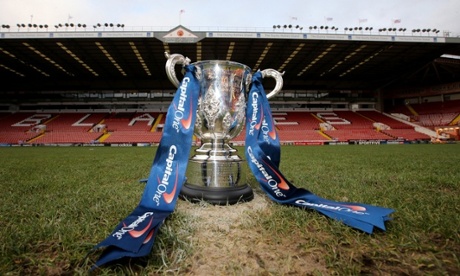
In the aftermath of the club’s 3-0 win away at Premier League Queen’s Park Rangers in the FA Cup, Sheffield United’s in-house TV station asked Nigel Clough whether his side would actually perform better in the Championship than they are in League One. “That’s a distinct possibility,” came the reply. It sounds an odd response from the manager of a club struggling to hold a spot in the third tier’s play-off places, but equally he could have been forgiven had he asked why the questioner had restricted his sights to only one league above.
Since Clough arrived at Bramall Lane in October 2013 his record against Premier League sides in cup competitions reads P7 W5 D1 L1 F12 A8, with five of those goals conceded coming in one game, last season’s 5-3 defeat against Hull City in the FA Cup semi-final at Wembley. Four of those five wins have come away from home.
It is a remarkable record and one that can be bolstered further by two wins in two over Championship opposition in the same timeframe. It is no wonder then that the Blades take on Tottenham Hotspur on Wednesday evening in their second cup semi-final in little over nine months, this time in the Capital One Cup, with plenty of expectation to complement the hope.
The frustration at Bramall Lane has been the side’s inability to translate their knockout form into league success. Defeat at MK Dons on Saturday saw United slip out of the play-off places, albeit on goal difference, and, perhaps more importantly, saw them fall 18 behind Bristol City and Swindon in the race for automatic promotion.
Predictably for a fanbase thoroughly sick of life in the third tier and facing the prospect of their stay in the division stretching into a fifth season, the result led to familiar grumblings about the need for change in the dugout. Cup success is clearly not enough for a club that tops the average attendance charts in League One by more than 6,000 – United boast an average home gate of 19,583, while the league average remains shy of 7,000.
But therein lies a problem for Clough and his side. Even with their stellar record against Premier League sides over the past year, there is an acceptance among fans that fixtures against the big beasts will follow a certain pattern. On Wednesday Tottenham will undoubtedly dominate possession while United retain a puncher’s chance and fans rally round beneath the flag of an underdog. In the league, wins are demanded rather than seen as a bonus. That brings pressure and it is a pressure that United have not coped with so far this season.
United’s own big beast status in League One has at times been a hindrance in other ways. Clough has this week acknowledged as much, pointing out that teams tend to sit back with 10 men behind the ball against the Blades, placing the onus on them to break the opposition down. His team, with pace through Jamie Murphy and Jamal Campbell-Ryce on the wings, is fundamentally better at playing on the break and that is a luxury rarely afforded to them in the league.
These days United are also – in a break from the tradition established by Dave Bassett and Neil Warnock in their tenures at the club – a tiny and stereotype-bustingly technical side. Players such as Louis Reed, an exceptionally talented 17-year-old who could well anchor the midfield at White Hart Lane, James Wallace, Florent Cuvelier, Jose Baxter, Ryan Flynn and Stefan Scougall are all fine footballers, but are perhaps not best suited to the sometimes (though by no means always) rugged nature of League One.
Clough says the fact that cup ties are “not as frantic as League One” has helped his side, as has the point that they have been on the receiving end of the odd slice of luck in a way that – in his view – they have not been in the league. It all paints a picture of a series of results that while unlikely are not inexplicable. Free from the stress of expectancy and faced with a tactical situation that suits them, United have thrived.
Only one Premier League side has managed to solve the puzzle, but Hull City – in a furious second-half display in which they scored four times – did show during last season’s Wembley semi-final that there is potential for Clough’s side to unravel in the face of Premier League superiority.
The law of averages suggests their current level of success cannot be maintained and Tottenham should have more than enough over the course of two legs to secure a spot against Chelsea or Liverpool in the final, but the five sides to suffer at the hands of Clough’s Blades – Southampton, West Ham, Fulham, Aston Villa and QPR – would all counsel caution.