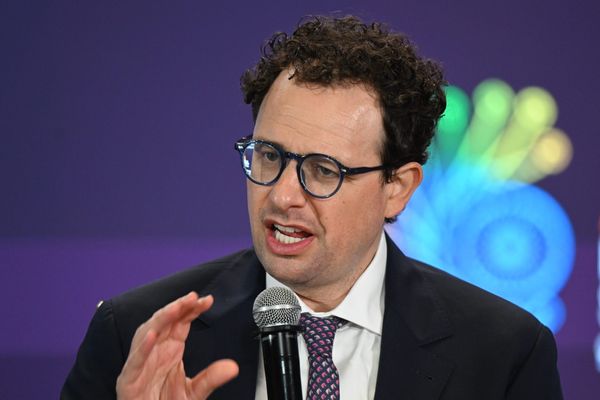
Senator Nick Xenophon has slammed the growing trend of companies paying million-dollar bonuses to chief executives for hitting vague performance targets.
He said chief executives should not be getting bonuses for doing what they should be doing in the first place, and he will be raising the issue at the next senate economics committee.
He joins a backlash of large superannuation funds, shareholders, and contrarian fund managers calling for corporate Australia to rein in the practice.
The Greens Treasury spokesman, Peter Whish-Wilson, said the Greens would also be pushing to rein in executive pay.
“Right now, meeting these new targets is about as hard as limbo dancing under the Arc de Triomphe,” Xenophon told Guardian Australia.
“This needs to be on the agenda. Why should someone get a bonus because no worker died on their watch? It’s offensive to what occupational health and safety ought to be about.”
The senators were responding to news that major companies like Woolworths, Commonwealth Bank, Telstra, and AGL Energy were increasingly setting “non-financial” targets for their chief executive bonuses.
The bonus payments are being made for progress in areas like company “diversity, inclusion, culture and safety,” which are difficult to measure.
The Australian Shareholders’ Association this week criticised the $12.3m pay packet of the CBA chief executive, Ian Narev, saying the bank’s move to change its bonus structure would make it easier for Narev to continue getting large payouts in the future.
“Previously, CBA executives were measured against total shareholder return (TSR) and customer satisfaction hurdles for their long-term incentives,” Goldin said this week.
“[But] in the 2015-16 financial year CBA did not meet its TSR hurdle.
“Under the new changes the TSR component of the long-term incentive, which used to be worth 75%, has been reduced to 50%. A new hurdle measuring progress in the areas of diversity and inclusion, sustainability and culture will constitute 25%.
“Whilst the changes reflect important sentiments, in reality where hurdles are based on qualitative measures, which we see quite often in the short-term incentives, there is so much flexibility in interpretation that payment of the bonus will effectively be up to the board to decide.”
The head of equity fund Allan Gray, Simon Mawhinney, told the AFR on Wednesday that CEOs should not be getting multimillion-dollar bonuses because no employee had died.
Andrew Mackenzie, BHP Billiton’s chief executive, had his salary halved this year from $US4.58m to $US2.24m after he suggested to the board that he shouldn’t get a bonus after 19 people were killed in a mining-dam failure in Brazil.
“If they don’t kill anyone, it is not that they should be paid another $1m bonus, they should get to keep their job,” Mawhinney told the Australian Financial Review.
Whish-Wilson told Guardian Australia that he had mixed views about non-financial targets for chief executives, because he would like companies to stop focusing solely on shareholder returns and start considering broader areas of corporate responsibility.
“Things like customers, employees, and community expectations are important,” he said. “But having said that, they’ve got to do it properly.”
He said the Greens want to introduce a broad “corporate responsibility mandate” attached to CEO pay that goes beyond shareholder returns.
But they also want to cap executive pay by anchoring it to the average employee’s wages in a company.
“Set the cap at a multiple of the wage of the average employee in their businesses. I think that would be the simple way of getting rid of the bonus culture, and the sales culture, in these vertically integrated businesses,” he said.
In 2013 voters in Switzerland rejected a proposal to limit executives’ pay to 12 times that of junior employees.