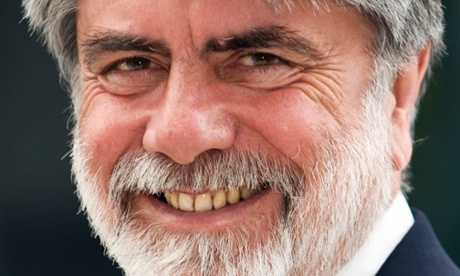
My husband, Nick Moore, who has died of a stroke aged 65, was a professor of information policy and strategy who was a passionate advocate of further education and campaigner for social justice. With Unesco, the UN and the British Council, he contributed to the development of national library plans across a range of less-developed countries, including Nepal, Botswana and Palestine. He believed that the printed word, rather than prestigious buildings, transformed lives and was the first chair of Book Aid International.
At the Policy Studies Institute in the early 1990s, he developed and harnessed information services to achieve social justice, in particular improving information services for people with disabilities and long-term health problems. From 1991 to 2002 he was chair of Help for Health, a charity providing information to patients that became the blueprint for NHS Direct and the NHS Choices website.
As chair of the board of Somerset College, Nick promoted further education in Somerset and nationally through the Association of Colleges. The college principal called him “an outstanding chairman who understood the power of education to drive social mobility”.
Nick was the son of Nora (nee Moor), a secretary, and Edward Moore. He was brought up in Gravesend, Kent, and attended the town’s grammar school. His father died when he was 16 and Nick assumed the role of head of household. He completed his A-levels, also working part-time, became a trainee librarian, and in 1969 was seconded on full pay to study for a diploma in librarianship at the College of Librarianship Wales, Aberystwyth.
In his mid 20s he took an Open University BA degree in economics, later gaining a master’s in public policy studies at the University of Bristol. He was the first professor of information management at Birmingham Polytechnic (1987-90), professor of information policy at City University (1998-2001), and visiting professor of information strategy at the University of Brighton (2000-08).
We met through work in 1978, when Nick was setting up research programmes on public libraries and community information, for the British Library, and married in 1982.
Nick became a committed campaigner for choice and rights at the end of life. He was the first chair of Dignity in Dying and helped to formulate the policy on assisted dying, which led to a bill currently going through parliament. He was also chair of Compassion in Dying and a trustee of St Margaret’s Hospice in Taunton at the time of his death.
He is survived by me, and by his sister, Christine, and brother, Peter.