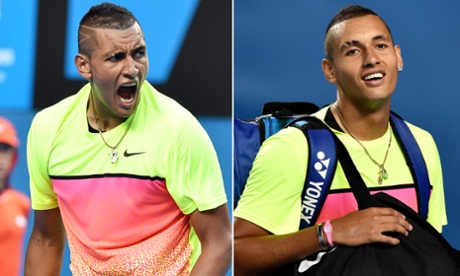
‘A snapshot of modern day, multicultural Australia’
Nick Kyrgios doesn’t fit the traditional mould of an Australian tennis star. Line him up with our most recent greats – Pat Rafter, Lleyton Hewitt, Alicia Molik – and it’s immediately clear that this half-Greek, half-Malaysian Aussie teenager with the lightning buzz cut and gold chains, seems to have come from some other star-making factory.
The 19-year-old is just a year older than my youngest brother, who as a kid said his dream was to become Australia’s first Asian rugby player and part-time DJ. They are a snapshot of modern day, multicultural Australia that looks up to both sporting heroes (who trot out the same old lines about being “team players” and “giving 110 per cent”) and stylish American hip-hop stars, with their language of swagger and braggadocio traditionally used to “fight the power”, as role models.
He may even be on the fringes of good taste of that thoroughly British game, “lawn tennis”, which has somehow managed to uphold so many stiff upper-lip protocols, even in the face of its global popularisation. The unruly crowd in Hisense Arena on Sunday evening – whipped into a frenzy by an explosive Kyrgios as he came back from two sets down to defeat Andreas Seppi – created an atmosphere so noticeably different to that of your standard match that Jim Courier likened it to the kind you’d see at a European football game.
Fans often feel that their support is directly influencing a player’s performance – despite the fact they’re rarely acknowledged during the game. Not the case with Kyrgios, who involves the crowd and ensures they feel part of the spectacle.
Of course strip away all the endless and gleeful commentary about Kyrgios’s personality – that flirtatious tweet to Vika, his on-court temper and post-game interview cheek – and you still have a young and hungry player with all the potential to become a true Australian tennis great. At two sets down, Kyrgios was hanging on the edge of a straight-set loss yet rather than go quietly into that good night, he seemed to unleash a strange devil-may-care attitude. He played wild, fast and strong, as if to say “I’m not going down without a fight”.
Turns out, he wasn’t going down at all, acing the third set and surviving two tiebreakers. And I for one, cannot wait to see what the boy from Canberra is going to bust out come Tuesday evening.
Monica Tan
‘Nobody seriously defends this behaviour’
It isn’t right to scream at the ball kids because they haven’t served your towel quick enough. Blaming unforced errors on the crowd that’s paid to watch you – who dare to leave the stadium between points or use their phones – is childish.
Breaking racquets, abusive tantrums, giving smug, sarcastic interviews to same media beast that’s helping make you famous – nobody seriously defends this behaviour from the next big thing of Australian tennis, Nick Kyrgios.
Instead, we just grimace and chalk it up to the cost of being a champion. He’ll grow up. He beat Nadal! You don’t make an omelette without heckling a few kids.
But the highest rungs of the ATP Tour are filled with extreme competitors who combine freakish talent with grace. The world’s best three men, Roger Federer, Novak Djokovic and Rafael Nadal, are bona fide legends. Remember the last time Federer told someone in the audience to “Get off your fucking phone”?
Sure, Kyrgios is young. He’s well-liked by his Australian colleagues on the Tour and has the support of a strong family. And the path from young brat to mellow veteran is well-worn: witness the transformation of Andre Agassi or Lleyton Hewitt.
But our tendency to give the unaccountably great a free pass is dangerous – not least to the athletes themselves. Stars such as Wayne Carey or Andrew Johns enjoyed consequence-free careers owing to their special talents, nearly destroying them both.
At its most extreme, the blind worship of success enabled athletes such as Lance Armstrong to run a decade-long doping racket at the top of cycling, bullying whistleblowers and critics, insulated by his wins and the uncritical adulation of the public.
Champions in the virtuous but gritty golden-boy mould, such by Rod Laver or Pat Rafter, probably belong to an Australia past. The future of Australian sport might come with flecked eyebrows.
Until we know for sure, the 19-year-old deserves a more discerning public. Because fanatical support is usually fickle, too. What’s the difference between a cocky showman and an unloved tennis brat? Winning.
Good luck, Nick.
Michael Safi