Afternoon summary
-
Donald Tusk, president of the European Council, has said that the fundamental values of the EU are “non-negotiable” at the start of a summit that will see EU leaders start a debate about David Cameron’s EU renegotiation. Tusk said:
There are some British concerns we should consider but only in a way which will be safe for all Europe. Today we start this process. However, one thing should be clear from the very beginning - the fundamental values of the EU are not for sale and so are non-negotiable.
Other EU leaders also highlighted the extent of the challenge facing Cameron. In an interview on the Today programme this morning, Belgium’s finance minister Johan Van Overtveldt warned that any demand for a British opt-out from commitment to “ever closer union” in the EU treaties would be difficult. Asked about a formal British opt-out on closer union, he replied: “That kind of statement and that kind of policy line would of course make negotiations, to say the least, not easy.” And the Austrian chancellor, Werner Faymann, said he was opposed to creating an “a la carte” Europe to appease the British. Asked whether he agreed with french minister Emmanuel Macron, who yesterday said it was not possible for member states to pick and choose “a la carte” which aspects of the EU they liked, Faymann said: “That’s right. I fully agree with this position.”
-
Almost 3,000 terror arrests have been made in the UK since the attacks on the US on September 11 2001, the Home Office has revealed. As the Press Association reports, a total of 2,877 people have been held for terrorism-related offences, figures from the Home Office show. Just 17% of arrests have led to convictions, however.
That’s all from me for today.
Thanks for the comments.
UPDATE AT 7.20PM: A Department for Work and Pensions source has been in touch to say that Iain Duncan Smith was not intending to suggest that the government was planning to announce measures to tackle low pay in the budget when he spoke in the Commons earlier. (See 1.41pm.) The source accepted that he may have given this impression, but says this was unintentional, and that he was just responding to combative questions. But Duncan Smith has been pushing for some time for more firms to pay the living wage, the source says.

Updated
In an interesting blog, the BBC’s Mark Easton says today’s poverty figures could be evidence that welfare form is working. Here’s an excerpt.
It would be foolish to claim any kind of success on the basis of one set of figures. There are still 2.3 million children in poverty in the UK and the government looks increasingly unlikely to meet its targets to get poverty down. The next set of numbers, of course, might tell a different story.
But ministers claim that the welfare reforms, far from pushing people into poverty, are helping them escape it by encouraging them into work. Work and Pensions Secretary Iain Duncan Smith points out that employment has reached an all-time high, while the number of workless households is the lowest on record.
Of course there are questions about the type of work people are taking - low-wage, insecure, casual jobs are increasing, critics argue. But consider just one statistic: the number of lone parents claiming Jobseekers Allowance in the UK has halved in the past two years. That is a remarkable change.
Tim Farron's IPPR speech - Summary
Tim Farron, the favourite in the Lib Dem leadership contest, gave a speech to the IPPR thinktank at lunchtime titled The Case for the Liberal Democrats. Here are the key points.
-
Farron said that the Lib Dem recovery could be “much more swift” than people expect.
Remember, there was only seven years between David Steel taking over the Liberal leadership in 1976 after the devastation of the Thorpe scandal and the Alliance’s record-breaking vote in 1983. I don’t see why our recovery shouldn’t be much more swift than we fear, but it is not a given, we will have to earn it.
- He said he believed certain values were at the heart of liberalism. They are: liberty, democracy, fairness, internationalism, environmentalism and quality of life.
-
He said that the Lib Dems were slightly closer to Labour than to the Conservatives in political terms. At the general election Nick Clegg and his team refused to express a preference for either of the two main parties. Farron criticised both of them, but he did not profess to be equidistant between them. He said:
Liberal Democrats have tended to see the Labour party as closer to our own progressive aims, partly because we have more of a history of cooperation with Labour governments – in Scotland from 1999 to 2007, in Wales from 2001 to 2003, or in the Lib-Lab Pact in the 1970s.
And I think they score a little better than the Tories on some of my tests: the last years of the last Labour government saw positive developments in environmental policy, they fought the last election on a redistributive package that nicked one of its main planks – the mansion tax – from us, and they’re generally supportive of UK membership of the EU.
-
He criticised the SNP, saying they “exalt the race over the individual”.
What about UKIP? I’m not aware we share any value with them; they are the polar opposite of everything we stand for. And while the SNP is unlike UKIP in many ways, in one way they are the same: they exalt the race over the individual, they value people in terms of their nationality, not their character, they foster intolerance of others just because they are different.
-
He criticised the Greens, accusing them of being “authoritarian” and valuing “the planet over its inhabitants”.
I admire [the Greens’] dedication and their commitment to environmental aims, but at base they value the planet over its human inhabitants, which leads them into authoritarian and illiberal territory. It’s attractive to some because it promises a short cut to solve the huge problems of climate change, or inequality. But it isn’t rooted in a reality that understands how people behave – emotionally or politically. Policy by wishful thinking or authoritarian dictat ultimately doesn’t work – and I fear that many of their policies haven’t been rigorously thought through . Ultimately though, my concerns with the Greens are that they simply aren’t liberal. Free choice isn’t an inconvenience – it’s a fundamental part of what it means to be human, yet for the Greens it’s treated almost as an add on.
-
He said on one measure the election result was the worst in the history of liberalism.
Compared to the last election, in 2010, we lost almost two-thirds of our vote and over 85 per cent of our MPs. There is no other occasion in the entire history of the Liberal Democrats or the Liberal party, stretching back to the early nineteenth century, on which we have lost such a high proportion of our vote or our seats.

Updated
The Cabinet Office has released a summary of the report that Sir Nigel Sheinwald wrote for the prime minister about the willingness of American internet companies to share information with the intelligence service. Here is the start of the Press Association story summarising what it says.
The willingness of US internet giants to co-operate with British law enforcement agencies in counter-terrorism operations and other serious cases remains “incomplete”, a report to David Cameron has warned.
Sir Nigel Sheinwald, a former diplomat appointed by the prime Minister to ensure UK police and intelligence agencies can gain access to data held overseas, said the current system was slow and bureaucratic and it could take months to deliver the information they needed.
He called for the creation of a new international framework on data sharing among “certain democratic countries” to enable them to request information direct from the companies in the most serious cases.
Since his appointment in September, Sheinwald - a former ambassador to the US - said he had been working with the communications companies on the most urgent requests, particularly in counter-terrorism and other threat to life and child protection cases.
While the companies’ assistance in these cases had improved, demonstrating the value of actively engaging with them, he said there was still more that needed to be done.
“Co-operation remains incomplete, and the companies and governments concerned agree that we need to work on longer term solutions,” he said.
Sheinwald said “limited and proportionate” access to private communication played a vital role in keeping the country safe - whether obtaining information about terrorist attack planning or locating a kidnapped child.
However law enforcement agencies seeking access to such material faced legal and technological obstacles while the disclosures by Edward Snowden about the activities of GCHQ and the US National Security Agency had provide a “challenging backdrop” to their work.
Lunchtime summary
- Iain Duncan Smith has signalled that the government will take action to address the problem of low pay following the publication of figures showing that average household incomes are at an 11-year low. The same report said that the proportion of children in relative poverty was flat, remaining at its lowest level since the 1980s. (See 1.41pm.)
UPDATE AT 7.20PM: A Department for Work and Pensions source has been in touch to say that Iain Duncan Smith was not intending to suggest that the government was planning to announce measures to tackle low pay in the budget when he spoke in the Commons earlier. (See 1.41pm.) The source accepted that he may have given this impression, but says this was unintentional, and that he was just responding to combative questions. But Duncan Smith has been pushing for some time for more firms to pay the living wage, the source says.
-
David Cameron has arrived in Brussels for the start of a two-day summit that will discuss his plans for an EU renegotiation.

-
Nicola Sturgeon, the Scottish first minister and SNP leader, has pledged to tackle the so-called “cybernats” over online abuse, saying SNP members who “cross the line” will face disciplinary action.
Writing in the Scottish Daily Mail, she said:
When tweets or postings from SNP members that cross the line are brought to our attention, we will act - as we have done before. That is why I am making clear today that the SNP will take steps to warn those whose behaviour falls short of the standards we expect. We will tell them to raise their standards of debate, to stick to issues not personalities, and to ensure robust and passionate debate takes precedence over abuse and intemperate language. I am also making clear that where appropriate we will take disciplinary action. In the SNP we have a code of conduct and online guidance for our members. Where that code is broken, members should have no doubt that we will use our disciplinary processes.
-
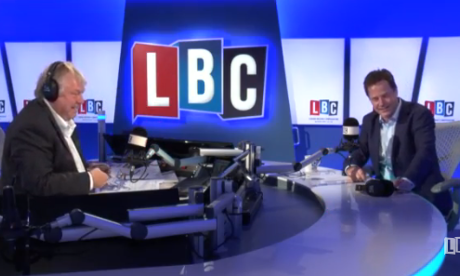
Former Lib Dem leader Nick Clegg has said his party’s evisceration at the general election would have happened even if he had resigned earlier. He was speaking in an interview on LBC. He is the key clip.
-
Lady Stowell, the leader of the Lords, has said that the House of Lords should not be “an alternative platform for party politics”. She was responding to a question from a Labour peer, Lord Campbell-Savours, who said the Lords would be brought into “disrepute and ridicule” if more Lib Dem peers were appointed. There are currently 102 Lib Dem peers, compared to 212 Labour ones and 227 Tory ones. Stowell said many peers would agree with Campbell-Savours, but she signalled that Lib Dems would be included in the forthcoming dissolution honours list. She said:
If and when a dissolution list marking the end of the previous parliament is published it would be surprising if it didn’t reflect the fact that there were two parties in government. More importantly, regardless of party balance this House has a very important role in the legislative balance and in doing our legislative work this House is not, and should not become, an alternative platform for party politics.
- A resolution to the political crisis gripping power-sharing in Northern Ireland appears further away than ever after talks between the Government and the Stormont Executive parties descended into angry exchanges. As the Press Association reports, in the most heated encounter of the meeting at Stormont House in Belfast, Sinn Fein deputy first minister Martin McGuinness apparently told Northern Ireland Secretary Theresa Villiers to “put that in your pipe and smoke it” when challenging her on child poverty statistics. The talks session involving Villiers, the five executive parties and the Irish Republic’s minister for foreign affairs Charlie Flanagan was the latest of a series of meetings to assess progress in implementing the troubled Stormont House Agreement.
- Downing Street has said that it will not provide government time for a backbench bill which would commit the UK to spending 2% of GDP on defence. Sir Gerald Howarth, the Conservative former defence minister who came third in the ballot for backbench bills (meaning his bill will be debated on a Friday), will bring forward the measure. But without the government promising to allow it to be debated in government time, there is a strong chance that a backbench filibustering operation could stop it becoming law.
- The Foreign Office has launched a review into how it distributes overseas aid after reports thousands of pounds have been spent funding a television game show in Ethiopia and finding female mates for fish in Madagascar. As the Press Association reports, Philip Hammond, the foreign secretary, has ordered a crackdown where it is found that taxpayers’ money is not being spent “wisely”, although officials insist that most aid money helps to promote UK prosperity and stability. Almost £7,000 was used in an anti-litter drive in Jordan, an investigation by the Sun newspaper found. A project to help find female mates for endangered Mangarahara cichlid fish in Madagascar cost £3,400, the paper said, adding that two of the only three male tropical fish left in the world in 2013 died in a London Zoo last year.
Updated
Duncan Smith hints government planning 'surprise' measure to tackle low pay
Here, as promised, is a summary of the urgent question on child poverty.
-
Iain Duncan Smith, the work and pensions secretary, has hinted that the government intends a “surprise” measure to tackle low pay. He was speaking in the Commons in response to an urgent question about today’s poverty figures, which show that the proportion of children living in relative poverty remains flat. (See 9.59am.) The 152-page report also shows that average weekly household incomes are at an 11-year low. (See 12.37am.) An Observer report suggested the figures would show child poverty rising and Duncan Smith claimed that Labour scored a “massive own goal” when it decided (before the figures were released) to table an urgent Commons question. He told MPs:
I think honestly the opposition today and particularly you have scored a massive own goal. They tabled this urgent question before the statistics came out. So certain were they, and their friends on the left, that the statistics would show a massive rise. They were wrong. They cannot accept our reforms of welfare, which they never did in their time, are working.
Duncan Smith also confirmed that he wanted to change the way child poverty is measured, a proposal supported by Frank Field, the Labour MP newly elected as chair of the Commons work and pensions committee. (See 10.49am.) Duncan Smith prompted jeers from Labour MPs when he said:
The current measures I think have led the last Labour government to a benefits system which gave families an extra pound here or there just to push them above the poverty line, but did nothing to transform their lives. Let me give an example, a family that is officially in poverty under those measures of parents that have huge drug problems. According to that measurement, they go over the line, they are not in poverty, but because all their money goes on drugs the children do not get fed. So the reality is they don’t measure the life chances of that family, they measure only the income transfer.
Labour MPs in the Commons chamber, and pressure groups outside the chamber, repeatedly said that child poverty would get worse if the government goes ahead with cuts to tax credits in next month’s budget, as David Cameron has suggested it will. But in the Commons Duncan Smith repeatedly hinted that the government will intervene to address the problem of low pay. In response to a question from Labour’s Jonathan Reynolds, he said:
I have made it very clear myself that I want employers to actually look to be paying that living wage, as the prime minister has said. And he will have to watch this space.
In response to a question from Labour’s Wes Streeting, he said:
I do genuinely believe, and I’m engaged in that process, of expecting British employers to actually pay a decent wage to people they employ. I think it will take a much shorter time [than Streeting suggested] to get employers to face up to their responsibilities.
And in response to a question from Labour’s Ruth Smeeth, who asked about constituents worried about losing their tax credits, he said:
I should tell them that they should wait, as you should do, to see what we bring forward. She may be surprised.
UPDATE AT 7.20PM: A Department for Work and Pensions source has been in touch to say that Iain Duncan Smith was not intending to suggest that the government was planning to announce measures to tackle low pay in the budget when he spoke in the Commons earlier. The source accepted that he may have given this impression, but says this was unintentional, and that he was just responding to combative questions. But Duncan Smith has been pushing for some time for more firms to pay the living wage, the source says.

Updated
Here is Alison Garnham, chief executive of the Child Poverty Action Group, on the child poverty figures.
These figures make grim reading for anyone looking for progress on child poverty. Because, make no mistake, we are facing a child poverty crisis in the years ahead and the Government is not going to meet the child poverty targets it signed up to ...
On the Government’s preferred absolute poverty measure, there are half a million more children in poverty than there were in 2010.
This child poverty crisis will undoubtedly deepen if the government goes ahead with plans to cut help for children in low-income families and for the low paid. You don’t tackle low pay by making the low paid poorer.
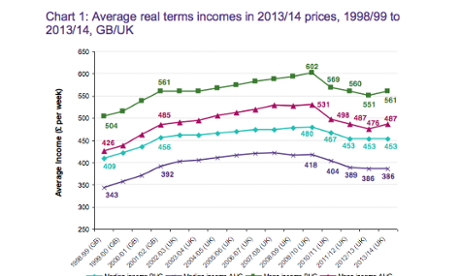
Here is the chart from the DWP poverty report (pdf) showing average household income at an 11-year low. (See 12.37pm.) The key line is the light blue (?) one (second bottom), showing median household income, before housing costs are paid.
Updated
Yvette Cooper, the Labour leadership candidate who has said fighting child poverty would be a key priority for the party if she won, has put out this statement about the child poverty figures.
David Cameron should be ashamed that 4.1m children are living in absolute poverty under his Government – 500,000 more than there were when he came to power. After decades of falling child poverty under Labour, the clock has been turned back under the Tories. And the target of eradicating child poverty by 2020 looks more distant than ever as an increasing number of families are being stretched to breaking point – more working families are now in poverty, and more children are being left behind.
And we know this will get worse in the next five years. Forecasts predict 5m children will be living in poverty by 2020 as the Tories push ahead with plans to cut tax credits, hit working families, and hit women hardest too.
Average weekly household income at an 11-year low, DWP figures show
Here is more from the Press Association on the poverty figures.
The average weekly income of UK households is at an 11-year low, figures show.
Real-terms household income before housing costs was £453 a week in 2013/14.
This was unchanged from 2012/13 and the lowest for over a decade.
Figures from the Department for Work and Pensions show that average weekly household income in the UK has not risen year-on-year since 2009/10.
Comparable records go back to 2002/03 when the figure was £461.
Average household income after housing costs was also unchanged at £386.
The statistics were published as part of the Government’s annual survey of household poverty, which found that 9.6m individuals were in relative low income in 2013/14.
This is a fall of 100,000 on the previous year, and down from 11.2m in 1998/99 when comparable records began.
The number of children classed as living in relative poverty in 2013/14 was 2.3m, a fall of 100,000 on the previous year and down from 3.4m in 1998/99.
The number of pensioners classed as living in relative property showed a slight increase of 100,000 to 1.9m.
The figures for families where at least one member was disabled were unchanged on 3.7m.
This is from David Holmes, chair of the End Child Poverty coaltion, which represents more than 150 organisations campaigning to end child poverty.
The announcement that 2.3m children are still living in relative poverty, and that half a million more are living in absolute poverty since 2010, underlines just how much further there is to go if we are to eliminate child poverty in the UK. It’s difficult to see how we’re going to make a difference to the childhoods and life chances of these millions of children without further concerted action at national level.
Today’s figures, showing the majority (64%) of poor children live in working families, are also a very clear warning about the damage cuts to tax credits for the low paid would inflict. This is also up from 55% in 2010.
All the main parties signed up to the legal targets to end child poverty so these latest figures ought to lead to a re-examination of the government’s approach to tackling child poverty.
Next month’s budget should be an opportunity for the government to announce positive steps to reduce child poverty and not a moment for cuts to children’s benefits, like tax credits targeted at children in low income families.
Alan Miliburn, the former Labour cabinet minister who chairs the child poverty and social mobility commission, has put out statement about today’s poverty figures. He says the government needs a “proper plan” to address poverty.
Any fall in child poverty is welcome. While it is positive that the figures suggest child poverty is not rising, the UK is not on track to eradicate it by 2020. Far more needs to be done to make sure that the poorest families share in the proceeds of economic growth.”
Two in three children in poverty have at least one parent in work. A key priority must therefore be tackling in-work poverty. This is why we look to the government to champion the living wage and to ensure that welfare cuts do not fall exclusively on the working poor. The risk otherwise is that child poverty - regardless of how it is measured - will rise, not fall.
Child poverty can’t just be legislated away and there is an urgent need for a proper plan that tackles its root causes - including low pay, low educational attainment and low levels of employment in some communities.

Labour’s Jack Dromey asks what Duncan Smith has to say to working mums in despair at the prospect of tax credits being cut.
Duncan Smith says Labour failed to halve child poverty as they hoped.
The crash that happened under Labour did more damage to people’s prospects than anything else, he says.
The child poverty urgent question is now over.
I will post a summary of the main points shortly, as well as posting more detail and reaction relating to the child poverty figures.
Peter Grant, the SNP MP, asks Duncan Smith to rule out applying benefit sanctions to families with young children.
Duncan Smith says sanctions are only applied after an exhaustive procedure. He says, even when sanctions are applied, family support, like child benefit, is maintained.
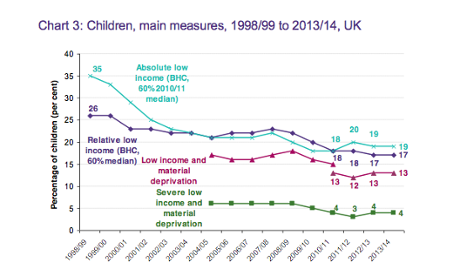
Here is the chart from the DWP poverty figures document (pdf) summarising the child poverty figures.
Labour’s Kelvin Hopkins asks about the research in the book, The Spirit Level, suggesting that income inequality contributes to poverty. Shouldn’t we try to make society more equal?
Duncan Smith says he agrees with Hopkins. He would like to see income inequality come down.
DWP child poverty figures - Details
This is what the DWP says about child poverty.
Relative poverty is defined as living in a household with an income less than 60% of the current median (2013/14, for these figures).
Absolute poverty is defined as living in a household with an income less than 60% of the median in a baseline year. The baseline year is 2010/11.
- The percentage of children in relative and absolute low-income households remained flat in 2013/14, as did the combined low income and material deprivation and severe low income and material deprivation figures for children.
- The percentage of children in relative low income BHC remained flat at 17 per cent, its lowest level since the 1980s. This series saw a general decrease between 2007/08 and 2010/11, and has remained broadly stable to 2013/14.
- Similarly, the percentage of children in absolute low income BHC in 2013/14 was stable at 19 per cent. After an increase in 2011/12, this percentage remains slightly higher than the 2010/11 level.
- The latest figures BHC show 2.3 million children in relative low income, whilst there were 2.6 million under the absolute low income measure.
- The percentage of children in combined low income and material deprivation, or in severe low income and material deprivation (household income of less than 50 per cent of median income and in material deprivation) have both remained flat at 13 per cent and 4 per cent respectively, and are consistent with levels from 2010/11. It is not possible to look at longer term trends due to a break in the series in 2010/11.
Labour’s Jonathan Reynolds says the cause of poverty in his constituency is that a quarter of jobs pay less than the living wage. What is the government’s strategy to increase pay?
Duncan Smith says the Reynolds will have to “watch this space”.
Back in the Commons Iain Duncan Smith, the work and pensions secretary, says food bank use has been rising in the UK for some time. He does not accept the government policies are to blame. He says Germany has higher welfare payments, but food bank use in that country is also higher.
Turning away from the Commons chamber, here is some reaction to the poverty figures.
From Matthew Reed, chief executive of the Children’s Society
It is a scandal that there are 200,000 more children who have been pushed deeper into poverty over the past year, as today’s figures reveal.
There has also been a steady rise over the last five years in the numbers of children living in in-work poverty, clearly showing that even those families with jobs are suffering because of government policies.
Moving the goalposts by changing the definition of child poverty will do nothing to help the millions of children who are suffering in real poverty. The government needs to stop debating definitions and start doing more to help children.
From Frances O’Grady, the TUC general secretary
Despite the headline employment rate returning to its pre-recession level, absolute poverty rates are still higher. Our economy is not creating enough good quality jobs to achieve the larger falls in poverty we need to give every worker a decent life and every child a decent future.
The extreme cuts to tax credits the government is planning for working families will do nothing to raise wages and will leave low-paid families even worse off. There’s a big danger this will start poverty rates rising again.
Caroline Lucas, the Green MP, asks what Duncan Smith did when he received the government report saying cutting the benefit cap would put more families into poverty. Does he still think people want to be on benefits?
Duncan Smith says he has never believed that people want to live on benefits.
Craig Whittaker, a Conservartive, asks what is happening about changing the defintion of poverty.
Duncan Smith says he started the debate on this in 2011. He says it is more important to measure life chances.
Here is more from the Press Association on today’s poverty figures.
The DWP said that in 2013/14, the average real terms household income before housing costs (BHC) remained unchanged from 2012/13 at £453 a week.
Average household income after housing costs was also unchanged at £386, said the department.
The latest figures showed 9.6 million individuals in relative low income.
The percentage of children in relative low income BHC remained flat at 17%, its lowest level since 1980s, said the DWP.
The figures saw a general decrease between 2007/8 and 2010/11 and have remained broadly stable to 2013/14, the department added.
In the Commons Labour’s Karen Buck asks if Duncan Smith accepts that the way to cut child poverty is not to cut tax credits.
Duncan Smith says he wants to see the minimum wage go up.
The child poverty figures are available here (pdf).
They are in a 152-page document called Households below average income.
Frank Field congratulates Duncan Smith on winding up the media to expect rising poverty figures. Will Duncan Smith invite the work and pensions select committee to conduct an inquiry into what new poverty measures could be?
Duncan Smith says he did not tell the media the figures would show poverty going up. He suggests Labour frontbenchers were responsible. He says his door is always open to Field.
Duncan Smith says Frank Field backs ideas of changing poverty definition
Duncan Smith is responding to Leslie.
He accuses Labour of scoring a “massive own goal”.
Labour tabled this urgent question before it had seen the figures, because they, and their friends on the left (that might be the Observer) were so sure the child poverty figures would be going up.
He criticises Labour for being wedded to the conventional measure of poverty.
Labour have “egg all over their face today”, he says.
And he says Leslie’s comments were “close to rank hypocrisy” because of Labour’s own record on child poverty.
He says the Tories said in their manifesto that they needed to look at new measures of child poverty. Looking at life chances is the way to do it. The conventional measure led to Labour thinking an extra pound could take someone out of poverty, even if it made no difference to their life chances.
A family might get more money. But what happens if that is just spend on drugs.
This generates lots of jeering from Labour MPs.
He says the government has a proud record when it comes to improving life chances.
And he quotes what Frank Field said this morning. Field, the Labour MP who is the new chair of the work and pensions secretary, put out a statement suggested he supported the idea of changing the definition of poverty. Here is the Field statement.
Politicians might understand these measurements but the electorate certainly doesn’t. What I hope would interest the electorate is action to prevent poor children becoming poor adults. We must therefore begin talking about, and measuring, poor children’s life chances and how they can be improved. It is important that such measurements are accurate, but that they can also safely drive anti-poverty policy.
Updated
Chris Leslie, the shadow chancellor, is responding.
He says today’s figures show a “depressing slowdown in progress we should be making towards the abolition of child poverty in the UK”.
Absolute child poverty has risen while the government has been in office, he says.
He says the Social Mobility and Child Poverty Commission says there is on chance of the government meeting the target in the Child Poverty Act, to get rid of child poverty by 2020.
Is Duncan Smith still committed to the Act?
How will it help if the government gets rid of tax credits.
Iain Duncan Smith answers urgent question on child poverty
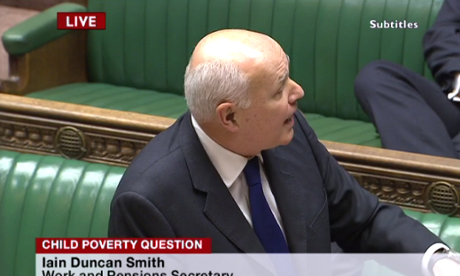
In the Commons Iain Duncan Smith, the work and pensions secretary, is answering an urgent question on child poverty.
He summarises today’s figures. (See 9.59am.)
Even though he thinks the current poverty measure is flawed, today’s figures show that government policy can make a difference, he says.
Nick Clegg's LBC interview - Summary
Here are the main points from Nick Clegg’s interview.
-
Clegg said that the Conservatives should not “misinterpret” the election result and assume they have a mandate for “illiberal, punitive” policies. They won because people voted for them on a “safety-first” basis, he said.
[People] looked to the Conservatives because they wanted to play it safe ...
What they didn’t vote for, which is why I think the Conservatives need to be very careful that they don’t misinterpret their mandate, is a punitive approach to child poverty or taking money away from our schools or only rewarding the rich. The Conservatives won fair and square, but they won an effective, safety-first campaign. They didn’t win a mandate to do a lot of quite illiberal, punitive things which they appear now to be planning to do.
-
He said fear of the SNP having influence over a minority Labour government became the key factor in the election that explained why the Lib Dems did so badly.
The beginning of the campaign felt like it was shaping up to be quite a traditional right/left argument, to which at least we were a plausible centre ground alternative. And then, maybe 10 days before election day, all of us felt that this seeping fear in England of a Labour government dancing to the tune of the SNP really, really chilled the English heart. And you could see lots of people who traditionally would have voted for the Liberal Democrats basically playing it safe and saying, ‘Oh no, that’s one thing we absolutely don’t want’, and the best guarantee against that was for them to vote Conservative.
- He criticised the role polling played in the campaign. He cannot remember polling dominating the public debate so much, he said.
- He said the Tories were “gobsmacked” to win a majority.
- He said, when asked what role he would like to play in the party in future, that he would like to speak out on Europe. But he ruled out playing a leading role in the EU referendum.
- He hinted that at some point in the future he would like to take a job in Europe. Asked about this, he said he had no plans along those lines, “certainly not now”. He also suggested he might stand down as an MP after this parliament.
-
He said he did not regret going into coalition “for a milisecond”.
Updated
There is an urgent question on child poverty in the Commons at 10.30am.
One Urgent Question today from @ChrisLeslieMP on child poverty expected at 10.30am. Watch live http://t.co/QPKp8ITKm8
— House of Commons (@HouseofCommons) June 25, 2015
Proportion of children in poverty remains flat, DWP figures show
The child poverty figures are out. According to the Press Association, they show the proprotion of children in relative poverty has remained flat.
The number of children classed as living in relative poverty is 2.3 million, the lowest level since the 1980s, according to figures published by the government.
The Department for Work and Pensions said the percentage of children in relative low-income households remained “flat” in 2013/14.
There had been speculation that the figure, published annually, would increase to 2.5m, while a row has been brewing over whether the government is planning to change the way the figure is measured.
The current definition of child poverty is whether a child lives in a household with an income less than 60% of the national average.
Work and Pensions Secretary Iain Duncan Smith said: “These statistics show that the proportion of individuals with low income is now at the lowest level since the mid-1980s.
“We know that work is the best route out of poverty, with children in workless families around three times as likely to be in poverty than those in working families. That is why, as part of our long-term economic plan, our reforms to the welfare system are focused on making work pay, while our reforms to the tax system are allowing people to keep more of what they earn.
“Latest figures show UK employment has reached an all-time high, with employment up more than two million since 2010, and the number of households where no one works is the lowest since records began.”
Q: Did you ever slam the phone down on David Cameron?
No, says Clegg. He is not a phone slammer.
Q: Did you cry after the European elections?
No, says Clegg. But his eyes were red because he had been up all night.
Q: Will you play tennis again with Cameron?
No, says Clegg.
And that’s it.
Q: What is your view of the polling companies?
Clegg says he cannot remember an election where polling dominated the public debate so much.
He says he just hopes the polling firms show a bit of modesty. Democracy should be unpredictable. Politicians know that people often make up their mind late.
He says the previous caller (see 9.49am) reflects what many people think.
The Conservatives need to be careful not to misinterpret the results of the election, he says. They did not win a mandate for punitive, illiberal policies.
Q: What did you think of the Edstone?
Clegg says he could not believe it. But no doubt he has done daft things too.
A caller says she voted Tory because she did not want Ed Miliband to be prime minister. But she expected a coalition. She is dismayed to have a Tory majority government. She is now campaigning for the Lib Dems.
Q: What has the mood towards you been in the party since the election?
Very positive, says Clegg. He says the party decided collectively to go into coalition.
He says 20,000 party members - a third of the total - are new. They will say they joined because of pride in what the Lib Dems achieved, and because of their belief in liberalism.
Q: How mutinous is Tim Farron?
Clegg says Farron is a good friend. He does not accept the premise of the question.
Ferrari reads out a quote from Farron, criticising people preoccupied with having ministerial cars.
Nick Ferrari plays a recorded question from Nigel Farage.
Q: Wouldn’t Clegg rather have lost his seat?
Clegg says Farage didn’t win his seat. He says he is delighted to be back.
Q: Will you stay in parliament for another 10 years?
Clegg says he is only focusing on this parliament.
Q: Would you like a big job in Europe?
Clegg says he is not thinking about that at the moment.
Clegg says, if the EU were abolished, there would still be a migrant crisis. Look at Australia, he says, or Vietnam. It is not the EU that is encourage migrants to come to Europe.
Clegg says he hopes that over time one of the larger parties will back electoral reform. They should accept this cannot carry on.
Q: What role will you play in the EU referendum?
Clegg says he will speak out when asked.
But he is not looking to play a leading role.
Clegg says the way parliament is composed is “kooky”. This parliament is one of the most unrepresentative, he says.
He says it would be wrong to assume that it will inevitably take the Lib Dems a long time to bounce back.
Ferrari plays a clip from Boris Johnson says history will judge Clegg kindly.
Q: How will history judge you?
If you look at the election, not well, says Clegg. But he says people will also focus on what the Lib Dems achieved in government.
Clegg now takes a question from a caller.
He says he does not have police protection any more. And he says he tried to speak to all the MPs who lost their seats.
Clegg asks why the caller is asking about this. The caller suggests that Clegg did not try to help Charles Kennedy. Clegg should have gone to visit him, the caller suggests.
Clegg says he was in touch with Kennedy after the election. He says he resents the suggestion from the caller that the party did not support him. Kennedy was looking forward to the future, and to playing a part in the EU referendum.
Updated
Q: How much did you laugh when Vince Cable lost?
He didn’t, says Clegg. But, at his count, Labour activists cheered when Cable lost. He thinks it is odd that Labour had got itself into a state where they cheered a Tory winning.
The constant “bile” towards the Lib Dems from the left was “bone-headed”.
Q: How mutinous was Cable?
Life is too short to worry about things like that, says Clegg. He says Cable is a friend. He says he does not know exactly what Cable and Lord Oakeshott were up to. But he does not bear grudges.
Q: Who should win the Lib Dem leadership?
Clegg says he won’t say. Both would be brilliant.
Q: What kind of job do you want?
Europe, Clegg suggests. But it will be a decision for the new leader. There are a whole range of issues, like mental health, he wants to continue to speak out on.
Q: Should you have quit a year before the election?
Clegg says he thought about it. But having a new leader would not have made much difference to the rise of the SNP, or to the fear people had in England about SNP influence.
Q: What did Miriam say to you about that?
Clegg says he does not want to sound flippant.
He says the Guardian article is a good read. But it is very funeral. It is portraying the journey the Lib Dems went through as if it was just a lurch from one crisis to another.
There were many high points for the Lib Dems: taking kids out of poverty, improving education, reforming pensions, and boosting apprenticeships.
Q: What do you miss about being deputy prime minister?
Being able to take decisions. Already he is seeing the government take decision he opposes. They are going ahead with the cuts. And they want to redefine poverty, something they tried in government.
Q: What was your biggest fight with Cameron in government?
We had a fair number, he says.
He says he will be speaking in the Commons later in the debate on surveillance. The Lib Dems and the Tories disagreed on the snoopers’ charter.
Q: What has the public reaction to you been since the election?
Extraordinarily generous, says Clegg. Many people have said they regret what happened. He thinks people expected the Lib Dems to get a slap on the wrist; they did not expect the Lib Dems to be thrown to the bottom of the stairs.
Q: What did David Cameron say to you after the election?
Clegg says they met at the Cenotaph the next day.
Q: What was his mood?
Clegg says he thinks the Tories were “gobsmacked” to find themselves elected with a majority?
Q: And Ed Miliband?
Everyone was just trying go get through the ceremony, he says.
Clegg says he is worried a lot of the coalition’s centre ground work will be undone.
Q: How much do you regret going into coalition?
Clegg says he does not regret it for a milisecond.
Q: But you have destroyed your party?
That’s not true, says Clegg.
And he says we would be in a poor state if people only acted for party advantage.
In 2010 the country was in a very serious state economically. The coalition gave Britain stable government for five years.
People are joining the Lib Dems. That shows they support what the Lib Dems did in government.
One of his proudest moments in government came late last year when figures were produced showing the attainment gap - the gap between the performance of rich kids and poor kids - was closing. That was a result of Lib Dem policies like the pupil premium.
Clegg says they went into the campaign on the back foot. But they ran an optimistic, positive campaign.
What transformed things was “the astonishing clean sweep” for the SNP in Scotland. So 20% of the Lib Dem parliamentary party was doomed from the start.
Q: For whom did you feel most sorry, of colleagues who were losing their seats?
It doesn’t work like that, says Clegg. But he spoke to Danny Alexander and David Laws. He cannot think of two better public servants for the country.
Q: What did you say to them?
Clegg says they were blindsided.
Nick Clegg's LBC interview
Nick Ferrari is interviewing Nick Clegg.
Q: What have you been up to since the election?
Clegg says LBC have renovated the studios since he was last here.
He repays Ferrari the £50 they bet before the election that Clegg would not be back as deputy prime minister. Ferrari points out that he handed £50 over, so he is just getting his stake back.
Q: What did you feel about the election?
It was a funny campaign, he says.
About 10 days before election days, Lib Dems realised that this fear of the SNP was chilling English hearts. People really did not want the SNP in power. And people who would have voted Lib Dem were going to vote Tory.
But he did not expect to lose as many seats as he did.
Q: What did you do when you heard the exit poll?
Clegg says he reached for a cigarette, having given up smoking. He was “pretty blindsided”. He was with his wife Miriam. At first he did not believe it. But even if he got twice as many seats as the exit poll suggested, it was going to be a very bad night.
Liz Kendall says she's not a Blairite
Liz Kendall, the Labour leadership contender, was on the Today programme this morning. Here are the key points.
-
Kendall said she did not see herself as a Blairite.
I’m not a Blairite Kendallite candidate, I’m my own candidate.
- She said she wanted the Low Pay Commission to have powers to increase the take-up of the living wage. But the living wage would remain a voluntary target, she said.
Rather than tackling the full range of issues around low pay, [the commission] is focused on setting the level of the national minimum wage.
We must now look at increasing pay beyond that.
As Labour’s next prime minister I would extend the legal remit of the Low Pay Commission to work with employers, unions and civil society to identify practical, non-statutory ways to move wages towards the living wage, sector by sector.
Giving the Low Pay Commission this additional remit would protect its independence and mean the expertise and institutional support behind the minimum wage can support the living wage as well.”
- She said she had commissioned experts to devise plans to stop the “exploitation” of up to 220,000 care workers who end up earning less than the minimum wage because they do not get paid for travel time between appointments.
-
She rejected the proposal from Lord Lawson, the Conservative former chancellor, for the top rate of tax to be cut to 40p in the pound. Asked if she supported this, she replied:
No. We need a fair tax system where people pay their fair share. Policies change according to the economic circumstances. We have a huge deficit and debt that we need to bring down and I believe that those with the broadest shoulders should bear the biggest burden.

Nick Clegg is giving his first proper broadcast interview since the election defeat this morning. His LBC appearance coincides with the publication in the Guardian of long read feature looking at what when wrong for the Lib Dems. The whole article is excellent, and is well worth reading. And here is the news story with the top lines. Here’s how it starts.
Nick Clegg discussed resigning as Liberal Democrat leader in the wake of the party’s humiliating reverses in the European and local elections in May 2014, an investigation by the Guardian has revealed.
In a sign of the immense toll taken by four years in coalition, the former deputy prime minister experienced what his mentor and former Lib Dem leader Lord Ashdown described as the “darkest of the dark nights of the soul”. Clegg consulted several senior colleagues about whether he had become a barrier to the party’s message being heard and whether he should go.
Clegg made numerous phone calls to discuss his position a year before the general election in which his party was reduced from 56 seats to eight. He told one colleague: “If I believe – and I am very close to thinking it – I am the problem and not the solution, I have to stand to one side.”
One senior Lib Dem who spoke to Clegg at the time said: “I told him, ‘You don’t have that luxury – this is your burden now, you have to carry it through to the election. Whether you believe that or not, it’s tough-titty. You can’t now put this down until the election. You can do it after the election if you want, but you can’t do it now.’”
I’ll be covering the interview in detail. Clegg on LBC at 9am on a Thursday - it’s just like the old days.
After that, it’s busy. Here is the agenda.
9am: Nick Clegg is interviewed on LBC.
9.15am: Sajid Javid, the business secretary, gives a speech on the Green Investment Bank.
9.30am: Child poverty figures are published.
10am: Liz Truss, the environment secretary, gives a speech on farming technology.
11am: Professor John Curtice, the psephologist, and James Morris, Labour’s pollster, speak at an event in the Lords on why Labour lost.
Around 11.30am: MPs begin a general debate on surveillance powers.
12pm: Liz Kendall, the Labour leadership contender, announces plan to tackle low pay in social care work.
1.30pm: Tim Farron, the Lib Dem leadership contender, gives a speech at the IPPR on the future of liberalism.
2pm: EU leaders begin their summit in Brussels.
As usual I will be covering the breaking political news as it happens, as well as bringing you the best reaction, comment and analysis from the web. I will post a summary at lunchtime and another in the afternoon.
If you want to follow me on Twitter, I’m on @AndrewSparrow
Updated