Afternoon summary
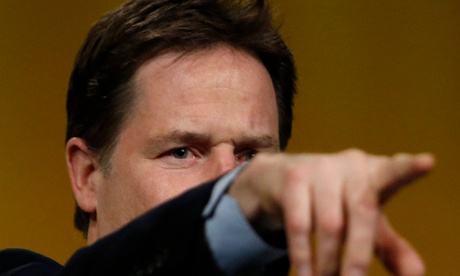
Well, Nick Clegg has faced his party members, and one of them did ask why the Lib Dems were doing so badly in the polls. But it wasn’t exactly a hostile grilling. In fact, at times the Q&A session was over-laudatory.
Clegg did have an explanation as to why the Lib Dems have lost popularity (see 3.49pm), although, curiously, he did not mention one obvious answer: tuition fees. He also tried to cheer his members up by telling them that the party’s private, constituency polling suggests all is not lost.
Here are the main points from today.
-
Clegg told members that internal party polling showed that the party was doing “much, much better” in key seats than the national polls suggested. He made this point during the Q&A in the conference hall.
There’s only one antidote. And that is to proudly and loudly continue to say what we’ve done, and what we want to do again in the future. Here’s the good news. Whatever the national opinion polls say, where we do that on the ground where we can tell our side of the story, because no one else will, I tell you the polls look very very different, much much better, we make the weather and we’re going to win.
- He announced that the government is committed to spending £250m a year over the next five years on CAMHS (child and adolescent mental health services). The move will be confirmed in next week’s budget. (See 12.02pm.)
-
He criticised Conservative colleagues for not being more critical of China over its handling of Hong Kong. The Chinese were reneging on their promise to allow free elections for the Hong Kong chief executive, he said.
I’ve been very outspoken, much more than anyone else in government - I’m not going to hide my frustration, but I think there’s a somewhat mealy-mouthed response from other parts of government - to say, hang on a minute, we made a very solemn commitment at the time that we would not stand idly by if the terms of the handover of Hong Kong to Chinese sovereignty were going to be rewritten. And they are being rewritten in a way that we don’t think confirms to the principles of democracy that we believe in and to the principles of “one country, two system” which underpins the whole agreement in the first place.
-
He said it would be a mistake not to agree to TTIP (the transatlantic trade and investment partnership, a proposed free trade deal between the EU and the US) because Britain could lose influence over world trade deals. He said Cecilia Malmstroma, the European commissioner, has written to the government giving an assurance that there was nothing in TTIP that could force a UK government to outsource or privatise the NHS. But there were more important issues at stake, he said.
If I think about the world that my kids are going to inhabit, I would rather that they don’t necessarily live in a Britain where all the technical standards, all the trade standards, all the rules by which we work in a globalised world are set in Beijing, in Latin America, the other side of the world. I would like to think that the old world, on either side of the Atlantic, that we can still get together and use our clout to set some of the rules of the game ourselves.
Because power is shifting dramatically, from the old world to the new world, from the west to the east, and I just think, if we are not careful, some of our concerns about some of the details of TTIP - in my view, some of the misplaced views - might unwittingly mean that we don’t enter into that agreement, and before you know it, in 20, 30, 40 years’ time, all the rules of the game are set by people, who are not malign necessarily, but over whom we certainly have absolutely no influence or control whatsoever.
- Vince Cable, the business secretary, has launched a strong attack on the Conservatives’ proposal for a referendum on membership of the EU. (See 3.42pm.)
- Jo Swinson, the minister for women, has revealed that the Conservatives blocked a proposal for a review of sexism in the media. (See 2.08pm.)
- Don Foster, the Lib Dem chief whip, has said the party needs to clarify what would happen if Lib Dems MPs want to enter a coalition after the election, but the party as a whole does not overwhelmingly support this. The issue is particularly complicated because, under the Lib Dems’ “triple lock” rule, a coalition can only be formally agreed if certain conditions are met, and the criteria are designed to ensure that any deal must have overwhelming support. Foster said, in theory, the parliamentary party could do what it wanted. But the issue should be clarified, he said in a Q&A session just now. This is what he said in response to Gordon Lishman, who asked what would happen if MPs wanted a deal, but if they did not get the required two-thirds support from the party outside parliament.
In the circumstances that we are talking about you are quite right in saying that the parliamentary party is supreme in the decision it takes. But any parliamentary party will obviously have to take into account a number of issues and it will take into account political realities above all else. Therefore I entirely accept your point that any futher clarity that could be given, for instance by the federal executive on this matter, would be of benefit to the new parliamentary party.
Sal Brinton, the Lib Dem president, said she thought that it would soon become clear in coalition talks if there was a big gap between the views of MPs and the views of the party as a whole. But she said the rule was there for a purpose; the party insisted on the two-thirds threshold because going into coalition was a big decision which should not just be approved by a narrow majority, she said.
-
Danny Alexander, the chief secretary to the Treasury, has said that his view of union leaders has become much more positive since he started working with them in government.
Until I entered government my experience of dealing with trade unions was largely confined to seeing them as an aggressive and hostile campaigning wing of the Labour party in my constituency .... But on entering government I saw the other, and much more important side, to the work of trade unions, patient, careful advocacy of the collective interests of their members.
When negotiating public sector pensions reform, he found union leaders “real allies” in his dealings with the Tories, he said.
That’s all from me for today.
I’ll be blogging from the conference again tomorrow, and also covering George Osborne and Ed Balls’ pre-budget interviews on the Andrew Marr show.
Thanks for the comments.
Updated
The Lib Dems are now debating a motion on employment and the unions. Unlike Labour, the Lib Dems do not have institutional links with the trade unions and it is not often that you hear Lib Dem MPs speak up in their favour. But the motion praises the role that unions play in the workplace in negotiating better terms for their members, and in encouraging equality and training, and Danny Alexander, the chief secretary to the Treasury, opened the debate with a speech saying his view of union leaders had gone up markedly since he had started dealing with them in his role as a minister.
Q: If Ukip and the SNP are the party of protest, and the Greens are the party of youth, what are the Lib Dems for?
Clegg says he does not accept the terms of the question.
Ukip and the SNP are parties of division, he says.
And the Greens have not done for young people the things that the Lib Dems have done, such as free school meals.
The Lib Dems have got to defend their record, he says.
And that’s it. The Q&A is over.
I’ll post a summary shortly.
Clegg says the Lib Dems will not turn their back on Hong Kong.
The Chinese promised to allow universal suffrage for Hong Kong. But the system in force their does not comply with what universal suffrage is understood to mean.
He says other partners in government (ie, the Conservatives) are more “mealy mouthed” about this.
Q: How would you persuade people to support the transatlantic trade and investment partnership?
Clegg says the European commissioner in charge of this, Cecilia Malmstroma, a Swedish liberal and an old friend of his (they were MEPs together), has written to the government saying their is nothing in TTIP that would force the government to open up NHS services to American private companies.
Power is shifting from the old world to the new world, he says. Britain should be trying to set the terms of trade in the future. Britain should complete TTIP. If not, then in 30 years’ time Britain will have to abide by rules set by other people.
The questioner says Clegg’s answer should be produced as a video clip. It will be very useful to Lib Dem candidates who get endless emails from campaigners from 38 Degrees, he says.
Q: I want to say how proud we are you are are leader. Would you stop NHS doctors working in private hospitals?
Clegg says it was Labour that accelerated this process. It set up independent treatment centres to undercut the NHS.
And yet they have the gall to lecture us about the privatisation of the NHS. It’s shocking hypocrisy.
Clegg says doctors have always been self-employed. This is not the problem with the NHS.
The problem is the failure to join up health and social care, he says.
The NHS was not designed for the sort of problems we face today. Too many elderly people are being decanted into hospitals.
Simon Stevens, the NHS England, chief executive has a plan to address this.
Clegg says, under Labour, cuts would go on for longer, because they would not address the deficit as quickly as the Lib Dems.
And he says the Tory deficit reduction plans are unworkable.
Nick working his way through the range of questions we generate #ldconf pic.twitter.com/MupxKTp203
— Peter Lloyd (@EnlightBystand) March 14, 2015
Q: Hunger strikes are spreading in detention centres. Shouldn’t we end putting all people in detention centres, not just children?
Clegg says the committee chaired by Sarah Teather produced an excellent report on this. He agrees with its call for time limits on the length of time people can be held in these centres. But he would not phase them out altogether. In extremis, the state should be able to detain people prior to deportation.
Q: What Tory plans are you most pleased to have blocked?
Clegg cites the Conservative “fire at will” dismissal plans, or their plans for regional pay in the public sector.
George Osborne’s speech to the Conservative showed quite how much they want to shrink the state, he says. They want to cut billions more from public services than is necessary, even after the deficit has been addressed.
Without the Lib Dems, they would have done that, he says.
Q: What has most surprised you about being in government?
Clegg says, because it is in his mind at the moment, he would cite the public reaction to his stance on mental health. One of his first questions to Gordon Brown at PMQs was on this. People thought it was an odd subject to raise. Yet today he is announcing £1.25bn for children’s mental health services.
Anorexia is the biggest mental health killer in this country, he says. Now the government is doing something about it. Hundreds of thousands of people will be helped who would not otherwise get help.
Nick Clegg's Q&A
Nick Clegg is now holding his Q&A.
Q: Given the record of achievement of the Lib Dems in government, why are are opinion poll ratings so poor?
Clegg jokes that anyone with a perfect answer should stick in on a postcard and send it in.
Partly, the answer is obvious.
Going into coalition was unpopular with some supporters, he says. That was always going to be the case.
Also, the government has had to take difficult decisions.
And the powerful vested interests in politics, and their supporters, hate the idea of seeing the Lib Dems in government. It disrupts their model. The Daily Mirror and the Daily Mail are just as vituperative, from different directions.
There is only one solution: the Lib Dems must tell their story.
And, where they do that, the polls look “much, much better”, says Clegg.
-
Clegg says Lib Dem polling suggests they are doing “much, much better” in key seats than the national polling suggests.
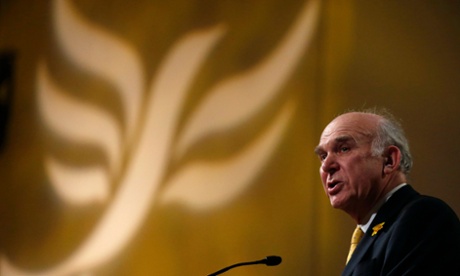
Vince Cable's speech - Summary and analysis
Vince Cable, the business secretary, has just finished. It was a very well-crafted speech, and it won’t go down well with the Tories at all.
And here are the key points.
-
Cable signalled that he was opposed to the Conservatives’ proposed referendum on EU membership.
Their fear of the UKIP Right has led them into the cul-de-sac of the EU referendum: potentially years of uncertainty which will scare off many inward investors who want to retain or bring jobs here for British workers. And if the result is negative or, even, close will leave Britain in a no-man’s land: diminished, marginalised and irrelevant.
This passage could be very significant. The Lib Dem position on an in/out referendum has, until recently, been ambiguous. Nick Clegg says he is in principle in favour of an in/out referendum, but he has criticised David Cameron’s timetable, and he has said the trigger for a referendum should be any new proposal to transfer powers to Brussels.
But, in this speech, Cable is being more hostile to the idea. Supporters of a referendum usually argue that it would settle the issue of Britain’s EU membership, but Cable says even a yes vote could harm Britain’s interests. I can’t recall a pro-European making this argument before. And he also warns about “years of uncertainty” scaring off investors. If David Cameron is prime minister after the election, he will propose a referendum in his first Queen’s Speech. But, if Cable is speaking for the Lib Dems, it is hard to see, on the basis of this speech, how the Lib Dems could support that.
-
Cable accused Labour of being anti-business.
The message from our opponents is a negative one. They define themselves by what they are against. Labour’s default position to anti-business; this in a country which depends on business to create wealth and jobs.
-
He said the Conservative thinking was marked by hostility to “workers, shirkers and burqas”.
The Tories have a lot of antis. They don’t like trades unions. They don’t like people dependent on benefits. They don’t like multi culturalism. I have called this an attack on workers, shirkers and burqas. Not just that: they don’t like young people very much either.
-
He urged moderate Conservatives to join the Lib Dems.
There are many sensible, moderate Conservatives who are horrified by what their party is becoming. We can offer them a home as we can to social democrats disillusioned with Labour.
-
He said the Conservatives’ support for free markets but opposition to immigration was incoherent.
The Tories have a strange, split personality which embraces, on one hand, free market economics and, on the other, nationalism – or, at least, English nationalism. A century ago the Tories believed in closing down trade: protectionism. Now they try to throw obstacles in the way of highly skilled Indian software engineers or Brazilian students or Chinese business visitors in order to meet some ludicrous, unobtainable target set for them by Nigel Farage or Migration Watch.
-
He said the Tories and Labour both had a flawed view as to what the role of the state should be in relation to markets.
The Tories have an ideological obsession with cutting back on state spending, however useful or productive, and relying on markets instead. But any illusions people may have had about rational and efficient markets were destroyed in the banking crisis. Left to themselves, markets often will generate speculative bubbles driven by short term greed or panic; and they primarily reward those who do not need rewards: the wealthiest 1%; the Tories’ paymasters and mentors.
Any illusions that existed about the virtues of central planning disappeared with the Berlin Wall but the leadership of the Labour Party still clings to the idea that the decision over what is what is produced and prices charged should be made by ministers and civil servants sitting in Whitehall.
-
He said the Tories and Labour were both making unrealistic promises on tax and spending.
Lacking a clear vision for the future, [the Conservatives and Labour] both pander to their core vote. Promising to cut taxes or increase spending out of money they don’t have for their favoured demographics. It used to be the Greens and UKIP whose economic policies involved breaking the laws of arithmetic: cutting taxes, increasing spending and reducing budget deficits all at the same time. Now this fantasy world has been mainstreamed.
-
He said the government should do more to promote skills.
We can and should look outward and bring in talented people from overseas who have something to contribute and resist the anti-immigration clamour. But we mustn’t let the British economy become like the Premier League where the top clubs – even in Liverpool – are stuffed with foreign players and there are barely enough English players to make up a decent national team.
-
He called for more spending on science and innovation.
The biggest innovations which have changed our lives – the internet, the WW Web – happened on the back of government programmes. We need to double the innovation budget to get close to the average of our main competitors. We must grow our basic science research alongside it.
The Lib Dems recently announced plans to ring-fence the science budget.
-
He said the Lib Dems were in favour of a public interest for takeovers.
Updated
Cable has turned to the economy.
The financial crash showed investment bankers at fault, he says.
But Conservative policy (ie, the pensioner bonds) will benefit retired investment bankers most. And Labour’s tuition fees policy will benefit the investment bankers of the future.
Cable says he recently invited two apprentices to cabinet to mark the success of the government’s apprenticeship programme. One of them had excellent academic qualifications, but chose to do an apprenticeship instead. This would not have happened in the past, because apprenticeships were seen as a second-rate option. The Tories claim this is a coalition achievement. By that, they mean it’s a Lib Dem idea
Cable also addresses mental health. He says he is using adult education to help people with mental health problems. He says this means a lot to him personally because his mother was incarcerated in a mental hospital when he was 10, after the birth of his brother. She was suffering from post-natal impression. Adult education was very important in her recovery, he says.
Vince Cable is speaking now. I will post a summary as soon as he’s finished.
“@LibDemConf: And now, the speech from Rt Hon Dr Vince Cable MP, Secretary of State for BIS" #ldconf” pic.twitter.com/ypHUmXAtaz
— Lee Fallin (@LeeFallin) March 14, 2015
The Lib Dems have sent out a news release with more details of the policy adopted in the form of an amendment to the economy motion covering government databases. (See 12.46pm.)
The proposals championed by Lib Dem ministers David Laws and Simon Hughes, include extending the regulatory regime for DNA and fingerprint records in the Protection of Freedoms Act to cover all biometric data and other identifiers of innocent people including facial images. The Liberal Democrats will also impose a moratorium on government creating any new databases, or using any new technology that infringes the rights of innocent British citizens, without prior oversight and scrutiny from parliament.
Currently, police forces in England and Wales have an estimated 18 million facial images held in a secretive central database, including images of innocent people with no criminal record. Images of innocent people are being held despite a court ruling in 2012 where the judge ordered forces to revise their policies as soon as possible.
In the conference hall Lib Dem members are now debating a motion about the party’s five proposed green laws. They are:
1 - A Nature Act, making the natural capital committee statutory and including a 25-year plan for recovering nature.
2 - A Zero Waste Britain Act, increasing penalties for waste crime and setting a 70% recycling target for England.
3- A Green Transport Act, giving councils the power to reduce speed limits outside schools to 10mph and setting 2030 as a target for the electrification of all major rail routes.
4 - A Zero Carbon Britain Act, setting 2050 as a legally-binding target for zero carbon Britain.
5 - A Green Buildings Act, introducing a council tax discount for people who make significant energy efficient improvements to their homes.
Earlier I wrote about the Lib Dem mansion tax no longer being called the mansion tax. (See 11.19am.) Mark Pack has been in touch to say he addressed this in a blog recently. Here’s an excerpt.
“High value property levy” is rather clunky but there is something about “mansion tax” which does rub up some voters the wrong way.
I’ve been surprised how many people I’ve come across in the last year (mainly in more expensive parts of London, it is true) who say something along the lines of “a mansion tax is wrong as that’s just picking on people who live in areas where house prices have gone up a lot, but taking more money from the richest via council tax is fair”.
Jo Swinson's speech - Summary
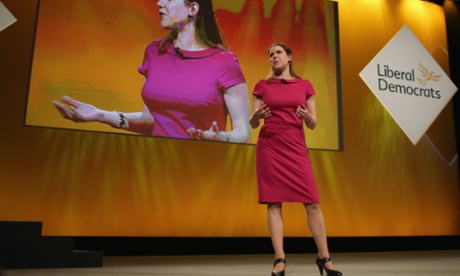
At a conference like this (spring, smallish party) most speeches are mediocre and good ones are unusual. But Jo Swinson, the minister for women, delivered one just before lunch that was really first-rate.
It was about sexism, in the workplace and in society generally. Here are the key points. You can read the full text here.
-
Swinson said the Tories had blocked a proposal for a review of sexism in the media. (Swinson illustrated her talk with examples of media sexism, featuring articles from the Daily Mail, the Sun and the Daily Telegraph.)
I have argued within government for a review – to be led by senior representatives of the media – to look at the implications of media sexism. Guess what? The Tories blocked it.
They are either happy with how things are or too afraid of a backlash. As we might find out in tomorrow’s papers, sometimes suggestions like this one can be taken out of context.
But make no mistake. This is not a call for censorship, this is not a call for editorial agendas to bow down to government diktat, this is a call for an independent review – chaired by media representatives – to work with government and other stakeholders to take this issue seriously.
- She said that misogyny was “commonplace” and she praised the Everyday Sexism blog for highlighting this.
-
She said girls needed to be encouraged to be more assertive from a young age.
From a very early age girls are socialised not to put themselves forward, not to put their head above the parapet, not to have that confidence, so it is any wonder that twenty years later when it comes to negotiating a pay rise or putting themselves forward for promotion, the women might be less likely to do so?
In fact there’s a whole stream of adjectives used to criticise women who get too big for their boots:
Bossy, brazen, brash, forward, obstreperous, pert, pushy, saucy, shrill, strident.
When was the last time you heard a man being called strident?
We also have a wider culture that values women primarily for how they look, while promoting an ideal “look” which is at best time-consuming and at worst impossible to achieve.
I’ve heard 14 year old girls say they aren’t comfortable going to school unless they’ve spent an hour doing their make-up. Think what that hour a day could achieve for a schoolgirl in terms of learning, exercise, sleep or building friendships.
This all combines to have a silencing effect on girls and young women. But we need those voices to be heard, so I constantly try and convince women to get engaged and stand for election themselves.
-
She said that, thanks to Lib Dem pressure, the government had just legislated to force big companies to publish data on the gender pay gap.
It wasn’t an easy battle to win, from the beginning Labour only wanted a voluntary approach and the Tories didn’t want it at all. But at meeting after meeting – and I sometimes get invited to cabinet now – I plugged away at the issue.
Nick was incredibly supportive, and when I said to him there might be an opportunity to use the small business bill to deliver pay transparency, he was up for the fight with the Tories.
So finally, this week, we amended the bill in the House of Lords, so that within a year, large companies will have to set out their average pay for men and women.
-
She said introducing shared parental leave was her proudest achievement.
It’s a radical change, but a simple one, it gives parents more choice, benefits children, and encourages more equality at work.
It’s my proudest achievement in government.
Of course getting dads to use it is a cultural challenge. It’s new, so we need to raise awareness. And it’s already prompting some very interesting discussions.
Some dads-to-be have said they’d like to take shared parental leave but they’re worried about the impact on their career. Welcome to the world of the working mum!
The truth is, our economy needs the skills of parents in the workplace, and neither mums nor dads should have their careers stalled just for being parents. Perhaps with men engaged in these dilemmas as much as women we can change attitudes and ditch the parenting penalty at work.
- She said the pay gap had fallen, but that “women still basically work for free for 57 days a year”.
-
She accused the media of regularly misrepresenting her views.
I lose count of the times that my comments are twisted and caricatured by sections of the media.
Tim Farron says liberalism matters 'more than ever'
Tim Farron, the Lib Dem foreign affairs spokesman (and favourite to be the next leader) spoke in the debate on the economy earlier. He told Lib Dem activists that liberalism was needed more than ever before.
We launch this manifesto into the most crowded political marketplace in history. Britain has finally become the pluralistic, multi-party democracy we Lib Dems have always dreamed of … it’s just that it’s not as much fun as we’d hoped.
The market may be crowded, but there has never been more space for a liberal party. You have never mattered more than you matter today.
We fight this election against nationalists and separatists - and Tories and Labour who pander to them - their only response to the challenges we face to blame Brussels, or England, or people on benefits, or businesses, or immigrants. Wrapped in a saltire or a union jack, if you’re wearing a flag then you have bought into the politics of fear, of blame, of exclusion. Small, shameful politics.
You are all that stands between this country and that dark, dismal future. No pressure ...
In a dangerous world of threats where the instinct of many politicians is to become insular and authoritarian, liberalism matters more than ever. You matter more than ever. This is a manifesto for Britain of which we can be justly proud - now lets sell it to Britain, on every doorstep the length and breadth of the country.
Miliband accuses Cameron of not offering leadership
Ed Miliband has given his speech in Birmingham unveiling the Labour party’s pledge card. You can read the full text here.
And courtesy of @LabourList, here is 2015 Pledge Card... pic.twitter.com/jB2xoM2qOc
— Andy Westwood (@AndyWWestwood) March 14, 2015
My colleague Patrick Wintour wrote it up based on what the party released overnight, and there was not much new in the full text. But this passage, on leadership, is worth noting.
It is not leadership to say “we’re all in it together”, while cutting taxes for millionaires and imposing the cruel, vindictive, unfair bedroom tax.
A tax soon to be abolished with a Labour government.
It is not leadership to be strong in the face of the weak but always weak in the face of the strong.
And it is certainly not leadership to claim to be a strong leader but to refuse to defend your record in front of the British people in a TV election debate.
Let me tell you what leadership is:
It is about having strong, consistent ideas to change the country.
It is about standing up for those ideas, through thick and thin, even in the face of powerful forces.
And it is about standing up for people from every background and every walk of life, not just those with the access, the power and the wealth.
That’s what matters in leadership.
That’s the leadership I will bring.
It is also interesting to see that Miliband toned down one line about the implications of Tory spending cuts.
In the text released overnight he said:
The Tories will carry on putting in place their vision of how our country succeeds by stripping public services to the very bone so they hit their target of spending back to levels not seen since the 1930s, before there was a NHS and children left school at 14.
But today this passage read:
And they will strip public services back to the very bone.
Their current plan is to cut public spending back to the levels of the 1930s, before there was an NHS.
The Rethink Mental Illness charity has put out a statement welcoming the mental health spending announcement. This is from its chief executive, Mark Winstanley.
This extra funding in child and adolescent mental health services is urgently needed. Every week we hear shocking stories about children being held in police cells, or sent hundreds of miles away from home for care, because the right support isn’t available in their own community.
Lib Dem members have passed a wide-ranging motion on the economy, including three amendments. The amendments proposed introducing a replacement for the independent living fund, uprating benefits in line with inflation once the deficit has been cleared and having a moratorium on having any new government databases with information about citizens.
Jo Swinson is just winding up a terrific speech about sexism. I’ll post a summary of it soon.
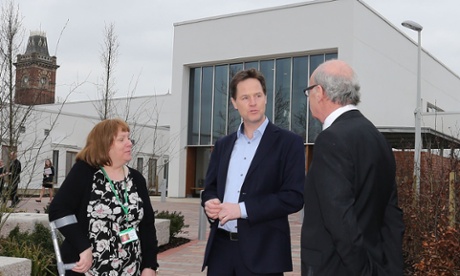
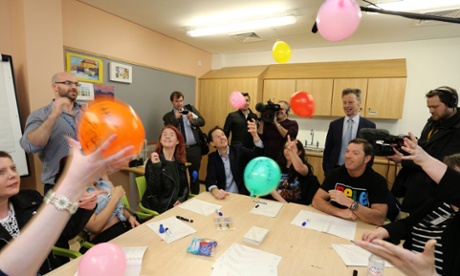
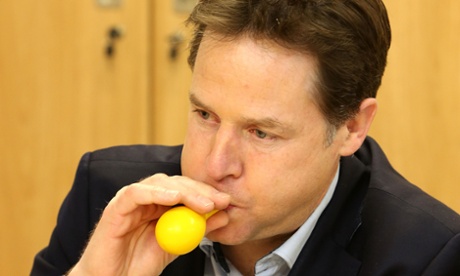
Here are some pictures from Nick Clegg’s visit to Clock View hospital.
(But I’m not quite sure what role the balloons play.)
Simon Stevens, the NHS England chief executive, has welcomed the mental health announcement. He said:
Today our campaign for NHS mental health services gets an important boost. This much needed investment will kick-start a multi-year upgrade in care for younger people and their families. NHS nurses, therapist and doctors will use this funding to benefit families in every part of the country.
Clegg says children with mental health problems currently face 'institutionalised cruelty'
Nick Clegg made the announcement as he visited the Clock View hospital in Liverpool. He said that it would make “a huge impact” and that the way children with mental health problems are currently treated amounts to “an institutionalised form of cruelty”.
I think [this investment] will have a huge impact. You have got, on average, three children in every classroom in our country who have got mental health problems and are not being properly catered for, not being properly identified, not being properly supported.
This huge expansion - £1.25bn over the course of the next parliament - will help around 110,000 children, children who at the moment are being let down by the system.
It’s an institutionalised form of cruelty, the way we allow vulnerable children with mental health problems to basically have to fend for themselves at the moment.
This big announcement I’m making is going to seek to change that. It won’t happen overnight, it will happen over the coming years.
It’s all part of a journey where we start, as a country, lifting the stigma that has surrounded mental health and making sure that we treat mental health in the same way as we do people with physical health problems.
Clegg said extra funding would also help pregnant women and mothers with mental health problems who currently receive a “second-class” service.
One in ten women experience mental health problems during pregnancy and the first year after childbirth but for far too long many have been subjected to a second-class mental health service.
It is terrifying to think that in this day and age some new mothers are having to travel miles for treatment and others are even being separated from their newborn child. This has to stop.
Here’s Norman Lamb, the Lib Dem care minister, on the mental health spending announcement. (See 12.02pm.)
I am delighted with this investment in what is truly a ground-breaking moment for mental health. Mental illness can be devastating for young people and their families, and there is both a moral and an economic case for ensuring they get the best possible care at the right time.
Last year, I appointed experts to advise on how we can fundamentally modernise children’s mental health services – this funding will be an essential boost to the new proposals, which we will publish shortly.
Clegg announces extra £250m a year for child mental health services
Danny Alexander, the chief secretary to the Treasury, told the Times overnight that the budget would include more money for mental health and this morning the Lib Dems passed a motion calling for extra investment in this area.
Now Nick Clegg has just announced a hefty investment in mental health services for children and adolescents. It is a government commitment, not a Lib Dem aspiration. The Lib Dems sent out details earlier, embargoed until 12pm.
The Lib Dems say this is a key issue because 10% of children aged five to 16 suffer from a diagnosable mental health disorder. That is around three children per class, the party says. It also says up to one child in every 12 deliberately self-harms, and that over the last 10 years there has been a 68% increase in the number of young people being admitted to hospital because they self-harm.
Here are the key points in the announcement.
- Clegg said the government was committed to spending £250m a year over the next five years on CAMHS (child and adolescent mental health services). That amounts to £1.25bn over the next parliament. The funding starts to come on stream in April this year.
- He said this amounted to a “seismic shift” in provision.
- He said this would enable an extra 11,000 children to be treated.
-
He confirmed that waiting time standards for child mental health will be introduced. He also said that specialists in children’s talking therapy will be available in every part of the country by 2018.
And here’s a quote from Clegg on this.
There would be an outcry if a child with diabetes was left to cope without support or treatment. But that’s exactly what’s been happening with young people’s mental health services
I have heard, time and again, harrowing stories from young people and their families about how they suffered and their condition deteriorated waiting to get the right treatment for serious mental health problems.
That’s why I am determined to start a seismic shift to revolutionise children’s mental healthcare and end this unacceptable injustice.
By introducing waiting time standards and committing to talking therapies for children in every region, we are helping to build a fairer society where young people can get the right treatment and support they deserve to live a better life.
The Lib Dems are also announcing measures to improve mental health services for new mothers. The party says 10% of women suffer mental health problems during pregnancy or the first year after childbirth, and services for them are patchy.
- The Lib Dems said extra funding would be available to improve mental health services for new mothers and women experiencing mental health problems during pregnancy.
Lib Dem members are now debating a wide-ranging motion on the economy, and it seems to be focusing on housing. Yesterday the party announced a plan to help people unable to afford a deposit on a home to become owners, by allowing them to convert rent into equity, and this has been praised. One speaker said the issue was so important the party should insist on having a minister for housing in the cabinet in any future coalition talks. And she proposed a “red line” for coalition talks with the Tories; the sacking of Eric Pickles. The audience approved.
Danny Alexander's speech - Summary
Earlier I said that the Lib Dems seem determined to be positive at this conference and Danny Alexander, the chief secretary to the Treasury, said as much in his speech. “Now you might be reeling in shock that I am talking about optimism, but I am,” he said. The best illustration of this was his yellow box moment. (See 10.45am.) This is how he introduced it.
Now you all know there’s a coalition budget this week. Next year, I want us to be delivering a Liberal Democrat budget. This is what it would look like.
Before anyone writes in to say that he is clearly delusional, it is worth acknowledging that this was just a stunt. I don’t think he really expects to be delivering the budget next year.
Alexander’s speech did not raise the rafters - about nine people gave him a standing ovation, but the remaining 200-odd people in the audience remained firmly seated - but it includes some noteworthy lines. Here are the main points.
-
Alexander said the Lib Dems wanted to make tax evasion as socially unacceptable as drink driving.
As recent weeks have shown yet again, nothing upsets law abiding tax payers more than people who think they can evade paying the tax they owe. Paying the tax you owe isn’t an optional extra – it’s a legal requirement. Quite rightly, benefit fiddling is a crime and a social taboo. For too long, tax evasion has been seen by the rich and privileged more like a sport than the crime it is. So in our future vision, they’ll be even more measures to crack down hard on the tax dodgers.
I want to see tax evasion as socially unacceptable as ‘drink driver’. I want to see those who aid, abet, facilitate, or encourage tax evasion hit as hard with criminal and financial penalties as the tax evaders themselves. That will be in our manifesto too.
-
He claimed that the Lib Dems had delivered “the largest tax cuts for working people in living memory”.
Over the last 5 years we, the Liberal Democrats, have delivered the largest tax cuts for working people in living memory. Just think back to 2010. The amount you could earn before starting to pay income tax was only £6475. Within a few weeks, it will have rocketed to £10,600. That’s the biggest income tax cut for working people for a generation. Lower taxes for 26 million working people.
(As the Institute for Fiscal Studies pointed out yesterday, that is only true if you ignore the taxes that have gone up to fund the tax allowance increase. I suppose you could also say the coalition has delivered the largest tax rises for working people in living memory.)
-
He said a majority Conservative government would be “grim’ for Britain.
The prospect of a Britain under a majority Conservative government is grim indeed. And haven’t we all groaned when they use their soulless mantra - Long Term Economic Plan. The truth is their Long Term Economic Plan means Long Term Economic Pain for millions of families.
- He said Labour were still in denial about their role in the financial crash and that their economic policies amounted to “incoherent waffle”.
-
He said the SNP had misjudged all the “big calls” economically.
Interestingly, it also seems that the mansion tax is no longer the manison tax. Some time ago the Lib Dems reshaped the policy, and now it involves creating extra council tax bands for expensive homes. (The original idea, a straight levy on the value of homes over £2m, has been adopted by Labour.) Arguably the Lib Dem idea still amounts to a mansion tax, but Alexander did not use the term. Instead he described it as a “high value property levy”.
If Emily Ashton wants to update her list of bizarre #ldconf moments, she will certainly want to include this. Danny Alexander, the chief secretary to the Treasury, has just given his speech. He said he wanted to unveil a Lib Dem budget and he produced a visual aid to illustrate it.
@dannyalexander sets out @LibDems budget plans. Investing in infrastructure, £400 tax cut for ordinary people. pic.twitter.com/RmryscJL7U
— Paul Burstow MP (@PaulBurstow) March 14, 2015
Yup, it’s a yellow box.
I’ll post some highlights from the speech in a moment.
I’ve already mentioned Paddy Ashdown’s toy parrot routine at the Lib Dem rally last night. I’m afraid I wasn’t there, but luckily Emily Ashton was. She says it was “utterly bizarre” and she’s produced one of those BuzzFeed picture stories to explain why.
Danny Alexander says budget will include extra money for mental health
I’m in the conference hall at the ACC centre now listening to the conference proceedings. The last time I was hear was for the Green party conference eight days ago. It was a lot busier then, but it was a Friday afternoon, and the party leader was speaking. But there seems a reasonable crowd for 10.30 on a Saturday morning, 200 plus, I guess.
The conference has just approved a motion on mental health, calling for an extra £500m investment in this area every year, “to drive progress towards parity of esteem for mental health in the NHS”.
The Times today says the Lib Dems have already secured extra money for mental health in next week’s budget. The Press Association has filed a summary.
Extra money for mental health services will be included in next week’s budget, Treasury chief secretary Danny Alexander has revealed.
The package will include £8.5m over five years to support veterans as well as a component for children with mental health problems.
Securing more money for mental health has been a key goal for the Liberal Democrats and the package will more than double the amount available to help former service personnel.
Alexander told The Times: “A mental health package will be announced in the Budget and there will be a children’s component. Nick (Clegg) has made mental health a huge thing for our party - it’s going to be one of the five key pledges on our manifesto.”
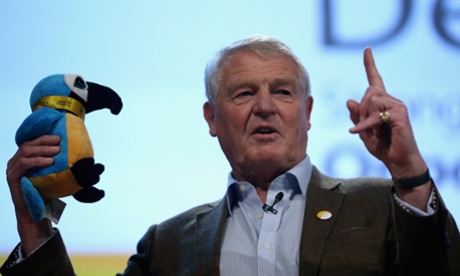
It’s the Lib Dem spring conference in Liverpool and Nick Clegg is holding a Q&A with members this afternoon, ahead of his main speech tomorrow. Given the party’s poll ratings, this may well be Clegg’s last party conference as leader, and you might expect the questions all to be along the lines of, “Are we doomed?”, but the Lib Dems seem determined to keep their spirits up. Extracts from conference speeches released overnight keep stressing that the party has a “positive” vision and, at a rally yesterday evening, Paddy Ashdown, the former leader, deployed a toy stuffed parrot to make the point that the party had been written off before. That’s a Lib Dem in-joke about Margaret Thatcher using the Monty Python dead parrot sketch to dismiss the party in a conference speech in 1990. If Ashdown really wanted a Monty Python allusion, one feels that “Always look on the bright side of life” might have been more appropriate, but never mind.
I’ve just arrived at Liverpool station and I will be blogging from the conference today and tomorrow. Ed Miliband is also giving a speech in Birmingham later, and I will cover some of that too.
Here’s the agenda for the day.
9.25am: Debate on mental health.
10.25am: Danny Alexander, chief secretary to the Treasury, speaks.
10.45am: Debate on economic policy.
12.10pm: Ed Miliband delivers his speech on Labour’s pledge card promises at a rally in Birmingham.
12.25pm: Jo Swinson, minister for women, employment relations and consumer affairs, speaks.
2.15pm: Debate on the Lib Dems’ proposed five green laws.
3.10pm: Vince Cable, the business secretary, speaks.
3.30pm: Nick Clegg’s Q&A with members.
4.15pm: Debate on employment and unions.
If you want to follow me on Twitter, I’m on @AndrewSparrow
Updated