Nick Clegg, on sprightly form, is chatting to trainee nurses at Solihull College. But there’s a problem. On one side of the training ward is a row of beds, each containing an anatomical dummy. One has his heart wired up to a monitor and another, mouth wide open, looks dead as a doornail.
“He had a cardiac arrest and we didn’t get to him in time,” jokes Linda McCloughlin, head of the school for health and social care, as the deputy prime minister wanders over. As photo opportunities go, it is clearly far from ideal for a party fighting for its life, but Clegg accepts he is trapped with a nightmare image. “I can just imagine the caption contest on this one,” he says as he poses for the cameras.
Solihull is one of the 30 or so Lib Dem seats on life support which they could say goodbye to on Friday morning. It was held by Lorely Burt with a majority of just 175 votes over the Tories in 2010. Burt, accompanying Clegg round the college, accepts her race is “neck and neck”. That is probably optimistic.
Outside, students mill about. Most are too young to remember Clegg’s 2010 tuition fee about-turn and seem to quite like him. But more will vote Green than Lib Dem, Tory or Labour. “It’s the Greens for me because they would get rid of tuition fees,” says 18-year-old Charlotte Hayward. At the last election the Lib Dems were the students’ party. No longer.
The focus of this campaign may be on the battles in “key marginals” between Labour and the Tories and Labour’s unequal struggle to hold back the SNP in Scotland, but it will be fights in a few Lib Dem seats such as Solihull that could decide what kind of government Britain has for the next five years, and whether it is plunged into unprecedented and potentially prolonged constitutional uncertainty for weeks or months.
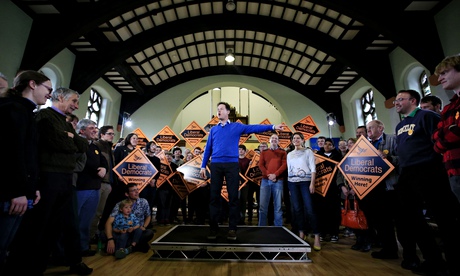
Clegg is impressive on the stump, breezy, articulate, upbeat. He reiterates his message that only the Lib Dems can make Labour fiscally responsible and give the Tories “heart”. His pitch is that neither of the two main parties can win a majority and only a vote for the Liberal Democrats will ensure a middle way between extremes and deliver sensible, rigorous, stable government. He creates an impression that coalitions in which the Lib Dems hold the balance of power are now a permanent reality of UK politics.
But that rests on an assumption that the Lib Dems will retain enough seats to be able to – or even want to – enter another coalition. Currently they hold 56 seats. If that falls to fewer than 30 – what one Lib Dem minister calls “Armageddon” for his party – they may lack both the numbers to push the Tories or Labour over the line on their own, and also the will to try do so.
Nowhere is the Lib Dems’ fight to remain as central players – as the glue that binds coalition – being fought out more dramatically than in Clegg’s own seat of Sheffield Hallam. He says he is “confident” of holding on in the face of a Labour surge that has seen Ed Miliband’s party come from third place in 2010 to a position where last week they were one point ahead in the latest constituency poll by Lord Ashcroft. “I have knocked on doors and think it will be OK,” says Clegg.
He believes Conservative tactical voters are coming over to him in large enough numbers to stop Labour. He doesn’t think his hardline anti-Tory messages will damage that quest and offend Tories too much: “These kind of Conservatives don’t want the Tory hardline agenda that would take us back to the 1950s.”
In smart suburban streets with views of the Peak District the messages on the doorstep were mixed last week. The Lib Dems may be confident but are not sure. They are pouring troops in from neighbouring constituencies, knowing that losing in Sheffield Hallam will be a huge story and a massive blow. On Friday evening Joe Otten, the Lib Dem candidate for neighbouring Sheffield Central, thought his time was best spent knocking on doors for Clegg, rather than to boost his own vote. “If I can help here I do,” he said.
The reaction in the prosperous Dore and Totley ward was mixed. A middle-aged mother with one child approaching university and another already studying for a degree answered the door to Lib Dem canvassers but had her doubts: “One of my concerns is tuition fees. I have not decided between the Lib Dems and Labour.” But down the road Stephen Hall, a mortgage adviser and former Tory sympathiser, was definitely switching to Clegg. “I don’t like Labour because they waste money and I admire Nick Clegg because he has reined in the Conservatives. I wish the Lib Dems could form the government.”
There are ample scenarios in which the Lib Dems could hold the balance of power alone. If Labour or the Tories get, say, 290 seats, and the Lib Dems hold on to 35, then together they could cross the magic line of 323 (the number needed to win votes in Parliament). But if both main parties are stuck around 275 or 280 and the Lib Dems hold just 25, Clegg’s party will lack any such bargaining power.
Aides close to Clegg have long believed that the Tories are destined to be the biggest party. “It is all in their favour from the economy to incumbency,” one told the Observer. A survey by this newspaper of Liberal Democrat MPs suggests a majority in the parliamentary party would stomach a second deal with the Conservatives if the arithmetic works and the terms were reasonable. With 30 seats, Lib Dems believe they could even claim some plum cabinet slots in a new government. Tessa Munt, Lib Dem MP for marginal Wells (majority 92), admitted she could live with a renewal of the current coalition: “Cameron isn’t ideological. You can work with someone like that”.
Burt in Solihull added: “You don’t have to like who you work with”, and David Ward, the incumbent for Bradford, said: “If that’s how the numbers are then we’d have to, wouldn’t we? We’ve got to have a government.”
But others are very anxious about a deal with the Tories. Among them is business secretary Vince Cable who is gravely worried about any deal that would mean the Lib Dems signing up to anything like current Tory spending cuts or plans for an EU referendum – which Clegg is willing to accept as the price of a deal. Cable says an EU referendum would cause huge economic uncertainty and damage the economy.
Even if the numbers add up, a deal with the Tories (or Labour) could still fall foul of an internal Lib Dem revolt. Some MPs says the situation cannot be compared to 2010 when Lib Dem participation was needed in an emergency. This group thinks the party might recuperate best in opposition. “Last time the cabinet secretary Gus O’Donnell got things moving by saying the value of the pound would crash if we didn’t get on with it,” said one Lib Dem MP. “That was the message sent back to us. Well, we are not going to believe it this time. That isn’t going to wash. Negotiations will take weeks not days.”
Another said: “I’d have to say, I’d be very reluctant [to go into coalition]. I can conceive of arithmetic that would put an awful lot of pressure on us to do so, but I wouldn’t have a great deal of enthusiasm for it. We’ve lost a third of our members, half of our councillors, two-thirds of our popular vote. And apparently we’re about to lose half of our MPs – why would we want to do it all over again?”
But on the day after the election, members of the powerful 1922 committee of Tory backbenchers will spell out their terms, not with the Liberal Democrats but with their own party. They want a secret ballot on whatever deal is struck between the Tory and Liberal Democrat leaderships, and want the chair of the committee, Graham Brady, in on the negotiations.
The truth is many of them don’t want anything that would mean five more years of coalition with Clegg’s party. Many would rather run a minority government, and some might even prefer to be in opposition, than to govern with Clegg again. So despite the comforting messages Clegg preaches about the role his party can play a second time, as a stabilising force navigating between extremes, he may find that this time it doesn’t go to plan.