Afternoon summary
- MPs have effectively ordered Sir John Chilcot to say when he will publish his report into the Iraq war. A backbench motion tabled by David Davis saying Chilcot should “publish a timetable for publication and an explanation of the causes of the delay by 12 February 2015” was passed without opposition. Chilcot will have a chance to respond when he gives evidence to MPs next week.
- The BBC and ITV have said that they are going to ignore David Cameron’s call for the proposed leaders’ debates to be moved so they do not take place in April. In a joint statement, they also said they were opposed to his sugestion that Northern Ireland parties should be included. And they reaffirmed their threat to stage the debates without Cameron if he refused to participate. (See 11.47am.)
- Clegg has confirmed that the Lib Dems have dropped plans to stop wealthy pensioners claiming free pass passes. Earlier I described this as a U-turn. (See 10.12am.) The Lib Dems says this isn’t a new announcement, and that it was included on page 35 of the pre-manifesto published in September. (But lots of us did not notice that at the time; it’s still a U-turn, just a four-month-old one.)
-
The Unite union has said it is giving £1.5m to Labour. In a statement, it said:
The union is determined that the present government should not be allowed to float to re-election on a tide of big business cash, while Labour remains under-resourced.
- Vince Cable, the business secretary, has published plans to give the groceries code adjudicator power to levy fines worth up to 1% of annual turnover on supermarkets that break the rules governing the way they treat suppliers, including farmers.
That’s all from me for today.
Thanks for the comments.
Here’s the Guardian’s Politics Weekly podcast.
Updated
David Davis is concluding the debate now.
They all agree the report has taken too long.
Next week Sir John Chilcot is giving evidence to the foreign affairs committee. He says he thinks that that hearing is happening partly because of this debate. He says Chilcot will be asked to explain the delays, and to give a date for the report’s publication. He hopes Chilcot does give a date. The report needs to be published “very fast”, he says.
And that’s it.
The motion (see 12.25pm) is passed by acclamation.
I’ll post a summary soon.
On the idea of forcing the inquiry to publish its report early, Wilson says the government knows of no mechanism that could be used to force Sir John Chilcot and his colleagues to put their signatures to a report which they thought was not ready.
But he says it would be helpful if Chilcot were able to provide “some indication” of the likely date of the report’s completion.
Wilson says that it will be up to the inquiry to decide if it wants to publish its correspondence with government.
Wilson says the inquiry has on occasion asked for extra help. That has always been provided by the government, he says.
Rob Wilson, a Cabinet Office minister, is winding up now for the government.
It is “frustrating and very disappointing” that it has taken so long for the inquiry to report, he says.
When it is over, the government will want to consider what lessons can be learnt as to speeding up future inquiries, he says.
He says the cabinet secretary was put in charge of arbitrating on what could be published because he is the country’s most senior civil servants, and because he can see papers from a previous administration.
The process of declassifying the most serious documents has finished, he says. As for other documents, requests are being dealt with when they are made.
Wilson says the US has not tried to block the publication of any material.
Lisa Nandy, a shadow Cabinet Office minister, is winding up for Labour now. She says Labour want the report to be published as quickly as possible. But they do not want to intervene in the work of the inquiry, she says.
She says it is not true to say Labour opposed an inquiry. Labour was in favour of an inquiry when it was in power, but only when combat operations were over.
Norman Baker, the Lib Dem former Home Office minister, is speaking now.
He says there is some suggestion that those being criticised by the inquiry have used expensive lawyers to respond to the report.
Why was no action taken to speed up the report’s publication, he asks.
He says the report is important because, in 2002-03, the normal processes of government were abandoned, and a case was made for war that Tony Blair knew to be false.
The 45-minute claim was clearly bogus, he says. Yet the government allowed it to be reported.
The Press Association has more details of the row that erupted between Jack Straw, and Paul Flynn and George Galloway earlier. (See 2.05pm.)
Flynn said Straw should have responded earlier in the debate that he took Britain to war on a lie.
Straw said:
I’ve dealt briefly with [John] Baron’s intervention because this debate is about the Iraq inquiry and its timing, not about the substance, and I would be slapped down very quickly [by the Speaker]. But just for the avoidance of doubt I want to point out to Mr Flynn, the whole of the Security Council judged in November 2002 that there was a threat to international peace and security ...
At that point Galloway started shouting at him:
Because they believed you and Colin Powell .... Because they were fooled ... You are lying.
Lindsay Hoyle intervened and silenced Galloway.
Then Flynn resumed his speech.
The intervention [from Mr Straw] was contemptible and I share the view of Mr Galloway about it. We remember the ignominy of Mr Straw walking behind [US former secretary of state] Colin Powell after Colin Powell presented a tissue of lies about the threat. It wasn’t true and Mr Straw was supporting him in those lies. They were lies, they were untrue, and they sent all those young men and others to their deaths.
Amess says there are three measures the Commons could take to get the report published. It could sub-poena the report, and publish it; it could convert the inquiry into a full public inquiry, and set a timetable for publication of its report; or it could pass emergency legislation to force its publication.
He says parliament should not accept the fact that the government says there is nothing it can do to get the report published.
David Amess, the Conservative MP, is speaking now. He recalls hearing Tony Blair says Iraq has weapons of mass destruction that could be launched in 45 minutes. He says he believed Blair, and on that basis he changed his mind and voted for the war.
He says re regrets that now. This influenced his decision to vote against the proposed attack against Syria, he says.
Adam Holloway, the Conservative MP and a former soldier, says there were no expert on hand when Tony Blair agreed to support President Bush. It was like someone allowing their drunken mate to drive, he says.
He recalls a very senior member of the government asking him if he really thought the Taliban were not a threat to the UK. This figure clearly did not know the difference between the Taliban and al-Qaida. He says MPs would be very surprised if he told them who it was.
He recalls another briefing in Helmand where he and others were told things were going well. A few weeks later the same figure met him an apologised for the briefing. It was not correct. But the man told Holloway that people did not get promoted for telling the truth.
The people who took the decisions did not know anything about Iraq, he says. For example, who thought it would be a good idea to disband the Ba’ath party structure?
Jeremy Corbyn, the Labour MP, is speaking now. He says Iraq was a seminal mistake.
Rory Stewart suggested that Britain had been good imperialists, before becoming bad imperialists, and that we now needed to become better imperialists. Corbyn says he disagrees with that analysis.
Corbyn recalls coming to parliament to read the dossier about Iraq’s weapons of mass destruction at 8am on the morning it was published. After looking at it for 20 minutes, he concluded it was “nonsense”.
The SNP’s Pete Wishart has summarised his speech earlier on Twitter.
The Commons was duped by a Lab Gov't who fabricated a case for war because they were determined to go to war. My speech on Chilcot.
— Pete Wishart (@PeteWishart) January 29, 2015
Rory Stewart, the Conservative chair of the Commons defence committee, says Iraq is Britain’s Vietnam. It is something we cannot get beyond, he says.
George Galloway intervenes. He says he admires Stewart. But he can see Stewart as a colonial administrator, in a pith helmet, from a different era. Yet last September we almost lost the UK, he says. We won’t get it back by being better imperialists.
Stewart says the UK must be an engaged global power.
He says Britain has got to get used to criticising itself.
It is going to involve us as a country getting beyond our anxieties - and this is a very difficult thing to say - our anxieties about soldiers dying in vain. A soldier’s life cannot be held relative to the decisions of politicians. A soldier’s courage, a soldier’s sacrifice is a commitment to their country. The danger of reducing every mistake that this country has made - from the Boer War to 1842 to our recent debacle in Iraq - to the question of soldiers’ life is that it stifles debate. Nobody can stand up and criticise what we did for the fear that somebody might say soldiers died in vain.
Updated
George Galloway's speech - Extracts
Here are extracts from George Galloway’s speech earlier. I’ve taken the quotes from the Press Association.
-
Galloway said that the report was delayed to avoid embarrassment to the two main parties before the election.
We have heard the circumstances we find ourselves in is a scandal. It is one compounded by the acres of empty green benches surrounding us today. Everybody knows the answer to the question why Sir John Chilcot has come forward, a week before our debate to tell us this inquiry will not report before the general election. However much flannel is pulled around it, it is to avoid the fact the report can only highlight the iron-clad consensus that existed at that time between the two front benches.
The prime minister [Tony Blair] and his acolytes, only one of whom has the courage to be here today, and the leaders of the Opposition [Iain Duncan Smith] - the then-leader who isn’t here today but whose principal role in these matters was to egg the prime minister on to war bigger and faster.
-
He said parliament was to blame for not ensuring the report was published earlier.
I could talk for hours, and I usually do, about what this has all cost the people of Iraq, the people of the wider region. But I want to concentrate on what it has cost us, and I don’t mean financially either.
When the Chilcot inquiry was announced in this House, I described it as a parade of establishment flunkies. Who will now say I was wrong?
That it has taken so long and been so expensive would, of course, be tolerable if our position in the world had not continued to deteriorate and the conditions in the world had not continued to deteriorate.
I don’t blame Sir Jeremy Heywood, Sir Humphrey. I don’t blame even the Chilcot Inquiry. I don’t blame Tony Blair, at least for this.
I blame us - this is a poor excuse for a parliament, if only members of it could more clearly see so. It is a poor excuse for a parliament that sets up an inquiry, funds an inquiry and then says, three parliaments on, we might, who knows when, get the fruits of that inquiry.
-
He said the war had been a disaster.
This is washing our hands of something which is bleeding us at home and abroad. This has cost us millions, yes. This has cost us six years, yes.
But the world is hurtling to disaster. The decisions that were made in here on the basis of the arguments made by the government at the time has torn Iraq and its region asunder. It has fantastically, unbelievably, incalculably, inflated the danger of extremism, fanaticism and terrorism.
Iraq no longer exists as a state. One third of it is now controlled by the heart-eating, head-chopping, amputating, crucifying, so-called Islamic State and members still will not say they were wrong.
Mr Blair still says he was right and would do it again. Iraq had no weapons of mass destruction. The argument for the war was therefore false. It has been a catastrophe.
I told the former prime minister the fall of Baghdad would not be the beginning of the end but the end of the beginning.
No one outside can really understand how all these political professionals, highly remunerated, highly rewarded, with all their intelligence and education, can have made such a catastrophic error when millions of people who did not enjoy those privileges outside already knew it would end in the disaster in which it has ended.
-
He said Jack Straw was now a haunted figure.
You will never escape from the consequences of what you have said and done. You look to me a haunted figure compared to the spring-heeled Jack you used to be - as well you might.
You will never escape from it. It will follow you to the grave and into the history books that you proselytized for something which has turned into an unmitigated catastrophe for the world but also for us.
Wishart says it will take a generation to get to the truth about Iraq. In the future there could be a judge-led inquiry, he says.
Eventually it could lead to people going on trial at the Hague for war crimes, he says.
Pete Wishart, the SNP MP, says Tony Blair was talking “mendacious nonsense” when he spoke in the Commons on the eve of the Iraq war. He must have known that the claims he was making about Iraq’s weapons of mass destruction were untrue.
This House was misled, this House was duped. The House passed the vote on Iraq by 412 to 149. I was among the 149. It’s the proudest vote of my 14 years in this House. It was a vote that defined the parliament between 2001 and 2005, a vote which characterised the last Labour government. It was a vote that is now personally associated with Tony Blair. It will follow him to the grave. It will be on his tombstone. He might as well have it tattooed on his forehead.
He says the MPs should be debating a motion calling for the report to be published now.
Updated
Andrew Mitchell, the Conservative former international development secretary, is speaking now. He says he only decided to vote for the Iraq war after attending the debate and being persuade by Tony Blair’s speech.
Pete Wishart, the SNP MP, says Mitchell was not “persuaded”. He was “duped”.
Mitchell says that is for the inquiry to decide.
He says it was an extraordinary time. He remembers being visited by the executive committee of the Sutton Coldfield Labour party because they wanted him to vote against the Labour government. And he says his own wife was strongly opposed to the war.
Paul Flynn was referring to an intervention that took place earlier, when the Conservative MP John Baron asked Jack Straw, during Straw’s speech, if he would accept that Britain went to war on a “false premise”. Straw said he would not.
Flynn says he is disappointed that Jack Straw cannot say now that he accepts that the war was founded on a lie. Straw intervenes to say that at the time the UN security council said Iraq had weapons of mass destruction. Galloway shouts at Straw, and Lindsay Hoyle, the deputy speaker has to intervene. Flynn says Straw’s intervention, and refusal to admit that the premise for the war was wrong, is contemptible.
Paul Flynn, the Labour MP, says he would like to repeat a speech he made in 2009. He read out the names of all those killed the war. It took 10 minutes. For the relatives of those who died, this is not a historical matter.
(Flynn might be referring to this speech.)
Simpson says he hopes the Chilcot report will publish information about the negotiations that took place over what it could and could not publish.
One way around the problem [of knowing what information was suppressed] of course is to suggest to Sir John Chilcot, and other colleagues have touched on this, is that he puts into the public domain when he publishes his report perhaps a lot of the correspondence and communications that went on between his inquiry and the Cabinet Office and various other organisations.
Because my experience as a military historian is that when the official histories were published on the First and Second World Wars they were interesting but it wasn’t until 30 years later that you were actually able to see the correspondence between the official historians and individual commanders and others and see at times how in fact the official historians stood up to pressure but at other times how they massaged that.
And I would be particularly interested to see the emails, correspondence and telephone conversations between Margaret Aldred who ran the secretariat and Sir Jeremy Heywood and perhaps members of the Cabinet Office.
Updated
Keith Simpson, the Conservative MP, is speaking now.
He says that sadly he has concluded that, unless the Chilcot report accuses people of duplicity and treason, people will describe it as a whitewash.
The Iraq inquiry is only act one of a two act play, he says. The second act will be an inquiry into Afghanistan.
Sandra Osborne, the Labour MP, says she agrees with George Galloway about the Commons being at fault for allowing the inquiry to take so long.
Here are two more snippets from the debate.
Jeremy Corbyn MP has just suggested there be a new judicial inquiry into the Iraq war after Chilcot which he says may be a “disappointment”.
— Carl Gardner (@carlgardner) January 29, 2015
As I said in the Commons, we will be in our third Parliament of its writing before #Chilcot reports. Wholly unacceptable and outrageous
— Dr Liam Fox MP (@LiamFoxMP) January 29, 2015
Farron says the Iraq war was a “shameful blot” on this country’s history and the biggest foreign policy disaster since Suez.
It has also made legitimate intervention harder, he says.
He says he is proud of the Lib Dems’ opposition to the Iraq war. But he is equally proud of his party’s support for intervention in the Balkans in the 1990s.
Tim Farron, the Lib Dem foreign affairs spokesman, is speaking now.
He says he suspects that the Chilcot report will say the last Labour government was obsessed with its relationship with the US, and that it allowed it judgment to be clouded.
In his speech earlier Jack Straw also urged MPs not to put members of the inquiry under additional pressure. There was a danger of the panel being coerced into changing its conclusions, he said.
The unanticipated delays in the inquiry’s progress now make for additional pressures on inquiry members themselves. In particular, as the months go past, wholly unfounded suspicions fall on the inquiry about a whitewash. And, in equal and opposite concern, they may feel obliged to respond to these pressures by conclusions more starkly drawn than the evidence would allow.
Everyone, I suggest, has a heavy responsibility for ensuring that the inquiry is not put in the position where it becomes impossible to conduct a fair process and reach a fair and independent conclusion.
Updated
Elfyn Llwyd, the Plaid Cymru MP, is speaking now.
He says Sir John Chilcot has questions to answer, including: Why has the inquiry stopped publishing documents on its website? How many witnesses have been given a right to respond under the Maxwellisation process? When did the letter go out? How long were they given to reply?
Dominic Grieve, the Conservative former attorney general, says the Maxwellisation process has just begun.
He does not understand this, given the fact that Sir John Chilcot was supposed to have reached agreement on what he could publish some time ago.
David Davis's speech - Extracts
Here are some of the key points from David Davis’s speech.
-
Davis said the delays in publishing the report could have cost lives.
Since the announcement of the Inquiry we have had three major foreign policy decisions that could have greatly benefitted from lessons learnt from the Iraq War.
In Libya we undertook a military intervention which was intended to prevent a massacre, but which was the precursor to protracted conflict and unrest following our nominal military victory.
In Syria the Government was blocked by this House from military intervention, an intervention which would have led us to providing military support to ISIS, our sworn enemies.
And now in Iraq the UK has become embroiled in the ongoing civil war that has raged since the invasion in 2003.
Foreign policy, and specifically whether or not we go to war, is intrinsically a matter of life or death ...
When such decisions are made without knowledge of all the facts mistakes are made and sometimes people die as a result. The delay to the Iraq Inquiry could easily cost lives.
- He said he did not think witnesses were to blame for the delays in publishing the report.
-
He said civil servants should not have been allowed to decide what was and was not published in the report.
Sir Richard Scott was allowed to decide what he would release into the public domain unfettered by Whitehall [when he conducted the arms-to-Iraq inquiry].
By contrast Sir John Chilcot – a man who is a past Northern Ireland permanent secretary, who has chaired an incredibly sensitive Inquiry into intercept evidence, and who is considered a responsible keeper of government secrets – is tied up in protocols subject to the whim of Whitehall ...
The Inquiry protocols are symptomatic of a mind set that seems to assume that serving Civil Servants are the only proper guardians of the public interest. And that leads to a particular problem here. If a minister is asked to make a decision which affects him, or his family, or his property, or even his constituency, the ministerial code requires him to step back from the decision – to recuse himself in the jargon – and let someone else make the decision.
This does not say that the minister is corrupt. It simply ensures that there is no appearance of corruption, no chance of improper decision, and it removes the risk of unconscious bias.
No such rule appears to apply for civil servants. This inquiry process is littered with people who were central to the very decisions the Inquiry is investigating. Sir Jeremy Heywood was principal private secretary to Tony Blair for the entire period from 9/11 until the war. Yet he is Whitehall’s gatekeeper as to what can and cannot be published.
Even the head of the inquiry secretariat, Margaret Aldred, was deputy head of the foreign and defence policy secretariat and therefore responsible for providing Ministers with advice on defence and policy matters on Iraq, and she was nominated to the Inquiry by the previous cabinet secretary.
All of this would matter less if these ridiculous restrictive protocols on publication were not there. Like Scott, Sir John Chilcot should be allowed to publish what he thinks is in the public interest – not what Whitehall thinks is acceptable.
-
He said the Iraq war was “the greatest foreign policy failure of this generation”. And he said that as someone who voted for it, he said.
Galloway says he does not blame Sir Jeremy Heywood for the delays. And he does not blame Tony Blair. He blames us.
This is a poor excuse for a parliament.
This is Pontius Pilate, this is “washing our hands of something that is bleeding us at home and abroad”, he says.
He says Iraq no longer exists as a state. One third of it is under the control of the heart-eating, head-chopping Isis. And yet those responsible will still not admit that they were wrong.
It has been a catastrophe, he says.
He says he told Blair before the war that there was no al-Qaida in Iraq, but that there would be if the war took place. He did not realise it would spawn something much worse.
Outside parliament, people cannot understand how highly-paid political professionals could have made such a disastrous decision.
Galloway says there should have been a soldier on the inquiry panel. He would have liked to have seen David Davis do that job. And there was no lawyer on the panel. Sir Menzies Campbell would have been suitable.
He says two of the members of the panel had described Bush and Blair as Churchill and Truman.
The main gatekeeper to the Chilcot inquiry was the main gatekeeper between ministers and the Foreign Office during the way.
Members of the inquiry panel were either unqualified of disqualified, he says.
He says Jack Straw is “in the dock”. He will never escape from the consequences of what he did. He looks like a haunted figure, compared to the spring-heeled Jack he was.
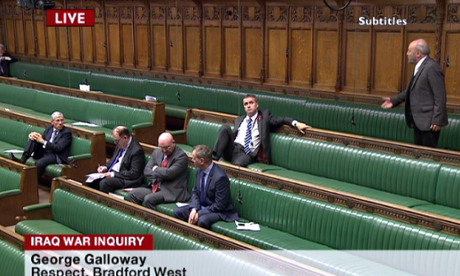
George Galloway, the Respect MP, is speaking now.
He says Lord Hurd’s comment that the delay is a “scandal” is illustrated by how few MPs are here.
There are only 30 MPs present, including very few Labour MPs, even though Labour took us to war.
Everyone knows why Sir John Chilcot announced the report would not be published before the election. It was because the report will highlight the folly of Labour and the Conservatives in voting for war. Only one of Tony Blair’s acolytes is brave enough to be here (Jack Straw). And Iain Duncan Smith, the Conservative leader at the time, is not here, even though he egged Blair on.
People like Sir Richard Ottaway looked into Blair’s “Bambi eyes” and followed him to war, he says.
Yet millions of ordinary people could see the war was a mistake.
Ottaway says Sir John Chilcot will be appearing before the foreign affairs committee next Wednesday.
Sir John Chilcot is a distinguished public servant who has done his best to assist the country. There is no finger of blame pointed at him or there will not be next Wednesday afternoon and I quite accept he will not be able to discuss substantive matters when he appears before us. What I want him to talk about is the process and I want him to guide us on to streamline things for the future.
Bernard Jenkin, the Conservative chair of the public administration committee, asks Ottaway to ask Chilcot if he thinks Sir Jeremy Heywood has been obstructive.
Updated
Sir Richard Ottaway, the Conservative chair of the foreign affairs committee, is speaking now.
He says he voted for the Iraq war because Tony Blair persuaded him in the Commons debate that the UK’s security was at risk.
There have been previous inquiries into the war. None has lasted more than six months, he says.
Straw says no one thought this report would not be out before the 2015 election.
He says he has looked at the precedents for holding inquiries while wars are still going on, such as the Dardanelles and the Crimea.
You can hold an inquiry like this, he says. But evidence was taken in private. You would not want to hold an inquiry like that now, he says.
He says he hopes the report will now be published as quickly as possible.
Jack Straw, the Labour MP and foreign secretary at the time of the Iraq war, is speaking now. He reminds MPs that he was a witness before the inquiry.
He says that all witnesses who have been part of the Maxwellisation process (which allows facing criticism to respond to points made in the draft report) are bound by a duty of confidentiality. So there are limits to what he can say, he says.
He says he gave evidence to the inquiry three times.
When this is over, MPs will have to decide how inquiries like this could be improved, he says. They should consider whether inquiries need counsel, and high-quality legal teams.
He says there has been a lot of “nonsense” spoken about witnesses trying to spin out the Maxwellisation process to hold up the report. He is glad David Davis said this was not the case, he says.
No witness to the inquiry has been responsible for any of the delays, he says.
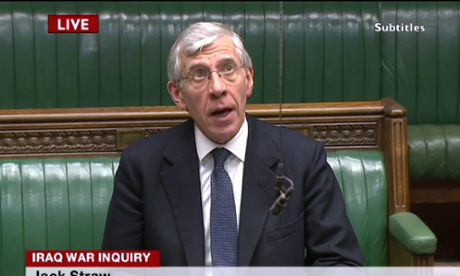
Davis says Lord Hurd, the former foreign secretary and by no means an anti-establishment figure, has described the delays as a scandal. He is right, says Davis.
He urges MPs to pass his motion. (See 12.25pm.)
Davis says he also does not see why publication should be delayed because of the election. What is wrong with putting an impartial report before the public, he asks.
The public interest should trump any party political advantage.
Davis says there will be no point in the inquiry if it cannot publish documents about Tony Blair’s dealings with President Bush.
The process of deciding what could be published was frustrating, he says.
Sir John Chilcot said he did not see why he could not publish information, when those who took part were able to publish revelations in their memoirs.
It was assumed that civil servants could only decide what should be published, he says.
The Whitehall protocols are “ridiculous”, he says.
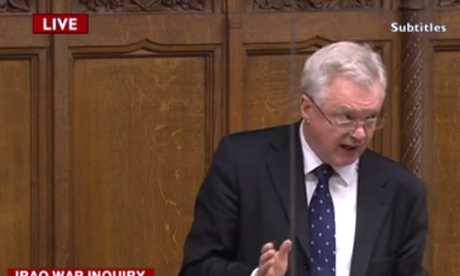
David Davis, the Conservative MP, is opening the debate.
He says there are reasons to believe Sir Jeremy Heywood, the cabinet secretary, has contributed to the delay in the publication of Sir John Chilcot’s report.
He does not think the witnesses are to blame for holding things up, he says.
MPs debate the delay in publishing the Chilcot report into the Iraq war
MPs have just started the backbench debate on the Chilcot report.
They are debating a motion tabled by David Davis, the Conservative backbencher, and signed by other MPs including Labour, Lib Dem, Plaid Cymru, Ukip and Green members.
Here is the motion.
That this House regrets that the Iraq Inquiry has decided to defer publication of its report until after 7 May 2015; and calls on the Inquiry to publish a timetable for publication and an explanation of the causes of the delay by 12 February 2015.
It’s getting chilly - and David Cameron is on the case.
I have asked for an update on our heavy snow contingency plans. The gritters are out and people should listen to warnings. #WeatherAware
— David Cameron (@David_Cameron) January 29, 2015
In his Call Clegg phone-in, Nick Clegg was asked about speculation that there could be a coalition after the election featuring Sinn Fein. (See 9.21am.)
My colleague Henry McDonald says that Sinn Fein are a red herring, and that Westminster journalists should instead focus on the SDLP. He’s sent me this.
It was not The Sun that started it!
Although their story this week about an alleged potential pact between Ed Milliband and Sinn Fein signalled the onset of dirty tricks throughout election 2015, the paper was not the first to suggest a supposed deal between Gerry Adams party and Labour. Last year the New Statesman ran a speculative feature suggesting left wing Labour MPs were urging Sinn Fein to drop its boycott of Westminster. Which dissident republican critics of Sinn Fein latched onto as a “kite flying exercise” to see how far the party could move further from its traditional stance of not taking seats in parliament.
Both publications fail to appreciate that Sinn Fein’s main focus is where real power lies on the island of Ireland – Dublin. The party’s priority will be to defend its seats and sustain its voting base in the north. However, the real battle is not election 2015 but rather 2016 when the people in the south elect a new government. Riding high in the opinion polls and buoyed by the success of their fellow anti-austerity allies in Greece, Sinn Fein’s central goal is to have their ministers on the podium to salute the official parade to commemorate the centenary of the 1916 Rising next Easter. Paradoxically it is the other nationalist party, the SDLP with three Westminster seats which could find itself propping up Labour should Milliband need support to enter Downing Street. SDLP sources indicate that talks will start soon with the SNP and Plaid Cymru to strengthen the Celtic bloc after votes are cast and counted.
Broadcasters reject Cameron's call to shift timing of TV debates and to include DUP
Today ITV are also saying no to the DUP. The BBC and ITV have issued a joint news release. It’s a snub to David Cameron, who on Monday called for the DUP, and other Northern Ireland parties, to be included.
Here’s an excerpt.
In separate letters, ITV and the BBC have written to Peter Robinson and set out the reasons for not including the DUP in either network debate. Both the BBC and UTV plan dedicated debates in Northern Ireland involving all the larger Northern Ireland parties.
The BBC’s Director-General, Tony Hall, said: “We would not be fulfilling our obligations of impartiality to the voters of Northern Ireland if we were to invite one of the Northern Ireland parties but not all the others, which also have substantial support in Northern Ireland.”
An ITV spokesperson said: “We take the view that these proposals best meet the objective of delivering a series of relevant and valuable political debates for viewers across the UK. We are satisfied that it is in the public interest to proceed with these proposals as they now stand.”
The broadcasters point out that voters who live in Northern Ireland have a different set of choices from voters elsewhere. The five major parties in Northern Ireland are all different from those in the rest of the UK. In Northern Ireland the main parties are the DUP, Sinn Fein, the Ulster Unionist Party, the SDLP and the Alliance Party. BBC Northern Ireland and UTV plan debates involving those parties and all viewers in Northern Ireland will be able to see them.
If the DUP were included in the network debates it would be necessary to include all the other major Northern Ireland parties too. Including only one, or some, of the Northern Ireland parties would be unfair and discriminatory to the rest. Including all the major Northern Ireland parties in the network programmes would mean having 12 participants - and 97 per cent of viewers, in the rest of the UK, would not be able to vote for at least five of those 12 parties. The broadcasters say that such an arrangement would be disproportionate and not in the wider interests of viewers throughout the UK.
Just as importantly, the broadcasters have rejected David Cameron’s call for the debates to be scheduled before the election campaign proper starts. In a joint statement, the BBC and ITV say:
We are proposing that the debates should happen within the campaign period at a time when the parties will be setting out policies in their manifestos and when the audience is fully engaged with the election. The 2015 campaign will be nearly six weeks long and there is plenty of time for three debates to be held without overshadowing the rest of the campaign.”
The proposed dates for the network debates are 2, 16 and 30 April. The order of the debates is to be discussed with the parties. In the event that any of the invited party leaders decline to participate, debates will take place with the party leaders who accept the invitation.
Updated
At the Paddy Power Political Book Awards last night Revolt on the Right, Matthew Goodwin and Robert Ford’s account of the rise of Ukip, won the main award. The full list of winners in all categories are here.
The judges described Revolt on the Right as “a ground-breaking book which provides essential and enjoyable reading for anyone who wants to understand the shifts in modern politics”. It was a good choice. Regular readers will know that I’ve quoted from the book often, because it provides detailed psephological research explaining where Ukip support is coming from. I summarised the book’s main arguments last year here.
Nick Clegg's Call Clegg phone-in - Summary
Here are the main points from Nick Clegg’s phone-in.
-
Clegg said he had abandoned plans to scrap free bus passes for wealthy pensioners. At one point he was proposing this, but Clegg said he would now keep free bus passes for pensioners as a universal benefit, although he said the Lib Dems would take away winter fuel payments and free TV licences from wealthy pensioners. (See 10.12am.) Clegg also defended providing free transport for disabled children as a universal benefit, and rejected suggestions that the millionaire Katie Price should have to pay herself for her disabled son’s transport.
We, as a society, think there are some things we should provide universally to everybody. We make the NHS available to everybody, paupers or multi-millionaires, regardless of their wealth, based on need not ability to pay. I think this may well be one of those areas where most people think, on balance, it is better to provide it universally.
Of course, it means you get cases like that of Katie Price. But I would be pretty reluctant to say, on the facts of this individual case, we should therefore throw out the idea of universally treating all children with disabilities with the same kind of compassion and support everywhere we can.
-
He said the state should not “bribe” people to improve their behaviour. Asked about a pilot scheme that involved getting pregnant women to stop smoking by offering them vouchers worth £400, he said he was “perturbed” by the implications of the idea.
I’m slightly perturbed by this ... Where does this end? Do you then given people cash in hand to provide their children with a healthy regular meal? Do you then give people cheques to make sure their kids go to bed on time?
I’m perturbed in the sense that, at the end of the day, in any free, open, liberal society - yes, there are things that we’ve got to try and encourage other people to do, but we’ve also have to just assume that people will take responsibility for their own lives and for that of their loved ones. And it is not for the state to come up with ever more exotic ways of incentivising or, worse still, trying to bribe people to do what is good for themselves and their loved ones in the first place.
- He accused Labour of hypocrisy over the NHS. Andy Burnham had been “ranting” about the use of the private sector in the NHS, even though this was a policy promoted by the Labour government, he said.
-
He said people who didn’t like the coalition would find a coalition involving Ukip or the SNP far worse.
For people who don’t like this coalition, just have a look at those prospects. The idea of Nicola Sturgeon or Nigel Farage basically with the whip hand over Downing Street would make the most fierce critics of this coalition slightly more benevolent in their attitude to this coalition.
-
He suggested the proposed multi-party leaders’ debates were too big to be interesting to viewers.
The danger with this increasingly laughable way in which the Conservatives are pushing the broadcasters to invite an ever larger cast of people is - just imagine what it is going to be like for the viewing public? By the time everyone has done their one minute introduction, the whole nation will have switched over to Coronation Street.
He also mocked Cameron’s stance on the debates, saying Cameron would soon be calling for the inclusion of the Monster Raving Loony party. And he renewed his call for a four-party debate involving just Labour, the Conservatives, the Lib Dems and Ukip.
-
He said PMQs was making people disillusioned with politics.
Joking aside, I think it has descended into the most facile, yah-boo style politics. The only people who get excited about it are the people in the Westminster village who think the whole world revolves around who said what, who made what joke. The vast majority of the British public, if they listen, they are pretty unimpressed. Actually, the vast majority of people don’t listen at all. And perhaps that is a blessing in disguise, because if more people did see what happens every half an hour from midday to 12.30 on a Wednesday, they would be even more disillusioned about Westminster politics than many people already are.
-
He said the Lib Dem MP David Ward was “crass and insensitive” when he used the word “genocide” to describe Israel’s treatment of the Palestinians in a message issued on Holocaust memorial day.
He doesn’t speak for the party and I think this - on that day of all days - was a crass, insensitive thing to say. To compare - however distressing it is to see - what is happening in Gaza to the Palestinian people to what has happened in Darfur or Cambodia or the Holocaust is completely inappropriate. Is it something people take offence at? Yes. Do I think it is wrong? Yes. But he doesn’t speak for the party and he never has.
Nick Clegg’s new stance on pensioner bus passes brings him closer to Labour, but there are still differences.
Labour would means-test the winter fuel payment, but not free TV licences and free bus passes for pensioners.
The Lib Dems would means-test the winter fuel payment and free TV licences, but not free bus passes.
The Tories have not confirmed their plans yet, but David Cameron has signalled that they will protect all of these benefits for all pensioners.
Clegg abandons plans to means-test free bus passes for pensioners
I did not notice it at first, but Nick Clegg performed a sneaky U-turn on Call Clegg this morning.
He said he was opposed to taking away free bus passes from wealthy pensioners.
The Lib Dems were in favour of taking away winter fuel payments and free TV licences from pensioners paying higher-rate tax, he said.
But free bus passes for pensioners should remain a universal benefit, he said.
I think the bus pass is slightly different ... I actually think bus passes for everybody, for those who’ve retired, I think that makes a lot of sense.
Asked to justify the inconsistency, he replied:
[To] encourage everyone, regardless of their income, who are elderly to use buses, get out and about, be able to get to the shops, be linked to their communities, is a good thing.
Why is this a U-turn? Because Clegg used to say that free bus passes for pensioners should be means-tested. This is is what he told the BBC in 2012.
It would be quite interesting if you could ask the Labour party for this, because they appear to be saying that at a time when people’s housing benefit is being cut, we should protect Alan Sugar’s free bus pass?
A more detailed summary is coming soon.
There are two statements in the Commons today, after the business statement at 10.30am.
2 statements after business statement so circa 11.15: 1. Birmingham Schools (Morgan/Hunt) 2. Local Growth Deals (Clark/tbc)
— Labour Whips (@labourwhips) January 29, 2015
That means the Chilcot debate probably won’t start until after 12.30pm.
Nick Ferrari asks Clegg about the news that has just dropped about the school performance tables. This is what the Press Association says about this.
Hundreds of secondaries, including many top private schools, have seen their GCSE results plummet to zero following a shake-up of annual league tables.
Under the government’s overhaul, some combinations of English GCSEs and some international GCSEs - often known as IGCSEs - do not count in the rankings.
As a result, many secondaries which took these qualifications have seen their results drop in a key government measure of school performance.
An analysis of the statistics suggests that around 335 schools registered 0% for the proportion of pupils gaining at least five C grades at GCSE including English and maths.
Clegg says this is a consequence of the way the figures are compiled changing. But he says he has not looked at the new figures properly.
And that’s it. Call Clegg is over.
I’ll post a summary soon.
Q: What will you do about the Lib Dem MP David Ward? He said, on Holocaust day, that what was happening in Palestine was genocide?
Clegg says Ward does not speak for the party. To compare what is happening in Palestine to the Holocaust is crass and offensive.
Clegg says any instability in the eurozone will impact on the UK.
Britain is not involved in the discussions between the Greek government and the eurozone.
But, after the election, the British and Greek deficits were very similar. Five years later, they are in a real state of turmoil, but Britain is making good progress.
Q: Why was the winter fuel payment made universal?
Clegg says providing free bus passes on a universal basis makes sense. But, with winter fuel payments and free TV licences, he agrees with the caller. The Lib Dems want to take them away from pensioners who pay higher rate tax. That would only affect 5% of pensioners.
The Conservatives want to protect these benefits, but take housing benefit away from young people. That is not fair, he says.
Q: Why are the Lib Dems happy to give Bruce Forsyth a free bus pass, but not winter fuel payments?
Clegg says bus passes should continue to be free.
The Conservatives have the wrong set of values, he says.
Q: I listened to PMQs yesterday. It sounded like MPs had been drinking.
Clegg says, joking aside, PMQS has “descended into the most facile, yah-boo politics”. The only people interested are those in the Westminster village. Most people don’t watch. If they did, they would be even more disillusioned with politics than they are already.
Nick Ferrari plays Clegg a clip of David Cameron saying the Greens were not included in the TV debates because Clegg did not want them there.
Clegg mocks Cameron’s stance. Next Cameron will be saying the Monster Raving Loony party should be included, or the tea lady.
He says it is getting too big. But the time everyone has done their introduction, the whole nation will have switched over to Coronation Street.
There should be one debate with the main parties identified by Ofcom (Labour, the Conservatives, the Lib Dems and Ukip), he says.
Q: What do you feel about Sinn Fein and the SNP propping up a Labour government?
Clegg says there is a cottage industry of coalition speculation.
If people don’t like this coalition, what would they think of one with the SNP or Ukip in it.
Let’s wait and see what the election produces, he says.
Q: Who is flirting with the Lib Dems?
Clegg says it is “unlikely” he will be prime minister.
But if the British people issue instructions through the ballot box saying they want Lib Dems around the cabinet table, he would look at that.
It would not be at all costs. He would have to look at the merits.
Q: What do you think about giving pregnant mums vouchers for £400 to give up smoking?
Clegg says he is “slightly perturbed” by this idea. Where does it end? Do you then pay people to feed their children properly, or to make sure their children go to bed on time.
People should take responsibility for their lives. It is not for the state to bribe people into doing the right thing.
Q: On the subject, should the state be paying for transport for Katie Price’s disabled son. She is worth £30m.
Clegg says the local authority has decided this should not be means tested.
He understands the debate. But this may be an area where most people think it is best to provide this benefit on a universal benefit (ie, without means-testing parents). He would not want to give that up just on the basis of this case.
Clegg says he is in Bristol today. He is announcing £1bn being transferred from Whitehall to local enterprise partnerships, in Bristol and elsewhere.
Q: Is Ed Miliband weaponising the NHS?
Clegg says he does not know what Labour is up to. He heard Andy Burnham “ranting and railing” about the private sector in the NHS. Yet it was on his watch that the private sector was shortlisted to take over Hinchingbrooke. And Labour spent £250m on private treatment centres. And they have not come up with a plan to fully fund the NHS in the future.
Labour are not thinking about how their own record stands up, he says.
Nick Clegg's Call Clegg phone-in
Q: How are you going to address the problem of nurse recruitment?
Clegg says the government has already recruited more nurses. But the NHS needs more nurses too. Simon Stevens, the NHS England chief executive, says it needs another £8bn. The Lib Dems have proposed means of finding that money, such as closing tax loopholes that benefit the rich.
Q: I’m a nurse. I asked about British nurses. We are having to recruit foreign nurses because British nurses are leaving. Care is sub-standard. And, because of the Stafford hospital scandal, nurses are afraid to speak out, in case they get blamed. No manager has ever gone to prison.
Clegg says the government needs to train more British nurses. More are being recruited, he says. And he wants to make NHS funding more sustainable.
Q: Guilt is a big problem. I had a case with a 90-year-old who was incontinent, and who cried because I took so much time to get to him. I felt guilty.
Clegg says he is sorry to hear the man’s story. Nursing is a noble profession, if not the noblest profession of all.
The Stafford hospital scandal did not happen under the coalition, he says.
Nurses should not feel intimidated about coming forward.
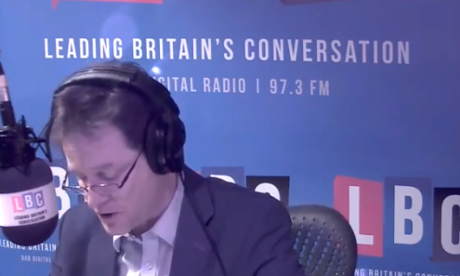
Nick Clegg is hosting his Call Clegg phone-in this morning, but he has already given a series of interviews to broadcasters, and here are the highlights. You can’t say I don’t spoilt you.
- Clegg said that a majority Labour or Conservative government would be “the worst thing” for Britain now and that it would put the recovery at risk.
It is fair to say that I am making the case that the worst thing for this country right now - as the economic recovery still needs to take root, as we need to make sure we finish the job of securing an economic recovery but doing it fairly - the worst thing we can do as a country is give the keys to 10 Downing Street either to Ed Miliband or David Cameron on their own.
Ed Miliband sticks his head in the sand and simply doesn’t want to deal with the issue of how we balance the books, and David Cameron and George Osborne have announced quite categorically that they want to cut, cut, cut the amount of money going to public services, way beyond what is necessary, for ideological reasons.
If we allow either a Labour or Conservative government, I genuinely think that the economic recovery will be put into jeopardy and, worse than that, that the kind of economic recovery we have - particularly if the Conservatives are in government on their own - wouldn’t be nearly as fairly spread as we have tried to do in coalition over the last five years.
-
He rejected claims that the Lib Dems are face a wipe-out at the election.
I have been leader of the Liberal Democrats for eight years and I have lost count of the number of breathless predictions that the end is nigh and the Liberal Democrats are going to be wiped out. Every single time, we confound our critics and we confound the vitriol and cynicism from right and left. I do think we will confound expectations and confound our critics again.
- He rejected claims that millionaires are better off under the coalition.
[It’s] nonsense [that millionaires are better off] – the top in society have actually paid far more than anybody else in terms of the contribution to dealing with the deficit. If you look at all the tax and benefit changes actually the tax burden on them has increased. By the way you should remember that the top rate of tax at 45p is 5p higher than pretty well 13 years under Labour.
-
He claimed that Britain was in a similar situation to Greece in 2010.
If you ask what I am proud of doing: I’ll tell you what I’m proud of doing. I’m proud of creating a stable government without which we wouldn’t have had an economic recovery now: Look what can happen, look at Greece. Our deficit and Greece’s deficit were pretty similar in 2010 but look at the huge differences since then.
I’ve taken the quotes from the Press Association and PoliticsHome.
Later I will be covering the Commons debate on the delays in publishing the Chilcot report in detail.
Here’s the agenda for the day.
9am: Nick Clegg hosts his Call Clegg phone-in.
9.30am: The Department for Education publishes secondary school performance tables.
Around 11.30am: MPs begin a debate on the Chilcot report.
As usual, I will be also covering all the breaking political news from Westminster, as well as bringing you the most interesting political comment and analysis from the web and from Twitter. I will post a summary at lunchtime and another in the afternoon.
If you want to follow me on Twitter, I’m on @AndrewSparrow