Afternoon summary
- Nicky Morgan, the education secretary, has announced government plans to spend a further £1.6bn on new school places. As the Press Association reports, ministers said that the majority of the cash - £1.3bn in total - will be provided in 2017/18 to help ensure local councils have the school places they need ready for September 2018. The remainder, £300m, will be allocated over the next two years to help fund places in areas that are seeing “significant and unexpected” rises in pupil numbers.
- A British Election Study analysis has been released suggesting the Lib Dems could win just one seat at the election. (See 4.10pm.)
That’s all from me for today.
And next week I’ll be off for half-term.
Thanks for the comments.
Lib Dems could win just one seat at the election, BES analysis suggests
Today the British Election Study have been holding a conference on Predicting and Understanding the 2015 General Election, with papers from various eminent psephologists.
I have not seen any full reports from it, but here are some highlights from Twitter.
The highlight seems to have been the British Election Study’s 2105 constituency forecast, which has the Lib Dems winning just one seat!
From Hetan Shah from the Royal Statistical Society
John Curtice: Lab forecast pretty consistent across pollsters with different methods - either all right or all wrong! #GE2015 @NCRMUK
— Hetan Shah (@HetanShah) February 12, 2015
John Curtice: 10 pt difference between different pollsters on UKIP vote share. Partly derived from internet v phone polling. #GE2015 @NCRMUK
— Hetan Shah (@HetanShah) February 12, 2015
From Will Jennings, a politics professor at Southampton University
At the @NCRMUK @BESResearch #GE2015 event, the @pollingobs forecast for vote share: Con 33.5%, Lab 33.6%, LibDem 8.8% (as of Feb 7th)
— Will Jennings (@drjennings) February 12, 2015
At the @NCRMUK @BESResearch #GE2015 event, the @pollingobs forecast for seats: Con 269, Lab 293, LibDem 21, UKIP 1, SNP 47 (as of Feb 7th)
— Will Jennings (@drjennings) February 12, 2015
Ed Fieldhouse presenting #GE2015 nowcast with @jon_mellon using @BESResearch: Con 296, Lab 282, LibDem 1, UKIP 3, SNP 47 <- lots of caveats!
— Will Jennings (@drjennings) February 12, 2015
From Nick Phipps, head of Sky’s election night coverage
... some scepticism expressed (including from authors!) but Ed Fieldhouse from Manchester Uni says difficult to see #LibDems getting >20
— Nick Phipps (@nickphippssky) February 12, 2015
From Jon Mellon from the British Election Study
Just released our nowcast of #GE2015 using a proportional swing based method. Con 296, Lab 282, LibDem 1, UKIP 3, SNP 47. @BESResearch
— Jon Mellon (@jon_mellon) February 12, 2015
Lib Dems obviously much lower than other forecasts.Multiple reasons why.1)we model deviations from proportional swing rather than uniform
— Jon Mellon (@jon_mellon) February 12, 2015
2)Lib Dem proportional swing is ten points smaller in their seats but not enough to save most of their seats.
— Jon Mellon (@jon_mellon) February 12, 2015
3)we use standard vote intention not Ashcroft's "in your own constituency" wording.
— Jon Mellon (@jon_mellon) February 12, 2015
.@robertoroblesf @roger_scully LD currently at 34% of 2010 share. we can't find evidence that they greatly outperform in their seats
— Jon Mellon (@jon_mellon) February 12, 2015
@robertoroblesf @roger_scully nowcast not a forecast.Voters may focus more on own MP closer to elec but that's not reflected in current data
— Jon Mellon (@jon_mellon) February 12, 2015
.@angeallic @drjennings @BESResearch prior vote share and incumbency are in the model, but we didn't find large effects on LD vote choice
— Jon Mellon (@jon_mellon) February 12, 2015
To get 11 seats with current vote share,LD needs to retain 1.75 times as many of their 2010 voters in their own seats as they do overall
— Jon Mellon (@jon_mellon) February 12, 2015
Updated
And here’s a Guardian video with an excerpt from Nigel Farage’s speech.
Andrew Tyrie, chair of the Commons Treasury committee, has announced that the committee will take evidence about the HSBC scandal.
The committee is concerned about allegations involving HSBC and its Swiss private bank. It has decided to take oral evidence from both HSBC and HMRC.
Banks have repeatedly told the committee that, since the crisis, they have put in place reforms to ensure that they operate on the basis of sharply improved standards. The committee will need reassurance that they have done so in private banking. The committee will also examine whether part of the banks’ apparent ‘solution’ – de-risking – may have created another problem, that of unreasonably denying customers access to banking services.
Sam Freedman, the Teach First research director who used to work as an adviser to Michael Gove, has written a post on his blog explaining in more detail why he thinks Conservative spending plans for schools would be more generous than Labour’s if inflation stays low. (See 12.45pm.)
Miliband's education announcement - Reaction
Here is some reaction to Ed Miliband’s education speech.
The education world (or what Michael Gove used to call “the Blob”) certainly seems to like it.
From Dr Mary Bousted, general secretary of the Association of Teachers and Lecturers (ATL)
This is an important speech which sets out the battle lines between Labour and the Conservatives in the run up to the election. The free schools programme would, effectively, end under a Labour government. A return to national planning of school places is plain common sense – because it makes no sense, in times of austerity, to waste money building free schools which are not needed.
Schools and colleges will not achieve the ambitious goals, rightly set for them, without adequate funding. Labour has recognised this need. Ed Miliband’s very important, and significant, pledge to protect education funding in real terms, including early years and further education, is a highly significant and important commitment to all children and young people. It is a solemn pledge, in particular, to those young people who rely solely upon the education system to provide the road map to their economic independence, personal and professional fulfilment.
Labour’s Standards Challenge builds upon the firm evidence of the great success of the London Challenge. Schools succeed, not in competition, but in collaboration and cooperation. Parents should find a firm advocate in Labour’s Directors of School Standards. Local authorities, who will be charged to work with the Directors, must take the opportunity to re-establish their role as champions of high educational standards in their areas.
From Chris Keates, general secretary of the NASUWT teaching union
In the last two weeks we have heard from the leaders of the two major political parties on their plans for education post the General Election.
In contrast to what the Prime Minister said last week, Ed Miliband’s remarks this morning will have strong resonance with many teachers and school leaders.
Last week David Cameron promised ‘in Treasury speak flat cash per pupil’ which he was later forced admit publicly would be a further real-terms cut.
Today Ed Miliband promised a rising education budget protected in real terms every year.
Any government that is committed to high quality public education must recognise that investment in education has to be the key priority.
From Martin Doel, chief executive of the Association of Colleges
Ed Miliband’s announcement that a future Labour Government would protect education funding right the way through from 0 to 18 years old will be immensely reassuring and encouraging to young people and those charged with providing their education.
From James Kewin, deputy chief executive of the Sixth Form Colleges’ Association
This is an extremely welcome announcement that could throw a lifeline to the Sixth Form College sector. The Labour party has responded to the deep concerns of students, teachers and parents that sixth form funding has been cut to the bone over the past five years. Without real terms protection, some Sixth Form Colleges will close and others will only be able to provide an impoverished educational experience to students.
From Neil Leitch, chief executive of the Pre-school Learning Alliance
It’s crucial that when we talk about giving children the best start in life, we recognise that this means more than just statutory schooling. As such, we warmly welcome Labour’s pledge to protect the entire education budget, including the early years, in real terms.
From David Laws, the Lib Dem schools minister
Liberal Democrats will protect the budgets for schools, early years and 16-19 education in real terms. You simply can’t recruit great teachers, raise standards and give every child a fair start in life if the education system is starved of cash. This will be one of our top priorities in the next government and on the front page of our manifesto.
Labour would fund their education plans through excessive and reckless borrowing, leaving today’s schoolchildren to pick up the tab when they start work. The £4bn that Labour would waste on debt interest payments would be better spent on schools.
Here’s Jon Trickett, a Labour shadow minister without portfolio, on the Nigel Farage speech.
No single speech is going to hide UKIP and Nigel Farage’s long-held beliefs on increasing NHS privatisation and further tax breaks for those at the top.
The truth is UKIP are a party of Tory people, Tory policies and Tory money: they are more Tory than the Tories. The fact that Nigel Farage stood by UKIP’s Party Secretary after it was revealed he said the NHS was the “biggest waste of money in the UK” tells you all you need to know about UKIP’s plans for our health service. They have supported people being charged to see their GP, increased privatisation and even deeper cuts to the NHS. Nigel Farage cannot claim to stand up for hardworking people.
Unfortunately there isn’t a text of Farage’s speech. When I asked about this, Ukip thought I must be joking; speaking from a text isn’t really Farage’s style. My colleague Rowena Mason has written more about this in a good feature we’ve posted today on Ukip’s election campaign.
Lunchtime summary - plus Miliband v Fink: Who's won?
Ed Miliband’s battle with Lord Fink is over. And, essentially, Miliband has won, because Fink has dropped his threat of legal action. Admittedly, Miliband also chose not to inflame the row, and he specifically said he was not accusing Fink of being “dodgy”. But he never specifically accused him of being “dodgy” yesterday anyway, and Fink’s suggestion that he did is probably best seen as a smokescreen put up to disguise a tactical withdrawal.
But is this really quite the “defining moment” that Miliband says it is? (See 1.21pm.) Unless the dials shift on the polls, the answer must be no, and it is hard to imagine that this spate is really quite that significant. Over the last 24 hours Labour has been engaged in a major exercise in sleaze-labelling. This worked quite well for the party in 1997, but these days fuelling public anger about tax avoidance, multi-millionaires and party donors may well do more good for the Greens and Ukip than for Labour.
The row has also, unfortunately for the party, overshadowed quite an important Labour policy announcement.
Here’s a summary.
- Lord Fink, a Tory donor and former party treasurer, seems to have abandoned his plans to sue Ed Miliband over Miliband accusing him of tax avoidance. Miliband said he was not calling Fink “dodgy”, but he said other Tory donors were “dodgy” and he challenged David Cameron to say whether he agreed with Fink’s comment, in an Evening Standard interview, about tax avoidance being something everyone does.
-
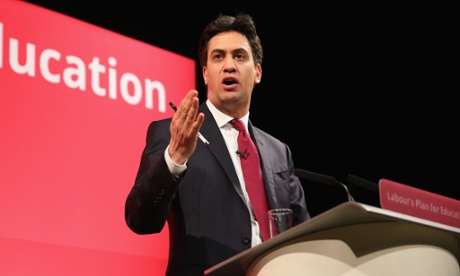
Miliband has said Labour would increase education spending at least in line with inflation if it wins the general election in May, Ed Miliband has announced. In a speech at his old school, Haverstock, Miliband said:
This government used to say it would protect schools. But last week the prime minister abandoned that commitment and said he would cut schools spending, driven by his plan to cut back public spending as a share of national income to 1930s levels, an era when children left school at 14.
We will take a different path. And we can do it because we have a sensible, balanced approach to deficit reduction. Not a dangerous and extreme one.
All of us know that the success of our children depends so much on the first steps children take in the early years and the further education they go on to.
David Cameron has had nothing to say about any of these areas. So we can only assume he is planning big cuts in spending. This will short-change our children’s future.
If we are to act on the principle that education is the passport to success in life for individuals and our nation’s economy, we must be willing to invest in the early years, in schools and in further education.
The next Labour government will protect the overall education budget. Rising budgets, protected in real terms, every year. Not cut as they will be under the Conservatives.
Because our future prosperity depends on our young people. And we will not, we must not, let them down.
One analyst claims that, if inflation remains low, the Tory pledge could turn out to be more generous. (See 12.45pm.)
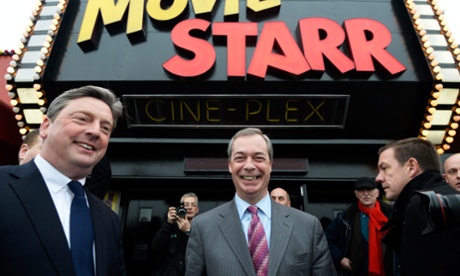
- Nigel Farage has said the Conservatives and Labour both “fear” a Ukip breakthrough at May’s general election giving it the balance of power. As the BBC reports, in his first major speech of 2015, Farage said he believed no party would secure a majority after May’s pol. But Ukip would not “prop up” a government led by another party unless it offers an “immediate” EU referendum. he also said Ukip had “crossed the class barrier”.
We have crossed the class barrier in British politics. That is a remarkable achievement for Ukip and we pick up support from across every social spectrum.
And we are also beginning now to dig quite deep into some of the ethnic community vote in this country as well, because people that have come to this country legally, that have made this country their home, that have integrated within our society, they want the Ukip agenda as much as anybody else.
And what you will see during this election campaign are lots of Ukip candidates from the ethnic minorities. It is something the commentariat in Westminster probably won’t understand but I think all of us in this room do.
- Mark Carney has warned interest rates may rise earlier than the City expects, despite Bank of England expectations that inflation will turn negative for the first time in more than half a century. As the Guardian reports, the slump in oil prices and falling food prices is likely to push inflation to zero in the second and third quarters, probably dipping into negative territory for one or two months, the Bank said in its February inflation report. However, Carney, the Bank’s governor, said negative inflation in the UK would not lead to the dangerous deflationary spiral feared in the eurozone.
- David Cameron has called for “not a stand-off but a solution” to the eurozone row over Greece’s debts, as he met new Greek prime minister Alexis Tsipras for the first time. He was speaking as he arrived in Brussels for an EU summit.
-
Cameron has issued a warning to Russia’s Vladimir Putin that EU sanctions will not be lifted unless the new ceasefire agreement in Ukraine is followed by “action on the ground”. Speaking in Brussels, Cameron said:
I welcome and thank Francois Hollande and Angela Merkel for the hard work that they have put in. If this is a genuine ceasefire, then of course that would be welcome. But what matters most of all is actually actions on the ground rather than just words on a piece of paper. I think we should be very clear that Vladimir Putin needs to know that unless his behaviour changes, the sanctions we have in place won’t be altered.
-
Grant Shapps, the Conservative chairman, has said the Tories will “put rocket boosters under free trade” if they win the election. He said the potential benefits to British businesses and customers were huge.
Listen: in the last 12 months alone, British business forked out an astonishing $1 billion dollars trying to comply with US regulations, just to try and sell their products.
That figure is an estimate, by the way.
The true cost is likely to be much higher, because it does not include opportunity cost: the lost economic activity we might have created, had it not been for the regulatory deterrent, preventing people from trying.
Surprisingly, at the most aggressive level, these barriers take the form of criminalisation.
Incredibly, British lamb is illegal in the United States, and so is British venison.
It is quite literally a criminal offence, for a British farmer to sell certain products to the largest economy on Earth, even if American diners want to enjoy these dishes.
President Obama - whose family tree is said to go all the way back to a 12th-century king of Scotland - has never in his life been able to buy an authentic Scottish haggis for his family, not even on Burns night.
Now, you may or may not like haggis… But, to paraphrase Voltaire: I may not agree with what the Scottish eat, but I will defend to the death their right to eat it!
It would be wonderful to decriminalise haggis - but, of course, most trade barriers aren’t criminal in nature
Updated
Miliband defends his own personal tax record and accuses Tories of smearing him
Here are the full quotes from Ed Miliband during the Q&A, when he was asked, by the BBC’s Nick Robinson, about Lord Fink, about John Mills, the Labour donor who gave money to the party in the form of shares, and about Miliband’s own mother leaving a home to him using a deed of variation.
-
Miliband said he was not calling Lord Fink “dodgy”. But other Tory donors were “dodgy”, he said.
On “dodgy”, I was very clear what I said about Lord Fink. The thing he objected to, let’s be clear about this, until his extraordinary U-turn 24 hours later, was me saying that he was engaged in tax avoiding activities. I made a general comment about dodgy donors in the Conservative party. And I totally stand by that comment. I’m not saying it about Lord Fink. But let me just tell you about donors to the Conservative party. There are several questionable donors to the Tory party. One donor had to leave the House of Lords after breaking his promise to move his tax affairs onshore. And a firm owned by another donor was fined for involvement in the Libor rigging scandal. I think, personally, that’s pretty dodgy.
-
He challenged Cameron to say whether he agreed with Lord Fink that tax avoidance is normal.
I think it is a very important moment. Lord Fink yesterday was threatening to sue me, right, because I said he was engaged in tax avoidance, and there was much outrage from the Conservative party. I think this is a defining moment in David Cameron’s leadership of the Conservative party because it is now revealed that he appointed a treasurer to be the treasurer of the Conservative party who says everyone engages in tax avoidance. I don’t think that is the view of most people. I don’t think that is the view of the country. And I think it does say something about the Conservative party. And the question for today is, does he agree with Lord Fink about this? Does he sanction his attitude? Or does he not?
-
He rejected claims that the way he acquired a share of his parents’ home involved a tax avoidance procedure. Robinson asked if there was anything “dodgy” about using a deed of variation to leave a home to your children. Miliband replied:
This is a question directed at me personally, and something that my mother did 20 years ago, a decision she made. Let me just say this; I paid tax as a result of that transaction. I’ve avoided no tax. No doubt the Conservative party wants to smear mud today. But, frankly, it’s not going to work. The story has been written before. And I’ve paid tax on that money.
-
He rejected claims that John Mills, a Labour donor, gave to the party in the form of shares to avoid tax. Miliband said:
[Mills] was very clear on Newsnight last night that his donation to the Labour party in shares was not about avoiding tax.
Updated
Fink accuses Miliband of a climbdown - and calls him 'man willing to smear'
Lord Fink has just issued this statement in response to Ed Miliband’s speech.
Yesterday I challenged Ed Miliband to repeat the accusations he made in the Commons – that I used an HSBC bank account to avoid tax and that I was a “dodgy donor.”
He did not.
This is a major climbdown by a man who is willing to smear without getting his facts straight.
But in his letter yesterday Fink did not say anything about being accused of being a “dodgy donor”.
Sam Freedman, a former aide to Michael Gove and now director of research at Teach First, says Ed Miliband’s education spending announcement (see 12.29pm) is not as generous as it sounds.
If Labour's pledge is "real terms" on current spending BUT not per pupil it's not that different from Tory pledge.
— Sam Freedman (@Samfr) February 12, 2015
There will be 650,000 more pupils by 2020 - if that's not included it basically eats away the inflationary increase.
— Sam Freedman (@Samfr) February 12, 2015
If Labour funding pledge isn't per pupil then I estimate it's an effective cut of 9% on the 5-16 schools budget. Tories = 10.5%.
— Sam Freedman (@Samfr) February 12, 2015
If inflation is lower than 2% the Tory spending pledge could actually be better for schools than the Labour because it covers pupil increase
— Sam Freedman (@Samfr) February 12, 2015
If inflation is much higher than 2% then the Labour pledge becomes proportionately better for schools.
— Sam Freedman (@Samfr) February 12, 2015
Freedman may be a former Tory adviser, but he was also one of the first commentators to point out the downside to David Cameron’s recent education spending announcement.
Miliband's Q&A
Ed Miliband is now taking questions.
Q: In the Commons yesterday you talked about “dodgy” Tory donors. Will you repeat that now? And is it “dodgy” to give money to a party in shares, to avoid tax, or to leave property to your children using a deed of variation, also to avoid tax?
Miliband says this is a defining moment for Cameron. He appointed a party treasurer who says it is normal to engage in tax avoidance.
He says John Mills was very clear that he gave money to Labour in shares, but not to avoid tax.
He says his mother left his home to him 20 years ago using a deed of variation. But he paid tax, he says.
He says the Tories are trying to smear him.
He says he used the phrase “dodgy” about donors to the Tory party. But he was not using it about Fink, he says.
He cites some donors are “dodgy”.
-
Miliband declines to describe Lord Fink as “dodgy”.
Earlier I said that, technically, putting money into an ISA could count as tax avoidance. (See 11.46am.)
Martin Hearson, a researcher specialising in international taxation, says this is wrong.
"Technically, anyone putting money in an ISA is engaged in tax avoidance." http://t.co/7ISPYGo6Hd @AndrewSparrow this old trope is wrong
— Martin Hearson (@martinhearson) February 12, 2015
.@AndrewSparrow putting money in an ISA is doing exactly what the law intended, so not avoidance
— Martin Hearson (@martinhearson) February 12, 2015
Miliband is now talking about Fink. He quotes from what Fink told the Evening Standard, and says Cameron must now explain why he supported someone who boasts about engaging in tax avoidance.
I’ll post the full quote shortly.
Miliband says Labour would protect education budget in real terms
Ed Miliband has just made an important announcement.
-
Labour would protect the education budget in real terms, for every year of the next parliament, Miliband says.
Miliband accuses Cameron of failing 'to act properly against tax avoidance'
And this is what Miliband is going to say in the speech about tax avoidance generally.
Of course, supporting education at times when there is a deficit to reduce, means we will have to make tough decisions elsewhere.
And, in these circumstances it is more important than ever that the people and businesses of our country who pay their taxes, know that everyone is playing their part.
And that the rules make sure they do.
Because those taxes pay for brilliant schools like this, upon which our future prosperity depends.
This government likes to talk big on tax avoidance.
But it acts small.
It has failed to take on the tax havens.
Failed to act properly against tax avoidance.
Miliband says Cameron should find out about Fink's tax avoidance activities
This is what Ed Miliband is going to say about Lord Fink in his speech. Labour has released the text, and there does not seem to be an embargo on its use.
Yesterday a Conservative donor challenged me to stand by what I said in the House of Commons.
I do.
David Cameron should say what steps he is going to take to find out about the tax avoidance activities of Lord Fink.
Because the use of trust arrangements to minimise tax otherwise payable, and sustained involvement with businesses linked to tax havens, amounts to tax avoidance in my book.
(If Cameron wants to find out about Fink’s tax avoidance activities, now, I suppose, he could just read the Evening Standard.)
Updated
Miliband says world-class education is not a luxury for young people in the 21st century. It is a necessity.
This is true for individuals, but true for nations too, he says.
Miliband says he comes back to his old school with a sense of pride. And some trepidation too. Has he remembered to do his maths homework?
(So, he’s not going to mention Lord Fink at the start of his speech. We may have to wait until the Q&A until we get his response to Fink’s interview.)
Ed Miliband's speech
Ed Miliband is speaking at his old school, Haverstock in north London, now.
And this is from Manuel Cortes, general secretary of the TSSA transport union
Fink says #taxdodging is normal - true for him and his Tory millionaire chums but not for the rest of us! #outoftouch http://t.co/ZuVX3SplER
— Manuel Cortes (@Manuel_TSSA) February 12, 2015
Labour says Fink has performed a climbdown
The Labour party is also describing Lord Finks’ comments as a climbdown.
Tories desperately trying to cover up Lord Fink climbdown over tax avoidance - @bbcnickrobinson has clarified https://t.co/Hcp7GKhkVY
— Labour Press Team (@labourpress) February 12, 2015
Lord Fink's interview - Verdict from the Twitter commentariat
This is what political journalists are saying about Lord Fink’s interview on Twitter.
Generally, it is seen as a climbdown.
And there is some doubt about the wisdom of “everyone does tax avoidance” as a soundbite.
So sounds like Ed MIliband has won the war, looks like Fink won't sue: “I didn’t object to his use of the word ‘tax avoidance’"
— Paul Waugh (@paulwaugh) February 12, 2015
Expected High Noon shoot-out btwn EdM v Fink. But looks the Tory peer has waved a white hankie without a shot being fired.
— Paul Waugh (@paulwaugh) February 12, 2015
Lord Fink blinks first - tells @JoeMurphyLondon his tax planning at "mild" end of the spectrum. Still challenges EdM to repeat "dodgy" claim
— steve hawkes (@steve_hawkes) February 12, 2015
Lord Fink talks about "vanilla" tax avoidance. In the spirit of 50 Shades week, what does BDSM tax avoidance look like?
— Craig Woodhouse (@craigawoodhouse) February 12, 2015
Big clarification from Lord Fink on what he would sue Ed M over in i/view with @JoeMurphyLondon Dodgy rather than tax avoidance is the issue
— James Forsyth (@JGForsyth) February 12, 2015
"Everyone does tax avoidance at some level," says Lord Fink in climb-down. Miliband should reply: "Actually, they don't".
— George Eaton (@georgeeaton) February 12, 2015
(Not quite, George. It depends how widely you define tax avoidance. See 11.46am.)
Fink's claim that "everyone does" tax avoidance is apt example of how wealth distorts perception.
— George Eaton (@georgeeaton) February 12, 2015
Not surprised Fink is backing off. Can't see how you can sue someone for accusing you of doing something perfectly legal.
— Dan Hodges (@DPJHodges) February 12, 2015
I know what Lord Fink means when he says "everyone does tax avoidance" - an ISA is tax avoidance - but it's not the perfect soundbite.
— Patrick Wintour (@patrickwintour) February 12, 2015
The Tories are now attacking Labour for supposedly suggesting that Ed Miliband’s fight with Lord Fink is “another Milly Dowler moment” (ie, a moment where he is standing up to powerful vested interests).
Genuinely unpleasant that Ed Miliband is trying to make political capital from the death of a child http://t.co/ilsdIDp9cU
— CCHQ Press Office (@CCHQPress) February 12, 2015
But Nick Robinson says he was not quoting anyone when he used the phrase.
Calm down Twitter. I did not quote anyone re Ed M & Milly Dowler. Said his aides saw this as moment like that ie to stand up to powerful
— Nick Robinson (@bbcnickrobinson) February 12, 2015
In his Evening Standard interview Lord Fink sets out more detail about the tax avoidance measures he took when he was working in Switzerland. It was the “mildest” form of tax avoidance, he says.
I chose the mildest end of the spectrum that I was advised on. What I did … was at the vanilla, bland, end of the spectrum.
Fink set up some simple family trusts, he says.
Really what I was trying to do was, not like a living will, but to allocate a very small shareholdings to each of my children so they could pay deposits on houses in London one day after we returned. There was nothing complex, and they weren’t aggressive tax planning.
My family and I paid tax on all the dividends, both in Switzerland and the UK. They were done because my children were under 18 and I wanted them to have something to help them make their way in the wider world.
Fink is right about the term tax avoidance being one that covers a range of normal activities (as well as some that are unusual). Technically, anyone putting money in an ISA is engaged in tax avoidance.
UPDATE AT 12.31PM: Martin Hearson, a researcher specialising in international taxation, says I’m wrong to describe using an ISA as a form of tax avoidance. See 12.31pm.
Updated
Here’s the text of Lord Fink’s open letter to Ed Miliband yesterday. And here’s an extract.
Today at Prime Minister’s Questions, you alleged that I had undertaken ‘tax avoidance activities’ in Switzerland: ‘Let’s take Stanley Fink who gave £3 million to the Conservative Party. He actually appointed him as Treasurer of the Tory Party and gave him a peerage for good measure. So now can he explain what steps he is going to take to find out about the tax avoidance activities of Lord Fink?’
This allegation is untrue and defamatory.
And this is what Fink is saying in the Evening Standard today.
I didn’t object to [Miliband’s] use of the word ‘tax avoidance’. Because you are right: tax avoidance, everyone does it.
Lord Fink seems to drop his threat to sue Ed Miliband
Lord Fink, the Tory donor and former party treasurer, has apparently dropped his threat to sue Ed Miliband.
In an interview with the Evening Standard, he says:
-
He does not consider the claim that he engages in tax avoidance libellous because that is something everyone does.
The expression tax avoidance is so wide that everyone does tax avoidance at some level,
-
He says he does not want to sue Ed Miliband.
I don’t even want to sue Ed Miliband. In my life I have been libelled a few dozen times and I have never sued anybody, even for some comments that were quite outrageous.
If he simply uses the words ‘Lord Fink did ordinary tax avoidance’ then no, I couldn’t sue him.
-
But he would sue Miliband if Miliband said he was “dodgy”.
If he made the statement ‘dodgy’ about my bank account, that was potentially libellous. That was the issue I took exception to.
Fink also says he objects to Miliband suggesting he has questions to answer. “In fact, whenever anyone has put questions to me I have answered them,” he says.
So Fink is still unhappy about the tone of Miliband’s remarks. But the threat of legal action has probably been lifted, unless Miliband choses to escalate the row later this morning (which seems unlikely).
Updated
Nick Clegg and Boris Johnson's LBC phone-ins - Summary
Here are the main points from the Nick Clegg and Boris Johnson phone-ins.
-
Nick Clegg said that the public were fed up of party funding scandals and he challenged Labour and the Conservatives to commit to reforming the system within six months of the election. Both parties “pulled the plug” on a previous attempt to introduce new rules, he said.
We need to clean this up. We need to clean up party funding. We have got the two larger parties now resorting to type. Labour ever more in the pockets of the trade union bosses, the Conservatives ever more in the pockets of City financiers.
I think that the public is so weary of this. This keeps coming around like clockwork every few months, every few years.
My challenge to both Ed Milband and David Cameron is, yes, we can as a political class carry on like this [but] there is only one result, which is that the public will become ever more cynical and switched off by politics. Or why don’t they both now say that whoever is in power after May 7 will within six months commit to a final, proper cross-party deal to clean up party funding in British politics?
He said he wanted “new limits on donations, greater transparency, a proper level playing field”.
-
He accused the Tories of trying to “buy the election”.
This time round - certainly the Conservatives are doing it - it seems to me that they basically think that money can buy this election. Big money should not be able to buy elections.
He also said the Tory fundraising ball this week, which included a silent auction with lots like going shoe shopping with Theresa May, was “slightly weird” and “a bit unseemly”.
-
He said the announcement of a new ceasefire in Ukraine should be treated with some caution.
All I would say is we have been here before. We have had ceasefire declarations before. We’ve had promises of withdrawing troops. So it incredibly important to keep everyone’s feet to the fire, we don’t lower our guard.
-
He said that, if Britain left the EU, “as night follows day” Scotland would vote for independence.
Just think through what you would wish for. If we were to leave the European Union, as night follows day the Scottish people, in my view, would have another referendum to pull Scotland out of what remains of the United Kingdom. And, so within a few months and years, we would have lost two unions: Britain’s place in the European Union, and the Union of the United Kingdom. Then what’s left for England?
- Boris Johnson said that the proposed Tube strike, triggered by a driver failing a breath test, was “absolutely bonkers” and that it demonstrated the importance of Tory plans to make it harder for public sector unions to go on strike.
- He said Labour claims that David Cameron was “dodgy” were “absolute tripe”.
-
He claimed that the Americans secretly regretted gaining independence from Britain and that they yearned be subjects of the Queen again. This came when he pointed out that the Americans who contributed questions to the phone-in were all asking questions about the Queen.
What does it show you? That deep down, in a primal way, they regret that fundamental schism of 1776. And they wish, they wish that we were one, single commonwealth of English-speaking peoples again, united under Her Majesty. That is what they secretly want. You can tell, the atavistic urge to restore [the union].
It was a joke, of course, but, as with all Boris jokes, he was making some sort of point too.
- He said he was opposed to arming all officers with tasers, or potentially lethal zappers, as he called them.
-
He said he would ask the Metropolitan police to investigate the case for equipping officers with nuclear radiation monitors. This happens in New York, he said.
The question I have which I want to take back urgently to Bernard [Hogan-Howe, the Met commissioner] and to our security people is, is this something we should be doing? Is there an appreciable risk of a dirty bomb in London, a primitive nuclear device of the kind they are worried about in New York? If so, should we be spending money on this kind of monitoring.
He said he was not sure yet whether the cost would be commensurate with the risk. But he said it was worth considering.
Updated
George Osborne has another announcement for the Midlands.
For the 400th anniversary of Shakespeare’s death am announcing refurbishment of Shakespeare’s home New Place & a commemorative coin
— George Osborne (@George_Osborne) February 12, 2015
Conservative six-point plan for the Midlands
Just in case the morning is not exciting enough already, here is George Osborne’s six-point plan for the Midlands.
Our #longtermeconomicplan for the #Midlands is made up of six key points. They are....
— George Osborne (@George_Osborne) February 12, 2015
1. Grow #Midlands economy by £34bn by 2030 - equivalent to over £3,000 per person & matching growth rate of whole of the UK
— George Osborne (@George_Osborne) February 12, 2015
2. Create 300,000 extra jobs in #Midlands by backing the core strengths of the local economy like advanced manufacturing & engineering
— George Osborne (@George_Osborne) February 12, 2015
3. Grow skills working with local biz & LEPs on new job matching, increasing apprenticeships & offer of local control of skills budgets
— George Osborne (@George_Osborne) February 12, 2015
4. £5.2bn for Midlands transport, upgrading motorways to 4 lanes, looking at electrifying Bristol to Derby & make most of HS2 opportunities
— George Osborne (@George_Osborne) February 12, 2015
5. Back science including the plan for local unis to develop Energy Research Accelerator & expand MIRA automotive enterprise zone
— George Osborne (@George_Osborne) February 12, 2015
6. Improve #Midlands quality of life by building 30,000 new homes and improve #education so 150,000 more pupils attend outstanding schools
— George Osborne (@George_Osborne) February 12, 2015
Q: Has your trip to the US been worth it? When Hillary Clinton saw how many reporters were following you, she asked if you were running for president.
Johnson says these trade trips are very valuable.
And that’s it. The phone-in is over.
I will post a summary of Clegg and Johnson shortly.
Q: Should we be monitoring nuclear radiation levels in London?
Johnson says he wants to discuss this with Sir Bernard Hogan-Howe, the Met commissioner. He is not sure whether it would be cost-effective, as a terror attack prevention measures. But it is worth discussing, he says.
Q: Is Cameron a “dodgy” prime minister?
Johnson says: “What a load of absolute tripe”. He says Cameron is a man of the highest standards.
He suggests Labour has donors with accounts in all sorts of places.
Q: Why did you pay your American taxes?
Johnson says he believes in paying his taxes, unlike some members of the Labour party. (He is referring to Ken Livingstone, and the Tory allegations during the 2012 mayoral contest that Livingstone was taking steps to minimise his tax bill.)
Q: Why do people who work for the Underground get free tickets for their families?
Johnson says this is a perk that has been in place for a long time. The cost to TfL is very low.
But the RMT leadership should be much more responsible, he says.
LBC plays another question from an American. And it’s also about the Queen. What are the sandwiches like at Buckingham Palace?
Johnson says this shows that, deep down, the Americans regret getting rid of the royal family.
Q: What do you think of the proposed Underground strike because a train driver has failed a breath test?
Johnson says he thinks this is very bizarre. He thinks the driver failed two breath tests.
It is “absolutely bonkers” that a strike can go ahead as a result of this.
Under the Conservative plans to impose a threshold on votes for strike action in the public sector, this strike would not go ahead.
Around 1,200 people were balloted. Only 299 people were in favour of strike action. Another 221 people voted against.
Q: You allow people in the military to travel free on the Underground, but only if they are in uniform. Would you extend that to cover service people in civilian clothes?
Johnson says he thinks he has got the balance right at the moment.
He says people in uniform have a “civilising effect” on the Tube.
Q: My son was mugged. The police have a suspect and they want information from Transport for London about his travel movements. But TfL won’t supply that because the offence did not take place on TfL property.
Johnson says he thinks that is ridiculous. He will look into this immediately. TfL should supply the information, he says.
He says the Underground is the safest in Europe.
Q: Do you like water cannon?
Johnson says he would not say he likes them. But he thinks they may be necessary.
Nick Ferrari asks if Johnson discussed them when he met Bill Bratton, the New York police commissioner. He plays a clip from Bratton saying water cannon are not used in the US. Water hoses were used during the civil rights protests, and people in the US do not want to return to those days.
Q: Should ever police officer have a taser?
That’s different. There may be a case for having more of them, he says. But he says he would not want every officer to have one.
Going back to water cannon, he says he has no doubt that the home secretary would approve their use if they were needed.
Boris Johnson's LBC phone-in
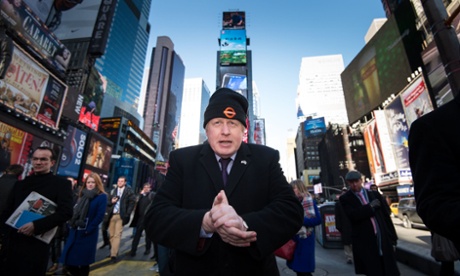
Boris Johnson is hosting his LBC phone-in from New York.
He is now taking a call from an America.
Q: What did you say last time you spoke to the Queen?
Johnson says, after the Olympics, she wanted to know if people had been entertained by her performance in the opening ceremony. She wanted to know if people thought it was funny. He told her it was brilliant.
Call Clegg is over.
@David_Cameron & @George_Osborne are at the Bombardier site #Derby to talk about the economic plan for the Midlands. pic.twitter.com/YmLNRLp84r
— CapitalEastMids News (@CapitalEMNews) February 12, 2015
We’re now about to get Boris Johnson’s LBC phone-in.
Q: How much would you pay to have a cup of tea with Boris Johnson? (This was a prize in the silenct auction at the Tory fundraising ball.)
Clegg says he hopes someone would pay him for it.
Then he says, as mature politicians, he thinks he and Johnson could have tea together for free.
Q: The latest Evening Standard poll shows the Lib Dems in fifth place.
Clegg says polls come and go.
Q: But you are at 6%.
Tomorrow there will be one showing us at 13%, Clegg claims.
Q: What do you think about Labour’s pink campaign bus for women?
Clegg says he thinks it is like him thinking that, if he drives around in a red sports car, people will vote Lib Dem.
For Harriet Harman to be pious about women, when this government corrected the injustice facing women in the tax system, raised the tax allowance and introduced free school meals, is a bit much, he suggests.
Q: Is Cameron right to say firms should give people a pay rise?
Clegg says it is up to business leaders to decide if they can pay their staff more. But he wants everyone to share in the benefits of recovery.
Q: Couldn’t the UK negotiate a trade deal with a country like the US more quickly if it was independent of the EU?
Clegg says it is “naivety of the most dangerous variety” to think that a country of 60m could negotiate a better trade deal than a Europe of 500m.
He says, in his previous job, he sat opposite hard-faced Chinese negotiating trade deals. The UK would not get a better deal on its own.
And, if we left the EU, Scotland would leave the UK, he says.
Q: I’ve been in international finance. You’re talking tosh. Look at Spain. The EU has impoverished the whole of Spain, Greece and Portugal. The EU favours big corporations, not ordinary people.
Clegg says the EU needs reform. It spends too much on the common agricultural policy.
But leaving it would be an act of “economic self-harm”.
Q: We have just heard that a ceasefire in Ukraine has been agreed, and that President Putin has agreed to withdraw some heavy artillery.
Clegg says any ceasefire is welcome. But he urges caution; we have been here before, he says.
He pays tribute to Angela Merkel, the German chancellor. She has been “formidable” on this, he says.
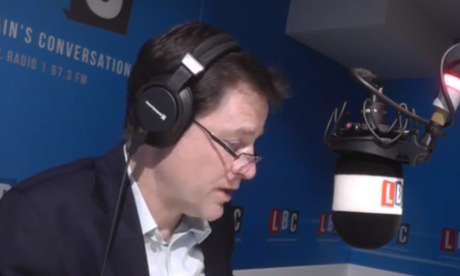
Nick Clegg says he is “incredibly proud” of the amount of money the UK spends on overseas aid.
As an example, he cites Ebola. That could have engulfed the UK, he says.
Q: How? We don’t have the same conditions as they do in West Africa.
Clegg say experts said this could have spread around the world. But Britain was able to lead the world in helping countries in West Africa deal with the problem.
Q: PMQs got ugly yesterday. David Cameron was accused by Ed Miliband of being a “dodgy” prime minister. How appropriate was that?
Clegg says people should not be thin-skinned at PMQs.
There is a serious point here, he says.
He says he won’t get pious; the Lib Dems have had problems with donors before.
We’ve had the Tory fundraising ball this week, he says. The whole thing is a bit “unseemly”.
We need to clean up the system, he says. The public is weary of this.
He says there were talks on party funding. But Labour and the Conservatives both pulled the plug.
The public will become ever more cynical, he says.
He challenges Labour and the Conservatives to say that, whoever wins the election, they will clean up politics within six months.
He says the Conservatives seem to think they can buy the election.
He admits that he spends time on fundraising. But he has to, he says.
David Cameron and Ed Miliband conspired to pull the plug on the talks on reforming party funding. It was a cynical move. They should commit to cleaning up politics now, he says.
Nick Clegg's Call Clegg phone-in
Nick Clegg is hosting his Call Clegg phone-in.
The first question is about nursery provision. A woman who runs a nursery says she might have to make someone redundant because support for her nursery has been cut.
Clegg says he does not know about the local provision from Bath, where the caller is based.
But he says the Lib Dems want to protect nursery funding.
David Cameron is giving a campaign speech in Derby at the moment.
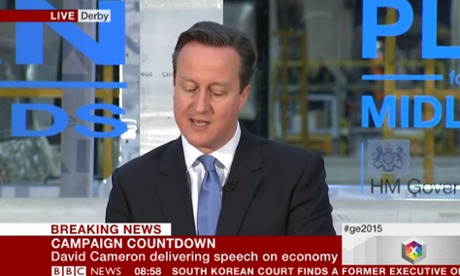
Party sources said in advance it would be a routine campaign speech, but I will be monitoring it anyway.
Ed Miliband is giving a speech on education this morning, but reporters will be primarily interested in whether he repeats what he said about the Tory donor and former party treasurer, Lord Fink, in the Commons yesterday. Fink is threatening to sue if he does.
According to Labour sources, Miliband will stand by his claim. This is what Harriet Harman, Labour’s deputy leader, said about this on Newsnight last night. Asked if he would stand by his comment, Harman replied.
Yes, and he stands by the assertion that these questions must be answered that are in the Guardian - and there they are - there are concerns about tax avoidance.
That’s one drama on the go today. Here’s the full agenda for the day.
9am: Nick Clegg hosts his Call Clegg phone-in.
9.30am: Boris Johnson, the mayor of London, hosts his LBC phone-in.
9.30am: Figures for violent crime and sexual offences are released.
10.15am: Nicky Morgan, the education secretary, speaks at the Early Intervention Foundation conference.
10.30am: The Bank of England publishes its quarterly inflation report.
10.30am: Grant Shapps, the Conservative chairman, gives a speech on free trade.
Morning: David Cameron and George Osborne are doing a campaign visit.
11.30am: Clegg holds a press conference in Oxford to announce the Lib Dems’ manifesto priorities.
11.40am: Nigel Farage gives a speech.
12pm: Ed Miliband gives a speech on education. He will announce that Labour could cap class sizes for children at five, six and seven.
As usual, I will be also covering all the breaking political news from Westminster, as well as bringing you the most interesting political comment and analysis from the web and from Twitter. I will post a summary at lunchtime and another in the afternoon.
If you want to follow me on Twitter, I’m on @AndrewSparrow