Afternoon summary
- Labour has condemned today’s council funding cuts in the light of figures showing that urban areas will be hit much harder than rural areas. According to the Local Government Chronicle, shire councils will see their spending power fall by 0.6% in 2015-16, but metropolitan councils will see their spending power fall by 3.8%. There is more detial on this BBC chart, which shows which areas will lose the most. Hilary Benn, the shadow communities secretary, said:
Ministers have been criticised by the National Audit Office, among others, for having little understanding of the impact on frontline services of their decisions and they are failing to devolve power so that public money is most effectively spent.
Instead of a fairer settlement the government has hit the communities with the most need the hardest, and instead of giving councils the long-term budgets and freedoms they need to make real long-term sustainable savings, the libraries that enrich our children’s education, the social care for our elderly to keep them healthy and out of hospital and the everyday council services like bin collections and street cleaning are bearing the brunt.
-
Labour has criticised the Conservatives and the Lib Dems for breaking their pledge to cut the cost of special advisers. Responding to figures showing that there are now 107 special advisers in Whitehall, costing £8.4m a year - up from £7.2m last year - Angela Eagle, the shadow leader of the Commons, said:
David Cameron promised to get the cost of politics down but under him the number of special advisers spirals ever upwards - the public are now picking up a bill of over 8 million to pay for his appointees.
This also shows how you can’t trust a word Nick Clegg says. The Lib Dems used to say that special advisers shouldn’t be paid for by the public but as soon as he got his feet under the cabinet table, he broke his word.
- A cabinet minster and two Whitehall departments have been rebuked by the statistics watchdog over their use of figures. As the Press Assocation reports, education Secretary Nicky Morgan was rapped for claiming that one in three youngsters left primary school unable to read or write under Labour. UK Statistics Authority (UKSA) chairman Sir Andrew Dilnot told her she should “reconsider” the comments made in the House of Commons and may need to correct the parliamentary record. The DWP was urged by Sir Andrew to “exercise caution” in future statements about the impact of its policies after asserting that more than 12,000 households have found work or stopped welfare claims because of the benefit cap. The UKSA found that while the figures for claimants moving into work and stopping claiming housing benefit were accurate, the DWP did not have evidence that the individuals took the decision because of the 500-a-week cap on most welfare payments. And the watchdog also criticised a Treasury document setting out the increase in female employment in different sectors of the economy. A bar chart produced by the Treasury showed a 23% increase between 2010 and 2014 in women working in agriculture and mining and a 14% increase in manufacturing, both towering over a much smaller bar showing a 5% rise in female workers in the service sector. However, the 571,000 increase in jobs in the service sector - which employs many more women - was far larger than the 38,000 rise in agriculture and mining and 91,000 in manufacturing.
- Matthew Hancock, the business minister, has announced that a specialist police unit to tackle international corruption will be set up as part of government efforts to tackle white collar crime.
That’s all from me for today.
Happy Christmas.
Updated
It is owed the money because it paid £4.5bn in compensation to British savers when the bank failed. It has now recovered £3.82bn of the money it is owed.
Andrea Leadsom, the economic secretary to the Treasury, said:
The failure of the Icelandic banks cost taxpayers billions of pounds, with no certainty of ever getting the money back. We remain committed to recovering the full outstanding amount of the British taxpayer’s claim from the Landsbanki estate, and will continue to work hard to make this happen as soon as possible.
On the written ministerial statement front, my colleague Frances Perraudin had a look at what Defra is saying about bovine TB.
On the same day that official figures seem to show that the slaughtering of badgers in Gloucestershire and Somerset did very little to reduce bovine TB, the Department for Environment, Food & Rural Affairs has released details of further plans to combat the spread of the disease which include more culling.
The Biosecurity Action Plan sets out measures to help farmers reduce the risk of disease on their farms, with plans for bespoke veterinary advice on TB management and the launch of a web-based map showing locations of the disease.
In another announcement flagged up in a written ministerial statements, the government has decided not to change the law to allow humanist marriages - or “marriages by non-religious belief organisations”, as they put it.
Even though a majority of people who responded to the consultation were in favour, the government has shelved the idea. This news release explains why.
The consultation raised a number of complex issues which have wider implications for the law concerning marriage ceremonies. In particular, the majority of couples with religious or non-religious beliefs are restricted in where they can marry, and so implementing this change for non-religious belief organisations would create a further difference of treatment in marriage law. There also needs to be further consideration of how to prevent inappropriate groups from registering to conduct ceremonies and guard against any risk in relation to forced and sham marriages and the commercialisation of marriage solemnisation.
Marriage is one of our most important and valued institutions and we need to make sure any changes to the law are conducted with care. In order to consider the legal and technical requirements and the range of relevant issues including those raised by the consultation, the government will ask the Law Commission if it will carry out a broader review of the law concerning marriage ceremonies.
More from the written ministerial statements. My colleague Frances Perraudin has looked at the one about the independent library report (pdf).
An independent report into the state of the public library service in England has come to some damming conclusions, warning of large-scale closures if services aren’t improved.
The report was written by William Sieghart, a philanthropist, entrepreneur and publisher, and recommended that more emphasis be put on the digital services that libraries provide, rolling WiFi out to every one in the country. Sieghart recommends that library services be provided in a “retail-standard environment”, with coffee and sofas provided – a detail that has been the main focus of most media coverage of the report.
In the report, Sieghart describes libraries as “a golden thread throughout our lives” and warns that they need to be preserved. He adds that over a third of the population still visits their local library, with that figure rising to nearly half in poorer areas.
“The library does more than simply loan books. It underpins every community,” the report reads. “It is not just a place for self-improvement, but the supplier of an infrastructure for life and learning, from babies to old age, offering support, help, education, and encouraging a love of reading.”
This is what David Hodge, the Conservative leader of Surrey County Council, told the World at One about the council cuts.
The reality for Surrey is we are facing significant demands on school places and on adult social care and children’s services. When we have taken 40% out of our budget, it is extremely difficult to continue to do that. There is a limit. You can only cut local government so far.
In my own county I am now faced with a situation where I have made a statement that I am not prepared to put the county council into debt for £200 million to provide school places, which I believe is a duty of government to ensure that the Surrey residents have school places.
And this is what Martin Tett, the Conservative leader of Buckinghamshire County Council, said:
I think we’ve reached the tipping point ... where we can’t just eat away at our back office services any more. We are going to have to do things in terms of home-to-school transport, cutbacks in a whole range of areas that people are going to really start noticing now.
We are going to have to make cuts of another £46m in the next three years, and those cuts are going to be felt by people.
Ed Balls has passed his grade 4 piano.
Thanks for all good wishes on my Grade 4 piano exam - just heard I passed - and 17/18 on sight-reading! On to Grade 5...
— Ed Balls (@edballsmp) December 17, 2014
In the Commons Kris Hopkins confirmed that the government had cut the funding for the local welfare assistance fund. Centrepoint, the homelessness charity, has condemned the decision. This is from Paul Noblet, its head of public affairs.
In failing to ring-fence funding to protect those in crisis the government has made a young person’s journey from homelessness to independence even harder.
Applications for local assistance schemes were already oversubscribed, but councils, some of whom have worked hard to plug the gaps in funding, will struggle to maintain this much needed safety net.
Ministers must look carefully at responses from councils to this announcement and consider whether their proposal really reflects the level of poverty in many of our communities.
The Local Government Association, which represents councils in England, says that the cuts required as a result of today’s funding settlement will be “the most difficult yet”. It says councils will have to cut £2.6bn from their budgets in 2015/16, and that, as a result, the total reduction in core government funding since 2010 amounts to 40%.
This is from David Sparks, a Labour councillor and the LGA chair.
Councils have spent the past four years finding billions of pounds worth of savings, while working hard to protect the services upon which people rely.
But those same efficiency savings cannot be made again. The savings of more than £2.5 billion councils need to find before April will be the most difficult yet. We cannot pretend that this will not have an impact on local government’s ability to improve people’s quality of life and support local businesses.
It is individuals who have paid the price of funding reductions, whether it is through seeing their local library close, roads deteriorate or support for young people and families scaled back.
He also says the next government should adopt “a much faster and bolder approach to English devolution”.
The government has today published a chart with salary figures for special advisers (pdf).
According to Labour, the cost of special advisers has risen 17% over the last year. This is from the Press Association.
The pay bill for ministers’ special advisers has risen to more than £8m, according to official figures.
Labour said the rise - to a total of 8.4 million for 103 “Spads” in 2013-14 - represented a 17% increase on the previous year.
Six advisers are being paid £100,000 or more, with the list topped by David Cameron’s chief of staff Ed Llewellyn and his director of communications Craig Oliver, who each received £140,000.
Christopher Lockwood, the deputy head of the No 10 Policy Unit, received £134,000; the prime minister’s press secretary Graeme Wilson got £110,000; and Kate Fall, Cameron’s deputy chief of staff, received £100,000.
Deputy Prime Minister Nick Clegg’s director of communications, Steve Lotinga, received £105,000.
Answering business questions in the Commons, the Leader of the House William Hague acknowledged there were more special advisers than there were under Labour, reflecting the “nature of coalition”.
However he said their average pay was lower than it had been during the previous government.
Updated
The government has announced that it would like to stop police cells being used to hold under-18s with mental health conditions. Publishing the findings of a review into this issue, Theresa May, the home secretary, said:
I am determined to put an end to children who are suffering a mental illness being detained in police cells. There is no place for this in our society.
Too frequently it is a police officer who responds to a person in crisis. Vulnerable children and adults should be treated by police with respect and compassion, but I am very clear that it is the job of health professionals to provide the healthcare and support required.
This review sets out valuable recommendations which will improve vastly the police response to people suffering mental health illness and build upon the successful work this Government has done already. In street triage pilot areas the number of people being detained under the Mental Health Act has fallen by an average of 25%, and over 8000 people have been treated by mental health professionals under Liaison and Diversion schemes.
But there’s a catch. As this written ministerial statement (pdf) reveals, stopping the use of police cells for under-18s would require legislation and there is no time for this before the general election. This is from the statement, which is from Norman Lamb, the health minister.
Although there is no space remaining in this parliament to make these changes, I believe there is a general consensus that these issues must be addressed. Therefore I hope that in the next parliament the momentum that has been generated will be maintained.
Thanks to everyone who has offered Christmas wishes BTL. Happy Christmas to you too. And Happy Christmas to everyone.
I haven’t finished for the day - more written ministerial statements coming soon - but I’ll just take this chance to say thank you to you all for reading, and to thank all of you who contribute. The comments are a big part of what makes this blog a success and I value them hugely (apart from the ones that are really rude, of course). I learn something new every day from readers.
I’m not planning to do a daily blog over the Christmas/New Year fortnight, but I intend to run readers’ editions on Monday and Tuesday next week, and every day the following week apart from New Year’s Day.
- Kris Hopkins, the local government minister, has announced that council funding for England will be cut by 1.8% in 2015-16. In a statement to the Commons, he also said the government would provide councils that freeze council tax with extra funding equivalent to a 1% council tax increase. He said that councils would continue to be allowed to raise council tax by up to 2% before having to put the matter to voters in a referendum, meaning that Eric Pickles, the communities secretary, failed to win cabinet support for lowering the threshold to 1%. And Hopkins also published a document showing how councils could save hundreds of millions of pounds from efficiency savings.
- Plans by the home secretary, Theresa May, to introduce a 28-day time limit on the use of police bail before a suspect is charged have been delayed by two months while a coalition dispute over its implementation is resolved. The plans are set out in this written ministerial statement (pdf).
- Nick Clegg has said prime minister’s questions is becoming an increasingly tedious exchange of party political point-scoring and that his presence at the event would not be “constant” in the New Year. On his Call Clegg phone-in, he also ridiculed Ukip for saying that its candidate, Kerry Smith, made offensive remarks about gays and a Chinese woman because he was on sedatives. (See 10.12am.)
- Jeremy Hunt, the health secretary, has said NHS staff should not be forced to work over Christmas to publish A&E waiting time figures. Asking an urgent question in the Commons, shadow health secretary Andy Burnham insisted it was “simply unacceptable” for the publication of A&E data, including waiting times, to be suspended from tomorrow for three weeks over the “crucial” Christmas period. But Hunt accused Labour of caring more about political opportunity than patients, as he said the data was never published during the period.
-
The government has introduced the Lords spiritual (women) bill to enable new women bishops to be given seats in the Lords quickly. There are more details in this written ministerial statement (pdf).
Most of the written ministerial statements due today are now out. You can read them here. I will be covering the news stories in them as the afternoon goes on.
The Unite union has said that council funding settlements are “not sustainable”. This is from its national officer, Fiona Famer.
Local councils are already at breaking point with services being cut to the bone or stopped completely. Many are staring into the financial abyss of bankruptcy because of this latest round of cuts which will eat into key services we all rely on.
Local government needs a fair funding settlement. It is simply not sustainable to expect councils serving some of the poorest communities in the country to bear the brunt of the Tory-led government’s addiction to austerity.
And this is what Tony Travers, the local government expert, was saying.
Professor Tony Travers says "local government has continued to have surprisingly good satisfaction measures" #wato
— The World at One (@BBCWorldatOne) December 18, 2014
But that has led to a confidence in the Treasury of being able to cut further - Tony Travers on #wato
— The World at One (@BBCWorldatOne) December 18, 2014
On the World at One council leaders have been talking about the impact of the cuts.
Surrey Council leader: "When we've taken 40% out of our budgets, it's extremely difficult to continue, continue to do that." #wato
— Nick Sutton (@suttonnick) December 18, 2014
"I think we've reached the tipping point.. people are really going to start noticing now" - leader of Buckinghamshire County Council #wato
— The World at One (@BBCWorldatOne) December 18, 2014
Bucks Council Leader: "We're going to have to make cuts of about another £46m in the next 3 yrs & those cuts are going to be felt by people"
— Nick Sutton (@suttonnick) December 18, 2014
Labour’s Jeremy Corbyn asks Hopkins if he realises what the impact of these cuts will be. His council (he’s MP for Islington North) will face cumulative cuts worth 50%, he says.
Hopkins says Corbyn should remember what state Labour left the economy in.
Hilary Benn, the shadow communities secretary, has been tweeting about the council funding settlement.
Once again, it is the poorest communities that are being hardest hit in the local government settlement.
— Hilary Benn MP (@hilarybennmp) December 18, 2014
Now clear that Eric Pickles lost his battle with George Osborne to save funding for the local welfare assistance fund.
— Hilary Benn MP (@hilarybennmp) December 18, 2014
Labour’s Jack Dromey says Birmingham is losing £338m over the next two years. It is losing more than Surrey.
The Society of Local Authority Chief Executives and Senior Managers (SOLACE) has said that today’s cuts will push some councils “to breaking point”. This is from its director, Graeme McDonald.
This settlement reminds us that the financial challenge facing local government is immense. Cuts of up to 6.4% will push some authorities to breaking point.
Government is beginning to recognise that councils have led the way on deficit reduction, but with cuts and demand increasing, fragility is beginning to show. The financial future of local services is unsustainable without a more ambitious plan for public service reform.
Here’s the start of the Press Association story about the cuts.
Councils in England are to face an overall cut of 1.8% in their total spending power in 2015/16.
Announcing the settlement in the House of Commons, local government minister Kris Hopkins said that the reduction would leave councils with “considerable total spending power”.
The 1.8% cut - first pencilled in last year - was lower than in 2014/15 and one of the lowest since the coalition came to power in 2010, said Mr Hopkins. No council will face a loss in spending power of more than 6.4%.
Hopkins described the settlement as “fair for all parts of the country, whether North or South, urban or rural”.
The bulk of local authorities’ spending power comes from grants from central government, with around a quarter raised from council tax.
Hopkins is replying to Benn.
He says he is disappointed by the tone of Benn’s statement. Benn did not recognise Labour’s role in the financial crisis.
All councils need to transform the way they operate. That is happening on the grounds, at, for example, Labour-controlled Manchester. Councils like that are more open-minded than the Labour frontbench.
Councils are facing a cut in central government grant of 1.8%. But, if you take into account other revenue, the cut in their spending power is 1.6%, he says.
Hilary Benn, the shadow communities secretary, says council resent the suggestion that the cuts are modest.
Councils serving the most deprived areas have been hit the hardest, he says.
He asks Hopkins to publish figures showing the cumulative impact of cuts.
Will he confirm the new homes bonus takes funding away from poor areas, and gives it to councils where homes would probably be built anyway?
Will he confirm that Eric Pickles has lost his battle to keep the local welfare assistance fund?
Benn says MPs have just had a statement on the crisis in A&E. But that is partly because by the loss of adult social care services.
Labour will not join the Conservatives in a headlong rush back to the 1930s, he says.
He says ministers have no idea what is going on.
Hopkins says over the last year councils have increased their reserves by £2.2bn. They now have reserves of £21.4bn.
He says the government will make funds available to allow councils to freeze council tax.
Councils that want to put council tax up by more than 2% will have to hold a referendum, he says. That means ...
- Eric Pickles has lost his bid to force councils to hold a referendum if they want to raise council tax by more than 1%.
Councils (+ police) can raise council tax (+ precept) by up to 2% without referendum...victory for Theresa May over Eric Pickles
— Rob Merrick (@Rob_Merrick) December 18, 2014
Updated
Hopkins is delivering this statement very badly. He keeps stumbling over his words. ITV’s Simon Mares says Eric Pickles, who is sitting beside him, is not helping.
Stumbling delivery by minister Kris Hopkins as he details council cuts to MPs - not helped by a running commentary by his boss Eric Pickles.
— Simon Mares (@SimonMaresITV) December 18, 2014
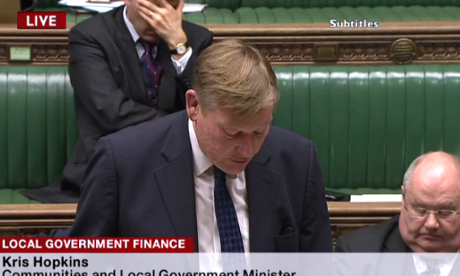
Hopkins says the best authorities are transforming the way they do services.
He says they need to prioritise the way they do business.
Hopkins says it is not just about the amount of money the government gives to councils.
The government has given them the tools to help themselves. Now they can keep business rates revenue. Hopkins says 91% of them expect to increase their business rates revenue.
And they can also raise money through the new homes bonus, he says.
Statement on council cuts
Kris Hopkins, the local government minister, is speaking now.
He says local government has made a significant contribution to putting the public finances back on track.
But “very substantial savings” will have to be made in future.
He says the local government settlement is fair to all parts of the country.
Councils in England are due to spend £114bn - a quarter of public spending.
The overall reduction to councils will be 1.8%, as planned, he says.
-
Council funding in England to be cut by 1.8%, as planned, Hopkins announces.
Councils to lose spending power of 1.8% says govt in #localgov finance settlement @lgcplus
— Rachel Dalton (@RachelDaltonLGC) December 18, 2014
No council will lose more than 6.4% in spending power, says Kris Hopkins in #localgov finance settlement @lgcplus
— Rachel Dalton (@RachelDaltonLGC) December 18, 2014
Updated
Actually, it is Kris Hopkins, the local government minister, making the statement, I’ve been told.
He is due to speak any minute now.
Eric Pickles, the communities secretary, is due to make his statement about council spending in the Commons shortly.
He will present the funding grants for 2015-16. Last year the government signalled that councils would face a cut of 1.8%.
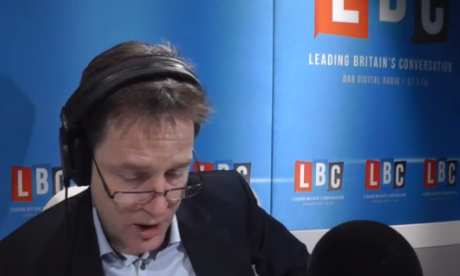
Nick Clegg's Call Clegg phone-in - Summary
Here are the key points from Nick Clegg’s Call Clegg phone-in.
-
Clegg ridiculed the Ukip claim that its candidate, Kerry Smith, made offensive remarks about gays and a Chinese woman because he was on sedatives.
Apparently, according to Kerry Smith, he was on sedatives. Of all the excuses for this kind of bile and racist, homophoboic vitriol, was “I was on a sedative”. Most people on a sedative don’t become Alf Garnett on stilts, do they. Most people on sedatives go to sleep. But apparently in Ukip, if you are on a sedative, you just become even unpleasant.
What we are seeing in Ukip is what I always predicted would happen, which is that the more they try and become like a political party, rather than just a movement of angry blokes - it’s almost always angry blokes in suits just saying they are against everything - and the more they are being pressed on what they would do, the more the problems emerge.
When Nick Ferrari joked about Smith being on Red Bull instead, Clegg said:
If that’s what they do on sedatives, just imagine what they would do on Red Bull.
-
He said Sony was wrong to cancel the release of a comedy about North Korea following online threats.
They’ve got it wrong. It’s a comedy, for heaven’s sake. It’s just extraordinary that in a free society we are allowing these online thugs from this police state to intimidate people having a bit of fun ... There’s a big issue of principle here. We can’t have police states, through hacking and online intimidation, stopping free societies like ours having films shown on the cinemas that we want to see.
- He suggested he would be boycotting PMQs more in the new year because it was becoming a party political contest between Labour and the Conservatives.
Do I enjoy sitting there watching Ed Miliband and David Cameron, week in, week out, tear strips off each, and I can’t get up and say my piece - it’s not my favourite place to be ...
David Cameron, to be blunt, is not speaking as prime minister of a coalition government, increasingly, at prime minister’s questions. He’s basically using it as a platform to advertise Conservative party policy. Now, it’s not really my job to sit there, on my hands, politely helping him along ...
The more this is basically becoming an increasingly tedious exchange of party political people branding their own party credentials, rather than what prime minister’s questions is supposed to be about, which is the opposition scrutinising the coalition government as a whole, and the prime minister defending the coalition government as a whole, then I think my present isn’t going to be constant.
-
He defended Vince Cable’s handling of the sale of Royal Mail.
I’ve got to go to a meeting now. I won’t be posting again until around lunchtime.
Updated
Q: Were Sony right to pull the comedy about North Korea?
No, says Clegg. They were wrong. They should not back down in the face of threats from “online thugs from a police state”.
We should not allow them to intimidate cinema chains.
There is a big issue of principle here. We cannot allow police states to stop cinemas showing films.
Nick Ferrari says he and Clegg have prerecorded a Call Clegg from Sheffield children’s hospital that will go out on Christmas Day. (There won’t be live blog coverage, you’ll all be glad to here.)
And Ferrari presents him with a cake to mark the fact it is seven years to the day since he became Lib Dem leader.
Clegg says he does not expect to be doing another seven years.
And that’s it. I’ll post a summary soon.
Q: At our school, where people are supposed to get free school meals, they are just getting packed lunches, including frozen sandwiches and donughts.
Clegg asks for the name of the school. The caller says she does not want to give it on air. Clegg says what she is describing is “completely wrong”. He will get the details of the school and look into it.
Q: Do you think Kerry Smith, the Ukip candidate who resigned over offensive remarks, shows the true state of Ukip?
Clegg says Ukip said Smith made those comments because he was on sedatives. Sedatives are supposed to calm you down, he jokes. Imagine what he would be saying without sedatives.
Clegg says this shows the reality of Ukip. They are angry, negative men.
Q: Do you support the EU’s decision to take Hamas off its list of terrorist organisations?
Clegg says the EU decision is a bit more complicated than that. It was to do with definitions affecting financial sanctions.
Q: Why don’t you just not turn up at PMQs?
From time to time, I don’t, says Clegg.
Q: Why don’t you yawn?
Or do my Christmas cards, Clegg suggests. Or catch up on emails? Or play Candy Crush?
Clegg says the more PMQs becomes a party political affair, rather than the government defending coalition policy, the more likely he is to miss it.
Q: Why do my partner and I no longer get child benefit, when child benefit is being paid to children living abroad?
Clegg says the caller is right. That system is wrong.
Q: What are you going to do about it?
Clegg says the EU rules need to change. The government is already talking to other countries about this.
Q: At PMQs yesterday you looked very grumpy?
Clegg says it is not his favourite time of the week. He has to listen to David Cameron and Ed Miliband and cannot say anything.
Cameron is increasingly using PMQs as a platform to advertise Conservative policy, he says. He is not talking as head of a coalition government.
Q: Pupils are shunning your free school meals, according to a story.
Clegg says this is from that joyless lot at the Daily Mail.
Some 85% of pupils are eating free school meals.
Clegg says packed lunches are often not as healthy as school meals.
Now 1.6m pupils are eating free school meals.
That saves families £400 per child, he says.
There will always be some grumpy people trying to pooh-pooh an idea like this. But parents like it, children like it and teachers like it.
On Call Clegg Nick Ferrari asks about a story that has just broken about a European Court of Justice ruling.
Here is the Press Association snap about it.
The European Court of Justice has ruled that British-Irish citizen Sean McCarthy should be allowed to bring his Colombian wife to the UK from their home in Spain without her having to apply for a travel visa, potentially opening UK borders to large numbers of non-European Union nationals.
Clegg says he does not know about this case.
Q: So Columbians are free to come here now?
Clegg says he suspects the case was about the status of the wife’s resident permit compared to a passport.
Back to the Myners report about the sale of the Royal Mail. Lord Myners was on the Today programme earlier talking about it. He said on balance it was a “well-executed” exercise.
Actually it was on balance a well-executed, complex exercise. The government managed to achieve its objective; privatising the Royal Mail, exposing it to market discipline and importantly access to private capital should it require further capital in the future. So, this was something which governments over the last twenty years or so had tried to do but had failed. And the government was successful in the privatisation …
The important thing is that the panel of experts concluded that it’s possible that the Royal Mail could have been sold for 20p or 30p more a share, but that would have taken considerable risk into the transaction.
I’ve taken the quote from PoliticsHome.
Updated
Q: What are you going to do about the epidemic of child abuse? [The caller says she is an abuse survivor.]
Clegg says the government has set up a child abuse inquiry.
The police will have to face some cuts, he says.
But this is one of the reasons why he disapproves of George Osborne’s rightwing lurch. Osborne expects services like the police to bear all the burden of deficit reduction.
Q: But I’m concerned that the police don’t have the resources they need.
Clegg says the police will have to make savings. But it is a balancing act. They must be allowed to pursue the truth.
Nick Clegg hosts his LBC phone-in
Q: There is a report today about the shortfall when the Royal Mail was sold. Shouldn’t those responsible have to pay?
Clegg says Lord Myners says the sale of the Royal Mail was done professionally, very well. People said the sale was undervalued by £1bn or so. The Royal Mail was sold for £2bn. Myners says the government could have got £180m more. But it says that could not have happened without the government taking a risk, and that the government was entitled not to take a risk.
Clegg says he has always defended Vince Cable on this.
Q: But £180m is not peanuts. This is taxapayers’ money. And you won’t admit this was wrong. Your advisers are benefiting, not the taxpayer. When will you admit you made mistake. If these are professionals, no wonder the country is in the state it is in?
Clegg says the caller should read the Myners report. (You can read it in full here - pdf.)
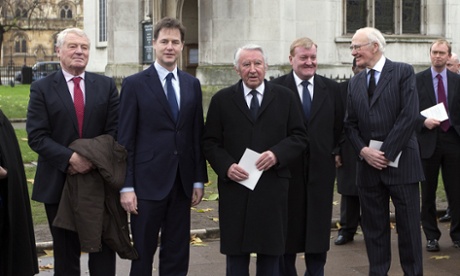
The Commons is sitting today for the last time in 2014. This may also be my last live blog of the year (I’m working some days next week, but probably won’t be doing a daily blog, unless a big story breaks) and it’s going to be a bit patchy, because I’ve got to disappear after 10am until lunchtime for a meeting.
That means I won’t be doing minute by minute coverage of the Eric Pickles statement on council spending cuts, which is due at about 11.15am, but there will be coverage at theguardian.com/politics and I will pick up reaction later.
This is the day when the government always unloads a mountain of ministerial statements - announcements that they have to make before the recess, but which they’ve been holding back, often because they contain bad news. Here’s the full list of statements we’re getting.
1. Secretary of State for Business, Innovation and Skills: UK Anti-Corruption Plan
2. Chancellor of the Exchequer: Annual European Union Finances Statement
3. Chancellor of the Exchequer: Trading plan for Government’s shares in Lloyds Banking Group
4. Secretary of State for Communities and Local Government: Ebbsfleet
5. Secretary of State for Communities and Local Government: Integration update
6. Secretary of State for Communities and Local Government: Sustainable drainage systems
7. Secretary of State for Culture, Media and Sport: Publication of the Independent Library Report
8. Secretary of State for Defence: Future Reserves 2020 External Scrutiny Team Report 2014
9. Secretary of State for Defence: The United Kingdom’s Future Nuclear Deterrent 2014 Update to Parliament
10. Deputy Prime Minister: City Deals
11. Deputy Prime Minister: Publication of Lords Spiritual (Women) Bill
12. Secretary of State for Education: Fund for European Aid to the Most Deprived: School Breakfast Clubs
13. Secretary of State for Education: Publication of Reformed AS and A Level Content
14. Secretary of State for Energy and Climate Change: Lima Climate Change Conference
15. Secretary of State for Environment, Food and Rural Affairs: Bovine TB
16. Secretary of State for Foreign and Commonwealth Affairs: British Council Annual Report
17. Secretary of State for Foreign and Commonwealth Affairs: EU: Balance of Competences Review
18. Secretary of State for Foreign and Commonwealth Affairs: Falkland Islands: Award of South Atlantic Medal
19. Secretary of State for Foreign and Commonwealth Affairs: Protection and immunity for UK military personnel
20. Secretary of State for Health: Mental Health and Policing
21. Secretary of State for the Home Department: Counter-Terrorism and Security Bill: Consultation Documents
22. Secretary of State for the Home Department: Daniel Morgan
23. Secretary of State for the Home Department: Statutory time limits for police bail
24. Secretary of State for the Home Department: Violence Against Women and Girls
25. Secretary of State for Justice: Marriages by non-religious belief organisations
26. Secretary of State for Justice: Office of the Public Guardian - Report into the Review of Supervision
27. Secretary of State for Justice: Transforming Rehabilitation Update
28. Prime Minister: Annual report on the National Security Strategy and Strategic Defence and Security Review
29. Secretary of State for Transport: Haulage: road tank vehicle compliance
30. Secretary of State for Work and Pensions: Access to Work
31. Secretary of State for Work and Pensions: Employment, Social Policy, Health and Consumer Affairs Council (EPSCO) 11 December 2014, Brussels
32. Secretary of State for Work and Pensions: Remploy Annual Report and Accounts 2013-14
I’ll be going through them, of course, this afternoon.
First, though, there’s Call Clegg.
If you want to follow me on Twitter, I’m on @AndrewSparrow.
Updated