Summary
- Ed Miliband has pledged to stand up to “powerful vested interests” in the banking and energy sector as prime minister if he wins the general election next May. As Nicholas Watt reports, in a speech designed to herald a fightback after facing criticism from Labour MPs, Miliband promised to take on those forces as he said that banks and energy companies must be made to work in the public interest. But the Labour leader declined to endorse a claim by Andy Burnham, the shadow health secretary, that powerful vested interests have been behind the criticisms of him and his poll ratings in the past week. Asked by the Guardian to explain Burnham’s intervention, Miliband said: “As for the business about the last week, I am going to leave that to others.”
- John Major is to warn that Britain is in danger of stumbling out of the EU in a divorce that would be “final”. As Nicholas Watt reports, speaking to Angela Merkel’s CDU party, the former prime minister will say in Berlin on Thursday that Britain and the EU are heading towards a “breach” unless concerns over immigration are addressed. Major, who will speak to the CDU’s main thinktank, the Konrad Adenauer Stiftung, will say that Europe could find itself “sleepwalking into antagonisms it cannot repair”, which could lead to an irrevocable split. This, he will say, would neither be in the interests of the UK nor the EU.
-
The Electoral Commission has released figures showing the Conservative Party received more than twice as much in donations as Labour in the third quarter of this year. As the Press Association reports, the Conservative party reported donations totalling 6.76m, while Labour’s total was 3.19m. The Liberal Democrats reported 2.75m, the SNP 1.57m and Ukip £98,387, the Electoral Commission figures showed.
That’s all from me for today. I’ve got a school parents’ evening to go to.
Tomorrow I’ll be blogging from the SNP conference in Perth, where Alex Salmond will be making his last speech to the conference as party leader.
Thanks for the comments.
My colleague Tom Clark has written an analysis of the speech. And he liked it. Here’s an excerpt.
The Blairite wing will, as so often before, despair at a “35% strategy”, which banks all those who stuck with Brown in 2010 and chucks in a few disillusioned Lib Dems, but fails to do much to lure former Tories over to Labour. The truth, however, as revealed by the polls at the moment is that 35% would be a pretty good showing for either of the two main party tribes. Labour MPs say that what has changed over the past six weeks of panic is that the old assumption that the core would stay loyal is fizzling away, as voters who no longer know what their party stands for peel off in every direction, to the Greens, Ukip and the SNP.
Today Miliband set himself the task of reminding them what he was about, and what the party was for. That made for a good speech, and it could also prove smarter politics than the alternative of abandoning tribe and rendering Labour so indistinct that core voters would sit on their hands. There are moments when triangulation serves its purpose, but Miliband may be smart to recognise that this isn’t one.
Here’s a Guardian video with highlights from Ed Miliband’s speech.
In the light of Ed Miliband’s speech, Nigel Farage is challenging him to a debate.
Come and have a go, @Ed_Miliband pic.twitter.com/zRbooh84b9
— Nigel Farage (@Nigel_Farage) November 13, 2014
(Farage seems to be the last person in the UK to write letters on a typewriter.)
Five reasons why Ed Miliband's speech was rather good
On the World at One a few minutes ago Matthew Taylor, a former adviser to Tony Blair, said Ed Miliband’s challenge today was to turn adversity to his advantage. The speech did not contain any novel news lines, but it may well have boosted Miliband’s authority in his party, and amongst the commentariat, as well as any speech of this kind can do. (By “speech of this kind”, I mean something delivered on a quiet Thursday morning, not in parliament or at a party conference.)
Why? Here are five reasons why I thought the speech was effective.
1 - At last, Ed Miliband launched an unequivocal attack on Ukip. For some time now Labour and the Conservatives have been confused about how to handle Ukip, torn between accommodation and confrontation. This infuriated Tony Blair, who earlier this year made a rare intervention in British politics to deliver a lecture to Miliband, and David Cameron, on what they should say. Today, on this point at least, Miliband went Blairite. I’ll quote what he said at length.
Unlike the Tories, what we will never do is try to out-UKIP UKIP.
I think it is time we levelled with people about UKIP.
They’ve got away with it for too long.
It is time we had a debate about where they really stand.
They do have a vision of the past.
But I say to working people in this country, let’s really examine their vision.
Because when you stop and look at it, it is not really very attractive.
And it is rooted in the same failed ideas that have let our country down.
Piece together the different statements from Mr Farage and his gang and think about what it says:
That working mothers aren’t worth as much as men.
Life was easier when there wasn’t equality for gay and lesbian people.
You feel safer when you don’t have someone who is foreign living next door.
The NHS would be better off privatised.
Rights at work, whether they come from Europe or from here, are simply a barrier to economic success.
And let’s get out of the European Union.
Is that really the country we want to be?
I don’t believe that.
I don’t believe that’s the kind of country people want.
Of course, people rightly feel a sense of loss about the past.
Jobs that have gone.
Communities that have changed.
Prospects for your kids that are diminished.
But the answer is not to return to a more unequal, more unjust past.
Mr Farage, you may want to live in that world.
But come the general election, I don’t believe the people of Britain will follow.
2 - Miliband quite cleverly turned being monstered into the press into a virtue. At one point in his interview on the BBC last night Miliband seemed to come close to saying it was good his poll ratings were at a record low, because that allowed his mettle to be tested. Today he found a slightly better way of turning demonisation to his advantage.
I am willing to put up with whatever is thrown at me, in order to fight for you.
That’s my duty, that’s my responsibility.
That’s our duty, that’s our responsibility.
Not to shrink from the fight.
Not to buckle under the pressure.
But to win.
3 - He reminded Labour that victory was in its grasp. A reader of the press over the last week would conclude that Miliband’s chances of winning the election are almost non-existent. Actually, that’s not true. Most polls show Labour ahead and, even if the lead narrows or disappears, seat distribution still favours the party. But Miliband did not just tell his party to have a go on the Electoral Calculus seat predictor. (See 10.18am.) He came up with a better argument.
And remember:
We’re in a fight not because our opponents think we’re destined to lose the election.
But because they fear we can win.
4 - He explained why people should vote Labour very simply. At the CBI this week David Cameron summed up his manifesto case in a sentence. Today Miliband did something similar.
Now I have heard some people say they don’t know what we stand for.
So let me take the opportunity today to spell it out in the simplest of terms.
It is what I stood for when I won the leadership of this party.
And it is what I stand for today.
This country is too unequal.
And we need to change it.
5 - He explained why his background made him a good candidate to be prime minister. Miliband had a relatively unconventional upbringing. His parents were both immigrants, they were both very radical (his father is dead, but his mum is still alive), and his father was a Marxist academic. In the speech Miliband did not talk about this directly. But he clearly alluded to this in a passage where he said he was brought up to believe in the power of ideas and the need for change.
When I hear the stories of people who say this country isn’t working for them and they don’t see a future, I don’t shrug my shoulders and say there’s nothing we can do.
Because I was brought up to believe that it matters and we can change things.
When powerful forces try to tell me “no way”, I answer: “who says?”
Because I’ve always believed that no force in our country should be too powerful to be held to account.
And I am proud to believe that we need big ideas to change our country.
This passage worked because it rang true.
One final point. The attack on Ukip was Blairite, but Miliband also quoted Blair almost directly at one point. In his final conference speech as Labour leader Blair said:
If we can’t take this lot apart in the next few years we shouldn’t be in the business of politics at all.
And today Miliband said:
Friends, I say we can take this lot apart and it is time we did.
It doesn’t quite make Miliband a Blairite. But perhaps Blair might be a bit more positive the next time he’s asked about Miliband on Sky.
Updated
And here’s Ukip’s Douglas Carswell hitting back at Ed Miliband.
Ed Miliband attacks UKIP. Just remember that his party put in place a tax credit system that uses public money to encourage low wages.
— Douglas Carswell MP (@DouglasCarswell) November 13, 2014
Here is some comment on the speech from journalists
From LabourList’s Mark Ferguson
Miliband looking right down the barrel of the camera. Compared to conference this speech is better pitched, written and delivered
— Mark Ferguson (@Markfergusonuk) November 13, 2014
Much improved performance from Miliband. Delivered with passion and that will have boosted the base - still a great deal to do, but better
— Mark Ferguson (@Markfergusonuk) November 13, 2014
Good questions about “vested interests” for Miliband to answer. They do exist, but Labour must name them and be clear about who they mean
— Mark Ferguson (@Markfergusonuk) November 13, 2014
From PoliticsHome’s Paul Waugh
Perils of holding press + party Q and A, journalists hissed at (@chrisshipitv) or heckled (@andybell5news) by members. Is that a good look?
— Paul Waugh (@paulwaugh) November 13, 2014
Miliband's best answer so far was on immigration, says it's positive 'in aggregate..but people don't live their lives in aggregate'
— Paul Waugh (@paulwaugh) November 13, 2014
From the Spectator’s Isabel Hardman
This section on the party's policies is very good and passionate.
— Isabel Hardman (@IsabelHardman) November 13, 2014
I thought that was a good speech from Miliband. He seemed passionate and talked more about Labour values than himself.
— Isabel Hardman (@IsabelHardman) November 13, 2014
Look it didn't really tell us anything new about Miliband and didn't feature a personality transplant. But he managed to appear in charge
— Isabel Hardman (@IsabelHardman) November 13, 2014
From the Birmingham Mail’s Jonathan Walker
This Q&A session is the type of thing Ed Miliband is good at and he should probably do it more often
— Jonathan Walker (@jonwalker121) November 13, 2014
Miliband's speech - Snap verdict
Snap verdict: Job done, I guess. That wasn’t a speech that will transform the political landscape - hardly any speech ever does - but it should certainly calm the nerves in Labour for a while, and it should effectively draw a line under the last eight days of party turmoil. (Which is not to say that there won’t be another bout before the election.) As a statement of what Ed Miliband stands for, it was robust and quite powerful. But what was most interesting was what Miliband had to say about Ukip. Labour and the Conservatives have both been relatively uncertain about how to handle Ukip over recent years, but today Miliband attacked them more directly, and more coherently, than he has ever done before.
I’ll post a more detailed summary soon.
Updated
Miliband concludes with a message to his party.
Labour is in a tough fight, he says. It can only win with your support. Thank you for what you do, he says.
Q: It is obscene that some wealthy people can get away paying no tax. What will you do about that?
Miliband says nothing annoys people more than tax avoidance.
Labour will say more about this shortly.
Many people feel there is one rule for the rich, and one for everyone else.
The government says that, to make the rich work harder, it will cut their taxes. But, for everyone else, it will punish them to make them work harder. That’s not fair.
Q: (From the Guardian’s Nicholas Watt) What do you think of John Major’s message in Germany today? And who are the shadowy vested interests in the media that Andy Burnham talked about this morning?
Miliband says Major’s speech is a pretty damning indictment. Major is saying that Cameron’s strategy in Europe is burning bridge and burning alliances. Two years ago you could have said this might work. But now the jury is in. We know it doesn’t work. Look at the Jean-Claude Juncker vote. That is because, if Cameron is supporting a cause, it is seen as toxic. People think he is only acting to please the Tory party.
On the media point, he will leave that commentary to others. But he will stand up to vested interests, he says.
Q: The CBI leader said immigration is good for us. So why do people always talk about the negative impact of immigration?
Miliband says he always talks about the benefits of immigration when he talks about this subject.
In aggregate, immigration is good.
But people do not live their lives in the aggregate. Immigration affects people differently. Some people are having their wages undercut. That is why it is important to have the right controls.
Miliband says Cameron made a promise to get immigration below 100,000 without having any idea how to meet that promise. That has massively increased cynicism about politics, he says.
And you have this flexibility in the labour force.
But one person’s flexibility is another person’s exploitation.
Q: (From a sixth-former) What can you do to ensure my young sisters have a better future than me?
Miliband says he wants 16 and 17-year-olds to get the vote. He wants to show he trusts them.
And he wants to show young people that Labour has answers.
Q: (From Newsnight’s Allegra Stratton) Can you identify one mistake you’ve made in the last four years?
Miliband says the lesson he’s learnt is that you need to get out of Westminster more. You learn more that way. And he will be doing more of that, he says.
Q: So your ratings are low because people have not seen enough of you?
Miliband says getting out to campaign is the best thing he can do.
Q: Why should we stay in the EU?
Miliband says we benefit from the single market. Millions of jobs depend on it. And, if we want to tackle issues like climate job, it is better to do so within the EU.
And he says he believes in an outward-looking Britain. He does not believe in a Britain that cuts itself off.
The Tory party is “increasingly a party drifting towards exit in the European Union”, he says. David Cameron does not stand up to that force. And Ukip explicitly wants to leave.
But you can only have an outward-looking society by having a more equal society at home. That’s because it is discontent with the status quo that is driving people towards Ukip.
Q: (From a Labour member) All parties seem out of touch. The rich borough where I live has a social cleansing programme; it is trying go get the poor to move out. How can we say we have a plan to preserve mixed communities?
Miliband says Labour would build 200,000 homes a year. That is a practical plan, he says.
And it is going to deal with the injustices in the private rented sector, he says.
Q: (From the Sun’s Tom Newton Dunn) You’ve said it’s not the media’s fault. So how do you get the public to love a geek in just six months?
Miliband says he will be doing events like this again and again over the next six months.
He does not accept the commentary that says the result of the election is already decided.
Q: (From Channel 4 News’ Gary Gibbon) You say you offer big change. But, if you go out and ask people, they won’t say Labour offers big change. Why’s that? Is that the media’s fault?
Miliband says, on the media, that he said last night he was not a whinger. That’s his position.
After 2010, people thought Labour would be out for two terms, he says.
And the election is not over.
Q: Isn’t it about time these bankers who have been laughing at us went to jail?
Miliband says he perfectly undertands that. But he thinks the more important thing is to make sure that banks make a contribution. Labour would do that, by taxing bonuses and having a bank levy.
George Osborne went all the way to Europe to protect bankers’ bonuses.
Labour would make the banks work for our economy, he says.
Q: (From Sky’s Faisal Islam) How have you allowed your supporters to go off to Ukip?
Miliband says there is deep discontent with the way the country is run. And there is deep doubt about whether any party can change things.
Labour’s challenge is to show it has the right answers.
The Tories do not acknowledge the problem. And Ukip’s solutions are wrong.
Q: You’ve been wrong about growth, and jobs, and earnings. If you have been wrong on that, why should people trust you?
Miliband says Cameron said on Monday his manifesto could be summed up in one sentence; our plan is working.
But that is not what people feel, he says.
If all was going so “swimmingly”, why are the Tories finding it so hard to get people to vote for them.
Q: (From ITV’s Chris Ship) Labour MPs says that the problem on the doorstep is that people do not want to vote for you?
Miliband says he does not accept that characterisation. He thinks you should stand up for what you believe in, and go out to win the election.
The match is not over until the final whistle, he says.
If the Tories are so confident of the choice between Miliband and Cameron, why won’t Cameron agree to a TV debate.
I say bring those debates on.
Q: (From the BBC’s Ben Wright) Who are these vested interests out to get you? And aren’t you in danger of sounding paranoid?
Miliband says this is about changing Britain. He wants to take on forces like the banks. And that is what the British people want. They want to ensure people are not ripped off. As with payday lenders, for example. It is Labour’s campaign on this that led to change.
When he made his predators and producers speech a few years ago, people disagreed. But they don’t know; they accept that analysis.
Q: Zero-hours are one of the cruellest cons in the book. Will Labour abolish them?
Miliband says Labour will have more to say about this. Labour’s view is that if you do regular hours, you should get a regular contract.
All the government has said is that you cannot be made to work exclusively for one employer. But that would allow zero-hours contracts to continue for years.
He says he was at an awards event recently where security guards told him they did not know what hours they were working from week to week.
Labour would ensure people working regular hours get a regular contract.
Miliband's Q&A
Miliband has now finished. He is taking questions from journalists and party supporters in the audience.
Q: (From a non-journalist) What would Labour do to improve my local hospital?
Miliband says a hospital is only as good as the services in the community. Hospitals are under pressure because services have been neglected.
When Andy Burnham warned that cutting social care would harm the NHS, he was right. Strengthening social care is the only way forward.
Miliband is now on his peroration.
Millions of people in this country are resting their hopes on us.
We can’t let them down.
We must not let them down.
We will not let them down.
Let’s fight for a fairer, more just, more equal Britain.
That’s what I am going to do.
That’s what you do, day in, day out.
That’s what every person in this Party must do.
That’s the way we’re going to fight and win this general election.
Miliband says Labour will fight the election door by door.
He rattles off a list of priorities.
An £8 minimum wage.
An end to the exploitation of zero hours contracts.
Freezing energy bills until 2017.
Putting our young people back to work.
Paying down the deficit and doing it fairly.
Reforming our banks so that they work for small businesses.
Cutting business rates.
Apprenticeships alongside every government contract.
Building 200,000 homes a year.
Abolishing the bedroom tax.
Tackling tax avoidance.
Hiring more doctors, nurses, midwives and careworkers, and putting the right values back at the heart of the NHS and repealing the Health and Social Care Act.
Miliband says the Tories have no answer to the discontent people feel.
Ukip has the wrong answers, he says.
And who knows what the Lib Dems think?
But we can take this lot apart, Miliband says.
Miliband says we need to look at what Ukip really stands for. It is not attractive, he says.
Piece together the different statements from Mr Farage and his gang and think about what it says: ‘working mothers aren’t worth as much as men; life was better when there wasn’t equality for gay and lesbian people; you feel safer when you don’t have someone who is foreign living next door; the NHS should be privatised; rights at work, whether they come from Europe or from here, are simply a barrier to economic success. And they say let’s get out of the European Union’. Is that really the country we want to be?
Miliband says people feel a sense of loss about the past.
But the answer is not to return to a more unjust past. Nigel Farage may want to live in that past. But, come the general election, I don’t think the British people will follow, Miliband says.
We are Britain; we are better than this.
Miliband says Labour believes in devolving power.
And he turns to immigration.
He is the son of immigrants, he says. Next year will be the 70th anniversary of the death of his grandfather at the hands of the Nazis.
Labour needs to learn from its mistakes on immigration, he says.
Just as we should apply the values of the British people in the way our country is run, so too on immigration. A sense of fairness and community which means that we can’t simply allow wages to be undercut, that entitlements should be earned, and that people should learn English and be part of our society.
We will be talking more about immigration as a party and we should. But always on the basis of Labour values, not Ukip values. What we will never do is try to out-Ukip, Ukip. I think it is time we levelled with people about Ukip. It is time we had a debate about where they really stand.
Unlike the Tories, Labour will never try to out-Ukip Ukip.
The future will require big ideas, not big spending, he says.
There was a huge financial crash only a few years ago and it left our country with a deficit that has to be paid down. That’s why change has to be about big reform, not about big spending. Big spending won’t solve the problems of an economy that doesn’t work for working people and we won’t have the money to do it.
So we will be the wealth creators, not just the wealth distributors; the devolvers of power, not the centralisers, and the reformers of the state, not the defenders of it.
Miliband says this is not just what he believes; it is who he is.
He was brought up, not to shrug his shoulders, but to change things.
When powerful forces say no way, he rejects that.
And he is proud to say that he believes in big ideas.
Miliband says security at work is the foundation of a successful economy.
Everyone who works hard should be rewarded.
And vested interests, whoever they are and however powerful they are, should not be allowed to hold the country back.
And Britain only succeeds when working people succeed, he says.
These are Labour values. They are the values that will win the election, he says.
Miliband says this Conservative government has a core belief; they think Britain does best when the most powerful do best.
That’s when they try to pretend they are on the side of working people, you cannot believe them.
They won’t do anything about low pay, or zero-hours contracts. They won’t stand up to the banks. And they won’t levy taxes on the rich to raise more money for the NHS.
They don’t understand the problem. And they can’t stand up for you, he says.
Miliband says the country is too unequal. We need to change it, he says.
It only works for the privileged few.
Our country only works for the privileged few today, not for most people. That is not just a slogan or some theoretical idea, it is rooted in the real lives of people in every part of our country.
People asking why are they being told there is a recovery when they aren’t feeling the benefits, people working so hard but not being rewarded, young people fearing that they are going to have a worse life than their parents, people making a decent living but still unable to afford to buy a house, people who worry that one of the foundation stones of their security - the NHS - is under threat.
And people asking why they are on zero-hours contracts while those at the top get away with zero tax. This zero-zero economy is a symptom of a deeply unequal, deeply unfair, deeply unjust country; a country I am determined to change.
Miliband says he will be saying more about tax avoidance later today.
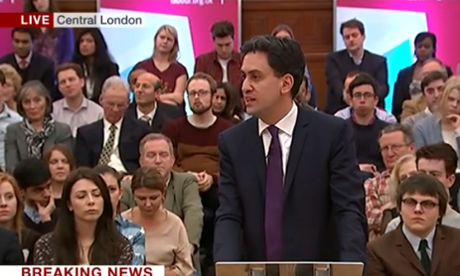
Ed Miliband's speech
Ed Miliband is about to start.
He starts by quoting Niestzsche, or Kelly Clarkson. (See 11.21am.)
He is driven by resilience, he says.
But think about people doing really hard jobs, people on zero-hours contracts, people doing two or three jobs. He is willing to put up with whatever comes to stand up for them.
And Labour is not in a fight because its opponents think it will lose. It is in a fight because people think it will win.
Labour must focus on the prize of changing this country.
And here’s the scene at the Senate House.
At Senate House waiting for Ed Miliband to speak. He's delivering it in the round pic.twitter.com/FGTBS5ZlWn
— Isabel Hardman (@IsabelHardman) November 13, 2014
Miliband in the round: somewhere in the middle of the crowd is the lectern where Ed can relaunch his leadership. pic.twitter.com/Wna6wWsCz5
— Jim Waterson (@jimwaterson) November 13, 2014
One Nation Labour is back, according to Theo Usherwood, who is at the Senate House in London, where Ed Miliband is about to speak.
The One Nation banners are out here at Senate House for Ed Miliband's speech.
— Theo Usherwood (@theousherwood) November 13, 2014
Miliband coined the slogan in 2012, but Labour has not been using it recently.
These days, with political speeches, you often get the reaction before the speech itself has even been delivered. So, for the record, here’s what Grant Shapps, the Conservative chairman, said about it last night.
Ed Miliband’s tenth relaunch does not cover up his failure to learn the lessons from Labour’s mistakes.
He has opposed everything we’ve done to turn our country around, he’s failed to put forward an economic plan to secure Britain’s future, and all he offers is more of the same failed ideas that got us into a mess in the first place – more spending, more borrowing and more taxes. That is why he is simply not up to the job.
Voters will view this latest effort with the same lack of enthusiasm that Ed Miliband’s own colleagues view his leadership.
And here’s what Nigel Farage, the Ukip leader, was tweeting about the speech last night.
Ed Miliband is due to give a speech tomorrow in which he will yet again attack UKIP for standing up for British people. Unelectable. A joke.
— Nigel Farage (@Nigel_Farage) November 12, 2014
Miliband will tomorrow lie about UKIP's record, and try again to appeal to North London's champagne socialist clique. He's useless.
— Nigel Farage (@Nigel_Farage) November 12, 2014
Miliband U-turn: Lab calls UKIP "racist" for speaking out on mass immigration. Suddenly, now he says it's not prejudiced to worry about it.
— Nigel Farage (@Nigel_Farage) November 12, 2014
On the basis of this, I suppose Farage’s claim that he would be willing to do a coalition deal with Labour after the election should perhaps not be taken too seriously.
Last night Ed Miliband said that what doesn’t kill you make you stronger. My learned colleague Nicholas Watt says he was quoting Friedrich Nietzsche, but some of us only recognised a cruder cultural reference.
I thought @Ed_Miliband was quoting Kelly Clarkson w "what doesn't kill u makes u stronger" but Guardian says he quoting F Nietzche!
— Luke Akehurst (@lukeakehurst) November 13, 2014
Ed Miliband is not short of advice on the blogosphere this morning.
Yesterday’s Ipsos MORI poll was damning about Ed Miliband’s leadership. He was compared unfavourably with William Hague and Iain Duncan Smith. But Tim Bale, an academic who has studied Hague and Duncan Smith (he wrote a very good book on the modern Conservative party) has this morning been flagging up an article he wrote for the Parliamentary Affairs journal saying that Miliband may have done a better job than his critics argue.
You can read the whole thing here, although you may have to register. Here’s the conclusion.
If one analyses the detailed polling on leadership attributes, one finds that Cameron beats Miliband by a decent margin (albeit from a low base) on virtually all of them except on the quality of being in touch and/or of understanding ordinary people. One’s initial inclination may be to dismiss this: ultimately, in an era of valence politics, and in a country post-Iraq and post-expenses, surely what voters want is someone who radiates competence, integrity and looks willing and able to make the tough calls that being Prime Minister requires (e.g. see Clarke et al., 2009). But maybe this assumption is mistaken. It could be that when looking at a Leader of the Opposition and judging his potential for the very top job, voters actually look for the very quality on which Miliband appears to have the edge over his incumbent rival. Certainly a recent study of the role of leader evaluations, which takes as its example the last UK general election, suggests that this might just be the case. Although the extent to which leaders of the opposition are seen as trustworthy and knowledgeable matters, what matters more—at least if the government they are trying to overturn is relatively unpopular and thought to be out of touch—is that they themselves are seen to be in touch with voters’ concerns (Stevens et al., 2011). The extent to which this matters may depend on other factors such as how long the government has been in power and/or the electorate judging that there is little to choose between the candidates when it comes to other qualities. It may also be the case that Miliband’s ratings on this score are simply a by-product of his party’s more ‘caring’ brand than the result of anything he himself has said or done—or appears to be. Nevertheless, it may ultimately stand him in greater stead than the strength he supposedly lacks, especially if broadcasters manage to drag David Cameron (probably kicking and screaming) into televised election debates—a format in which Miliband is, as anyone who has seen him in similar fora will testify, highly likely to exceed the public’s very low expectations. Whether it will be enough to win Labour a general election is another matter: much like the increasingly impatient owners of football clubs and those who write so breathlessly about their fortunes on and off the pitch, parties and pundits need to remember that the guy (or indeed the gal) in charge can only do so much.
Updated
There is a big social media campaign backing Ed Miliband today.
Today, Labour Fights Back. Use hashtag #6monthstowin. Retweet if ur with us as Ed Miliband delivers a keynote speech pic.twitter.com/MK9I28L69O
— Dr Éoin Clarke (@LabourEoin) November 13, 2014
For the record, here are today’s YouGov GB polling figures.
Labour: 35% (up 1 from YouGov yesterday)
Conservatives: 32% (down 1)
Ukip: 15% (no change)
Lib Dems: 7% (no change)
Greens: 6% (no change)
Labour lead: 3 points (up 2)
Government approval: -25
According to Electoral Calculus, this would give Labour a majority of 30.
When Andy Burnham had a go at the press being out to get Ed Miliband (see 10.08am), he may have been thinking about articles like this, in today’s Sun.
Mili no mates pic.twitter.com/ubJoVoFXw2
— Stig Abell (@StigAbell) November 13, 2014
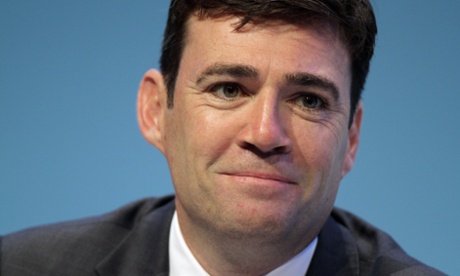
As Nicholas Watt reports, Andy Burnham, the shadow health secretary, used an interview on the Today programme this morning to “vested interests” in the media of being partly to blame for the attacks on Ed Miliband in the media over the last week. Burnham said:
I see somebody whose leadership has been characterised by his willingness to take on vested interests – more so than any of the Labour leaders I have served under. They are the vested interests in energy, in banking and, yes, in the media too. That takes courage, it takes leadership to do that.
No wonder some of those vested interests don’t want Ed Miliband to win and don’t want Labour to win. But he has put us in a position where, six months out as a first term opposition, we are in a position to win. There has been a campaign on in the last few days to destabilise and demoralise us. My message this morning is it just won’t work. In fact it’s going to galvanise us. We are united behind Ed and we are fighting to win an election that matters so much to so many people across the country.
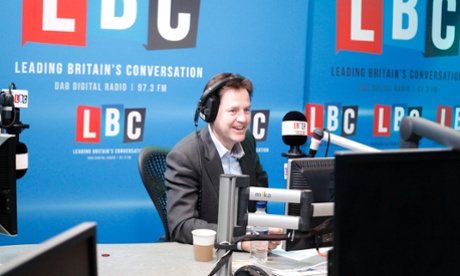
Nick Clegg's Call Clegg phone-in - Summary
Here are the main points from Nick Clegg’s Call Clegg phone-in.
-
Clegg criticised Philip Hammond, the foreign secretary, for saying that the proposing to enshrine Britain’s 0.7% aid target in law was “bizarre”. This was a Conservative manifesto proposal, Clegg said.
I think what is a little bizarre - to put it as diplomatically as I can - is that the foreign secretary, a Conservative, should go to Sierra Leone to tear up his own manifesto. It was a Conservative party manifesto commitment to legislate on this commitment of devoting 0.7% of our national income.
He said Hammond’s comments were “a measure of quite what’s happened to the Conservative party over the last several years”.
Four and a half years later, they used to believe in the environment, they used to believe in helping people on the other side of the world and now they’re claiming it’s bizarre. It was their own idea.
- He said the Fifa report criticising England for its behaviour in the World Cup bid but clearing Qatar and Russia was “very surprising indeed, to put it mildly”.
- He floated the idea of ensuring that EU nationals who receive child benefit for children abroad only get paid at the rate in their home country. He said he had asked officials to look at this idea.
- He said that he did not think Sheffield United should not take back Ched Evans, the convicted rapist. He was more explicit about this than he was when asked about this last month. Perhaps Evans could go abroad to play football, Clegg suggested. But Clegg acknowledged this was a matter for the club.
- He said corrupt bankers should be pursued by prosecutors as aggressively as corrupt journalists have been.
-
He said Labour’s problem was not its leader, but its failure to admit its role in the financial crash and to have a clear plan for getting rid of the deficit.
Updated
Q: Qatar has been cleared of corruption over its World Cup bid. Russia has been cleared too. But Britain has been criticised.
Clegg says he wants to be diplomatic. This conclusion “is very surprising indeed, to put it mildly”, he says.
But you have to abide by the decision of the referee, “however eccentric” it is, he says.
And that’s it. I’ll post a summary soon.
Q: How big a shambles was the European arrest warrant vote?
Clegg says it would have been better to have set out more clearly what the vote covered. But there was nothing dastardly about what the government was doing, he says.
Q: Who should lead the Labour party? Would you do it?
Clegg laughs that off.
But Labour’s problem is not its leader, he says. It is a political one; Labour does not acknowledge its responsibility for the financial crash.
And Labour has not said when it would get rid of the deficit. That’s why people don’t trust them to run the economy.
Q: How many British sandwich makers will be made redundant by Greencore hiring people from Hungary?
Clegg says he thinks Greencore is recruiting from abroad because it cannot find people locally.
Q: That can’t be true. Aren’t they just recruiting from abroad so they can hire people cheaply?
Clegg says there must be rules to stop employers from hiring people from abroad to undercut local workers. Penalties for people who hire illegal immigrants have been quadrupled, he says.
He says, although it is not directly relevant, he would also like to stop child benefit going to the children of migrants abroad.
This cannot be changed overnight, he says.
But he says, if Poles have to get child benefit for children abroad, it should be paid at the rate paid in Poland, not the rate paid in the UK.
Q: Can you do this?
Clegg says he has asked people to look into this.
Freedom to move is not the same as freedom to claim, he says.
Nick Ferrari plays a recording of a call from a cancer patient who complains that she did not get a drug that might have helped as early as she wanted.
Clegg says he will look into this.
Q: Aid money is being wasted on corruption.
LBC’s Nick Ferrari mentions Philip Hammond’s criticism of the Lib Dem proposal to enshrine the 0.7% aid target in law.
Clegg says Hammond’s comments were “a little bizarre”. This was a proposal in the Conservative manifesto. Yet now Hammond is going to a country afflicted by Ebola to tear up this idea.
This is a measure of how much the Conservative party has changed.
Ferrari plays a track from what he says is an Ethiopian band, the equivalent of the Spice Girls, that has received £4m in aid money. Why?
Clegg says he doesn’t know. He doesn’t know every item in the aid budget.
There is money wasted in every budget, he says.
If money is being wasted, programmes should be closed down.
But think of the money spent to help the victims of Ebola, says Clegg.
Ferrari says that is relief. People do not object to that. But they object to other aid spending.
Clegg does not accept that, because some aid spending might not be justified, all aid is being wasted.
DfID money has had a dramatic effect in Ethiopia, he says.
Ferrari says he does not object to spending on relief.
So would you not object to spending 0.7% of national income on disaster relief, Clegg asks.
Clegg says if you are a listener, and you earn £25,000, you will be paying just over £50 a year to help people around the world. Ferrari might like that. But Clegg says he thinks that a lot of people will think that is a good, compassionate thing to do.
Q: Only 13 people have been charged by the SFO since the start of the financial crisis. But many journalists have been pursued. Why aren’t bankers being prosecuted with the same vigour as journalists?
Clegg says they should be. He agrees with this.
But there may be an issue to do with the complexity of these cases, he says.
Q: Can’t we take money from the banks to pay off the national debt? And will bankers go to jail?
Clegg says corrupt bankers should be brought to book. The Serious Fraud Office is investigating. It can take time. But he hopes people will be brought to book.
He says the government has imposed a levy on the banks. That is raising more than anything Labour imposed, he says.
And the government has reformed banking, to split high street banking from casino banking.
Q: What is happening to the fine money?
Clegg says the government has not decided yet.
Q: If you take someone’s career away, they might have to rely on benefits.
Clegg says maybe Evans could play abroad for a while.
Q: So you are saying the Spanish should take on a convicted rapist?
Clegg says Sheffield United was the team that employed him when he committed the offence. He is a role model. He knows that, as a Sheffield MP.
Q: Would you shake his hands?
Clegg sidesteps the question.
It is up to the club to decide whether to take him on.
But, given the nature of the offence, he would not take him on if it were up to him.
Q: Plymouth Argyle took back a goalkeeper who had killed people in a car accident? Is that worse?
Clegg says this is why is he reluctant to be drawn on this. But he has views on Ched Evans, because he is the local MP.
Q: Would you shake his hand?
That’s a hypothetical question, says Clegg.
Nick Clegg's Call Clegg phone-in
The phone-in is starting.
Q: The country is divided on Ched Evans. Could the government legislate to increase rape terms?
Clegg asks the caller for her view. She says that, if Evans were an eminent surgeon, perhaps people would not be so sure about his not being allowed to return to his profession.
Clegg says the government should not legislate to tell employers what to do. But his concern is that footballers are role models. But is wary of telling football clubs what they should do. But, if it were up to him, he would not take him on. The football club has to think long and hard about this, he says.
After a fairly wretched week, Ed Miliband will today mount a fightback with a major speech in London on the theme of Britain’s “zero-zero economy”. Labour briefed extracts from the speech overnight and it’s the Guardian splash. Here’s how it starts.
Ed Miliband will launch a highly personal political fightback when he declares that the Labour infighting of the past week has emboldened him to take radical measures to tackle “zero-zero” Britain in which the poor are forced to work on zero-hours contracts while the rich benefit from zero tax.
In a defiant message to critics within the party, who had hoped to replace him with the former home secretary Alan Johnson, the Labour leader will quote the German philosopher Friedrich Nietzsche to insist that his opponents have strengthened his resolve. Miliband will say in a speech at London University: “There is a saying which goes: what does not kill you makes you stronger.”
The remarks mark a shift from Miliband’s position last week when he rubbished the suggestion that he was facing dissent by declaring: “I don’t accept that this matter arises.”
Miliband used the “what does not kill you makes you stronger” line in an interview with the BBC’s Nick Robinson last night. It’s worth watching in full, and here it is.
And here’s a blog from Robinson with a transcript.
The speech is at 11.30am, and I will be focusing on it, and the reaction, for most of the morning.
First, though, by popular demand, it’s Call Clegg at 9am.
As usual, I will be also covering all the breaking political news from Westminster, as well as bringing you the most interesting political comment and analysis from the web and from Twitter. I will post a summary at lunchtime, but I will be wrapping up after that because I’ve got a meeting this afternoon.
If you want to follow me on Twitter, I’m on @AndrewSparrow.