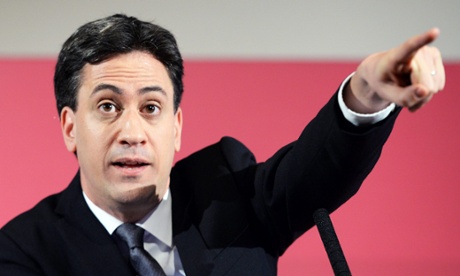
Afternoon summary
That’s all for now.
Later, at around 10pm, I will be launching a separate blog to cover Nigel Farage and Russell Brand on BBC’s Question Time.
Thanks for the comments.
Here are three blogs about the Ed Miliband speech that are worth reading.
Please forgive a shorthand that may hide important nuances, but Labour believes that by cutting less in the short term, the economy would grow faster - and that would yield higher tax revenues that would finance a relatively bigger public sector. And debt as a proportion of GDP would be reduced by a swelling of the GDP denominator.
The Tories are convinced that the momentum in the economy is sufficient to absorb more immediate and larger public sector cuts - and that the imperative is to cut debt sooner rather than later.
And the Lib Dems, well, they would in effect be Tories in the first two years of the next Parliament and Labour thereafter.
So one thing is clear: Ed feels that now is not the time to be clear about cuts. His only advantage is that the other party leaders agree. His disadvantage is that the polls show that voters are less inclined to trust his judgement on these matters than they are David Cameron’s (or indeed Nigel Farage’s).
Labour could be spending £50bn a year more than the Tories by 2020, says IFS
On the World at One Carl Emmerson, deputy director of the Institute for Fiscal Studies, said Labour could end up spending £50bn a year by the end of the next parliament more than the Tories would be spending under their plans. But this would involve more borrowing, he said.
He said that it was significant that Labour was only planning to balance the budget for current spending, not for all spending.
Perhaps the biggest thing is Mr Miliband reconfirming what Labour had previously said, that they want to balance the deficit on day-to-day spending. In other words, allow borrowing to be carried out for investment purposes, but not for day to day purposes by government. That would require some cuts in the next parliament but nowhere near as much as what the Conservatives’ aspiration to eliminate the whole budget deficit would imply.
Asked what Labour would cut, Emmerson said the party had already committed itself to matching the coalition’s spending plans for 2015-16. So, broadly, it would match the coalition’s planned cuts for that year, in areas like local government and the Home Office budget.
Beyond that, the cuts that Labour would have to find could be very shallow indeed. It could just be cuts of 2 or 3% across unprotected areas outside the NHS and overseas aid, if they were to borrow as much as their rule would allow them ...
There’s two things that give Labour potentially a lot of wiggle room. Firstly, Mr Osborne is aiming for a £23bn overall budget surplus. So, if you only want to balance that, that gives you £23bn to play with. In addition, Mr Miliband has said that the Labour government would be happy to borrow to invest. Investment spending at the end of the next parliament is planned to be £27bn. Which means in total the amount of wiggle room that Labour would have could be as much as £50bn in any one year.
So you would get much, much less spending cuts potentially under a Labour government, but you would have much more borrowing, and therefore more government debt.
This last quote is the one the Tories are highlighting.
IFS' Carl Emmerson on Wato about Labour's policy: "you'd have much more borrowing, and therefore government debt".
— Tory Treasury (@ToryTreasury) December 11, 2014
Here’s Labour’s Diane Abbott on Ed Miliband’s speech.
Labour Leftwinger Diane Abbott on Ed Miliband's deficit speech today - "fine" but "quite short of specifics" @JoeWatts_ on @LondonLive
— nicholas cecil (@nicholascecil) December 11, 2014
Simon Walker, the director of the Institute of Directors, has welcomed Ed Miliband’s speech. He said:
It is prudent that the Labour Party is pledging no unfunded spending commitments and that Ed Miliband has confirmed their manifesto policies will not require additional borrowing. The strong message from both Ed Miliband and Ed Balls on the need to cut departmental spending is one of the clearest signs yet that Labour acknowledge there is still a long way to go.
We look forward to seeing more detail on Labour’s plans for deficit reduction as we get closer to the election. Business will be looking for the party to propose a programme which will restore government finances, while fostering a dynamic and entrepreneurial economy. This will not be achieved with new taxes on effort and aspiration.
John Cridland, the CBI director general, has also issued a statement about the speech which is very dull and general, but vaguely supportive. He said:
Businesses want the next government to continue to prioritise tackling the deficit. Getting the UK public finances in order is critical to our long-term growth and international credibility.
At the same time as getting the deficit down, we need to remember the growth-boosting benefits of investment in infrastructure.
Kris Hopkins, the Conservative local government minister, has dismissed Labour’s claim to be able to save £500m from local government efficiency savings. (See 1.43pm.)
We are already delivering these local government savings to clear the deficit as part of our long-term economic plan.
So Labour are proposing a zero-based spending review that saves precisely zero money.
Labour’s call to cut council funding in the form of the New Homes Bonus is just robbing Peter to pay Paul, and will mean a return to the bad old days where councils are penalised for building new homes.
Here is some comment on Ed Miliband’s speech from political journalists on Twitter.
From the Guardian’s Rafael Behr
EdM speeches nearly always based on a big macroeconomic argument working towards a strategic position. In this case ... (1/3)
— Rafael Behr (@rafaelbehr) December 11, 2014
... that cost of living crisis and deficit reduction are in fact the same issue; have been all along; can't fix latter without former (2/3)
— Rafael Behr (@rafaelbehr) December 11, 2014
... which is neat. But drains life out of political language. No story, no colour, no rhetorical pleasure with words. Those things matter.
— Rafael Behr (@rafaelbehr) December 11, 2014
From LabourList’s Mark Ferguson
Miliband reiterates no borrowing to invest in capital spend pledge. It was wrong at conference at it’s wrong now *HEADDESK*
— Mark Ferguson (@Markfergusonuk) December 11, 2014
Borrowing to build infrastructure pays for itself and grows the economy. Miliband wrong to rule it out (or at least, out of the manifesto)
— Mark Ferguson (@Markfergusonuk) December 11, 2014
From Jenni Russell
Like clarity of Miliband pledge to cut deficit, mend social fabric, but 'everyday people' v offputting phrase. Special ppl vs everyday ppl?
— Jenni Russell (@jennirsl) December 11, 2014
From the Times’s Michael Savage
Miliband event in short - no detail of new cuts, but fact he is talking about deficit will cheer many in Labour.
— Michael Savage (@michaelsavage) December 11, 2014
From the tax campaigner Richard Murphy
I wouldn't agree with everything in Ed Miliband's speech on the economy this morning but it had the essential quality of credibility
— Richard Murphy (@RichardJMurphy) December 11, 2014
From the Financial Times’s George Parker
Typical fiscal consolidation around world 70/30 split or 80/20 on spending cuts/ tax rises. Ed won't say what split he has in mind
— George Parker (@GeorgeWParker) December 11, 2014
But still a big moment to hear ed m speaking so openly about spending cuts- lab think they can get back into deficit debate. But too late?
— George Parker (@GeorgeWParker) December 11, 2014
From the FT’s Janan Ganesh
Miliband speech reminds me of Cameron NHS/deficit poster in 2010. Says too many hard-to-reconcile things to persuade anyone.
— Janan Ganesh (@JananGanesh) December 11, 2014
From the Independent on Sunday’s John Rentoul
"I'll cut the deficit, not the NHS" @LabourList pic.twitter.com/3OqGsqTpHS
— John Rentoul (@JohnRentoul) December 11, 2014
The Tory press office is making a similar point to Robert Peston. (See 1.50pm.)
So @Ed_Miliband saying he won't return public spending to the same level as when he was a special adviser in the Treasury setting budgets
— CCHQ Press Office (@CCHQPress) December 11, 2014
The BBC’s economics editor, Robert Peston, has been interviewing Ed Miliband. He is not impressed by Miliband’s claim that the Tory plan to cut state spending to 35% of GDP would inevitably be disastrous.
In interview with me, @Ed_Miliband attacks Tory plans to cut public spending to 35% of GDP. But when was it last less than 36%?
— Robert Peston (@Peston) December 11, 2014
public spending was sub 36% of GDP in 99/2000, when Lab in office. Matters coz Miliband says Tories wrecking public services with 35% target
— Robert Peston (@Peston) December 11, 2014
Here’s a Guardian video with extracts from Ed Miliband’s speech.
Labour says it would save £500m from council efficiency measures
In his Q&A Ed Miliband talked about Labour’s plans to save money from local government back-office reforms. (See 11.37am and 1.05pm.) There was also a brief reference in the speech.
The details here here. Labour has published a report from its zero-based policy review, covering local government (pdf), and it says £500m could be saved by 2016/17.
Here’s an extract from the news release.
In the third interim report from Labour’s Zero-Based Review (ZBR) of every pound spent by government, Chris Leslie, shadow chief secretary to the Treasury, and Hilary Benn, shadow communities and local government secretary, outline how Labour will:
· save over £500 million a year from 2016/17 through shared services, back-office collaboration, and streamlining, to better protect the frontline;
· end the complex, regressive and ineffective New Homes Bonus, with the funding reallocated more fairly within local government;
· consider proposals to merge some of the 46 Fire and Rescue Authorities in England, making savings of between £62.7 million and £83.6 million a year, in order to better protect frontline firefighters and appliances; and
· save £100 million from the £320 million Transformation Challenge Award 2014-16, in which small authorities have been forced to bid for central government approval for outsourcing projects rather than focussing on collaborating with neighbouring councils.
Updated
Danny Alexander, the Lib Dem chief secretary to the Treaury, told Sky News that there was nothing new in Ed Miliband’s speech.
I think we have learnt today why Ed Miliband didn’t mention the deficit in his conference speech - because he’s got absolutely nothing new to say.
In a sense both Labour and Conservative parties now are saying that the process of deficit reduction will need to carry on for the whole of the next parliament - Labour more slowly, the Conservatives going too far.
What we are saying as Liberal Democrats is that we need to finish the job - and do so in the first couple of years of the next parliament - of eliminating the structural deficit, and then the country has a chance to turn the corner and have a different approach to the public finances because the books are balanced.
Labour would take longer, borrow more. The Conservatives would go on much more than is necessary, cutting further than is necessary for basically ideological reasons.
You are seeing now three very different approaches to sorting out the public finances in the next parliament.
Essentially, the Lib Dems are claiming to have a Goldilocks strategy on the deficit - where their approach is not too fast, and not too slow, but “just right”.
Ed Miliband's speech and Q&A - Summary
A poll yesterday showed that there is clear public support for the idea the government should cut public spending, but at a slower rate than is being proposed by the Tories. This, essentially, is what Ed Miliband is proposing and this was a solid, intelligent speech that explained, reasonably clearly, how Labour’s deficit reduction programme would differ from the Conservatives’. Miliband pitched it as kinder, smarter deficit reduction. The Labour leader did not, though, announce any new cuts and, as Tom Bradby suggested in his question (see 11.47am), the speech did not do much to illuminate what a cuts programme would actually look like in practice. Miliband made a fair stab at trying to answer this charge. (See below.) But the most honest answer was the one that he didn’t use: if you think we’re being evasive, the other lot are even worse.
Much that was in the speech was briefed overnight. Here’s a summary of what Miliband said, focusing on the new points. And here’s the text of the speech.
- Miliband outlined his “balanced” approach to deficit reduction, identifying five principles that a Labour government would follow as it got rid of the budget defict.
-
He announced that balancing the budget would be Labour’s first general election pledge.
And so I can announce our first pledge of the general election campaign:
We will build a strong economic foundation and balance the books.
We will cut the deficit every year while securing the future of the NHS.
And none of our manifesto commitments will require additional borrowing.
(By my count that’s at least three pledges, but never mind.)
-
He effectively committed Labour to not raising VAT. Asked if he could give a firm commitment on this, he replied:
We will set out our tax plans at the election but I think I would steer you well away from any Labour government raising VAT. It hasn’t happened in the past and I don’t think it’s going to happen in the future.
-
He played down the prospect of Labour announcing further taxes for the rich. The party was already proposing a mansion tax and the reintroduction of the 50p top rate of tax, he said. These measures were right, fair and proportionate. He went on:
It is always important that we are careful on these taxation issues and we judge carefully any measures that we announce. And that’s the basis on which we will proceed.
-
He rejected claims that he was being evasive about the scale of cuts required under Labour. Other Labour leaders have not promised year-on-year departmental cuts, he said.
It’s not what Labour leaders have said in the past. It’s not what was said in the 2010 general election. It is me being very clear.
In his speech he said that there would not be year-on-year cuts in most departmental budgets until the deficit was eliminated. And he stressed that Labour had already identified some cuts it would make.
We’ve identified a whole series of areas - the winter fuel payments for the richest pensioners, capping child benefit rises, abolishing police and crime commissioners, cutting ministers’ pay, the local government back-office reforms that I’m talking about today.
-
He claimed that it would be wrong to be too prescriptive about likely cuts before the general election.
Now, beyond that, the right way to make these decisions is frankly in government, when you have all of the resources behind you. Because if we start picking things out of the air without having done that work, without having gone into the departments and found how we make these reductions in the most sensible way, then they won’t be the most sensible changes for the country.
- He rejected the idea of planning to get rid of the deficit using a specific cuts/tax rises formula. When asked if he favoured an 80:20 ratio (80% of the money coming from cuts, 20% from tax rises, a formula favoured by the Lib Dems and - at one point in the past - by the Tories), Miliband said this was the wrong approach, because it ignored the importance of increasing the size of the economy.
- He said George Osborne’s proposed charter for budget responsibility was “a stunt” and that Labour could not say whether it would support it or not until it had seen the details.
-
He said he was sure his brother David never supported government involvement in torture when he was foreign secretary.
I know how seriously [David] took these issues when he was in government. He actually answered questions about this in the House of Commons while he was in government. He is never somebody who would ever countenance the British state getting involved in this kind of activity.
But he sidestepped a question about whether Tony Blair should be called to give evidence to the intelligence and security committee about his knowledge of Britain’s involvement in torture.
Updated
Ed Miliband’s Q&A is over. It was almost more interesting than the speech, given that the speech had been extensively trailed in advance, and I will post the highlights shortly.
Q: [From the Royal Institute of Chartered Surveyors] The property market is incredibly important to the economy. Will you work with us to ensure your property tax plans are not a drag on the economy?
Miliband says it is important to have a successful housing market. Of course Labour will listen to RICS on these subjects.
Miliband says the government has got to deal with businesses that avoid tax. That undermines trust in the tax system, he says. Margaret Hodge, the chair of the public accounts committee, has done “brilliant” work on this, he says.
Q: Do you think your brother David has questions to answer about torture?
Miliband says David has answered questions about this in the past. He is someone who would never countenance the government getting involved in torture.
Q: If cutting spending to 35% of GDP is wrong, what level should it be?
Miliband says he does not believe in plucking an arbitrary figure from the air.
Firstly, the percentage does not just matter. Depending on how much the economy grows, a percentage could mean different things.
And, second, some government spending is more valuable than others.
But the Tory plan would be “deeply destructive”, he says.
Q: Will you introduce new measures to get the rich to pay more?
Miliband says Labour has already announced plans to raise more money from the rich. Their plans are proportionate and fair. It is best to proceed carefully with tax matters, he says.
Q: Are you saying you won’t borrow for investment?
Miliband says he does not believe the Tories will meet their target for balancing the overall budget.
Q: Will you vote against the government charter for budget responsibility? That specifies a timetable for getting rid of the deficit.
Miliband says this is a stunt. The Tories and the Lib Dems don’t seem able to agree on this. Labour will see what this charter actually says, and then make a judgment, he says.
Q: If you could sum up Labour’s message on a billboard, what would it be?
Miliband says it would be a country that works for you, not just the privileged few.
Updated
Q: Do you think Tony Blair has questions to answer about what he knew about the US’s use of torture? Should he give evidence to the intelligence and security committee?
Miliband says the senate committee report is “deeply troubling”.
The government announced an inquiry into these matters, but held off while court cases are going on.
It is right to let those court cases proceed, he says.
(He does not mention Blair at all.)
Q: Do you accept that if Labour does not stop the SNP’s surge in Scotland, Labour will be a goner at the election?
Labour faces a challenge in Scotland, he says. What people want is a party that offers different choices, but not necessarily easy choices.
Miliband says Labour is committed to keeping the most competitive tax rate in the G7. That would primarily benefit big business, he says.
But it also has plans to help small firms, he says.
He says he recognises the importance of having a competitive tax regime.
Q: Can you give some indication as to the scale of the cuts envisaged? Are you planning cuts on an 80:20 basis (ie, with 80% of the deficit reduction coming from spending cuts, and 20% from tax rises)?
Miliband says he does not accept that a firm rule should apply.
And the right place to decide is when you are in government, he says.
Q: Are you prepared to rule out VAT?
Miliband says he will set out his tax plans at the election. But he would steer us well away from that. Labour governments have not raised VAT in the past “and I don’t think it is going to happen in the future”.
-
Miliband effectively rules out raising VAT.
Q: [From Sky’s Faisal Islam] Under your plans, state spending would still be only 37/38% of GDP. Is there really that much difference between your plans and the Tory ones?
Yes, says Miliband.
George Osborne wants to balance the overall budget, he says. And then he wants to run a £23bn surplus.
Osborne has not explained why his plan is sensible for the economy.
Labour’s approach reflects what “sensible people say”, he says.
Updated
Q: [From ITV’s Tom Bradby] This was billed as a big economy speech, but there is not much new in it. Would you accept that you, and all leaders, are failing to level with the public as to what cuts you would introduce if you get into power?
No, says Miliband.
He says he is saying very clearly that budgets will fall, year on year, until the deficit is cleared. Labour leaders have never said that before.
And he has identified difficult cuts: winter fuel payments for the wealthy; capping child benefit; getting rid of police and crime commissioners; cutting ministers’ pay; cutting local government back-office costs.
But it would be wrong to specify all cuts now, Miliband says. Labour needs to wait until it is in office until it can do this.
Updated
Q: What is your policy on science?
This is really important, Miliband says. He recognises the importance it has for the productive potential of the economy.
Miliband's Q&A
Miliband is now taking questions.
There are a mix of journalists and party invitees in the audience.
Q: [From someone in the building trade] What will you do about late payments?
Miliband says this is a problem both parties have tried to tackle.
Miliband summarises his five principles for deficit reduction again.
And he announces Labour’s first general election pledge.
So I can announce our first pledge of the general election campaign:
We will build a strong economic foundation and balance the books.
We will cut the deficit every year while securing the future of the NHS.
And none of our manifesto commitments will require additional borrowing.
These are my clear commitments to the British people.
Updated
Miliband says the Tories are proposing unfunded tax cuts.
This is not responsible and not right.
And the British people should be in no doubt what the Tory promise means: they will pay the price for tax cuts one way or another.
They will pay the price in higher VAT or even bigger cuts to public services.
Miliband says Labour will only make credible promises.
I understand why some people want us to make manifesto proposals funded by additional borrowing.
But while there is a deficit to be cleared it would be wrong to do that.
This is an essential test of credibility.
I said earlier there was huge uncertainty about the deficit because of economic circumstances and on the basis of recent experience.
That makes it all the more important that parties do not spray around unfunded commitments they cannot keep.
It is why we will only make commitments in our manifesto that are properly funded.
Not commitments that depend on extra borrowing.
Miliband says Labour would cut the deficit fairly.
The Conservative approach is very different, he says.
This year, they have asked families with children to contribute five times more to deficit reduction than the banks.
And now for the future, theirs is the only deficit reduction plan in history which seems to involve asking the wealthy to pay nothing more.
Miliband says Labour would make different choices; for example, it would levy a mansion tax, tax bankers’ bonuses and reverse the cut in the top rate of tax.
Miliband says the Tory plans would deliver cuts “on an unprecedented scale”.
The equivalent of more than the whole budget for schools.
Or three times more than the entire budget for social care.
Or nearly half of the budget for our NHS.
I want the British people to know what this really means: it is a recipe for the disintegration of our public services.
And, also, for a permanent cost of living crisis because we won’t be investing in the skills, infrastructure and education we need for good quality jobs.
Miliband says his third principle is that Britain needs “common sense spending reductions, not slash and burn”.
NHS and aid will be protected, and the Labour manifesto will set out “a very limited number of other areas which will have spending protected”, he says.
But, in other areas, there will have to be cuts.
But it won’t just be for the first year.
Outside protected areas, for other departments, there will be cuts in spending.
And we should plan on it being for every year until the current budget is in balance.
Miliband says Labour would not just chip away at departmental budgets.
We must take the opportunity to do what no government has properly done: reshape public services so that they deliver better for people, doing more for social justice with less.
Here we should take inspiration from what Labour local government has been able to do and give them the chance to do more.
We will devolve unprecedented levels of spending from Whitehall to local people over a whole range of areas, including transport, skills and back to work programmes.
Miliband says Labour will not be able to reform through big spending.
The last Labour government increased spending year on year, using the proceeds of economic growth to make our country fairer.
That option will not be available to us.
And nor would it deal with the root causes of an economy that does not work for working people.
Higher spending is not the answer to the long-term economic crisis that we have identified.
Miliband says the evidence is now in that shows that, without tackling the cost of living crisis, government cannot tackle the deficit.
Last week the Office for Budget Responsibility said income tax and national insurance receipts were £43bn lower than forecast in 2010.
That is because too many people are on low wages, he says.
Labour will have a different economic strategy, he says.
Putting our young people back to work will improve tax revenues and cut the social security bill.
Raising the minimum wage will do the same.
So will dealing with the scandal of zero-hours contracts and ensuring people have more regular hours.
And reforming the banks, transforming vocational education, a revolution in apprenticeships, helping nurture the businesses of tomorrow: all are part of building the economy we need to both deliver for working people and pay down the deficit.
Miliband says it make sense to differentiate between current spending and capital spending.
(Labour wants to balance the books on current spending. George Osborne wants to balance the books on all spending.)
Miliband says, by setting an objective for an overall surplus, the Tories will put investment at risk.
Miliband says Labour will take a “tough and balanced” approach to tackling the deficit.
He says Labour will adopt five principles for deficit reduction.
Miliband says the deficit matters
Miliband says the deficit matters.
Some people think the deficit simply doesn’t matter to our mission and should not be our concern. They are wrong. It matters.
Because unless there is a strategy for dealing with the deficit, it is working people who will end up paying the price of the economic instability that is created. It is also necessary for funding our public services because higher debt interest payments squeeze out money for those services and for investment in the long-term potential of our country.
There is no path to growth and prosperity for working people which does not tackle the deficit. What we need is a balanced approach which deals with the deficit - but does so sensibly.
Ed Miliband's speech
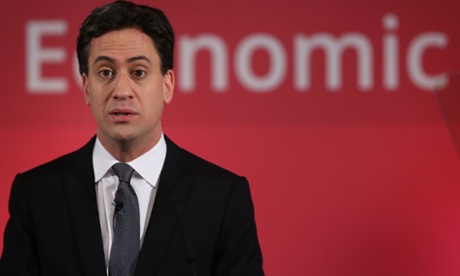
Ed Miliband is speaking now.
He starts with an attack on the Tories.
The Tory plan is to return spending on public services to a share last seen in the 1930s: a time before there was a National Health Service and when young people left school at 14. There is only one 35 per cent strategy in British politics today: the Tory plan for cutting back the state and spending on services to little more than a third of national income.
And they have finally been exposed by the Autumn Statement for what they really are: not modern compassionate Conservatives at all - but extreme and ideological, committed to a dramatic shrinking of the state and public services, no matter what the consequences.
They are doing it, not because they have to do it, but because they want to. That is not our programme, that will never be our programme, and I do not believe it is the programme the British people want.
This is a recipe for public services that will disintegrate and for a permanent cost of living crisis because we won’t be investing in the skills and education people need for good quality jobs, and indeed for sufficient tax revenues. And we know what the result will be: the Tories might be able to deliver the cuts they have promised, but they won’t be able to cut the deficit as they promised.
(I am taking some of the quotes from the extracts sent out in advance. There are some minor differences between these words, and what Miliband said just now, but they are not significant.)
Ed Miliband's five principles for deficit reduction
According to the overnight briefing, Ed Miliband will use his speech to set out five principles that Labour will apply to deficit reduction.
Here they are.
1. Setting a credible and sensible goal to balance the books and get the national debt falling as soon as possible within the next Parliament.
Not having a fiscal plan which sets a target of a 35 per cent state, putting public services and productive investment at risk.
2. Recognising that Britain will only be able to deal with the deficit by tackling the cost-of-living crisis.
Not allowing welfare spending to rise and tax revenues to fall because of low wages, insecure jobs, housing shortages and social failure.
3. Making common sense spending reductions with departmental spending falling and using money better by devolving power, breaking down old bureaucracies, and rebuilding public services around early intervention.
Not cutting spending to 35 per cent of national income that will lead to disintegrating public services and a permanent cost-of-living crisis because we won’t be investing in the skills needed for good jobs and healthy revenues.
4. Protect everyday working people by ensuring those with the broadest shoulders bear the greatest burden.
Not cutting taxes for the wealthiest while asking everyday working people to pay more.
5. Promising new policies only when they are fully funded, like Labour’s £2.5 billion time to Care Fund for the NHS, so that they do not require any additional borrowing
Not making commitments that depend on borrowing or promising unfunded tax cuts skewed to the wealthiest that will eventually be paid for by bigger cuts to public services or increases in VAT.
William Hague, the Conservative leader of the Commons, has been joking about Ed Miliband during business questions ahead of Miliband’s speech.
Hague in the Commons on Miliband: "He has finally remembered the deficit, but he can't yet think of what to do about it" #MiliCrisis
— Greg Hands (@GregHands) December 11, 2014
Labour have got a slogan for Ed Miliband’s speech: a strong economic foundation.
New slogan for Miliband deficit speech: a strong economic foundation pic.twitter.com/QyHMoOHELy
— Matthew Holehouse (@mattholehouse) December 11, 2014
Ed Balls' interviews - Summary
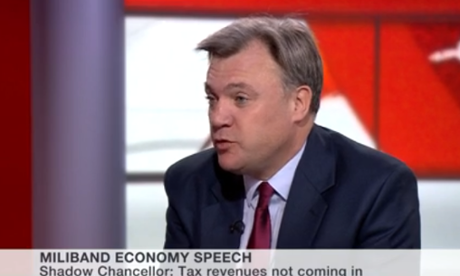
Ed Balls, the shadow chancellor, was on the Today programme, BBC News and Sky this morning. Presenters who tried to get him to give more detail of where Labour would impose cuts did not have much luck, but his general points about Labour’s approach to spending cuts were interesting. Here are the key points.
- Balls said Labour would eliminate the deficit “as soon as we can”, but he refused to set a timetable. That would be irresponsible, he said, because he did not know what state the economy would be in, and what would be happening to tax revenues. “The difference between me and the Conservatives is I am going to set out a credible plan, and I am not going to make promises I can’t keep,” he said.
- He said Labour would make departmental spending cuts every year until the deficit was gone.
- He hinted that Labour would ring-fence the schools budget. It has already committed itself to protecting the health budget and international development. Full details of protected areas would be set out in Labour’s manifesto, he said.
- He said Labour wanted to use “economic transformation” to raise tax revenues. The Tories were trying to make up for the gap in lost tax revenues just by cutting spening, he said. That was a mistake.
-
He said the Tory plans would take Britain back to the 1930s.
It would be so extreme to go back to a 1930s Britain … I don’t want to have our children grow up in a society where people sit behind fences because there are not any police, or where children born into poverty stay in poverty, or where our National Health Service becomes americanised.
-
He said he was not in favour of getting state spending down to 35% of GDP. But he refused to say what level he thought state spending should be at.
I think the idea of going to 35% would be hugely damaging, not only to our public services but to the productive capacity of our economy. And I think the important thing is not the percentage, but what you are spending the money on. If you are spending lots and lots of money on a rising housing benefit bill that is a bad reason to have it at 40%. If you are spending it on more young people getting apprentices, on the National Health Service expanding – that is a good thing.
-
He said that parents should not smack their children, but that there was no need to change the law.
I think parents shouldn’t smack children. I think schools shouldn’t smack children. I think we should say it so wring to smack children, because if you start to say its ok then it starts to encourage in which the question is: ‘how hard?’ And I think that is actually a bad way to bring up children, I don’t agree with making it illegal. I don’t want to change the law. I think the law is already pretty tough, and somebody who smacks and marks and hurts a child, of course they should be punished.
I’ve taken the quotes from PoliticsHome.
Nick Clegg's Call Clegg phone-in - Summary
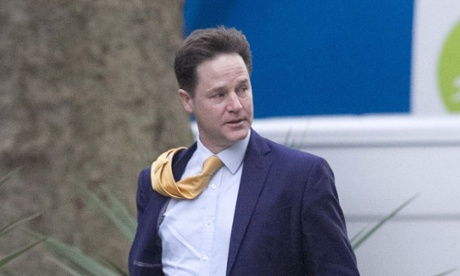
Here are the key points from Nick Clegg’s Call Clegg phone-in.
-
Clegg suggested there could be a case for a full judicial inquiry into the possibility of British complicity in torture in the wake of a report into brutal and ineffective methods used by the US Central Intelligence Agency. Human rights groups like Liberty and Reprieve (here) and Amnesty (here) have already called for such an inquiry. Clegg told LBC:
Since you ask about the past, I think, once the police are investigations are done, once this report from the intelligence and security committee is done, we should keep an open mind, if we need to, about moving to a full judicial inquiry if there are any outstanding questions. Because I’m like everybody else; I want the truth out there. And that’s one of the big differences; however shocking the senate report is, it is worth remembering - I doubt very much any state run by [Islamic State] or al-Qaida would ever have the maturity to lift the lid on its own mistakes in a way that a mature democracy like America has done.
He said the government did set up a panel to look at this, the Gibson inquiry, but it only produced a preliminary report because ongoing police investigations meant it could not look into certain torture allegations in detail.
-
He said torture was morally indefensible because it involved democratic countries abandoning their values.
Morally speaking, if you are defending the values of decency, dignity before the law, human rights - that’s what we do in democracy, unlike [terrorists], that’s what we do unlike those barbarians, those animals in [Islamic State] - we stand up for values that we have cherished for centuries. And if we instead lower ourselves to their level, use their methods of treating people in such a degrading way by using torture, then we destroy the very values we are trying to protect from their attacks ...
The moment you, as a country, as a people, as a community, the moment we abandon the very values that we claim to be defending, it is no longer about whether you win or lose one particular initiative or whether you find the location of one individual or not, what you have done is you have lost the war before you even wage the battle because you no longer uphold the values that you claim. At the end of the day all conflicts are often about competing values. And if you don’t abide by those values, then you have lost the conflict before it has even started.
- He also said the “very, very shocking” report from the US senate committee showed that torture was also ineffective, because it led to suspects making up evidence. Intelligence officials wasted time then following these false leads.
-
He said he was “absolutely sure” that British intelligence officials were not using torture now, or allowing people to be tortured on their behalf.
Updated
And this is what Nick Clegg said about why he was opposed to torture. He was responding to a caller who said it was justified to use torture against terrorists. Clegg replied:
Morally speaking, if you are defending the values of decency, dignity before the law, human rights - that’s what we do in democracy, unlike them [terrorists], that’s what we do unlike those barbarians, those animals in [Islamic State] - we stand up for values that we have cherished for centuries. And if we instead lower ourselves to their level, use their methods of treating people in such a degrading way by using torture, then we destroy the very values we are trying to protect from their attacks.
I’ll post a full summary of his comments soon.
Q: Should the government allow parents to smack their children?
Clegg says violence against children should not be allowed. But he agrees with Nicky Morgan, the education secretary, who defended physical chastisement.
He says it is hard to say when chastisement becomes unreasonable.
Q: Have you ever hit your children?
Clegg says he has never hit his children across the legs. But he is not claiming to be a perfect parent. Of course he has lost his temper with his children.
Updated
Clegg hints he could back full judicial inquiry into Britain's involvement in torture
Here’s the quote from Nick Clegg where he hinted that he could back a full judicial inquiry into Britain’s involvement in torture.
Since you ask about the past, I think, once the police are investigations are done, once this report from the intelligence and security committee is done, we should keep an open mind, if we need to, about moving to a full judicial inquiry if there are any outstanding questions. Because I’m like everybody else; I want the truth out there. And that’s one of the big differences; however shocking the senate report is, it is worth remembering - I doubt very much any state run by [Islamic State] or al-Qaida would ever have the maturity to lift the lid on its own mistakes in a way that a mature democracy like America has done.
Clegg says he wants to move to a situation where the police have to get permission from a judge before they can seize phone records from journalists.
But the government is waiting for a report from the interception of communications commissioner before it takes a final decision on this issue, he says.
Q: Have you had a reply from Theresa May to your letter about the data communications bill?
No, says Clegg. But he says he does talk to her.
Q: Will you consider defecting to the Tories?
No, says Clegg.
Q: Who will be in the Call Clegg slot after the election?
Clegg says he hopes it is him. But he says he expects the Lib Dems will do better at the election than they think.
Q: At PMQs yesterday you talked about inequality. Isn’t it the case that the figures do not represent the reality of the needs of the one in five voters who are deaf, disabled or carers?
Nick Ferrari raises the case of the court ruling against the man in a wheelchair who wanted to ensure that a mum with a buggy had to make room for him on the bus.
Clegg says most people would not need a law to make them make way for someone in a wheelchair on a bus. He does not like the idea that the law is needed to force people to act like this.
Clegg says spending on the disabled generally is higher than it has been.
Labour talks as if we lived in a world of milk and honey before 2010, and that all problems were created by the coalition. But that is not the case. That is why he feels the need to remind Labour that things like pensioner poverty and child poverty were higher under Labour than they are now.
Q: Why hasn’t the Iraq inquiry report been published?
Clegg says he is really frustrated about this.
But the inquiry is independent. It is not the government’s decision.
Q: Shouldn’t you ensure it does get published?
Clegg says it is not fair that relatives of people who died in the way are having to wait so long to find out how that “utterly wrong” decision was taken.
People who are running the inquiry, “punctilious though they are being”, recognise that they have an obligation to the families.
Q: It should be published before the election?
I hope so, says Clegg. He would be “very disappointed” if that does not happen. But every deadline before has slipped.
Clegg say Sir John Chilcott and his team are “good people”, people of integrity.
Nick Clegg's LBC phone-in
Q: Aren’t we justified in using torture against terrorists?
Clegg says he could not disagree more.
Q: What if it could be used to find someone like “Jihadi John”, the Islamic State terrorist?
Clegg says he would back normal interrogation methods.
Torture is not being used now by the British, he says.
Of course you can interrogate people forcefully. But you cannot mistreat and torture people.
Q: So how do you get information?
Clegg says the senate committee report shows that torture does not produce good intelligence. It encourages people to make things up.
Once the police investigations are finished, we should keep an open mind about having a full judicial inquiry into Britain’s involvement in torture, he says.
- Clegg hints he could back calls for a full judicial inquiry into Britain’s involvement in torture.
We’ve got a big speech from Ed Miliband on the economy this morning. Extracts have been released in advance, and here’s the Guardian’s overnight story.
Ed Miliband will seek to capture the middle ground on the deficit on Thursday, saying he will not follow the Tory plan for cutting total public spending to 35% of GDP but will promise to reduce spending in most departments year-on-year until the current deficit is eliminated.
In a speech on Thursday he will claim Labour is engaged in a fight for the soul of Britain, and assert that Tory fiscal plans will mean disintegration of public services.
The coalition is expected to publish a charter on budget responsibility, setting a target date to eliminate the deficit by 2017-18, with a vote on the charter in the new year. Labour has so far said it will cut the deficit “as soon as possible in the next parliament”, but has not committed itself to a specific date.
Miliband is likely to say Labour is, in principle, willing to vote for the charter but will meet the 2017-18 target only if the state of the economy allows it.
Ed Balls has been giving interviews about the party’s stance on eliminating the deficit, but, in the two that I’ve heard, he has had a tough grilling from presenters who want him to give more details of where the cuts would actually fall under Labour. I will summarise the key points later.
First, though, by popular demand, it’s Call Clegg.
Here’s the agenda for the day.
9am: Nick Clegg hosts his Call Clegg phone-in.
9.30am: The Department for Education publishes primary school league performance tables.
9.45am: Mark Lowcock, permanent secretary at the Department for International Development, gives evidence to the Commons international development committee on Ebola aid.
Morning: David Cameron speaks at the government’s We Protect Children Online global summit. He will announced that soliciting explicit pictures from children will become a criminal offence. Currently paedophiles can only be prosecuted if they receive explicit images.
11am: Ed Miliband delivers his speech on the economy.
Later this evening I will be doing a separate live blog covering Question Time, where tonight’s guests include Nigel Farage and Russell Brand.
As usual, I will be also covering all the breaking political news from Westminster, as well as bringing you the most interesting political comment and analysis from the web and from Twitter. I will post a summary at lunchtime and another in the afternoon.
If you want to follow me on Twitter, I’m on @AndrewSparrow.