Afternoon summary
-
Ed Miliband has criticised Nigel Farage’s comment about Islamist extremists constituting a “fifth column” in British society, accusing him of being divisive. He made the comment at this first People’s Question Time event.
Nigel Farage "seeking to divide us" with 'fifth column' #CharlieHebdo remarks - Ed Miliband
— norman smith (@BBCNormanS) January 8, 2015
-
Miliband has promised to stop the spread of zero-hours contracts if elected.
Zero hours contracts have spread like an "epidemic" across British workplaces, Miliband says. Promises to stop if elected.
— Ben Riley-Smith (@benrileysmith) January 8, 2015
Man in audience asking about zero hour contracts - says people turn up for work and still don't know how long they'll be there for.
— Vicki Young (@VickiYoung01) January 8, 2015
Miliband says zero hour contracts have become "epidemic across workplace" and sometimes "Victorian working conditions in 21st century"
— Vicki Young (@VickiYoung01) January 8, 2015
-
He has accused the Greens of promoting “pie in the sky” policies.
Question from former Lab voter now Green - wants to know when Lab will stop being stuck in centre ground and become party of the left
— Vicki Young (@VickiYoung01) January 8, 2015
Miliband says he believes in tackling inequality but it's got to be practical not pie in the sky.
— Vicki Young (@VickiYoung01) January 8, 2015
Miliband rebuffs Green Party's "pie in the sky" policies and rejects suggestion Labour has abandoned its socialist roots.
— Ben Riley-Smith (@benrileysmith) January 8, 2015
-
Peter Robinson, Northern Ireland’s first minister, has told MPs that Northern Ireland’s political leaders are not obsessed with accumulating more powers. He told a Commons committee:
We are open to look at further powers but we are not obsessed by this issue of stacking up more powers. I think what we need to do is to prove that we can operate on the powers that we presently have.
That’s all from us for the day.
Thanks for the comments. AS
Here’s a short afternoon reading list.
The closing chapter of the election story has begun but with four months until we reach the denouement, most of the audience is already transfixed with boredom. It is like a cycle pursuit race where the competitors go round and round zigzagging the track to little effect, looking nervously over their shoulders, while most of us take little or no interest until the final dash for the line
Yet in Monday’s entirely predictable, largely pointless, activities there were reasons to think things might have to change. It is unlikely media and public opinion will tolerate another 13 weeks of dodgy dossiers, glib posters, crude caricatures and windy rhetoric. Like a pair of middle aged DJs, the Parties on Monday tried out their favourite hits and instead of being greeted by a jostling dance floor of excited journalists, their tunes were drowned out by a collective public groan. We want to hear fewer golden oldies and more new material.
Indeed, as the two big parties search for the crucial, elusive, two or three extra percentage points of voters they need, they may have reason, even at this late stage, to revise their strategy.
Labour has not seemed quite sure how to respond. “We agree on a number of positions,” says Purna Sen, Labour’s candidate in Brighton Pavilion. The difference? “We have to not just protest, which is what Caroline Lucas does, but to govern.” Privately the Miliband aide says, “We’ve found the best line of attack is to attack the Greens as an upper-middle class lifestyle choice.” But, if this a reason why the Greens have failed to make any inroads in Labour’s northern heartlands, the line lacks traction with many Green supporters further south. Here, Labour is trying to flatter the party and its voters instead. Sadiq Khan recently praised Lucas, saying they “agree on a great many things.” But he warned: “every vote for the Green Party only makes it one vote easier for the Conservatives to win.” In Britain’s messy multi-party politics, ‘Vote Green, Get Tory’ is the new ‘Vote Ukip, Get Labour’.
The Green party has said that it is going to consult lawyers about the legal options it has to challenge the Ofcom decision about it not being a major party. It is also going to provide a full response to the Ofcom consultation.
In a note to journalists, the party set out some reasons why it thought the decision was wrong.
In a recent survey, the Green party polled at 24% amongst students, marking the first time the Greens have polled as the second party. The Green party is consistently polling at its highest levels ahead of a General Election since 1989 and ahead of the Liberal Democrats. Membership for the party rose by over 100% in 2014 and continues to surge. The party will be standing candidates at least 75% of constituencies in May 2015, which will allow 50% more people the opportunity to vote Green than were able to do so in 2010.
Ed Miliband is holding his first People’s Question Time event in Nottingham. Unfortunately, I’m in London, and there’s no live feed, so we’re going to have to rely on the magic of Twitter etc to bring you the highlights.
Ed Miliband begins his first People's Question Time in Hucknall, near Nottingham. Four policemen in the front row. pic.twitter.com/IhPrJGbxpX
— Ben Riley-Smith (@benrileysmith) January 8, 2015
On Monday Labour said Miliband would be doing these People’s QT events (otherwise known as a Q&A - something most leaders do) at least once a week between now and the election.
My colleague Patrick Wintour wrote about the strategy in an article earlier this week. Here’s an excerpt. AS
As many as 20,000 pieces of direct mail have been sent out for each event inviting locals to the meetings and the aim is to ensure an audience of up to 200 asks difficult questions. Miliband wants to be challenged from the left at these events and by traditional working-class voters. If the challenge from the floor is as much about immigration as Trident, his officials will be happy.
These sessions are envisaged as a version of Tony Blair’s “masochism strategy” in the 2005 election, when the then prime minister exposed himself to angry challenges on the most difficult issues, especially the invasion of Iraq.
The events, initially at lunchtime, will be televised, and if the format works will be switched to the evenings, even though this will make it harder for broadcasters to prepare their evening packages.
Lunchtime summary
- Ofcom, the broadcast regulator, has declared that the Green party does not have sufficient support to qualify for “major party status” in the general election, but Ukip may have. Natalie Bennett, the Green party leader, has said the decision risks damaging democracy. (See 11.38am.)
-
Downing Street has said that security is being stepped up at UK ports and border controls following the terrorist atrocity in Paris. A Downing Street spokeswoman said:
The intelligence does not suggest there is any change in the threat level here but on a precautionary basis we have tightened up border security, particularly at our juxtaposed controls. For example at ports people going through them will see increased car and truck searches, a bit more scanning of freight. They will also see an increased visible presence, for example at our juxtaposed control at Gare du Nord in Paris.
- David Cameron has said the best way to defend Britain’s democratic values it to “repeat our faith” in them. (See 12.41pm,) And Nick Clegg has said that the right to offend people is essential in a free society. (See 10.08am.)
- William Hague, the leader of the Commons, has said that MPs will vote on the coalition’s target of getting rid of the budget deficit by 2017-18 on Tuesday next week. The charter for budget responsibility plan was originally perceived as a trap for Labour, but Labour has indicated it will support the move.
-
Official figures have shown that 10.9% of patients in England could not get a GP appointment when they wanted one last year. In 2011 the figure was 8.85%. Andy Burnham, the shadow health secretary, said this amounted to 5.8m people. He said:
David Cameron talks about the increase in A&E attendances as if it’s nothing to do with him, but these figures show he should take responsibility for driving people to A&E. He’s made it harder to get a GP appointment and it’s getting even worse, contributing to the current crisis in A&E.
-
Alex Salmond, Scotland’s former first minister, has said that Gordon Brown’s intervention was crucial in deciding the result of the Scottish independence referendum. In a newspaper interview he said:
At the last minute an offer was made. I had discounted it on the basis of the people who had made the offer - Cameron, Clegg and Miliband - had no credibility. An offer without credibility isn’t worth much at all.
The problem was Gordon Brown, I didn’t anticipate him coming in. I didn’t think he would take over the campaign. And for one reason or another, and a reason I’ve not been able to quite understand, Gordon has credibility. Therefore a vow from Gordon was more influential.
-
Tony Blair has confirmed that he will give evidence to the Commons Northern Ireland affairs committee on Tuesday next week about his government’s policy towards IRA fugitives known as “on-the-runs”. The hearing will take place at 2pm.
Suzanne Evans, Ukip’s deputy leader, has defended Nigel Farage’s comments about multiculturalism. (See 10.08am.)
Nigel Farage is 100% right on multiculturalism, which is very different to multi-ethnicity, with which I have absolutely no problem at all.
— Suzanne Evans (@SuzanneEvans1) January 8, 2015
For me, the worst aspect of multiculturalism is the way it has legitimised discrimination against women in ethnic minority communities.
— Suzanne Evans (@SuzanneEvans1) January 8, 2015
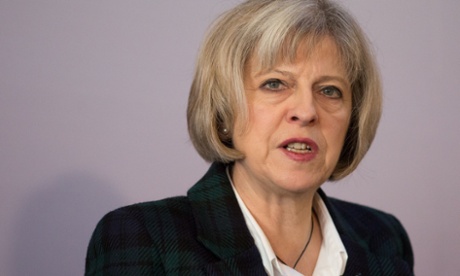
Theresa May, the home secretary, has joined those criticising Nigel Farage for his comments about “gross multiculturalism” and a “fifth column”. (See 10.08am.) This is what she told BBC News when she was asked if she agreed with the Ukip leader.
I think it is irresponsible to talk about a fifth column. We should all be working across society to ensure that we deal with and eradicate extremism wherever it exists.
For the record, here are today’s YouGov GB polling figures.
Labour: 33% (no change from YouGov yesterday)
Conservatives: 32% (down 1)
Ukip: 15% (up 2)
Lib Dems: 7% (no change)
Greens: 7% (down 1)
Labour lead: 1 point (up 1)
Government approval: -20 (up 1)
According to Electoral Calculus, this would give Labour a majority of six.
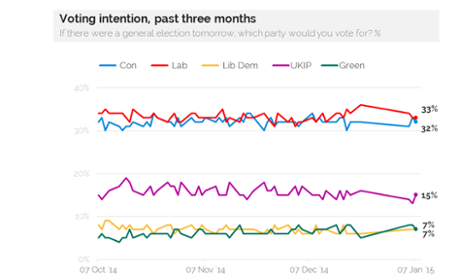
The Greens’ Scott Redding points out that, according to the YouGov data, the Greens are in third place amongst voters under 40.
@AndrewSparrow YouGov’s latest numbers for under 40 voters are interesting. We’re in third place - http://t.co/3Foj0DnoIm
— Scott Redding (@Scott_Redding) January 8, 2015
Updated
The best way to defend Britain’s democratic values it to “repeat our faith” in them, David Cameron said at his speech in Manchester today.
The prime minister told business leaders his thoughts were with the French people following yesterday’s “appalling” killings at Charlie Hebdo magazine in Paris.
Cameron said:
Everyone’s thoughts will be with the French people and will be thinking about the appalling events that happened yesterday in Paris. These are a challenge to our security because we have to fight this terrorism with everything we have.
But they are also a challenge to our values and ... when it comes to security we must use every part or vigilance and security we have.
He said the plot was not like those in the UK, according to the Daily Telegraph’s Steven Swinford.
David Cameron reveals he had a joint briefing with Angela Merkel on #CharlieHebdo attacks from MI5 and MI6. Says plot not like those in UK
— Steven Swinford (@Steven_Swinford) January 7, 2015
And he also attacked Nigel Farage’s response to the Charlie Hebdo massacre. The Ukip leader has criticised British multiculturalism.
David Cameron hits back at Nigel Farage: "this is not the time for politics... we stand foursquare with the people of France" #CharlieHebdo
— Adam Smith (@adamtimsmith) January 8, 2015
David Cameron criticises Nigel Farage for marking 'political arguments' while the "appalling" shootings are 'so fresh in people's minds'
— Steven Swinford (@Steven_Swinford) January 8, 2015
“Today is not the day to make political remarks or arguments,” Cameron said. “Today is the day to stand four-square behind the French people.”
David Cameron: Britain has a 'vibrant, exciting, passionate, disputatious and sometimes infuriating press but 'long may that be the case'
— Steven Swinford (@Steven_Swinford) January 8, 2015
Cameron said Britain would do everything it could to help France “hunt down and find” those responsible for the killing of the 12 people during the Charlie Hebdo massacre.
As countries in Europe, we share certain values, values we don’t think are incidental to our success but that are a key part of our success as a free and open society. These values include freedom of speech, the right to disagree... the right to have a government under the rule of law.
Cameron on UK security: "in a free society you cannot protect against every threat" - we mustn't let terrorists disrupt life #CharieHebdo
— Adam Smith (@adamtimsmith) January 8, 2015
Cameron said the UK could only have a strong economy if “no part of the country is left behind” and said he aspired to replicate the American model. “We need a strong London but we need a northern powerhouse too,” he said.
Cameron outlined five pledges in his speech, including the creation of 100,000 new jobs in the north-west in the next parliament and the largest ever investment in transport - 4.5 billion to benefit the region.
He also promised to make the north-east a “global centre” for science and raise the quality of life by building 25,000 new homes, improving schools and strengthening cultural and sporting opportunities.
In addition, he promised more power to the regions and to make people in the north-west better-off by an average 2,000 in real terms by 2030.
George Osborne, the chancellor, followed up Cameron’s five pledges with a six-point plan:
The #longtermecononicplan for the #North West consists of 6 points. They are...
— George Osborne (@George_Osborne) January 8, 2015
1. Raising the #NorthWest's growth rate to at least that of the UK means an £18bn real terms increase in size of NW economy by 2030
— George Osborne (@George_Osborne) January 8, 2015
2. Raising employment rate to UK average. That's 100,000 more people in jobs in #NorthWest in next parliament, by backing business
— George Osborne (@George_Osborne) January 8, 2015
3. Deliver largest ever transport investment in NW = new trains, new urban transport & major upgrade of roads & rail lines + High Speed Rail
— George Osborne (@George_Osborne) January 8, 2015
4. Make #NorthWest global centre of scientific innovation, especially material science, biomedicine, supercomputing and energy
— George Osborne (@George_Osborne) January 8, 2015
5. Raise quality of life with 25,000 new homes, nurturing rural environment, & ensuring over 75,000 more pupils attend outstanding schools
— George Osborne (@George_Osborne) January 8, 2015
6. Give greater power & voice to the great cities & counties of #NorthWest incl delivering new directly elected Mayor of Greater Manchester
— George Osborne (@George_Osborne) January 8, 2015
Tory MP George Freeman said George Osborne set out new commitments in biomedical and graphene research at the event.
CX @George_Osborne sets out new commitments to invest in Centres of excellence in Biomedicine, Graphene, Informatics #InnovationEconomy
— George Freeman MP (@Freeman_George) January 8, 2015
PM+CX set out powerful commitment to unlock #NorthernPowerhouse as global cluster of #LifeScience+ #InnovationEconomy pic.twitter.com/BuQLN8QmLh
— George Freeman MP (@Freeman_George) January 8, 2015
CX announces #HealthNorth: world class cluster in health informatics, e-health and digital healthcare w @The_NHSA to unlock #NHS innovation
— George Freeman MP (@Freeman_George) January 8, 2015
The Guardian’s Nicholas Watt noted a blurring of party and government lines at the event:
Blurring of party + govt lines at PM northern powerhouse event. Tory 'long term economic plan' slogan on walls + lecterns. But HMG paying
— Nicholas Watt (@nicholaswatt) January 8, 2015
Meanwhile Buzzfeed’s Siraj Datoo was rather scathing about the Tories’ event slogan:
Expecited to be tweeted soon from all the Tory accounts: the longest, most non-viral hashtag of all time. pic.twitter.com/kJwGEVKwSg
— Siraj Datoo (@dats) January 8, 2015
PO
Updated
I’ve just come back from Westminster Hall, in the House of Commons, where MPs, peers and other working on the parliamentary estate observed a minute’s silence in honour of the victims of the Charlie Hebdo attack. AS
Hundreds of parliamentarians and staff rallying in Westminster Hall in solidarity with France #JeSuisCharlie pic.twitter.com/8QYMuIqlIk
— Political Animal (@politic_animal) January 8, 2015
Updated
Here’s some reaction to the Ofcom ruling from journalists and commentators on Twitter.
Weird decision by Ofcom not to list the Greens, represented in the Commons since 2010, as a major party will only benefit them.
— Isabel Hardman (@IsabelHardman) January 8, 2015
@IsabelHardman ...though I think Ofcom is wrong on this and also that an all-male line up again will be infuriating.
— Miranda Green (@greenmiranda) January 8, 2015
Tories will be disappointed Greens haven't been listed as a "major party" by Ofcom. They want them in the TV debates to split the left.
— George Eaton (@georgeeaton) January 8, 2015
Will be amazed if Ofcom don't perform a screeching u-turn on strange decision to exclude Greens from TV debates but include Ukip
— David Singleton (@singersz) January 8, 2015
I know Ofcom has to draw line somewhere, but if decision based on polling LD's don't qualify, if based on MPs neither UKIP or Greens qualify
— James Murray (@James_BG) January 8, 2015
Updated
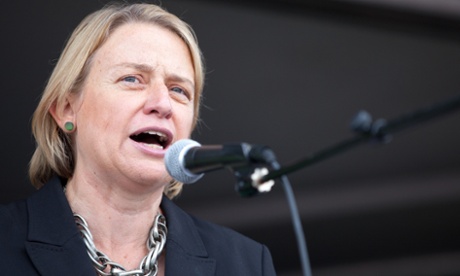
Natalie Bennett says Ofcom decision risks damaging democracy
And here’s the statement Natalie Bennett, the Green party leader, has issued about the Ofcom decision.
The Green party is deeply disappointed by this draft Ofcom ruling, not only for itself, but for the damage it risks doing to British democracy.
It is notable how the Ofcom draft focuses heavily on “past electoral support”. The media regulator has failed to grasp the fast-moving, fluid state of British politics today, and the fact that voters are seeking out the choice of real change.
Ofcom should not be making that option hard to find, but ensuring that voters have the chance to hear and judge the full range of political options today.
It is also important to note how Ofcom is ignoring the strong support for the Green party in particular sections of the community, particularly young people and students. Their engagement in the political process is vital for the future, and they will rightly expect to hear their views represented and explored in the mainstream press.
Updated
Here’s Natalie Bennett, the Green party leader, on the Ofcom ruling.
Deeply disappointed by Ofcom draft: stuck in past, fails to grasp politics changing fast &ignoring views young voters http://t.co/RtxckmEo4B
— Natalie Bennett (@natalieben) January 8, 2015
Updated
Ofcom’s decision may increase the chances of the Conservatives deciding not to take part in televised debates, my colleague Patrick Wintour points out in his story about the Ofcom decision. Here’s an extract.
The decision makes the Green party case to be included in the TV leader election debates much harder to prosecute successfully, although the Greens have until early February to make their case prior to a final decision in early March. It is also harder to mount a successful legal challenge to the broadcasters if they persist in excluding the Greens.
Ofcom stressed that it is for the broadcasters to decide the identity of the participants in the TV leader debates, but this ruling will give broadcasters cover to stick to their position that the Green should be excluded.
The parties have failed to reach heads of agreement on the conduct of the debates and likely contestants. The delay makes it more difficult to complete arrangements for the debates in time for the election, but not impossible.
Labour and the Liberal Democrats are concerned that the Conservatives will seek an excuse to avoid or reduce the number of debates, and the exclusion of the Greens may give the Conservatives a new argument.
For reference, this is what David Cameron said about the debates in October, when the broadcasters published a joint plan for three debates. He implied he wanted Natalie Bennett, the Green leader, to be included in at least one.
I’ve said many times I do favour the idea in principle, and that’s why we had debates at the last election. I will have a look at this proposal. I think there are some questions over it.
Why have all the debates inside the election campaign, rather than spreading them out over a longer period? And also, why include some parties and not other parties?If you have one person [Nigel Farage], then the Greens have an MP as well, so you have to think these things through.
And here is a BBC story with details of the broadcasters’ proposal for three debates: one involving just Cameron and Ed Miliband: a second involving those two, plus Nick Clegg; and a third involving those three, plus Nigel Farage. AS
In a victory for free speech, the Twitter ban in Manchester has been lifted.
Here’s my colleague Nicholas Watt 12 minutes ago.
'We do not want social media tweeting during formalities of PM speech' at northern powerhouse event. Oh dear
— Nicholas Watt (@nicholaswatt) January 8, 2015
And here’s his update.
Fastest U turn in the west. No 10: please ignore tweeting ban. Jobs-worth master of ceremonies to be told event being taken live
— Nicholas Watt (@nicholaswatt) January 8, 2015
Updated
Good to see someone in Manchester is ignoring the Twitter ban.
Business leaders in Manchester wait to hear David Cameron's plan for the Northern economy. @pavideo have the latest pic.twitter.com/MNTNcH3Pg9
— Richard McCarthy (@VJRichMcCarthy) January 8, 2015
David Cameron is about to speak in Manchester. But I can’t find a live feed, and the broadcasters aren’t covering it, so I won’t be able to do a minute by minute report.
Normally, in these circumstances, you can rely on Twitter to help out. But not today. These are from a Press Association reporter who is there. AS
In Manchester for Cameron and Osborne -'long-term economic plan' on both lecturns and the back wall.
— Lindsay Jane Watling (@LJWatling) January 8, 2015
Just been told we are not allowed to tweet from the @David_Cameron gig.
— Lindsay Jane Watling (@LJWatling) January 8, 2015
The Ofcom decision does not directly relate to whether or not the Greens are included in television debates. But if Ofcom were to categorise the Greens as a major party, in practice they would have to be included. And ruling that they are not a major party makes it easier for the broadcasters to justify keeping them out.
This is what the Ofcom report says about how election rules apply to major parties.
During election campaigns, any Ofcom licensed service that broadcasts election- related programming must comply with the special rules laid out in Section Six of the Code. The following rules apply to the coverage of the major parties:
Rule 6.2: “Due weight must be given to the coverage of major parties during the election period. Broadcasters must also consider giving appropriate coverage to other parties and independent candidates with significant views and perspectives”.
Rule 6.9: “If a candidate takes part in an item about his/her particular constituency, or electoral area, then candidates of each of the major parties must be offered the opportunity to take part. (However, if they refuse or are unable to participate, the item may nevertheless go ahead.)”.
(In contrast to Rule 6.9, under Rule 6.10 broadcasters are only required to offer the candidates of parties other than the major parties the opportunity to take part in constituency or electoral area reports and discussions, if those candidates represent parties with previous significant electoral support or where there is evidence of significant current support. This also applies to independent candidates).
Ofcom also says that “due weight” does not mean that all the major parties have to be treated equally.
Ofcom’s published Guidance to Section Six makes clear that: “The concept of giving ‘due weight’ to the major parties, as required by Rule 6.2, is flexible. Its application depends on the electoral context”. Rule 6.2, therefore does not require broadcasters necessarily to give equal coverage to all the major parties in any given election campaign.
Being classified as a “major party” also means that a party qualifies for at least two party political broadcasts during an election period, as well as three others during the year. Small parties get just one party political broadcast during the election. AS
Updated
The Conservative MP Zac Goldsmith has also condemned the decision.
. @tnewtondunn @TheGreenParty If confirmed, it's a disgraceful, indefensible decision by Ofcom.
— Zac Goldsmith (@ZacGoldsmith) January 8, 2015
The Green party may be surprised to learn that among those complaining on Twitter about the Ofcom ruling is Tom Newton Dunn, the political editor of the Sun.
Poor Ofcom ruling: @TheGreenParty not given 'major party' status for the election, despite one MP and more popular than Libs. UKIP given it.
— Tom Newton Dunn (@tnewtondunn) January 8, 2015
Ofcom on why Ukip should count as a major party
And this is what the Ofcom report says about why Ukip.
In relation to this party we observed that:
a) UKIP has not demonstrated significant past electoral support in previous General Elections (achieving between 0.7% and 3.5% of the vote in England, Wales and Scotland in 2010 and between 0.4% and 2.5% of the vote in England, Wales and Scotland in 2005 nor ever won a Parliamentary seat at a General Election).
b) UKIP’s performance in a number of other significant forms of election has, however, been stronger. Notably, since the 2010 General Election
- UKIP has won two seats in Parliament at recent by-elections. UKIP obtained 59.7% of the vote in Clacton on 9 October 2014 and 42.1% in Rochester and Strood on 20 November 2014. We recognised, however, that levels of support indicated by by-election outcomes may reflect specific circumstances that do not necessarily apply to a General Election.
- UKIP demonstrated a significant level of support in England and Wales in the European Parliament elections in 2014 (29.2% in England and 27.6% in Wales). UKIP’s share of the vote was lower in Scotland (10.5%); and
- UKIP has received significant levels of support in the English local elections (15.7% in 2014 and 19.9% in 2013).
c) The opinion poll data indicates that UKIP currently has significant levels of support in England and Wales to the extent that it has the third highest rating in those polls after the Conservative and Labour parties. Opinion poll data in Scotland shows lower levels of current support.
d) The level of support for UKIP exhibited in the opinion poll data for England and Wales has been growing steadily for a number of years in the period since the 2010 General Election (from an average of 7.4% in 2012 to an average 13.5% in 2014, in the BBC Poll of Polls, and from an average of 8.2% in 2012 to an average of 13.9% in 2014 in the Polling Observatory figures).
Taking together all the evidence, the criteria suggest that UKIP has sufficiently demonstrated evidence of past electoral support and current support to qualify for major party status in England and Wales for the purposes of the General Election and English local (and mayoral) elections in May 2015.
Ofcom says Greens don't count as a major party - but Ukip does
Ofcom has published a consultation paper today containing its draft findings on who should count as “major parties” at the general election (pdf). Their ruling affects party political broadcasts but, more importantly, it could also have an impact on who gets included in any TV debates.
For the first time Ukip should count as a major party, it says. But it says the Green party should not get this status.
This is what it says about the Greens.
This party has not demonstrated significant past electoral support in General Elections. This party has performed better in some elections (such as the 2014 European Parliamentary elections, obtaining 8.0% and 8.1% of the vote in England and Scotland). In terms of evidence of current support, this party’s opinion poll rating has increased in recent months to 5.9% in December 2014 (and was 4.0% on average for 2014) in Great-Britain wide opinion polls. Taking together all the evidence, the criteria suggest that the Green Party (including the Scottish Green Party) has not sufficiently demonstrated evidence of past electoral support and current support to qualify for major party status in England, Wales, Scotland or Northern Ireland.
What the papers say
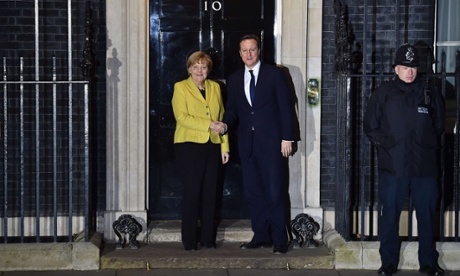
As Nicholas Watt reports in the Guardian, Angela Merkel, the German chancellor, declined on Wednesday to endorse David Cameron’s call for a major revision of the EU’s governing treaties to provide a legally watertight basis for British-led reforms before an in-out referendum in 2017.
John Crace sketched their meeting:
Merkel can afford to be gracious ... In her relationship with the prime minister she is very much the dominant figure. The less she gives away, the needier Cameron becomes. “Collaboration … long-term economic plans … single EU market …,” he said, longing for some nod of approval from Mummy while anxious to sound as independently minded as possible for the benefit of the Eurosceptics in his own party.
The Times’s Roger Boyes provides Cameron with “seven reasons not to trust Angela Merkel”.
They’re a bit sexist. The first two are “Merkel eats up men then spits them out: and “The fact is she wields a stiletto.” “She doesn’t think in terms of friendship, only of alliances that work and those that don’t,” Boyes warns Cameron.
Merkel was given an “extraordinary” joint security briefing with Cameron by British intelligence chiefs following the Paris attack yesterday, the Daily Mail reports.
Elsewhere in the Times, Tim Montgomerie warns Tories: “The possibility of [Ed] Miliband becoming prime minister in less than four months is very high.”
Cameron’s focus on the economy in this election campaign represents “Boringsville conservatism”, Montgomerie states.
There’s a real danger in this approach. Mr Cameron’s presentation of himself as a cardboard cut-out Boringsville conservative is meant to reassure floating voters. Its aim is also to win back ex-Tory voters who have defected to Ukip and don’t think Mr Cameron is much of a Tory at all. Not being your usual Tory was once Mr Cameron’s greatest selling point. I’m glad some of the über-modernisation of his early years as Tory leader has gone. The windmill on the roof and the attack on Ukip voters as fruitcakes was always ill-judged. Much of early Cameron was persuasive, even inspirational.
As Cameron and George Osborne head to Manchester today, the Daily Telegraph asks: “Will the Conservatives ever be loved in the north?”
The north is poorer, has more unemployment and more public sector workers, the paper reports – all things it links to a reluctance to vote Tory (or, to put it another way, to a rejection of Tory policies). Having too many posh southern candidates is a problem, too, it says.
The Telegraph explains to its readers that “to the people who live there, there is no such thing as ‘the north’”:
The north-west is very distinct from Yorkshire, and the north-east is different again. “The instant you talk about the north, you show you’re not from there,” says one non-southern Conservative. “That’s the start of our problem.”
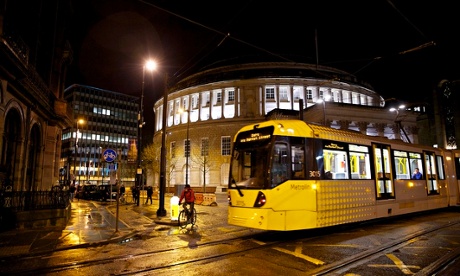
During his trip today, Osborne will promise to rebalance the economy and shift its focus from London, the Sun reports. His actual quote suggests this is more of an aspiration, however.
Rebalancing our national economy, ensuring that the economic future of the north is as bright, if not brighter, than other parts of the UK, is the ambition we should set ourselves.
The Tories are not alone in appearing London-centric. Miliband needs to escape from the “Westminster bubble” if he wants to see off a threat from Ukip and beat the Conservatives at the next general election, Liverpool’s elected Labour mayor Joe Anderson tells the Guardian.
My advice to Ed Miliband is to get out of that bubble down there and get amongst the people – whether it’s in middle England or in the working class areas of the north or down south, get out, talk to people. I genuinely believe he’ll be a better PM than he is leader of the opposition.
Elsewhere in the Telegraph, Channel 4 News presenter Cathy Newman looks at the history of political wives on the campaign trail.
“Miriam Clegg has managed so far to wear her feminist heart on her sleeve without landing her husband in hot water,” she notes. “That’s quite a skill.”
And the Daily Mirror and Independent both report that Labour has set out a women’s manifesto, with pledges on equal pay, childcare and maternity leave. Women are less likely to vote than men.
Harriet Harman, the deputy Labour leader, told the Mirror women saw politics as a “men-only game”.
They think politics is men from a different planet who don’t understand the pressure of balancing work, looking after an elderly relative and grandchildren. They think male politicians are less likely to have a sense of what they are facing.
The Independent also reports that Tony Blair will appear before the Northern Ireland select committee next Tuesday to explain the so-called “comfort letters” sent in 1999 to 187 people telling them they were not wanted by UK police.
And the Sun’s Trevor Kavanagh and Alex Salmond seem to have got into a bit of a dispute over a bet on the oil price slipping below $50 a barrel, which it did for a while yesterday.
You can read all today’s Guardian politics stories here. And all the politics stories filed yesterday, including some in today’s paper, are here.
As for the rest of the papers, here’s the PoliticsHome list of top 10 political must-reads, and here is the ConservativeHome round-up of all today’s political stories. PO
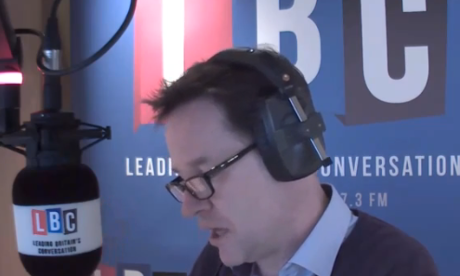
Nick Clegg's Call Clegg phone-in - Summary
-
Nigel Farage, the Ukip leader, has told LBC that the Paris shootings have illustrated the problem with the “gross multiculturalism” that has been adopted in the UK. He told the programme earlier (in a clip played to Nick Clegg):
What should have been done is we should have had a controlled immigration policy and made sure we did full checks on everybody who ever came to this country from anywhere - and that applies to everyone else.
But also, the real question is this: we in Britain, and I’ve seen some evidence of this in other countries too, have a really rather gross policy of multi-culturalism.
By that, what I mean is that we’ve encouraged people from other cultures to remain within those cultures and not integrate fully within our communities.
Farage also said that extremist Muslims amounted to a small “fifth column” in the UK.
-
Clegg has condemned Farage’s comments about multi-culturalism.
I’m dismayed, really, that Nigel Farage immediately thinks, on the back of the bloody murders that we saw on the streets of Paris yesterday, that his first reflex is to seek to make political points.
If this does come down to two individuals who have perverted the cause of Islam to their own bloody ends, let’s remember the greatest antidote to the perversion of that great world religion, Islam, are law-abiding British Muslims themselves. And to immediately somehow suggest that many, many British Muslims, who I know feel fervently British but also are very proud of their Muslim faith, are somehow part of the problem, rather than part of the solution, I think is firmly grabbing the wrong end of the stick.
-
Clegg has said that the right to offend people is essential in a free society.
At the end of the day in a free society people have to be free to offend each other. You cannot have freedom unless people are free to offend. We have no right not to be offended. That fundamental principle, of being free to offend people - I’m not saying that you have somehow a right not to be offended in a democratic, open society such as ours - is exactly what was under threat by these murderous barbarians.
-
He has joked about David Cameron and Ed Miliband being “Herberts”. Talking about PMQs, he said.
I’m not going to pretend that sitting there and watching my two main rivals, or the two Herberts as from now on they will be known in Lib Dem circles, going at each other hammer and tongs, and I have to sit there on my hands - do I enjoy it, no? Is it part of my front bench role? Yes. Am I going to do it every week? No.
He also said that he hoped there would be TV debates, so that viewers could see “all the Herberts”.
Nick Ferrari plays a clip from Nigel Farage, who told LBC earlier that Britain has persued “a rather gross policy of multi-culturalism”. Britain encouraged immigrants to stay within their own cultures.
Clegg says he is dismayed that Farage’s first reaction to this was to make political points.
The greatest antidote to the perversion of Islam is law-abiding British Muslims. To imply that British Muslism, who are proud of being British but also proud of being Muslim, is part of the problem is missing the point.
And that’s it. I’ll post a summary soon. AS
Q: The cartoonists killed yesterday were causing offence.
Clegg says he could not disagree more. There is no right not to be offended. The killers were barbarians. To suggest in any way that such a cold-hearted, cowardly act is justified is wrong.
The caller says he agrees with Clegg about the killings not being justified. But what about other issues, like Iraq?
Clegg says we should not mix up issues.
Of course, what the Americans were doing, in terms of torturing suspects, was wrong.
But to shoot cartoonists - even drawing the link is inexplicable, Clegg says.
Q: Do you agree governments have failed to control immigration. Enoch Powell’s predictions have come true?
Clegg says it is not racist to complain about immigration. We need to have an open society, but to tackle abuses too, he says.
He says he has been pushing for the government to put in proper exit checks at borders. This is happening.
Q: My son has been excluded from school, and sent to a pupil referral unit. But it does not cover the whole day, and my partner and I both work. What are we meant to do?
Clegg says he will look into this.
Nick Ferrari says LBC will take this up and see what it can do to help.
Q: Are you happy? You looked miserable at PMQs yesterday listening to those two Herberts. And it was your birthday.
Clegg says sitting at PMQs listening to those Herberts is not his favourite thing. That’s why he won’t be there all the time. He hopes there will be TV debates, so people can listen to all the Herberts.
Q: What did you do for your birthday?
Clegg says that he and his family went to Wagamamas, and that he and his wife then went to see A Theory of Everything.
Q: Why were warnings from the Trimbos Institute about a batch of dangerous ecstasy pills ignored by the government?Theresa May has blood on her hands.
Clegg says he will look into this. He does not know about the status of the Trimbos Institute.
Q: Ched Evans has not expressed remorse. Shouldn’t his licence be revoked, so that he can be sent to prison?
Clegg says he has said before that Evans was convicted, that footballers are role models as well as athletes and that is why has has said what he said. (Previously he has said Sheffield United should not take him back.)
Q: Should Oldham sign him?
Clegg says he has been convicted of a serious crime, and has not expressed remorse. Oldham need to take their own decisions. But Clegg says his views have not changed. He spoke out as an MP for Sheffield. But he does not want to provide a running commentary.
Q: You were asked recently who had a better temper: you or your wife? You said Miriam is “truly Spanish”. What did you mean by that?
Clegg says the Spanish are a forthright people. They express their feelings.
Q: What if you had been asked who wears the trousers in your household?
We share the trousers, Clegg says.
Q: Boris Johnson described Prince Andrew as an asset to the nation. Cameron refused to comment. Who’s side are you on?
Clegg says they were answering different questions. Cameron was not commenting on the court case. But Johnson was talking about Prince Andrew’s service to the country.
Q: I’m terrified about the NHS. It is being pulled apart by people who have never used it. You’ve never used it.
Of course I have, says Clegg.
Q: Osborne’s never used it. Cameron’s never used it.
Clegg says he visited a hospital on Monday where his third son was born. Staff were telling him that more and more people were coming into A&E. Significant extra money has been announced, £700m for the winter, £2bn in the autumn statement. But there is an ageing population. Older patients are kept in hospital for a long time. And there is a problem ensuring they have somewhere to go when they are ready to leave. Health and care services are not properly integrated.
Q: [From a police officer] Terror meetings are fine. When are you going to give the police more money. The Met wants £50m.
Clegg says he is not sure what money the caller is referring to.
The police have had to balance the books. The government is trying to get the balance right. The police have been very effective at getting the right balance between making savings and not compromising safety.
Q: Sir Bernard Hogan-Howe said on this show a few weeks ago that he needed another £50m.
Clegg says he doesn’t listen to the show all the time. He will look into this.
Nick Clegg's Call Clegg phone-in
Q: There is a Cobra meeting taking place this morning to discuss the attack in Paris. Why did it not take place last night? This is urgent.
Clegg says the threat level was raised recently. Security is maintained at all time.
It is right that Theresa May is chairing a Cobra meeting this morning. She’s there to stress-test and double check that all the measures are in place.
Q: Why didn’t it take place last night? Why has security not been doubled?
Clegg says a lot is happening. The threat to the UK is not new.
The government is also passing new anti-terror legislation.
Q: But why is this meeting only taking place now.
Clegg says measures don’t just happen because a meeting is taking place. It is not as if nothing happens until a meeting takes place. A lot happens all the time. Arrangements are constantly being tightened.
Coalition talks could take weeks, Lord O'Donnell says
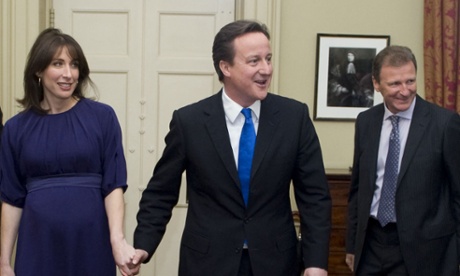
As I mentioned earlier, David Cameron and Ed Miliband look as though they are electioneering today. But the actual elections is months away.
#UKGENERALELECTION2015 119 DAYS TO GO
— General Election (@UKELECTIONS2015) January 8, 2015
But it’s worse than that; even after the election, it might not all be over, because coalition negotiations could go on for weeks.
That was the point that Lord O’Donnell, who was cabinet secretary in 2010 when the coalition negotiations were taking place, made in an interview on the Today programme earlier. He said this time coalition negotiations could be “even messier” than they were five years ago and that they could take a lot longer than the five days it took for Cameron and Nick Clegg to form a government.
Next time it could be even messier, because the share of the main parties is declining, we know that. So I think my successor will need to be preparing for all sorts of possible options. I think it’s really important that he doesn’t get into the game of trying to have one forecast. It could be minority government. It could be coalitions with side agreements with other parties. It could be quite messy. And it could take quite a lot longer next time to actually form a government.
O’Donnell said that, when he studied what had happened in Europe in 2010, he found that on average it took more than 40 days to form a coalition in countries where the happened. Subsequently Belgium took more than a year forming a coalition.
He also said that it was Cameron’s job to remain as prime minister until he was able to recommend to the Queen that somebody else was in a position to form a government (assuming he lost). AS
Updated
The main party leaders are all back on the campaign trail today. David Cameron is giving a speech in the north west, Ed Miliband is holding one of his new “People’s Question Time” events in Nottingham and, it being Thursday, of course it’s Call Clegg.
Downing Street have released some of Cameron’s words in advance. He will be promoting the government’s “northern powerhouse” vision.
When it comes to the next generation – to Britain’s long-term future – few things are more important than rebalancing our economy. We can only have a strong British economy if no part of the country is left behind. In the USA they’ve got major centres of industry not just in New York but in Los Angeles, Chicago, Houston, Atlanta. That is what we should aspire to in the UK, economic might not just held in one city but spread right across our country.
So we need a strong London, but we need a northern powerhouse too. In the modern world growth is being powered by big cities. The top 600 cities in the world contain just 20 per cent of global population but create 60 per cent of global GDP. When you get that critical mass of people – it amplifies jobs and ideas and businesses. The cities and towns of the North of England can have that critical mass. If we join them together as a team and let them pool their strengths, if we back their scientists and innovators, if we back their thriving cultural life, make them great places to live and give them powerful elected voices, then we can create a northern powerhouse.
We’ll be covering the Cameron event in detail, as well as the others too.
Here’s the agenda for the day.
9am: Nick Clegg hosts his Call Clegg phone-in.
Morning: David Cameron and George Osborne are due to deliver speeches in the north west.
11.30am: Peter Robinson, the Democratic Unionist party leader, gives evidence to the Commons political and constitutional reform committee about the future of devolution.
1.45pm: Ed Miliband hosts a “People’s Question Time” event in Nottingham.
I’m Andrew Sparrow (AS) and I will be writing the blog today with Paul Owen (PO). Where it matters, we will use initials to show how has written each post. If you want to follow us on Twitter, I’m on @AndrewSparrow and Paul is on @PaulTOwen.