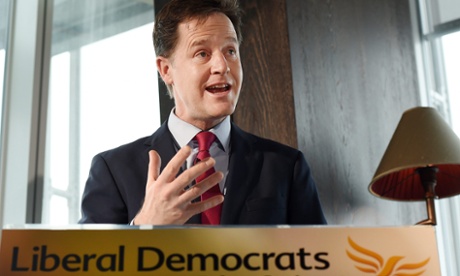
Nick Clegg has defended plans to spend more on universal free childcare provision, arguing that it is the single most effective way for the state to help children in life.
Faced with criticism that he would be providing childcare support regardless of income, the Liberal Democrat leader said: “One of the things we have discovered over time is that the kind of help you give as a society to little children before they have even hung up their coat on their first day at primary school has as dramatic an effect, if not more, on their subsequent ability to do well in life as what happens when they are teenagers in the classroom.
“So investing in the early years pays off massively. It means they are more obedient to their teachers, they mix better with their school mates.”
Speaking on LBC’s Call Clegg programme, the deputy prime minister contrasted his promise with the Tory pledge to spend £800m on a married tax allowance, which he described as an unmarried tax penalty that would not go to many married couples.
Clegg said that money would be better used to balance the books in 2017-18, and thereafter to make sure all two-year-olds have access to 15 hours a week of free childcare, worth £2,540 a year.
He said: “There are certain things that we believe as a country should be universally provided for. I think the evidence is giving all families childcare free from the state has a fantastic effect not only on their household finances, but also on the ability of children subsequently to do well in schools.”
He said his policy is better than “the higgedly piggedly partial marriage tax break for some couples and not for others”.
The three-stage Lib Dem plan is for 15 hours a week of free childcare for working parents with children aged between nine months and two years – saving the average family £2,670 over a year – and a universal entitlement to 15 hours a week of free childcare for all two-year-olds – saving the average family £2,540 over a year.
It also has a long-term ambition of free childcare of up to 20 hours a week for all two, three and four-year-olds, and for children of working parents aged between nine months and two years.
Clegg denied his plans were so expensive that they were unworkable, pointing out that the government already spent £6bn annually on early years support. He said the Tories’ planned £12bn welfare cut would cost 8 million people on modest incomes about £1,500.
He added that he would like to see the business rate burden on childcare providers eased and that there was a problem regarding the generous state funding given to local authorities for childcare provision being passed in full to childcare providers, and not kept by local councils.
He accepted he needed to look at how the childcare entitlement included in tax credits could be available early enough so there was no penalty in going back to work.