Nick Clegg has attacked Philip Hammond for comments in which the foreign secretary criticised a pledge in the Tories’ last general election manifesto to enshrine Britain’s spending on overseas aid in law.
The deputy prime minister accused his Conservative cabinet colleague of “tearing up his own manifesto” during a trip to Sierra Leone, where Hammond described proposals for legislation on aid spending as “bizarre”.
Clegg turned on Hammond after the latter told the Telegraph during the Africa trip, where he was examining British facilities to help treat victims of Ebola, that it was wrong to enshrine in law the UK commitment to spend 0.7% of gross national income (GNI) on overseas aid by 2013. Britain reached the UN target last year.
Hammond told the Telegraph: “Trying to enshrine it in law – it’s a bizarre idea. Somebody says shall we have a law that says you’ve got to build a building. Think about it – in the meantime we built a building. Someone comes along and says now we’ve built it shall we pass the law which says we’ve got to do it? We’ve done it. We’re doing it. You don’t need a law to say we’re doing it.”
The remarks by Hammond put him at odds with the Tory manifesto for the 2010 general election and the coalition agreement signed by the Conservatives and Liberal Democrats. The manifesto said a Conservative government would be “fully committed” to achieving the UN target, adding: “We will legislate in the first session of a new parliament to lock in this level of spending for every year from 2013.”
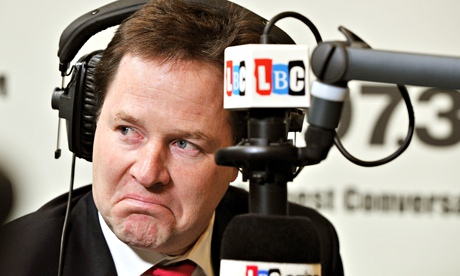
The deputy prime minister, who has criticised his coalition partners for blocking legislation to enshrine the UN commitment in law, reminded Hammond of the pledge. Speaking on his weekly LBC phone-in, Clegg said: “I think what is a little bizarre, to put it as diplomatically as I can, [is] that the foreign secretary, a Conservative, should go to Sierra Leone to tear up his own manifesto. It was a Conservative party manifesto commitment to legislate on this commitment of devoting 0.7% of our national wealth [to overseas aid].
“It was our idea as well. It was actually in both our manifestos. Here is the thing. Because we both put it in the coalition agreement. And here you’ve got a Conservative foreign secretary who … goes to an Ebola-affected part of the world and says that we somehow shouldn’t deliver his own party’s own manifesto commitment.
“That is a measure of quite what has happened to the Conservative party over the last several years. When we went into office with them it was totally uncontroversial that we would do what they had been saying for years, as we had as well, which is that we need to honour the international commitments we had made to devote some – 0.7% – of our national wealth to some of the poorest and most wretched communities in the world. They used to believe in the environment, they used to believe in helping people on the other side of the world. Now they are claiming it is bizarre. It was their own idea.”
Hammond, who recently claimed the prime minister, David Cameron, was lighting a fire under the EU with his pledge to hold an EU referendum by 2017, made his comments in Sierra Leone to show that he remained fully committed to disaster relief. But the foreign secretary, who admitted to being sceptical about overseas aid spending, questioned wider projects run by the Department for International Development.
He told the Telegraph: “The scepticism that some people have about the aid budget, which I absolutely recognise … I don’t think has ever been directed at emergency aid. I’ve never detected in Britain at all people saying we shouldn’t be sending food aid or disaster relief or earthquake relief.
“It’s never been that bit of the programme. It’s been the ‘we’ll invest over two decades in education in India, economic development in east Africa’. It’s that bit of it that people sometimes question. But I’m sure the British people always feel very well-disposed to the disaster relief.”
Michael Moore, the former Lib Dem Scotland secretary, is seeking to enshrine the 0.7% commitment in law through a private member’s bill. He is supported by the Lib Dem leadership.