Monday’s historic but stilted handshake between China’s president, Xi Jinping, and the Japanese prime minister, Shinzo Abe, in Beijing could mark the beginning of a thawing in relations between the two countries. But the hostile body-language between the two men suggest tensions still run deep and not just because disputed claims about uninhabited islands in the east China sea.
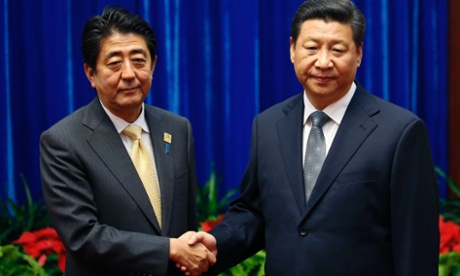
Until now Xi has resisted being seen in the same room as Abe, and he signalled that he would have rather have been somewhere else on Monday. Anti-Japanese sentiment goes a long way back in Xi’s family - his father made a name for himself fighting the Japanese in the second world war. Abe is portrayed in China as a militarist. Before the meeting with Xi, he insisted he wanted to improve relations with Beijing. But he angered China by continuing to visit Yasukuni shrine for the Japanese war dead.
Abe and Xi’s handshake is just the latest in the long historical greeting line of difficult hand-shaking. Below are some of the most diplomatically charged handshakes of recent years. In some the friendly body language disguises the sweaty palmed diplomacy that went on away from the cameras.
Barack Obama and Raúl Castro
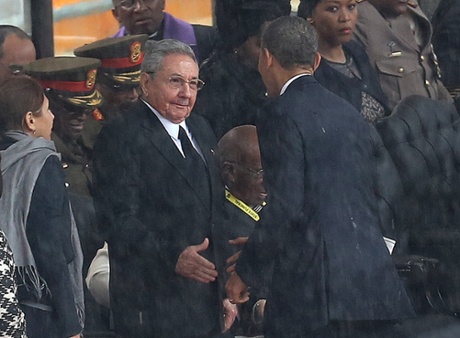
Nelson Mandela’s memorial service last year was rich in memorable diplomatic moments between world leaders. First there was Obama’s ill-judged selfie with David Cameron and the Danish prime minster, Helle Thorning-Schmidt.
But Obama also used the occasion to shake hands with the Cuban leader, Raúl Castro. The US broke off diplomatic ties with Cuba in 1961 when Raúl’s brother, Fidel, aligned with the Soviet Union in the cold war, and the frosty relations have continued to present day. The handshake was the first between leaders of Cuba and the US for more than a decade. Cuba said the handshake could show the “beginning of the end of US aggressions”. But Obama’s opponents likened the gesture to appeasing the Nazis (see more below).
Martin McGuinness and the Queen
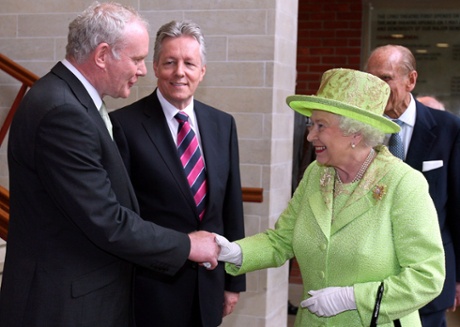
The Queen’s gloved handshake with former IRA chief of staff Martin McGuinness was difficult for some people to witness. The tabloid press in Britain said the Queen, whose cousin, Earl Mountbatten, was murdered by an IRA bomb, was right to keep her hands covered. While some said she was wrong to shake a “blood-soaked” hand with or without gloves. In Northern Ireland dissident republicans accused McGuinness of selling out. After the meeting McGuinness insisted he remained a committed republican but revealed that he personally liked the Queen.
Muammar Gaddafi and Barack Obama
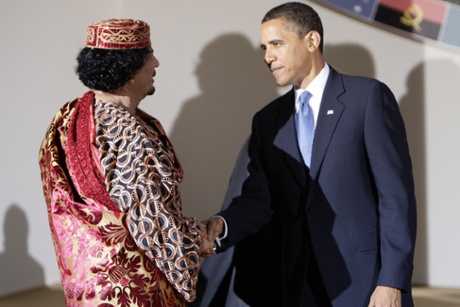
The families of the victims of the Lockerbie bombing said they were shocked to see Obama shake hands with the Libyan leader, Muammar Gaddafi, who they believed was behind the attack. The gesture, which took place in July 2009 looks even odder in hindsight. Just over two years later Gaddafi was killed by mob after a campaign of US-led air strikes against his regime.
Robert Mugabe and Jack Straw
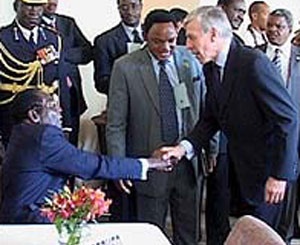
In 2004 at the height of international concern about Zimbabwe’s crackdown on political opposition and human rights abuses, its president, Robert Mugabe, was filmed shaking hands with Jack Straw, who was at the time Britain’s foreign secretary. Straw was accused of a “scandalous betrayal” of the people of Zimbabwe and their suffering at the “hands of Mugabe’s bloodstained regime”. Straw claimed he was caught unawares at a UN meeting in a “dark corner”.
Yitzhak Rabin and Yasser Arafat
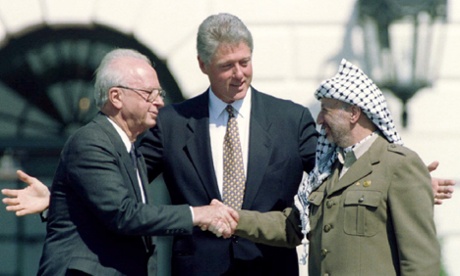
The 1993 handshake between Israel’s prime minister, Yitzhak Rabin, and the PLO leader, Yasser Arafat, was a rare moment of hope in the bitter Middle East conflict. At the time Guardian’s Simon Tisdall described the moment:
After the merest flicker of hesitation and a nudge from Mr Clinton, Mr Rabin acquiesced in the handshake, making eye contact for the first time with a man who for most of his life, and that of most Israelis, he has considered a mortal enemy.
The bravery of both Arafat and Rabin was widely praised. Two years later Rabin was assassinated by a militant Israeli opponent of the peace process.
Margaret Thatcher and Nelson Mandela
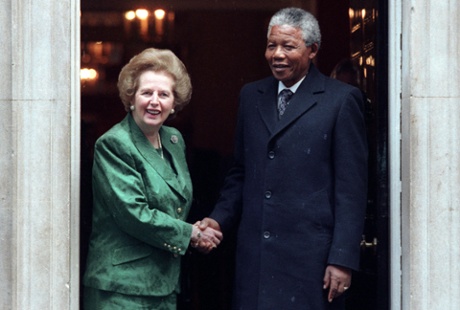
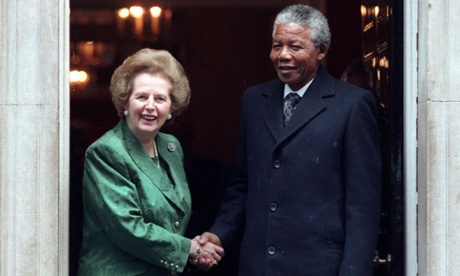
Margaret Thatcher’s 1990 handshake with Nelson Mandela - a man she once regarded as a terrorist - happened later than the ANC leader had hoped. Diplomatic cables revealed that Mandela was keen to meet the British leader soon after he was released from prison to spell out his annoyance with Thatcher’s decision to block sanctions against the apartheid regime. When Mandela failed to meet Thatcher on a trip to Britain in April 1990 this was seen as snub to Tory prime minister. But the cables revealed Mandela was furious when a planned meeting was cancelled by his appointments secretary. Mandela got his Downing Street meeting a few weeks later on his next trip to Britain.
Neville Chamberlain and Adolf Hitler
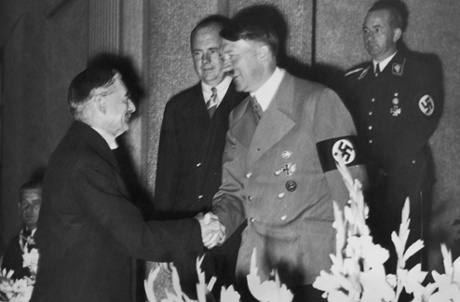
As ill-judged handshake go, there’s no beating Nevill Chamberlain’s greeting of Adolf Hitler in September 1938 in Germany . The British prime minister compounded the blunder with a “Sieg heil” to the German dictator and returned to Britain declaring peace in our time.