

That’s all from Niall today
SamSquanch asks:
In your opinion, what did Marx get wrong (or right) about the historical development of capitalism?
 Guardian contributor
 I used to say that I was a Marxist, except that I was on the side of the bourgeoisie. To be serious, Marx's big mistake in trying to marry Hegel to Ricardo was to believe in the inexorable polarisation of wealth distribution. He was sure the proletariat would just keep getting crushed and failed to foresee that capitalism would require workers also to be consumers. The idea of inexorable widening inequality continues to fascinate - hence the popularity of Thomas Piketty's equally wrong book.
'American-led intervention can be an effective way of ending war'
Chris2131 asks:
Recent western intervention in Afghanistan, Iraq and Libya has been unsuccessful. But Collier in ‘The Bottom Billion’ and Acemoglu & Robinson’s in ‘Why Nations Fail’ indicate that the west needs to intervene in the failing states to free the powerless from the kleptocracies that rule them. Do you think the west just needs to get better at intervention (Operation Palliser worked in Sierra Leone), or abandon it and accept greater migration flows? Or some alternative?
Guardian contributor Many people are making the mistake of thinking that because Iraq went wrong, all interventions are bound to go wrong. I think this was president Obama's view and explains his reluctance to intervene in Syria until it was much too late. But we know from the experience of the former Yugoslavia that American-led intervention can be an effective way of ending war. The recent French intervention in Mali was highly successful in preventing a jihadist takeover of that country. So we need to have a more nuanced view of the recent past.
'What we see now in the Middle East is that there is something worse than empire. That something is anarchy.'
Philip J Sparrow asks:
Regarding the Middle East, can you think of any examples throughout history whereby a foreign state has successfully imposed a form of government and rule of law on another state which has then been fully embraced? Can you force a population that doesn’t believe in freedom and democracy to be free and vote?
Guardian contributor The Ottoman empire imposed its form of government and law on most of the Middle East for rather a long time. My point has been for some time now that the United States has the utmost difficulty in acting as an effective empire because its founding ideology is anti-imperial. What we see now in the Middle East is that there is something worse than empire. That something is anarchy. The complete breakdown of political structures is a reminder that the pursuit of freedom and democracy, noble though those ideals are, can end disastrously when circumstances are simply not propitious. That is the tragedy of the so-called Arab Spring.
ID7784845 asks:
If some future historian were to use the term “a Fergusonian idea” to describe some notion or approach, what do you think she might mean?
Guardian contributor I doubt I am of sufficient significance to merit such an adjective.
Lafeyette asks:
‘What if’ history is often maligned, but can we truly grasp how important an historical event is, if we do not consider how things would have been otherwise?
Guardian contributor The answer is that we cannot. Those who disparage counterfactual or virtual history have failed to grasp a very essential point about the philosophy of history. Kissinger himself echoed Lewis Namier that what did not happen in history is as important as what did happen. At the point of decision a president or prime minister cannot know the future. Decisions are based on multiple possible futures. If all we look at is the decision that was taken and its proximate consequences we shall lose that sense of uncertainty that is so central to the human experience. Some historians imply counterfactuals. I think it is better to make them explicit.
'I can be thinking about a book while standing in lines at airport security'
Lluxate77 asks:
Can you explain your writing technique. For example, Murakami gets up at 4. Writes until 12. Reads for 2-3 hours, Runs 10k. Goes to bed at 9.
Guardian contributor I wish I could lead such a regimented life. I fit writing in around all the other things that I do: teaching, webchatting, playing with my youngest son... One of the things I have learned over the years is to be able to research and write in all and any circumstances, including in the back of a minivan with a film crew. In fact it may even help me to survive life's many challenges that I can be thinking about a book while standing in lines at airport security.
radnor asks:
Do you think it unfair that Kissinger is despised just because he deliberately planned and knew that hundreds of thousand of innocent people would be killed because of his ‘advises’. And do think it’s unfair of people to loathe people like you who shrug their shoulders at such atrocities and call Kissinger’s policies ‘real politik’ because he’s on ‘our side’.
Guardian contributor You really need to read this book about Kissinger before you express opinions like these. I certainly have never "shrugged my shoulders" about atrocities of any sort.
'Kissinger saw much more clearly than his critics on the left the cruelties of communism'
PoliticalUmpire asks:
Wasn’t the basic problem that Bob MacNamara, HK and others the same as the Marine Colonel in Full Metal Jacket - “we are fighting this war because inside every gook, there is an American, trying to get out”? Which, incidentally, was the view Blair had about Iraq and Afghanistan, and Cameron about Libya, and the liberal left have about mass immigration (which they assure us will present no issues whatever about integration/assimilation).
Guardian contributor The interesting point about Kissinger was that when he went to Vietnam for the first time in 1965 he understood very quickly just what was going wrong. He certainly was not like Graham Greene's Quiet American. Kissinger was rather favourably impressed by the Vietnamese he met, though he realised there was something chronically wrong with the South Vietnamese political system. He reserved his most scathing criticism for the American military, particularly those at the top, who wholly misunderstood the nature of the war they were fighting. Kissinger saw much more clearly than his critics on the left the cruelties of communism, and was sincere in his desire to check the spread of communist rule, in Asia and elsewhere. But he did not imagine that it would be possible to turn countries like South Vietnam into miniature replicas of the United States.
I will leave aside the points you make here about Messrs Blair and Cameron, not to mention mass immigration.
TheMarxOfProgress asks:
What is your (early) assessment of the Coalition?
Guardian contributor My early assessment in May 2010 was that the Conservatives would suck the lifeblood out of the Liberal Democrats and leave them a desiccated carcass in the gutter. That proved to be correct.
damopop asks:
What’s your perfect Sunday?
Guardian contributor My perfect Sunday would centre around a leisurely and rather bibulous lunch attended by my four children, my wife, my mother and at least three of my best friends. After the lunch I would go paddleboarding on a salt water pond. And after the paddle I would be transported magically to one of the world's great opera houses, to hear a performance of one of Verdi's operas. Alternatively I would be transported by the same magic to see Arsenal beat Tottenham Hotspur by at least three goals to nil.
'Both Obama and his predecessor approached foreign policy in general and the Middle East in particular with far too little historical knowledge'
Awylie asks:
Do you think Obama’s lack of knowledge of and application to international affairs has led to Putin’s rising star in the Middle East?
Guardian contributor I think both Obama and his predecessor approached foreign policy in general and the Middle East in particular with far too little historical knowledge. Putin's recent successes are not the worst consequence of their historical ignorance. Both Bush and Obama gravely underestimated the potential for sectarian conflict to escalate. Both underestimated the fragility of states like Iraq and Syria. There was a naive belief that if we toppled the dictators a brave new era of Middle Eastern democracy would begin.
I wish it could be possible to make history a far more central part of the education of western leaders. We need to work much harder as historians to challenge the dominance of subjects like economics, political science and law in elite education.
'A great mythology has sprung up that I have a small factory full of enslaved researchers'
LiviaDrusilla asks:
How many “research assistants’’ do you employ when writing your books?
Guardian contributor A great mythology has sprung up that I have a small factory full of enslaved researchers. This may be because I am over-generous when I write the acknowledgements to my books. In the case of Kissinger, I had one full time researcher, Jason Rockett, whose job it was to gather the material from the many archives that had relevant source documents. I got quite a few undergraduates to help proof-read digitised documents to make sure that there were no errors in the database, but this was a part time assistance that was marginally more interesting than stacking supermarket shelves. By and large, I like to work with one trustworthy and experienced researcher. But the reading, thinking, interpretation and writing I do on my own. By the way, this is not because I dislike archives. The problem is that as a tenured professor, I am tied down with teaching and other responsibilities. Jason's job was to be in the archives while I was in the classroom.
ID4591658 asks:
What is the key lesson an A Level History student should focus on understanding to be a great student of History? Are you doing any open lectures in the UK soon we could attend with our class?
Guardian contributor The skill that is least well taught at schools today is essay writing. I would urge anyone studying A Level history to read some of the great historical essayists of the previous generation - for example, AJP Taylor and his arch enemy, Hugh Trevor-Roper. Even reading Taylor's old book reviews will help sharpen your writing style.
'The US is capable of reforming its dysfunctional political institutions and culture'
hazh asks:
How do you see the world within the next 50 years? Will it be a world dominated by a rising Chinese power over a weakening American one, can Europe become dominant power, or is the west now in terminal decline?
Guardian contributor There is no such thing as the future, singular, only multiple futures. Historians are not clairvoyants so all I can offer you are some plausible scenarios. Although it is clear to me that the west and especially Europe have experienced and will likely continue to experience relative decline in economic and geopolitical terms, there is no guarantee that China will not stumble. The internal problems of the People's Republic are daunting. Meanwhile, as I argued in the The Great Degeneration, the United States is capable of reforming its currently dysfunctional political institutions and culture, and I would not be surprised to see a significant American revival within the next ten years, never mind the next fifty. The next president will have to work much more effectively with Congress to address the country's fiscal imbalances, tangle of regulation, chronic rule of lawyers, and erosion of civil society. We saw in the 1980s that strong presidential leadership can achieve great things. I hope we can see that once again.
Leviathan212 asks:
What is your response to critics who’ve argued that your book fails to engage with the rich historiography of the cold war, and lapses into a simply hagiography of your subject?
Guardian contributor I do not know which "critics" you are referring to. I think you may mean one reviewer who was cross that I did not cite his book. As for the accusation of hagiography, no-one who reads my book could possibly say that. The book is often critical, but above all, it aims to be an historically accurate account of Kissinger's early life based on tens of thousands of pages of documents from 50 archives.
johnmccartney asks:
Does it concern you that your political and moral opinions detract - in the eyes of many of your peers - from your trustworthiness as a historian?
Guardian contributor There is an unhealthy tendency to try to discredit my work as an historian by endlessly focusing on the much less important things that I have said or written on political issues. I suppose this is because it is easier to Google old journalism than to read long and carefully researched books. My simple advice is to read the books and base your judgement on them.
HumesHomeboy asks:
In light of the upcoming EU referendum I would like to ask about your position regarding British membership. You stated in your work on Civilisation that one of the deciding factors in the west’s rise was the competition and subsequent innovation fuelled by small, warring European states. Now that we find ourselves in the age of the monolith - with the rise of China, India and Brazil - where ideas and innovations cross the globe instantaneously, is it not time for the UK to recognise that its relevance and ability to compete in this coming age is dependent on being at the centre of another vast economic block, namely the EU?
Guardian contributor Although I was a strong opponent of monetary union, I have never argued for Britain to withdraw from the EU itself. So I very much hope that the referendum will give a clear victory to In over Out. But this is not because I visualise a world of giant economic blocs. From my vantage point, the biggest success of British policy in Europe was to shift the EU away from protectionism and towards freer trade.
'Kissinger was one of the most influential public intellectuals of the cold war'
ZebulonCarlander asks:
What would you say is Henry Kissinger’s place/role in the history of the cold war? What is his substantial impact on this period of history?
Guardian contributor Kissinger was one of the most influential public intellectuals of the Cold War. Unlike most intellectuals, however, he actually entered the realm of power. The big question I address in the first volume of his biography is how far Kissinger was more an idealist than a realist in his career before the Nixon presidency. The next volume will have to address how far the policy of detente was a necessary response to the problems of the early 1970s, or a wrong turning that Ronald Reagan corrected.
Updated
Jemimafraggle asks:
You spend a lot of time in America now, and your wife is a prominent and terrific woman. I absolutely respect her stand against religious oppression and for women’s empowerment around he world. Firstly, do you think Donald Trump could actually be the most suitable US presidential nominee, not only for the US economy, but also as a uniter across all social strata? Could it be possible that under a Hillary Clinton, Biden or Sanders presidency, the economy could become more treacherous and divisions could actually worsen.
Guardian contributor I agree 100% with you about my wife, but you are dead wrong about Donald Trump.
'I miss that irony that is absent from much American public debate'
whitehorsehill asks:
What do you miss the most about British academia? Do you think they miss you? Is the historian a public figure? Should the historian present the facts, as best as he/she understands them, and leave it to the audience to make any judgement, moral or otherwise, or should he/she tell them what to think?
Guardian contributor The Oxford and Cambridge tutorial system allows one to get to know students better than the American system of lectures and seminars. But what I miss even more is the much superior wine served at dinner, at least at some Oxbridge colleges. Finally, I miss that irony that is generally absent from much American public debate - I am glad to see a bit of it in this webchat.
Updated
twelfmonkey asks:
In early works you immersed yourself in the archives and focused on self-contained topics and time periods, while latterly you have attempted to tackle huge questions and have had to synthesise the works of lots of other scholars in a very broad manner. This necessarily produces a more superficial final product. Do you feel that the quality of your work has suffered as you have expanded the scope of your analyses? And how can historians hope to write such large surveys, which encompass a large amount of material that lies outside their fields of expertise, with the required levels of accuracy and clarity?
Guardian contributor I do not think these two forms of historical writing are mutually exclusive, but rather I see them as complementary. The Kissinger biography represents a return to deep-dive archival research, but I could not have done the book without first thinking about the Cold War and indeed more generally about 20th century conflict, which I did for a book called The War of the World. The big-picture books cannot be based on much archival research, by their very nature. The aim is to synthesise a specialist literature and give general readers a sense of the broad brushstrokes of history. But the books I value most are the books based on primary sources - that is why I'm so keen on this new Kissinger book.
Petra Fitz ask:
This article describes you as a “Scot”, but apparently you self-identify as American - which is it?
Guardian contributor I am still a British subject according to my passport, although I live and work in the United States. Regardless of my citizenship, I shall always be indelibly Scottish, not to mention Glaswegian. So just watch it.
toba asks:
For people that haven’t read Hitch’s ‘ The Trial of Henry Kissinger’, do you recommend they read it before or after your biography?
Guardian contributor I get my students at Harvard to read Hitchens's book, although I regard it as deeply flawed. Not least because it is based on very thin research. It probably makes sense now to read my book first, as it covers the first half of Kissinger's life, which Hitchens largely ignored. I am only sorry that Hitchens is not around to review my book. I have this fond dream that he would have given it a good review just to infuriate his former friends on the left.
joel76 asks:
Do you see a conflict of interest in your role as a objective historian and academic and your increasing forays into deeply subjective political punditry?
Guardian contributor Max Weber used to say that a professor should leave his politics at the entrance to the lecture hall. That has so far as possible been my approach. I think it is in fact worse for historians to remove themselves completely from political debate than to engage in it. You may not like my politics, but at least I endeavour to bring historical perspective to contemporary political debates.
donpennyworth asks:
It’s obvious to all that the present state of affairs in Syria can is only making things worse. What do you see as the best solution - a pact with Russia?
Guardian contributor I have been critical of the Obama administrations' handling of the Syrian civil war since it began. Clearly a "pact with Russia" is very far from the ideal solution. Letting Putin become the powerbroker in the Middle East has been a major error in its own right. But it is not realistic now to expect to defeat Isis and overthrow Assad at one and the same time. The priority must be on defeating Isis and preventing the complete disintegration of Syria, not to mention its neighbours. I don't see how this can be done without some Russian involvement.
Niall is with us now ... here he is at Guardian Towers
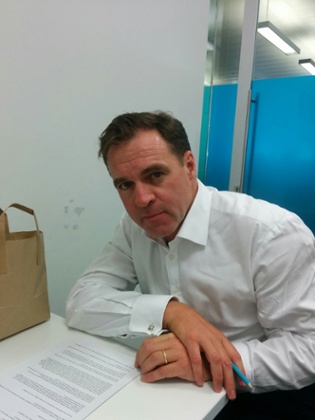
Post your questions for Niall Ferguson
Henry Kissinger remains one of the most divisive figures in modern American history, seen by some as a brilliant pragmatist, others as a brutal and blinkered operator – and is the latest focus for the historian Niall Ferguson. He has just written the first in a two-part biography of the former US secretary of state to Presidents Nixon and Ford, weighing in at nearly 1,000 pages, and drawn from more than 100 archives of material as well as Kissinger’s private papers (you can order it from the Guardian bookshop here with 30% off).
It’s the latest doorstop from the Scot, who has caught – and often rattled – the popular imagination with the vivid counterfactuals of Virtual History, his studies of British and American imperialism, and The Ascent of Money, his survey of global finance which was turned into a Channel 4 series. He also advised Michael Gove on reordering the UK’s school history curriculum, has taught at Harvard for over a decade, and just announced a move to Stanford.
He is joining us for a live webchat on Monday 12 October, from 1pm BST onwards, where he’ll take on your questions about his new book and indeed anything else. Post them in the comments below, and he’ll answer as many as possible.
Updated







Thank you for all your questions, serious and frivolous. Forgive me for not answering them all. This was rather like the kind of exam one has nightmares about: an infinite number of questions, some of them quite clearly unanswerable. As this is the Guardian, I have no doubt I have failed the exam.