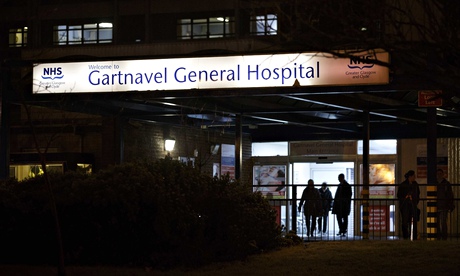
A confirmed Ebola case among one of the first healthcare workers to leave the UK for Sierra Leone is a major blow to the public health authorities, who have been trying to quieten fears about any possible impact of the disease here while ramping up the fight in west Africa.
Huge efforts were made to try to ensure that none of the hundreds of NHS workers who volunteered to make the trip would return with the virus. It took several months before the final decisions were made on which volunteers would be sent. They were given psychological tests and intensive training; the first batch were trained for nine days, much of it in a simulated treatment centre at the sort of high temperatures to be expected in Sierra Leone.
Finally, just 30 were sent out in the first wave in the last weeks of November. They were as well prepared as anybody could be. The long delay in their deployment was to make sure nobody would bring Ebola back to the UK. All the healthcare workers who have gone out have been well trained in the dangers, but the work they have gone to do is physically and mentally very demanding.
The virus is not as contagious as many people fear. It is fragile; it can be killed by soap and water, chlorine solutions and sunlight. But the doctors, nurses, paramedics and others who are working in Sierra Leone with Ebola patients will never have experienced such arduous working conditions before.
The job is incredibly hard. Donning the protective suits takes time and every step must be cross-checked by a colleague. They then can enter the Ebola ward where they will give whatever care is available to the patients. In most treatment centres, that mostly means hydration and painkillers and encouraging people to eat and drink.
Some centres are also getting staff to put in drips and lines into veins through which they can give drug infusions.
It is very difficult work, carried out behind a mask that fogs up and while wearing two pairs of gloves. It is also exhausting. Most people cannot stay in for more than an hour. Each one has a colleague who stays with them and leaves at the same time.
The precautions are great but there is still the capacity for human error, particularly in the heat and the tense and anxious conditions of an Ebola treatment centre. Removing the protective suits has to be done with extraordinary discipline. One item at a time comes off, with chlorine solution sprayed over the nurse or doctor at every stage. Everybody knows this part is dangerous. And yet, it may be the routine in the end that causes mistakes.
In some centres there are day and night shifts, which means people may not be getting enough sleep. And everybody is frustrated by the limited amount they can do to treat their patients, while no proven drugs are available.
It is not surprising that a healthcare worker from the UK has been infected. The unfortunate thing is that it has happened so soon. It would be a tragedy if this incident stopped more volunteers being sent or if it started another wave of Ebola panic in the UK. This virus would not easily be passed on in this country.
The healthcare worker who has fallen ill must have been sufficiently well to pass the many temperature checks on the route home, first at Freetown airport, then in Casablanca, which has a full body heat scanner, and then at Heathrow, where Public Health England’s nurses take you through a questionnaire and yet another temperature check. Until this person had a fever, he or she was not infectious. The risk to the British public is very low. But public confidence may again take a knock.