Boris Johnson has said England can ‘ride out’ the Omicron wave without further need for lockdown - but warned the pandemic is far from over.
During a Downing Street press conference the Prime Minister said those who believed the pandemic to be over were “profoundly wrong”.
But he said booster jabs and the recognition of Omicron as a ‘milder’ variant means there is no need for further restrictions at this stage.
Further controls will depend on when the variant “peaks how quickly it blows through”, the Prime Minister said.
Nothing can be ‘ruled out’, but Mr Johnson said, but he guessed “we have a good chance of getting through the Omicron wave without the need for further restrictions, and without the need certainly for a lockdown”.
From Monday, 100,000 critical workers will be offered daily lateral flow tests to help keep essential services open.
Staff working in areas such as food processing, transport and the Border Force would be sent test kits for every working day from January 10.
“As the NHS moves to a war footing I will be recommending to Cabinet tomorrow we continue with Plan B because the public have responded and changed their behaviour buying valuable time to get boosters in arms,” Mr Johnson said.

The Prime Minister was joined by England’s chief medical officer, Sir Chris Whitty and chief scientific adviser Sir Patrick Vallance to update the country on the current coronavirus situation.
Mr Johnson said it is “absolutely crazy” that people are ending up in intensive care with Covid because they have not been properly vaccinated.
While Sir Chris Whitty said he was “saddened” by the numbers of unvaccinated people in intensive care.
Here’s everything that was said during today’s press conference.
The battle with Covid is not over
Boris Johnson said the latest record Covid case figures showed that those who believed the pandemic to be over were “profoundly wrong”.
“Our United Kingdom is in the midst of the fastest growth in Covid cases that we’ve ever known,” he said.
“Previous waves of the pandemic didn’t have a single day with more than 100,000 new cases reported, one day last week we had 200,000 people test positive.
“And the latest figure today is another 218,000, though that includes some delayed reports.
“So anyone who thinks our battle with Covid is over, I’m afraid is profoundly wrong.
“This is a moment for the utmost caution.”
A chance to ‘ride out’ Omicron wave without further lockdowns
The government will not be imposing any new restrictions beyond Plan B at this stage.
Mr Johnson said Omicorn is ‘milder’ than previous variants and booster jabs have created a ‘substantial level of protection’.
The Prime Minister said, despite the high number of coronavirus cases being recorded in the UK, there was a “chance” extra restrictions would not be needed in England.
“Our position today differs from previous waves in two crucial respects,” he said.
“First, we now know that Omicron is milder than previous variants, so while hospital admissions are rising quickly, with over 15,000 Covid patients now in hospital in England alone, this is not yet, thankfully, translating into the same numbers needing intensive care that we saw in previous waves.
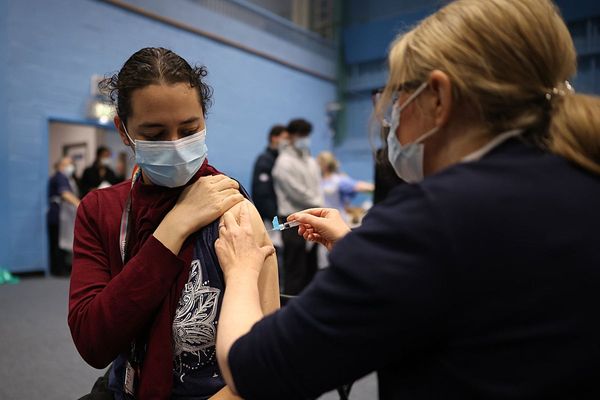
“Second, thanks to the fantastic national effort to get Britain boosted, we now have a substantial level of protection, higher than any of our European neighbours, with over 34 million boosters administered, including in England reaching more than 90% of the over 70s and 86% of the over 50s.
“And so, together with the Plan B measures that we introduced before Christmas, we have a chance to ride out this Omicron wave without shutting down our country once again.
“We can keep our schools and our businesses open and we can find a way to live with this virus.”

Staff absences will affect businesses
The Prime Minister said the weeks ahead will be ‘challenging’ and there is ‘no escaping the fact” that some businesses will be affected by staff absences.
But he said this would have a far less severe effect than another national lockdown.
The Government has identified 100,000 critical workers who will be offered daily lateral flow tests to help keep essential services open.
Staff working in areas such as food processing, transport and the Border Force will be sent test kits for every working day from January 10, he said.
“As the NHS moves to a war footing I will be recommending to Cabinet tomorrow we continue with Plan B because the public have responded and changed their behaviour buying valuable time to get boosters in arms,” he said.
Qualified teachers who have left the profession will be asked to come back to schools and the government will be ‘increasing NHS capacity’ with Nightingale hospitals.
The Government will also be working to identify NHS Trusts that will need military support.
People are dying “needlessly” because they have not been properly vaccinated
Booster doses provide 88% of “overall protection against being hospitalised”, England’s chief medical officer Sir Chris Whitty said.
“We now have confidence that the booster provides around 88% overall protection against being hospitalised and it is likely to be even greater than that for severe disease and mortality,” he said.
Sir Chris also urged anyone how had not yet received a booster to come forward.
He said: “Anybody who has not been boosted who is eligible really should do so. I think the idea that this is a mild disease, as opposed to less likely to be hospitalised, is easily demonstrated to be incorrect based on these data.”

He was referring to the high numbers of older people still being sent to hospital, because of the Omicron variant’s transmissibility.
Boris Johnson has said people are dying “needlessly” because they have not been properly vaccinated against Covid-19.
“There are still almost nine million people eligible, who haven’t had their booster,” he told a Downing Street news conference.
“It’s absolutely heart-breaking that as many as 90% of those in intensive care with Covid have not had their booster, and over 60% of those in intensive care, who have Covid, have not had any vaccination at all.
“People are dying needlessly because they haven’t had their jabs, they haven’t had that booster.”
Lower admissions does not mean lower numbers
Sir Chris Whitty warned that lower rates of people being admitted to hospital did not mean there were not “significant numbers” of people in hospital with Covid.
England’s chief medical officer said: “Lower does not mean there are not hospitalisations, there are significant numbers.
“Just to give some kind of feel for this, at the moment there are just over 15,000 people in hospital in England, the data for the UK is slightly later in time.
“If we went back to mid-December when we were still with the Delta wave the numbers were between 6,000 and 6,500. A very substantial increase.
“People are not admitted to hospital in winter unless they have a clear need for hospitalisation.”
He said the data was “relatively close to the initial peak” of hospital admissions in last January, of 18,000 people.
He added that people of every age are “significantly protected by vaccination”.
Plan B is the ‘right one’ for now
Boris Johnson said there is “no easy answer to a problem like Omicron” and “there is no easy lockdown”.
He said: “There’s no easy restriction on people’s lives or livelihoods. And the best thing I think we can do now is to continue to follow the guidance, protect our NHS in the way that that we are, increase the support that we’re giving to the NHS and as you know, you’ve heard from what I said earlier on, we’re increasing the numbers of staff, we have got a record number of people working in the NHS now than at any time in the past.”
Mr Johnson added that the Government will continue to “watch what happens very closely”, but noted: “We think that this is the right approach to take.
“It’s a balanced approach. It has to balance a lot of considerations.
“It has to balance the effect on people’s lives and livelihoods of lockdowns, which are painful, which take away people’s life chances and which do a great deal of social damage, damage to people’s mental health as well as damage to the economy.
“So it’s a difficult balance to strike. But that is where we are.”
“We can’t rule anything out”
Possible further controls will depend on if the variant “peaks how quickly it blows through”, Boris Johnson said.
“We will monitor everything very closely – we clearly can’t rule anything out, he said.
“What we are trying to do is take a balanced approach where we rely on people to implement Plan B carefully and to behave carefully with other people – and people are doing that, you can tell people are really responding to this and they are doing their absolute best, despite the extreme transmissibility of Omicron.
“What we’re also doing is massively accelerating the booster rollout and it has gone incredibly fast.
“I think, at the moment, it depends. To be absolutely frank with you, it depends on whether the virus will behave in the way it perhaps has behaved in South Africa, whether it peaks, how quickly it blows through.
“But if you ask me to guess, I would say we have a good chance of getting through the Omicron wave without the need for further restrictions, and without the need certainly for a lockdown.
“And the reason we are in that position, unlike many other countries in the world, certainly like many other countries in Europe, is that we just have such a high level now of booster protection, but that is no reason for everybody not to get more.”
Lateral flow tests a ‘very good guide’
Sir Chris Whitty said lateral flow tests are a “very good guide actually to whether someone is at that moment infectious”.
When asked about the shortening of the self-isolation regime, Sir Chris said: “The reason that we feel it is a useful tool to allow on day six and day seven, someone is isolated because they know they’ve got Covid to day five and then they have a negative test on day six and a negative test on day seven, we have confidence they’re much less likely to be in any way infectious to other people if they then leave isolation than if they had not done those tests.
“So that’s the reason why adding those tests on allowed ministers to decide to move from 10 days isolation down to seven but the last two you do the lateral tests because they’re very predictive of how infectious someone is… obviously if they’re still positive, then they do need to stay in isolation until it goes negative.”
On PCR tests, Sir Chris added: “The PCR tests which are the other way of testing, they can remain positive for a long time after someone has had an infection, including beyond the point where they are infectious.
“So the reason that we find the PCR is extremely good because they’re very sensitive and they’re extremely because they tell you which type of variants of Covid, it has got many advantages, but the lateral flows are really good at helping to determine whether someone is infectious at that point to other people.”
Hospital pressures will depend on how Omicron impacts the older generation
Sir Patrick Vallance, the chief scientific adviser, said there was “extraordinarily high levels of infection at the moment” in the UK, and that hospital pressures will depend on how Omicron impacts on the older generation.
“What we don’t know, and these are two things we don’t know that are key, exactly when the peak is going to occur or how big the peak is going to be,” he said.
“That is one thing that is going to determine how much disease comes on in terms of hospitalisation. And the second really important thing is that this has largely been an infection among younger people up until now, and it is moving up the age range now.
“And as it moves up the age range, you would expect to see more hospitalisations and we don’t know for sure how that’s going to manifest and what degree of disease.
“So I think with the degree of infection that we have got, we are going to see more hospitalisation for sure – 15,000 per day at the moment. That I expect to increase, and that of course will be associated with increased pressure and ultimately with some fatalities as well.
“I think what we now need to look for is when this peaks and starts to come down.”
Booster jabs should not be given to everyone every few months
Sir Patrick Vallance agreed with Professor Andrew Pollard of the Joint Committee on Vaccination and Immunisation that giving booster jabs to everyone periodically would be unsustainable.
Sir Patrick said: “I think Andrew Pollard is right – it would be a situation that is untenable to say that everyone is going to need to have another vaccine every three or six months.
“That is not the long-term view of where this goes to. There may be some people who will require an additional dose, but longer term I would think that as this becomes a disease which is endemic… it will be something like an annual vaccine like flu or of that order.”
He also said: “The good news is that as you get vaccinated more the immune system broadens its response so that it covers more variants.”
‘Absolutely crazy’ unvaccinated and those not boosted ending up in intensive care
Boris Johnson said it is “absolutely crazy” that people are ending up in intensive care with Covid because they have not been vaccinated.
“How absolutely crazy it is, absolutely crazy, that there are two million slots this week for people to get vaccinated and yet the majority of people in ICU for Covid are not vaccinated – 61%,” he told the news conference.
“It is sad but it is also a huge opportunity for us to correct it.”
Professor Sir Chris Whitty said he was “saddened” by the numbers of unvaccinated people in intensive care.
“The great majority of them are not anti-vaxxers in the ordinary sense with some really weird ideas,” he said.
He said that people wanted to know if the disease was important enough to warrant vaccination and whether the vaccines were effective. At the same time he said there was “misinformation” on the internet “a lot of it deliberately placed” about the potential side effects of the jabs.
“In so far as I am frustrated it is simply people deliberately trying to scare away fellow citizens from something that is potentially going to be life-saving for them,” he said.
Hospitals facing 'very substantial pressure'
Professor Sir Chris Whitty said hospitals across the country were likely to face “very substantial pressure over the next couple of weeks”.
“I don’t think we think that the ICU pressure is going to be like it was in previous waves but there is very substantial pressure on the emergency service part – ambulances, A&Es,” he said.
“My colleagues in the NHS who are on the emergency side are having an extremely difficult time because they have a simultaneous wave of people coming in with Covid on top of the usual winter pressures, and you’ve got a wave of people who are off sick because they have got Covid or indeed for other reasons, but Covid is very substantially contributing to that.
“As Patrick said, we would expect the peak in younger people to come before the peak in older people so it may well be that the workforce problems start to decrease before we start to see any decrease in the number of people coming into hospital. Indeed, they could still very well be going up for some time.”
Sir Chris said that there was not likely to be a “single threshold” for when further action might be needed to be taken by the NHS but more “little by little” that things are rolled back, firstly in terms of routine procedures and then to more urgent but not emergency services.
“It will be patchy in different areas of the country, it will be patchy at different points along the epidemic and it won’t reach a threshold but there will certainly be some hospitals in some areas of the country which will come under very substantial pressure over the next couple of weeks,” he added.