Summary
With the strike now over, it’s time for a closing summary. Many thanks for reading:
- Thousands of NHS staff across England have staged a four-hour strike over pay, the first such walkout for more than 30 years. The action involved, among others, nurses, paramedics, midwives, ambulance drivers and other staff.
- It remains too early to gauge the impact of the strike. Unions stressed the actions would not affect any emergency services, but outpatient appointments and routine procedures were likely to have been affected.
- There was support for the strike around England, though some of the picket lines were relatively small.
-
Striking staff said the government’s refusal to implement an across the board 1% pay rise for all staff means they are again taking a real terms pay cut.
-
The health secretary, Jeremy Hunt, has reiterated that the NHS cannot afford to give the pay rise to staff receiving an automatic 3% increment, and that to do so would require nurses to be laid off.
Some final input from Frances Perraudin - a video chat with John Campbell, secretary of the Unison branch at the Northern General. She shot it at 7.20am but has only just been able to upload the video – it’s not that dark in Sheffield now.
Aisha Gani has sent a final vignette from St George’s hospital.
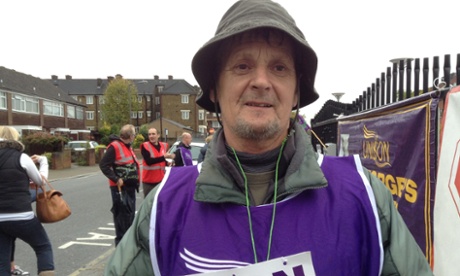
Bob Holdawaski is the chair of Unison Wandsworth and has worked for the NHS for 22 years. He is the head gardener at the hospital.
He said:
I think our offer of 1% is derisory and represents, over 5 years, just 0.2% per annum. It is not consolidated.
I feel that they expect more and more from the staff, and the health secretary says he can’t afford it. But the government bails out bankers. The NHS is crumbling because of a lack of morale and pay.
His day starts off by disposing of all the rubbish. Then he starts gardening with a team of six, covering 26 hectares of land. Walking one end to the other is about one mile. Other parts of his job include de-icing the roads in winter. He says that his team has won numerous awards and are treated well by the trust.
It’s just gone 11am, so today’s strike in England is over, though action is planned later in Northern Ireland.
Our Guardian Witness call-out has uncovered a compact but determined picket at London’s Moorfields Eye hospital.

small but active picket line at Moorfields Eye hospital
small but active picket line at Moorfields Eye hospital
Asiha Gani, still braving the rain outside St George’s hospital in south London, sends this from a strike supporter:
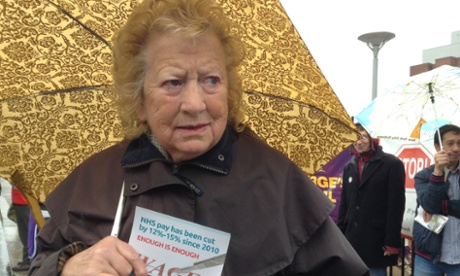
June Hautot, 77, from South West London Keep Our NHS Public, said that she had been an NHS activist for a long time, and recalled how things changed under Margaret Thatcher, saying five hospitals in Wandsworth closed in the 1980s.
She said: “I’m here today because of the fragmentation of the NHS and the sad thing is that the staff are given bad terms and conditions.”
A rough estimate of numbers in Sheffield from Frances Perraudin.
From my tour of the Sheffield teaching hospitals today I'd guess there have been nearly 200 people out on picket lines #NHSstrike
— Frances Perraudin (@fperraudin) October 13, 2014
My colleague Clare Horton has been outside the West Middlesex hospital in Isleworth, west London:
Pickets outside the West Middlesex hospital told this morning how they have been affected by the government’s NHS pay policies.
After three years of real-terms wage cuts, some staff cannot afford to live near the hospital in Isleworth, west London, and are commuting from Luton and the south coast of England.
More than 40 hospital staff – many of them midwives from the busy maternity unit – turned out in the rain to protest, with passing drivers honking their horns and putting their thumbs up in support.
Senior midwife Po Ying Li said maternity assistants had been particularly hit by successive years of pay restraint. “They are almost on the breadline,” she said, “some are having to go to food banks.”
Her colleague Natalie Carter added: “It is more than just about the pay, it is the workload, it is living costs, it is a lack of midwives.”
A community midwife, who asked not to be named, said she and her colleagues frequently worked more than their scheduled hours, skipped breaks and ate lunch in their cars between appointments. But staff shortages meant there was not the opportunity to claim time back in lieu.
“We just seem to give all the time and there does not seem to be any reward,” she said, “not even a thank you sometimes.”
Another mini-video update from Aisha Gani outside St George’s hospital in south London.
Chloe, 23, is an operating theatre practitioner. She says the cost of living is high while pay has frozen f... https://t.co/yOkPmHcQJY
— Aisha S Gani (@aishagani) October 13, 2014
An image of NHS strikers in Liverpool.
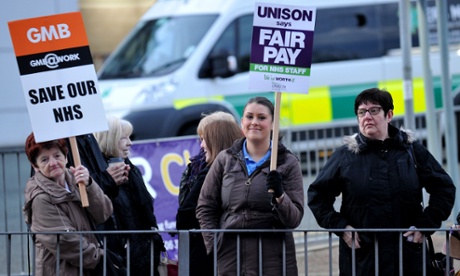
This is my favourite comment so far under this blog, from the mysteriously-named rustyschwinnToo:
Well, they have my unconditional support.
NHS midwives delivered my grandson about an hour ago having been with his mother through the process for the last two days.
My wife is threatening to hug entire picket if there is one and she gets there in time.
We can understand the value beyond the obvious: the father was born in the US. Even with insurance, a five year payment plan was required to settle the bill.
The rainy scene outside the Hallamshire hospital in Sheffield, courtesy of Frances Perraudin.
Midwives and other NHS workers outside the Hallamshire hospital in Sheffield https://t.co/Mn18rOlqg6
— Frances Perraudin (@fperraudin) October 13, 2014
Matthew Taylor has sent some words from University College hospital in central London:
Nurses and midwives at UCH seem angrier than I’d expected. They are very conflicted about striking but feel the government has given them no option. The midwives particularly seem slightly uneasy on a picket line - this is the first time in their history they have taken industrial action.
But as Eleri Bates, 27, explains they felt they had to take a stand for the future of the service.
She said: “As a group midwives are caring and generous really and most of the time that is fine. No-one came into this profession to earn a lot of money or have an easy time, we did it to help mothers and babies, but this government is trying to take advantage of that and putting the whole service at risk and we can’t stand by and watch that happen.”
Frances Perraudin has now moved to the Hallamshire hospital, also in Sheffield.
Midwife Alison Norris worked as a teacher and in the voluntary sector. She says she has never been paid so little for so much responsibility
— Frances Perraudin (@fperraudin) October 13, 2014
Helen Pidd, who has been outside a wet and windswept Hull Royal Infirmary, has spoken to Caroline Abernethy, an intensive care nurse, about the strike.
Here’s some words she’s also sent from the scene, and from the nearby Women and Children hospital:
Outside Hull Royal Infirmary, a group of around 25 increasingly soggy hospital workers have been garnering beeps of support from passing motorists.
Caroline Abernethy, an intensive care nurse for 15 years, said: “I don’t want to strike, but I feel I don’t have any choice. I don’t take leaving patients and interrupting their care lightly so it took some thought to come out.”
She said she was striking not just for the universal implementation of the 1% payrise recommended by the independent pay review, but also to safeguard working conditions and benefits, such as the small amount of extra pay nurses receive for working unsociable shifts.
Up the road outside the Women and Children hospital in Hull, 15 midwives held their own protest, while many of their colleagues stayed at home, refusing to cross the picket line. The hospital ante-natal clinic was cancelled until 11am and many home visits did not take place during the four-hour strike.
Alex McCann, a midwife for six years, said: “It goes unnoticed how much goodwill there is from nurses. We work our breaks, we work extra hours without overtime because we care so much about our patients, and yet we don’t get the respect we deserve from the government.”
Louise Hughes, a midwife for 19 years, said: “It’s the saddest day of my professional life to have to stand here striking for equal and equitable pay. We are striking with very heavy hearts.”
Pam Ward, a midwife in Bristol, has written a piece for Comment is Free explaining why she has taken the unprecedented step of going on strike. Here’s a snippet:
Midwifery is a busy but fulfilling profession, and the care of women and their babies is paramount to us all. This is why my colleagues regularly work over their hours to meet the needs of the service. Most work very unsociable hours and many are on-call overnight, going out at a moment’s notice to give care to women in labour or at other times during their pregnancy or postnatal period. This is what the job demands, and we love it.
However, over the past few years we have seen so many hits to our pay that, for the first time, we will reluctantly be taking industrial action. Midwives and support workers understand that the country has been in recession and colleagues in the private sector have also had pressure put on their pay. For us, it has been endless. Our pension contributions have escalated year after year, we have lost cost of living enhancements and we’ve had a rise in fees to our registering body, the Nursing and Midwifery Council.
However, the biggest impact has been due to the three years of pay restraint – two with no increase at all. Like everyone in the country, our living expenses have been constantly increasing. I estimate that this failure to keep up with inflation means that my pay has actually gone down by about £4,000. My eldest daughter is at university and another at school, and this wage restraint is now beginning to bite.
The last straw for us was this latest move by the government to ignore the objective view of the pay review body, which was to award a 1% pay rise to all NHS staff. That 1% wasn’t great, but we would have accepted it. What caused us so much anger is the “sleight of hand” in the way it has been imposed. Personally, I received it. This is because I have reached the top of my pay scale, and am now being paid the correct rate for the job. I am an experienced midwife and my hourly rate reflects this. My more junior colleagues will not get it as their incremental increase is seen by the government as sufficient.
Christopher Thomond has found this placard in Bury.
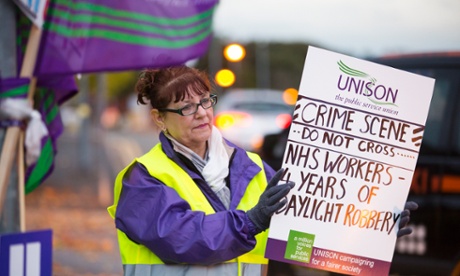
Steven Morris has sent this round-up of the early morning’s activities in Winchester. Below that is a statement from the local NHS trust:
For most on the picket line outside the Royal Hampshire County Hospital in Winchester, this was the first time they gone on strike.
“I’m very sad,” said midwife Liz Collings, who has worked in the NHS since 1973. “I never thought I’d be standing in front of a hospital saying: ‘Enough’s enough.’ But what I take home hasn’t changed since 2007. With the cost of living going up, I can’t live safely and comfortably without doing overtime. I’m 59, almost 60. I shouldn’t have to work full-time and extra hours to make ends meet.”
Graham White, 54, a biomedical scientist who has worked for the NHS for 13 years – and before that did the same job in the RAF – said he was on strike because he believed in social justice.
“Asking for 1%, especially for the lower paid, is not unreasonable. These people deserve a lot more – the porters, the cleaners, who keep the hospital running day and night. When petrol is £1.30, it’s £1.30 for the poor as well as the rich. I believe that the poor are really struggling.”
Most patients arriving – and cars passing by – seemed supportive. Many stopped to encourage the picket line.
Richard Pickett, 49, who spent 25 years as a healthcare assistant before a bad back prompted him to take a job on the switchboard, said he believed the NHS was one of the best health services in the world. “But it’s about time we got a decent pay rise – or a pay rise at all. You get upset when MPs and senior managers get pay rises. It would be nice if was filtered down.”
Statement on today’s strike from the Hampshire Hospitals NHS Foundation Trust:
A small number of staff are taking part this morning in the national industrial action in response to national pay on our hospital sites at Basingstoke, Winchester and Andover.
No services have been cancelled as a result of the strike. We have worked closely with the unions and staff to make sure there is minimal impact on patients.
Our staff are committed to ensuring our patients are safe at all times and will not do anything that places patients at risk. Patients should continue to keep their appointments at our hospitals and attend for planned treatment as usual.
A video round-up of banners outside St George’s hospital in south London from Aisha Gani.
Banners and leaflets on the picket line, St George's Hospital #NHSstrike https://t.co/eqROJHqlf0
— Aisha S Gani (@aishagani) October 13, 2014
Denis Campbell spent some of his early morning joining rain-soaked strikers (and other members of the media) outside St Pancras Hospital:
Pickets outside St Pancras Hospital in central London were cheered by a visit from Jeremy Corbyn, the Labour MP for nearby Islington North, about 7.30am and then TUC general secretary Frances O’Grady about 8am.
Her presence meant that media personnel – including BBC News and Sky News – outnumbered the gaggle of members of Unison and Unite standing outside the mental health facility, many displaying “I heart NHS” stickers, braving the wind and rain to make their point.
Jeremy Hunt’s rejection of the Pay Review Body’s recommendations showed the coalition was being “spiteful and unjust” towards dedicated, hard-working NHS staff, O’Grady told the Guardian.
“Today is about the million or so NHS staff being taken for granted and insulted by the government’s refusal to honour the recommendation of the Pay Review Body for the very modest 1% pay rise, which would actually have amounted to a pay cut. We have been very clear that NHS staff won’t do anything to endanger life or limb. But people have the right to take strike action, and of course it will have an impact on routine care.
“What’s important about today is that the public and patients massively support NHS staff. The really important thing is waking the government up to the fact that the public have rumbled them and this is seen as spiteful and unjust.”
Regular toots from passing motorists, including a passing fire engine, drew cheers from the pickets.
What would it take to settle the dispute? “Jeremy Hunt should be on the phone now asking to meet us. and he should listen, and then agree [to implement] the recommendations of the Pay Review Body,” said O’Grady.
“That’s all it would take. It would cost about £710m to implement the PRB’s recommendations. That’s about half the amount of unpaid overtime that NHS staff work every year.” [That figure comes from research the TUC published in June – see details here.]
“That goodwill will be withdrawn today and for the rest of the week [as the four day work-to-rule to back up today’s four-hour walkout starts tomorrow]. Maybe then the government will start to realise how dedicated staff are and what happens if we lose that goodwill,” added O’Grady.
Matthew Taylor sends in this quick video chat with Janet Maiden, an angry (and quite wet) nurse protesting outside University College hospital= in central London.
Rachael Maskell, head of health at the union Unite, has written a piece explaining why she thinks that inequality as much as absolute pay is the root cause of today’s strike. Here’s some of what she has to say:
Growing pay inequality is at the heart of the NHS pay dispute, in an NHS that speaks of universalism and fairness.
Recurrent pay freezes for the majority of the NHS staff has led to pay in real terms falling by up to 15% against the cost of living since the general election. Pension increases for smaller pensions and cuts to other terms has doubled the size of this cut to some. In fact staff have only had a 1% increase since 2010 with those at the top of their pay band being offered from 7p/hour pocket money this year, running roughshod over the independent NHS Pay Review Body. [Jeremy] Hunt has said that he will stop the pocket money if further cuts aren’t achieved.
Some 40,000 staff in the NHS are paid less than the living wage, and many now revert to in work benefits and foodbanks for bare essentials, and many low paid jobs have now been outsourced, so the NHS can deny its responsibility to those staff.
Those that keep our hospitals clear, keep us safe from infection and are often the ones who pass those encouraging words onto the sick are left floundering at the bottom of the scale, while repeated reports of pay increases at the other end of the scale continue to be the norm. Only last week, Yorkshire Ambulance Trust executives received a 30% uplift, a real kick in the teeth for those that drive their ambulances on £16,271. Former NHS chief, David Nicholson even justified the 11% increase for senior managers since 2009, in one of his parting interviews. He only had a seven figure pension pot to retire with. The new NHS England has also been caught advertising PR jobs for over £100k, hardly contributing to patient care.
We need to also remind ourselves of the £3bn wasted on the NHS reorganisation, that has now plunged our NHS into financial meltdown and the £4bn (2010 – 2012) handed back to the treasury.
Despite repeated calls by Unite to meet with Hunt to resolve the current dispute, reported to be the richest person in the Cabinet with a personal wealth of £18.65m, he has continued to refuse a meeting, abdicating his responsibility to try and settle this dispute.
His counterpart in Wales, has sat round the table to thrash out a deal in even tighter fiscal circumstances, and yesterday we learnt that an offer for local government workers would now go out to consultation following talks.
And now back to St George’s hospital in south London for this video snippet from Aisha Gani.
Oje midwife of 4 and a half years at St George's Hospital says "all I want is a decent pay" #NHSstrike https://t.co/xaTOYKVH60
— Aisha S Gani (@aishagani) October 13, 2014
We have an update – or at least a picture – from my colleague Helen Pidd, who is in Hull.
Striking midwife Sharon Scrutiny outside The Women and Children hospital in Hull, fighting for fair pay pic.twitter.com/p3PhRiIwvb
— Helen Pidd (@helenpidd) October 13, 2014
Another photo from Frances Perraudin in Sheffield.
Jane Howden, bottom right, thinks Sheffield hospitals are best in the country, but says they are being decimated. pic.twitter.com/mSK4QjO2Ll
— Frances Perraudin (@fperraudin) October 13, 2014
Matthew Taylor has sent in these video snippets, firstly of midwives chanting outside London’s University College hospital, and then one of the midwives, 53-year-old Josephine Oamen, explaining why she has joined the action.
The comments below this blog so far seem supportive of the strikers. According to a poll commissioned by the union Unite, this view is reflected more widely. Of 1,029 voters polled by Survation, 65% said they felt a below-inflation cap on wages was unfair. Asked if the strike was justified, 61% said yes.
Unison strikers have joined midwives at UCH and for a short time blocked the road outside hosp. pic.twitter.com/Sv2J4JS2PR
— Matthew Taylor (@mrmatthewtaylor) October 13, 2014
Meanwhile the crowd is growing outside University College hospital in central London.
More midwives join picket line at Uch in London. pic.twitter.com/xV9wFe9Yz5
— Matthew Taylor (@mrmatthewtaylor) October 13, 2014
My colleague, Aisha Gani, is outside St George’s hospital in Tooting, south London, where the striking midwives have a catchy slogan.
"Support your midwives, first person you ever met" St George's Hospital #NHSStrike https://t.co/R9EmAj1gTQ
— Aisha S Gani (@aishagani) October 13, 2014
The health secretary, Jeremy Hunt, has made a new statement about today’s strike, which I’ve taken from the Press Association:
We absolutely will talk to the unions, we’ve been prepared to talk to them throughout this. We will talk to them if they’re prepared to look to reform the system of increments, which is unclear and unfair.
I recognise frontline staff do a magnificent job in the NHS. We have had more than 650 NHS volunteers who are willing to put themselves in harm’s way to help tackle the Ebola crisis in West Africa. We have magnificent people.
We’re offering them all a 1% rise. The majority of NHS staff get an automatic 3% increment but we can’t afford to give a 1% rise to people already getting that.
We’re coming through a very difficult period with the tragedy of Mid-Staffordshire. We now have got 5,000 more nurses in just a year. We’re recruiting nurses like crazy at the moment and to put that in reverse would not be the right move at the moment.
The most important thing here is doing the right thing for patients. It would be irresponsible for any health secretary to accept a pay package that means the NHS has to lay off nurses.
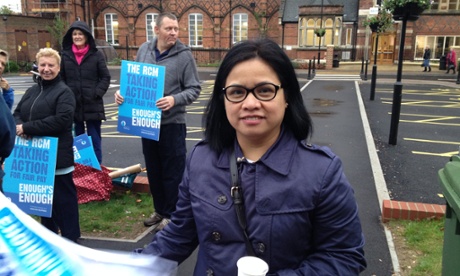
Steven Morris sends in this from Winchester:
Norma Poncian, a staff nurse in intensive care, who has worked in the NHS for 14 years having arrived in the UK from the Philippines via Kuwait.
She said: “I’m hoping for change. My pay hasn’t risen with inflation. We are entitled to an increase. There are contingency plans to make sure patients are safe. I’m happy to be representing my colleagues who are working hard.
My colleague Matthew Taylor is with the strikers at University College Hospital in central London.
Midwives on picket line at UCH in London say they have been exploited for too long. Forced to stand up pic.twitter.com/SGguUv2dIw
— Matthew Taylor (@mrmatthewtaylor) October 13, 2014
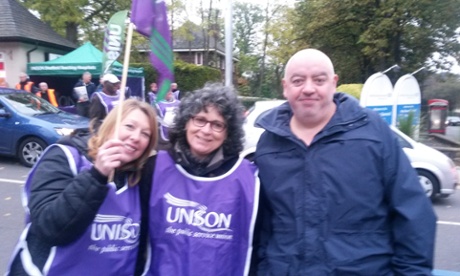
Frances Perraudin has been speaking to more NHS strikers in Sheffield:
About 35 NHS workers have gathered in the cold outside Sheffield’s Northern General hospital. The weather forecast predicts lots of rain any moment now.
“The 1% pay rise we’re getting this year isn’t even part of our basic pay, so it doesn’t count towards our pension or for over time,” says Gary Sellars, a medical laboratory assistant. “As far as we know that one percent will be withdrawn in March, so when they call it an NHS pay freeze it’s actually a pay cut.”
“It’s like a small bonus for a year,” says Jill Chanter, an occupational therapist.
Numbers growing - slightly - on the picket line at Winchester. pic.twitter.com/NV5e8GF3jP
— steven morris (@stevenmorris20) October 13, 2014
Over at Guardian Witness we’re seeking contributions from NHS staff taking part in today’s strike, both what’s happening and why.
The Press Association has spoken to one of the unions involved, which is, not unexpectedly, saying the strike has received strong support. Rehana Azam from the GMB union said:
Reports from across the country are that the strike action is rock solid. Members are determined to get government to listen to them.
Below are some other assorted union quotes.
Christina McAnea, Unison:
This is the first time in 32 years that NHS workers take industrial action over pay, and for many, it will be the first time. Up and down the country, hundreds of thousands of workers are out fighting for fair pay and for the NHS.
TUC general secretary, Frances O’Grady:
NHS staff are always reluctant strikers - there hasn’t been a national strike over pay in the health service since 1982 - and they will do everything they can to protect patients in their care. But morale has hit rock-bottom.
Not only have NHS staff faced year-on-year cuts in the relative value of their pay, ministers have turned down the recommendations of the independent pay review body, even though it called for an affordable, below-inflation pay rise.
Cathy Warwick, chief executive of the Royal College of Midwives:
At a time when MPs are set for a 10% pay hike, we’re told that midwives don’t deserve even a below-inflation 1% rise. And politicians wonder why the public does not afford them more respect.
It feels to a great many people, including midwives, that there is one rule for them and another rule for everybody else.
The tireless and tech-savvy Steven Morris has tweeted this audio clip of a chat with Richard Pickett, an NHS telephonist at the Royal Hampshire hospital in Winchester, who has worked in various roles in the service for 30 years. He says:
I believe in the NHS… I think it’s one of the best heakthcare systems in the world.
NHS strike - Richard Pickett in Winchester http://t.co/6kPrGEITsx
— steven morris (@stevenmorris20) October 13, 2014
Another view on the strike comes from the NHS Confederation, which groups together every hospital, mental health trust, ambulance service and other provider of care. Its chief executive, Bob Webster, put out this statement ahead of the strike:
We are working through some of the toughest times in the history of the NHS. Throughout this long period of pay restraint and pressure on services, employers have always sought constructive discussions with unions and the government to find a way out of this situation together. We hope progress is still possible.
We are seeing the NHS finding it difficult to manage its finances this year and staff under pressure. A pay award for all staff on top of increments would have cost £450m more – the equivalent of 14,000 newly qualified nurses. Hard-pressed staff would have been put under greater pressure or may have had to be reduced.
Restraining pay was a tough decision for politicians to make and I believe they did it on the basis of improving the quality of care and maintaining continuity of services.
Frances Perraudin in Sheffield has been hearing similar views from angry NHS staff.
"The government gives itself an 11% pay rise and we haven't even had 1%. It's a kick in the teeth" John Campbell #NHS pic.twitter.com/p54qgkECSV
— Frances Perraudin (@fperraudin) October 13, 2014
Steven Morris, at Royal Hampshire hospital in Winchester, has been talking to a midwife who explains why her profession is striking for the very first time. Liz Collings told him her pay is no longer enough to meet everyday bills:
I’m very sad. I’ve been in the NHS for a very long time – I was a nurse before I was a midwife – and I never thought I’d be in this position. I never thought I’d be put to the test, to see if I’d go and stand in front of a hospital and say, enough is enough.
There is, undoubtedly, significant anger among NHS staff over pay. Our Healthcare Professionals Network surveyed nearly 1,700 members and asked, “Do you think that NHS staff are paid appropriately?” The response: 73% answered “no”.
If still images of striking NHS staff isn’t enough, how about a brief video of them waving flags? Frances Perraudin has sent in this Vine.
My colleague Frances Perraudin is outside the Northern General in Sheffield, seemingly one of the few picket lines where it’s not (yet) raining.
The picket line at Sheffield's Northern General Hospital. It's threatening to rain #NHSstrike pic.twitter.com/ydnvyuCJSr
— Frances Perraudin (@fperraudin) October 13, 2014
Our Healthcare Professionals Network here at the Guardian has put together quite a lot on the strike, including this piece by an anonymous NHS finance manager explaining why she’s joining the strike. Here’s a taster:
I am striking because I am dismayed at the continuing and relentless reorganisation, marketisation, privatisation and fragmentation of the NHS. I want to work in an NHS with a collaborative rather than a competitive ethos. Where decisions about care are driven by the needs of the patient, not by the scope for profit. Where quality is a prerogative always, not just when it helps to win a contract. Where the entire NHS budget is used to provide and support patient care.
I am striking because NHS workers are bearing the brunt of the rhetoric and dogma at the heart of current policy, being presented as a cost rather than a benefit, a burden on the state, the costs of whom must be minimised. We have to “tighten our belts” like everyone else – but it’s not like everyone else because the richest 1,000 people in Britain – are now worth double that of five years ago and up 15% on a year ago. This is in the context of further cuts in staffing to come, and more work for those that are left; for example, NHS England reduced its management costs by 10% in 2014/15 and is required to reduce them by a further 15% in 2015/16.
And finally, I am striking for a properly funded, publicly provided NHS. Ultimately, I hope, this will benefit the wellbeing of our nation, and our pockets.
Steven Morris sends the first sense of the mood surrounding this morning’s strike.
Most passers-by at the Winchester picket seem sympathetic. A HR person just popped out to the picket line to say she supported the strikers.
— steven morris (@stevenmorris20) October 13, 2014
So what’s the Department of Health’s position on the strikes? Well, this is the quote they sent to Denis Campbell yesterday (the “1% additional pay” mention might sound confusing given the strike is over a refusal to give all staff a 1% pay rise - see his Q&A below for an explanation):
We are disappointed that trade unions are taking industrial action and have rejected our proposals to give NHS staff at least 1% additional pay this year and at least a further 1% next year.
They also provided a quote from Jeremy Hunt, the health secretary:
I know NHS staff are working extremely hard, but implementing a pay rise in addition to increments would cost jobs equivalent to 14,000 nurses – which would be the worst possible outcome for patients.
The picket line starts to form at the Royal Hampshire County Hospital. pic.twitter.com/ugwJf4l8RZ
— steven morris (@stevenmorris20) October 13, 2014
Meanwhile my colleague, Steven Morris, is outside the Royal Hampshire County Hospital in Winchester, where a damp-looking picket line is getting set up.
We have our first picture of today’s strike, and a Twitter account connected to the Unison union in northern England has beaten the photo agencies. The tweet doesn’t say where it is, however. Anyone recogise the hospital?
On strike for fair pay for nhs staff! #NHSstrike #13oct pic.twitter.com/ZGL0WQAixs
— Northern UNISON YM (@youngunisonNE) October 13, 2014
Denis Campbell has also put together this very useful Q&A on today’s strike:
Why are NHS staff striking?
Last year the independent NHS Pay Review Body, whose judgements ministers have traditionally honoured, said that all NHS staff in England deserved a 1% payrise from 1 April 2014 and that the service, despite growing financial pressure, could afford that. After two years of pay freezes and another year of just a 1% rise in salary, staff were grateful for, though not bowled over by, the planned 1%.
However, the health secretary Jeremy Hunt cancelled the recommended across the board increase. Instead, he said, only the roughly half of NHS personnel who do not receive annual pay increments – small salary uplifts that recognise someone’s skills, duties or length of service – would get the 1%. Everyone else would receive only their usual increment, which is worth about 3% on their salary.
So the Department of Health insists that everyone will be receiving “1% additional pay” in 2014-15. They will. However, that is much less than the recommended 1% universal payrise.
Health unions also point out that the 1% being received by some staff is a one-off payment and isn’t being consolidated into their pay, and thus is not paid on unsocial hours, overtime, call-out or standby payments, or count towards their pension.
How will the strike affect services?
The level of disruption to services will vary widely and depend on the number of staff joining the strike, the mitigating impact of the NHS’s contingency planning and how many patients need acute care, such as A&E care or surgery. The four-hour walkout between 7am and 11am is occurring on a Monday, which is usually the NHS’s busiest day.
The unions involved have stressed that patient care and patient safety will not be compromised. Anyone needing urgent or emergency care will still get it. For example, midwives tending to women in labour will remain with them throughout.
But the action will lead to planned operations and outpatient clinics being postponed in some places. Ambulance services may prove to be the most affected. About 100 military personnel will drive ambulances in greater London and another 30 will do the same in the north-west, covering for drivers who are on strike. In the capital, 74 Metropolitan Police vehicles will also respond to calls involving low levels of medical need.
The London Ambulance Service (LAS) will also be using managers in frontline roles and relying on private sector ambulance providers to supply extra capacity. It has already warned that “people with injuries such as minor breaks, women in routine labour, some patients with breathing difficulties or those involved in minor road traffic accidents will be given clinical advice, provided with alternative transport or told to make their own way to hospital.”
Will there be more strikes?
There will definitely be a second strike next Monday, 20 October, but this time involving solely radiographers belonging to the Society of Radiographers. In its ballot, 53% of participants backed a walkout. Their four-hour stoppage from 9am that day will not affect emergency care, but may lead to some patients not having their planned X-ray, CT or MRI scan or mammogram at the pre-booked time.
In addition, further action by some or all of the seven unions involved today – Unison, Unite, the GMB, Royal College of Midwives, Managers in Partnership, the British Association of Occupational Therapists and Ucatt – is highly likely. Legally, the results of their ballots allow them to mount another stoppage.
Officials at several unions privately believe a second co-ordinated stoppage is inevitable, unless Jeremy Hunt backs down, which looks highly unlikely.
The unions will meet on Tuesday 21 October to review the impact of today’s action, and how it was perceived by the public, and decide on their future plans then.
Updated
My colleagues will be out and about talking to the NHS strikers, and we hope to bring reports from hospitals in Sheffield, Winchester, Hull and London, among other places. We’ll also have analysis of the strike’s impact, and the political fallout.
From round about now – 7am – the NHS will see its first strike connected to pay in 32 years. The stoppage in England will last until 11am (similar action will happen later in the day in Northern Ireland. It will not, for obvious reasons, affect acute and emergency services. But there could nonetheless be some significant disruption.
Five separate trade unions are involved, among them those representing nurses, paramedics, hospital porters and ambulance crews as well as the Royal College of Midwives (RCM).
What areas will be worst hit remains to be seen, but those expected to be affected include outpatient appointments, planned operations, and routine scans for pregnant women. Ambulance services could be especially affected, with some military personnel driving ambulances in London and the north-west.
The reasons behind the strike are explained in this story by my colleague, Denis Campbell. Here’s some context:
The four-hour stoppage is intended to force Jeremy Hunt to make more money available for staff who claim their earnings have been cut by 15% under the coalition by a succession of pay freezes and below-inflation increases. The health secretary has rejected the independent NHS pay review body’s recommendation that all NHS staff in England should receive the [1%] pay rise and its view that that the service could afford that.
But the action by nurses, midwives and other staff comes amid warnings that it will “distress and inconvenience” patients and cause problems for important NHS services. There is also an escalating war of words between the health unions on one side and NHS bosses and ministers on the other.
The five unions whose members will be striking claim Hunt has betrayed them and left them feeling undervalued and undermined, while representatives of hospitals and other key services claim the strike has a dubious mandate because few staff voted for it.
Denis has this to say on the possible disruption:
Ambulance services are likely to be affected most. About 130 military personnel will drive ambulances in London and the north-west to replace striking drivers. In London an expected shortage of crews has led the capital’s ambulance service to warn that patients with a broken limb or trouble breathing, or who have been involved in a minor road accident, and women in labour may have to make their own way to hospital.
Jason Killens, the London Ambulance Service’s director of operations, said it expected to be “under significant pressure” on Monday as many staff were expected out on strike. “We have plans in place to ensure we reach the most seriously ill and injured patients as quickly as possibleThese include all clinical managers working on the front line, the use of more private ambulance crews and support from other emergency services,” said Killens. “However, people who need an ambulance response, but are not in a life-threatening situation, should expect to wait longer or may not get an ambulance at all,” he added.
The impact of the strike will vary across England. But some hospital trusts expect that it will lead to planned, non-urgent operations, including some surgically assisted caesarean births, being postponed. Pregnant women are likely to face delays to their 12 or 20-week scans. However, trusts hope to minimise disruption and patients’ concerns by doing the procedures later on Monday or within days of the scheduled date.
Jon Skewes, director for policy, employment relations and communications at the Royal College of Midwives (RCM) – whose members will walk out for the first time in its 133-year history – said midwives would continue to care for women and babies and prioritise patient safety during the walkout.
Skewes accused Hunt of not trying to broker a deal. “We have asked him to meet all the health unions but he has chosen not to. That’s an abrogation of leadership by Jeremy Hunt,” he said.