
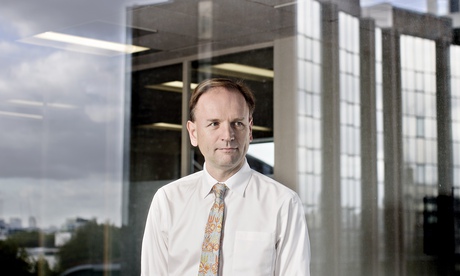
Simon Stevens, the NHS’s new chief executive, has shaken up next year’s general election. The Five Year Forward View (5YFV) is a blueprint for NHS renewal and sustainability over the next five years, beating the politicians to the punch on their manifestos. In a canny and carefully judged move, he is not asking for the public’s direct support, but for the support of all the political parties.
The 5YFV attempts to take away some of the need for the political parties to write their own individual health manifestos by explicitly asking the political parties to support it – the NHS’s own plan.
Stevens is a uniting force with the goodwill and support of most in the NHS, and he is today calling on some of that political capital. It is crucial to recognise that the 5YFV is not just the work of Simon Stevens or NHS England. Following the successful strategy of Labour’s 10-year NHS Plan in 2000 (of which Stevens was also a key author), and avoiding Andrew Lansley’s recent communication disaster, Stevens has built a coalition of interests in the sector to launch a plan by the NHS, for the NHS.
The 5YFV proposes change with pragmatism and a reasonable, common sense tone. This is politics in an impartial, non-political way. How could a politician possibly disagree with a plan devised by the health service itself? Opposing views will need to be voiced carefully. And in doing so, perhaps Lansley’s vision of a de-politicised NHS may come a step closer. Politicians would be following NHS England’s operational lead, rather than the health service dancing to a political tune.
The plans in the 5YFV are in step with most current thinking within the political parties, the health service and the wider health community. As is natural at elections, the parties are choosing to focus on the 10% they disagree on rather than the 90% they share. We can expect them to say the “new care models” agenda aligns with their plans – this involves deeper integration and collaboration to provide more patient-centred care in the most appropriate setting. Changes are proposed to be local, voluntary, and evolutionary, with no “one-size-fits all” solutions and no top-down reorganisations. The agenda to “get serious” about public health and prevention is also uncontroversial.
But some things in the 5YFV may be more difficult for politicians to swallow. Changes may mean altering how services are delivered, closing buildings and sites totally or in part. MPs will need to learn to support, not oppose, these moves. For Labour, Andy Burnham has pledged to repeal the competition elements of the Health and Social Care Act, yet the 5YFV endorses the principles of patient choice of hospital that this section of the act governs.
The biggest challenge is on NHS funding. The squabbling among the parties over their different NHS funding plans at their conferences has already shifted to whether they can endorse Stevens’ request for an extra £8bn in the next parliament – going far beyond any of the parties’ current pledges. Crucially, it suggests significant upfront investment is made above regular NHS funding to cover the development of the new care models. This is logical, but will require political consensus if a future government is to avoid accusations from the opposition that NHS funding has “fallen” in the later years of the parliament after an initial investment phase.
The document also notes that funding options will need to take in the context of how the UK economy is performing. David Cameron made this link recently, saying you can only have a strong NHS with a strong economy. Labour will, of course, back its own economic policies but Stevens’ document may revive debate in the party about a more direct dedicated NHS tax. Importantly, the funding scenarios and choices pass a large slice of accountability for the sustainability of the NHS back onto political shoulders. If the maximum investment choice is not taken, and NHS performance turns sour in future years, Stevens will be able to say, “I told you so”.
The 5YFV is frank but upbeat about the NHS. It believes that the NHS can meet its challenges, renew and sustain itself, and provide great care to all, free at the point of need. This is no different from all previous NHS strategies. But the big visions of previous strategies have usually translated into much smaller steps in practice. This time there is no room for partial success. The future of the NHS requires the challenge to be met in full.
• Andrew Harrison is a former Department of Health civil servant who worked with Simon Stevens under Alan Milburn
Are you a member of our online community? Join the Healthcare Professionals Network to receive regular emails and exclusive offers.













