The name of Biothai, a non-governmental organisation, usually comes up when there are cases of foreign companies trying to patent traditional plants and their extracts.
In November last year, Biothai revealed information about patent registration requests on marijuana extractions. The Department of Intellectual Property (DIP) is going to approve requests that are filed by foreign companies -- most of them from Japan and the US.
The timing was not the best. The National Legislative Assembly was passing a law, allowing marijuana -- while still being classified as a narcotic -- to be used for medical research and use.
The group warned that because the patents are still being considered by the DIP, other organisations -- including the Government Pharmaceutical Organisation and universities -- will be barred from conducting similar research, as applicants and their research are protected under existing laws.
The campaign forced the Ministry of Commerce to intervene and the DIP was asked to terminate some patent requests. Rangsit University, which was investing in medical research on marijuana extracts, threatened to sue the DIP.
It was not the first time that this non-governmental organisation has clashed with the DIP. In 2001, it came out to protest against a patent registration request by a US-based rice company to register a rice grain as Jasmati.
The group claimed that by using the name Jasmati, the company is misleading consumers into believing the product is jasmine rice grown in Thailand.
"We fought to protect our brand of Hom Mali rice. Almost 20 years later, we have do the same thing to protect our right of traditional medication for marijuana extracts. We need to fight to protect other plants and local traditional plant extracts in the future if our law to protect our own natural assets is still weak," director and founder of Biothai, Witoon Lienchamroon, told the Bangkok Post.
Established in 1999, the foundation has a mission to support independence and sustainability for the country's farming sector.
That mission pitched Biothai against cash-rich companies -- some of them conglomerates that are trying to register patents on plants and seeds or trying to introduce genetically modified plants and seeds in Thailand.
Mr Witoon said that the group, which registered as foundation, simply want to protect the sovereignty of farmers.
He said farmers in Thailand have always saved the seeds of plants and seeds in nature for further use. If natural plants and seeds are commercially patented, these farmers will be sued by companies for reproducing the same things.
"We need to protect this sovereignty because freedom in farming means that Thais will have more choices in eating good vegetables and plants that are close to nature, with fewer scientific methods to modify them," Mr Witoon said.
During the past two decades, BioThai has received strong support from society and consumers. The group is known for presenting reliable and relevant information to back its claims.
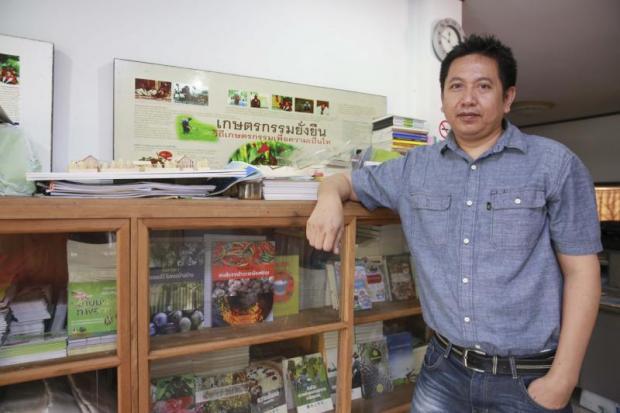
Mr Witoon, 57, admitted his educational background in agricultural science helped his work. He graduated at Kasetsart University's Faculty of Agricultural industry. His major is in seeds and plant development.
Most of the university's graduates work with farm companies or as official researchers at the Ministry of Agriculture and Cooperatives.
As his friends focused on developing seeds in greenhouses, Mr Witoon enjoyed going out in fields or travelling to remote villagers to talk with poor farmers.
"I have always believed I can learn a lot from fields and from farmers. I have only one thing on my mind, which is how to help poor farmers attain a better life," he said.
The young graduate started his job at the Thai Volunteer Service in 1985. He was sent to work with farmers in Surin. His assignment was to collect information on rice harvesting. Rice prices in 1985 hit rock bottom. The young graduate realised his knowledge obtained from his university studies was almost irrelevant.
In that year he also found local sage Father Maha Soonthornchai, a revered community leader who tried to persuade farmers carry out small-scale and organic farming, instead of relying on large-scale single-crop harvesting, a mass-market farming method that forces farmers to depend on fluctuating global rice prices, chemical fertilisers and middlemen.
"Rice harvesting is a very tough and risky profession," he said. "Some of my friends from Kasetsart University did not even survive when they did their own rice farming.
"But what I learned from Father Maha Soonthornchai is that his small-scale, chemical-free farming method can save farmers from racking up debt. So, I found the knowledge I learned at university might not be the solution for farmers in our country."
He later decided to open Biothai and registered it as a foundation in 1999. The foundation not only pushes for sustainable farming methods, but it has worked on campaigning for public policy and laws on biodiversity.
The foundation successfully pushed for the introduction of two new laws -- the Thai Traditional Protection and Promotion Law BE 2542 and Plant Variety Protection Law BE 2542 -- that protect and preserve traditional wisdom.
Biothai has also campaigned against trade monopolies, though he stressed that the NGO is not anti trade.
The foundation, he said supports fair trade. "In terms of plant law, we focus on equal benefit sharing because plants come from nature so commercial companies should not get the patents and exclusive rights to natural assets," he said.
"They have not invented anything new, they've just discovered things that already exist in nature."