For most established NFL players, this is a time to settle in. But for select others, it’s a time for concern, a time to look over their shoulder and wonder if a certain call is coming.
With free agency mostly over and the draft complete, a vast majority of veterans with a track record know their place on their respective teams. They’re going to be on the depth chart, either competing for or attempting to hold down a starting spot. But then there are the potential cap casualties, those aging stars fighting to prove their salary still matches their worth.
Around the league, there’s another category, a subset of receivers who might be traded or cut. We’ll get into three different cases below, all of whom could—and in two situations likely will—be moving on despite multiple 1,000-receiving-yard seasons.
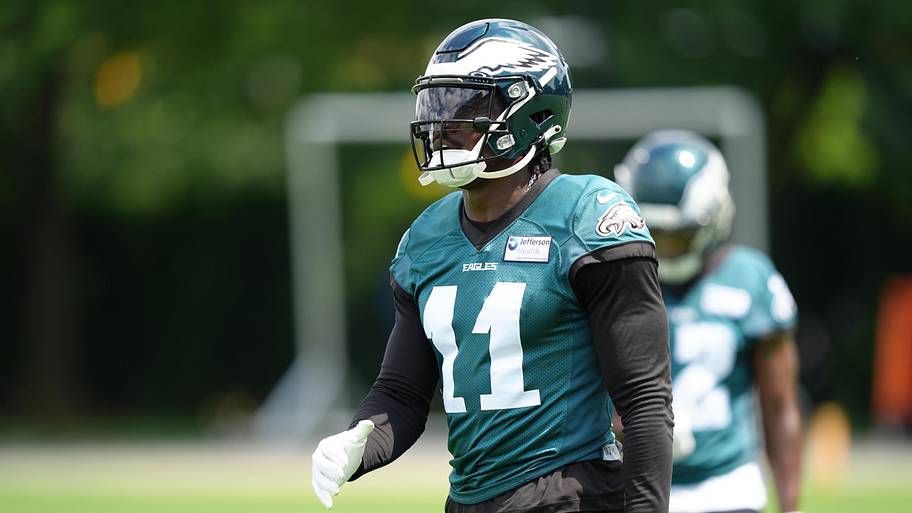
We start in Philadelphia, where the Eagles and A.J. Brown appear headed for a divorce.
A.J. Brown, WR, Eagles
It’s the worst-kept secret in football right now. Once June 1 rolls around, Brown is going to be traded. The only questions are to whom and for how much.
In his four years in Philadelphia, Brown has been a three-time Second-Team All-Pro and a Super Bowl champion, appearing in the big game twice. He totaled 5,034 yards and 32 touchdowns on 339 catches. However, Brown will turn 29 on June 30, and he’s coming off a second straight subpar season, perhaps his worst, with the Eagles.
In 15 games, Brown was targeted 8.1 times per game, one of the lowest marks of his Philadelphia career. He also did the least with those targets since catching passes from Ryan Tannehill with the Titans, notching 8.3 yards per target. A year prior, that number was 11.1. Additionally, his first downs (46), yards per reception (12.9), success rate (50.4%), yards per game (66.9) and receptions per game (5.2) were either tied for or his lowest marks with the Eagles.
Signed through 2029, Brown has only $4 million in guaranteed money remaining on his deal after this season. He also has a 2026 base salary of $1.2 million, which would be his cap number for an acquiring team. If that team, whether it's the Patriots or otherwise, believes Brown’s dip in production was an anomaly, he’s worth that cost and then some, even assuming a reworked contract in the coming years.
The big stumbling block will be draft compensation. Teams around the league believe the 2027 rookie class has a chance to be generational. So the Eagles could covet those selections rather than future choices, even if it means getting a bit less back overall. Looking at recent trades of receivers still in their prime, the Dolphins sent Pro Bowler Jaylen Waddle to the Broncos for first- and third-round picks in April while swapping fourth-rounders. Brown has been the more productive player and is a lesser financial investment, although he is also a year and a half older.
If Eagles general manager Howie Roseman is intent on getting back 2027 picks, first- and third-round picks might be the right price for both sides.
Tyler Higbee, TE, Rams
No team loves to use three-tight end sets more than Rams coach Sean McVay. After being married almost exclusively to 11 personnel (one RB, one TE, three WRs) for years, McVay used 13 personnel on more than 30% of Los Angeles’ offensive snaps last season, more than double any other team.
The reason? The Rams were without star receiver and top-end blocking wideout Cooper Kupp (went to the Seahawks), and Los Angeles replaced his in-line help with tight ends. When that led to 35 points in a blowout win over the Jaguars, including three red-zone touchdowns for Davante Adams, McVay stuck with it.
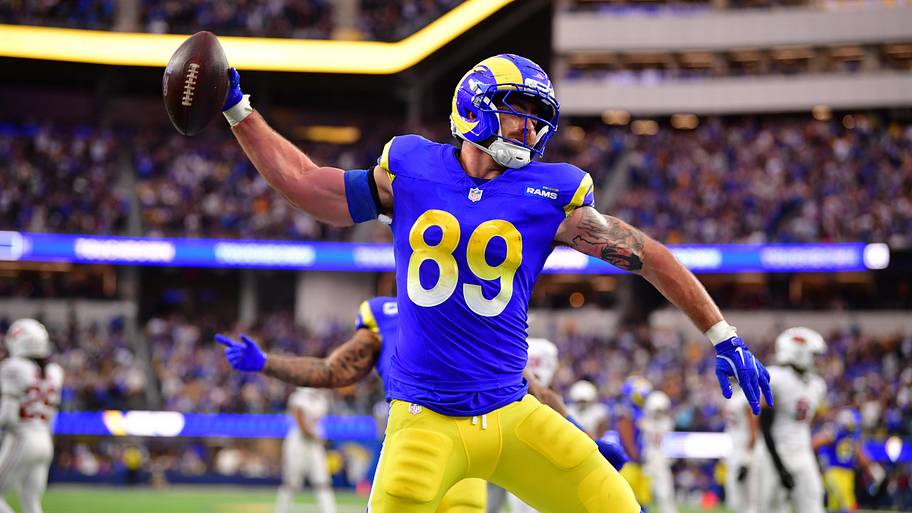
That said, the Rams have four tight ends who played at least 31% of their snaps, including veterans Colby Parkinson, Davis Allen and Tyler Higbee and rookie Terrance Ferguson. After drafting Max Klare from Ohio State in the second round, Los Angeles is potentially looking at rostering five tight ends, an absurd figure that exceeds most standard depth charts by one, if not two.
Looking at the cap sheet, Ferguson and Klare are signed for three and four more years, respectively. Parkinson and Allen are free agents after 2026, but Allen is the best blocker of the group, and Parkinson had 408 yards and eight touchdowns last year, and he's 27. Conversely, Higbee is age 33 and has played 13 games over the past two seasons. Although he was given a two-year deal this winter, the Rams could net a Day 3 pick for him while eating only $2.1 million in dead cap while saving $2.9 million.
Keon Coleman, WR, Bills
Coleman is an obvious name on this list. Since being selected in the second round of the 2024 draft, Coleman has been a disappointment. In January, at a press conference, owner Terry Pegula used Coleman’s selection to defend embattled general manager Brandon Beane, saying he was picked at the behest of fired coach Sean McDermott.
At times, Coleman has been a healthy inactive due to a lack of production and professionalism, leading Buffalo to spend a second-round pick to acquire veteran DJ Moore from the Bears this offseason. Going into the summer, Coleman sits fourth on the depth chart behind Moore, Joshua Palmer and slot man Khalil Shakir. If traded post-June 1, Buffalo would net $1.7 million in cap space.
Only 23, the 6'4" receiver has potential. As a rookie, he amassed 556 yards in 13 games on 19.2 yards per reception, ranking third among players with at least 25 catches. In 2025, his catch rate jumped from 50.9% to 64.4%, while success rate increaased from 43.9% to 61%. Still, if the maturity issues continue, Coleman will continue to tantalize without realizing his talents.
Taron Johnson, CB, Raiders
For years, Johnson was the prototype slot defender in the modern NFL. With Johnson inside, former Bills coach Sean McDermott was able to play his nickel defense almost without interruption, as the versatile defensive back doubled as a force defender against the run as a pseudo outside linebacker.
Unfortunately, at 29 years old, those extra snaps and hits are taking their toll on the 192-pounder. Over his eight years in Buffalo, Johnson played at least 84% of the defensive downs four times. A Second-Team All-Pro in 2023, Johnson has struggled to stay healthy since, missing nine games over the past two years (including for quad, groin and forearm injuries).
Released by the Bills this winter, one season into a three-year, $30 million deal, Johnson hooked up with the Raiders. However, Las Vegas re-signed cornerback Eric Stokes before drafting slot corner Treydan Stukes in the second round and Tennessee’s Jermod McCoy in the fourth. McCoy is a boundary corner with first-round talent, albeit saddled with a troubling knee injury, but Stukes lined up inside to start OTAs after playing six collegiate seasons at Arizona. Translation? Johnson’s spot as a starter could be in danger.
If Johnson were to be headed for a mentor role, he could ask for his release. The Raiders would save all but $1.175 million of his remaining $18.7 million.
James Conner, RB, Cardinals
Conner might be a very intriguing name on the open market in a matter of weeks.
This winter, general manager Monti Ossenfort spent $12 million over two years on running back Tyler Allgeier, bringing him over in free agency from the Falcons. Allgeier provides quality depth, rushing for 1,035 yards on 4.9 yards per attempt as a rookie in 2022 before Atlanta slid him down the depth chart behind first-round pick Bijan Robinson. Allgeier now finds himself in a similar position after Arizona selected Jeremiyah Love with the No. 3 pick, believing he can be the centerpiece of first-year coach Mike LaFleur’s backfield.
With Love and Allgeier, the Cardinals have little use for Conner, a pending free agent who, if released, would be $4.3 million in dead money, something the rebuilding team could handle. The 31-year-old veteran back is also coming off playing just three games before an ankle injury, putting his durability into question as he approaches ancient territory at the position.
For the Cardinals, moving on from Conner makes sense on multiple levels. While there’s virtually no financial savings (Arizona would net $480,000), it allows LaFleur to continue going younger on the roster. Furthermore, it clears up the logjam behind Love, allowing Allgeier and third-year back Trey Benseon to serve as his primary caddies.
Finally, the release would also give Conner a chance to catch on with a contender after spending nine years with the Steelers and Cardinals, playing in just two playoff games.
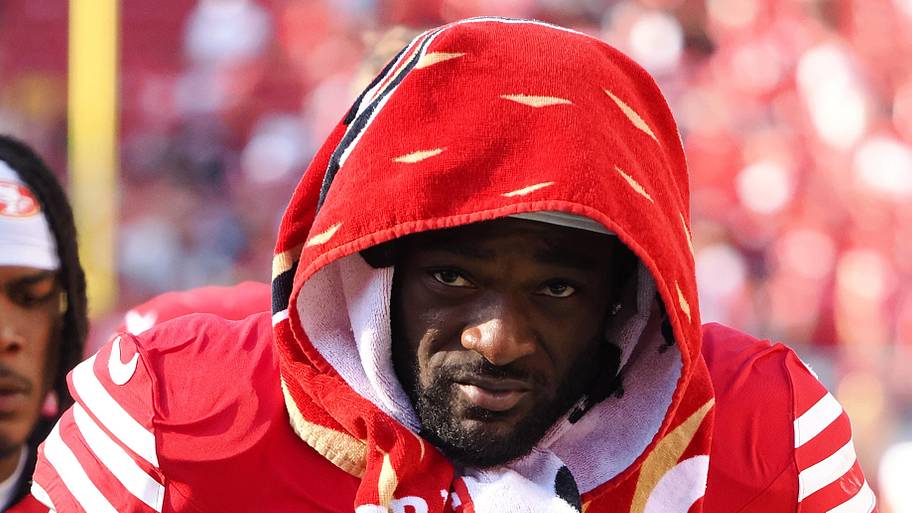
Brandon Aiyuk, WR, 49ers
Aiyuk’s situation might be the weirdest in the NFL entering June.
The 49ers signed Aiyuk to a four-year, $120 million extension prior to the 2024 season. At the time, he was coming off 1,342 yards and seven touchdowns, earning second-team All-Pro honors. Unfortunately, Aiyuk then tore his ACL, MCL and meniscus in Week 7 against the Chiefs and was ruled out for the year.
Despite all indications that Aiyuk would return at some point in 2025, he did not. San Francisco voided $27 million in guarantees due to Aiyuk missing rehab appointments last summer, further widening the disconnect between the two sides. Frustrated with the team, Aiyuk has stayed away from the 49ers, while general manager John Lynch has been open about his intention to deal Aiyuk amid the chaos.
Signed through 2028, Aiyuk counts only $1.2 million against the cap for an acquiring team. After that, he would essentially be on a pair of one-year deals for $27.2 and $29.1 million, respectively, with no guaranteed money remaining.
With two 1,000-yard seasons to his name and being 28 years old, Aiyuk is an intriguing addition to a contender if the medical evaluation checks out. With the situation being so toxic, the 49ers have little leverage to get anything more than a late-round pick. And for San Francisco, at this point, ridding itself of the Aiyuk headache while getting an extra draft choice and $6.3 million in cap savings this year would be an acceptable outcome.