Get NFL prospect scouting reports and team breakdowns in SI’s draft tracker.
The 2026 quarterback class once had so much promise. Garrett Nussmeier was going back to LSU, Drew Allar back to Penn State and Cade Klubnik back to Clemson. LaNorris Sellers was the avatar at South Carolina, full of talent and promise. Maybe all wouldn’t be first-round picks, but enough would surely deliver to give quarterback-needy NFL teams the options they lacked after Cam Ward came off the board in 2025.
Then, they all started playing football again.
Twelve months later, the one left standing as a surefire first-rounder is the endearingly goofy kid who was transferring from Cal that no one was talking about. And if another quarterback goes in the first round, it’ll be a guy, who, after the 2025 draft had concluded, was three months away from winning the starting job at Alabama.
So, no, no one is going to confuse this year’s class with 1983, 2004, or even ’18, ’20 or ’24. Nussmeier and Allar’s coaches, Brian Kelly and James Franklin, didn’t even keep their jobs until November. Klubnik was part of a similar meltdown at Clemson. All three were on teams in the AP preseason top 10 that finished unranked. Sellers went through growing pains, and his Gamecocks, similarly, fell well short of expectations.
What’s left now is a beauty-in-the-eye-of-the-beholder quarterback class, with a lot of teams casting their eyes to 2027, when Oregon’s Dante Moore, Texas’s Arch Manning, Notre Dame’s C.J. Carr, Ohio State’s Julian Sayin and a host of others will atone for all this, and give all those teams that were waiting for this year’s class what they crave. Right? Right?!?
Anyway, the cupboard isn’t completely bare in 2026. How you see this year’s group comes down to how you assign blame for what went wrong in the fall. Was Allar simply in the wrong offense? How much was Nussmeier’s injury to blame for his decline? And so on and so forth.
“I think you have guys who can be a starter in the league, in [Fernando] Mendoza, and a guy who needs some time, Ty [Simpson],” said one offensive coordinator. “And then you have two guys with NFL traits, who maybe can be Davis Mills or Jacoby Brissett, and that’s Allar and Nuss. It’s not a great group.”
As such, opinions vary.
And that really stood out as I dove into my annual story, tapping into the NFL coaching community to scout the quarterbacks. This one (I hope) is always designed to be a little different than the ones you’ve read for the past three months. It’s done solely with coaches, rather than scouts, who work with the position—NFL offensive coordinators, pass-game coordinators and quarterbacks coaches—and have spent the past two months evaluating these players.
It’s always an interesting exercise in that you get into the nitty-gritty of the position.
Hope you enjoy the 2026 edition.
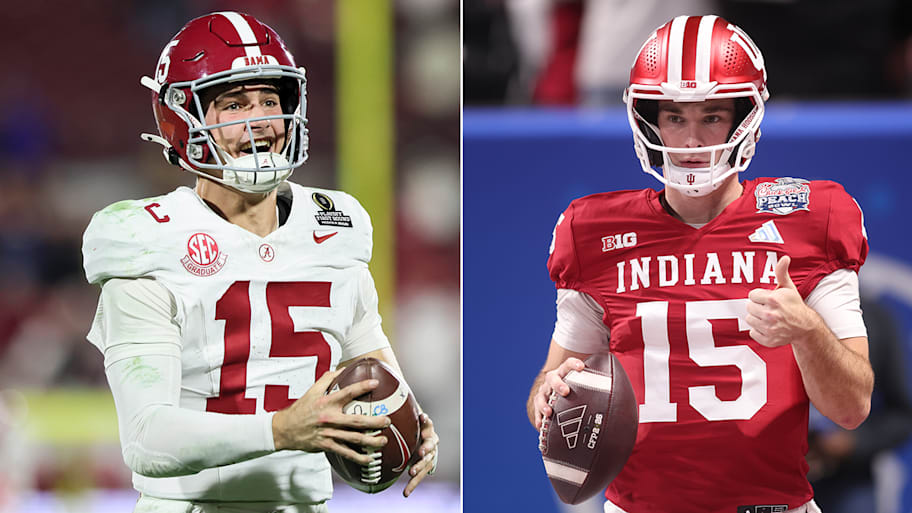
Fernando Mendoza, Indiana
Dimensions: 6'5", 236 pounds
Traits comp: Stockier Jared Goff
Mendoza went wire-to-wire as the top quarterback prospect in the class—a Heisman winner who led Indiana to its first national championship after starting for two years at Cal-Berkeley. And in talking to coaches who’ve evaluated him, it’s pretty clear why.
It seems as if his floor is to be a good NFL starter. And from there, there is definitely some disagreement on his ceiling.
“I went into it hearing [players] making fun of him for his interviews, and saying, ‘O.K., let’s see what this is all about,’” said an NFC quarterbacks coach. “I came out of it saying he’s probably one of my favorite guys of all the guys I’ve evaluated the last decade. The level of consistency and the level of ability to make every throw in the right moment, throwing the right kind of ball with good feet and good timing, is really, really impressive. I think he’s going to grow into a franchise quarterback, no doubt—the consistency, the toughness, the accuracy is so good. He had one bad game, against Purdue in bad weather, but the entire season, it really was the same guy every week.”
“He’s probably better than I expected him to be,” added an NFC coordinator. “He’s big and strong. A lot of guys look at the offense and the limitations in what they were doing, but for what he was asked, what stuck was the true accuracy to all three levels. He’s really an accurate passer, and has the arm to push the ball outside the numbers and down the field.”
Not everyone was quite that high on Mendoza—but as that coordinator said, his frame is ideal (“He’s a really big dude,” said an AFC coordinator, “that kind of sneaks up on you, when you’re walking up on him”), and he has plenty of arm and athleticism, though he’s not necessarily elite physically.
“He’s probably better than I expected him to be. He’s big and strong. A lot of guys look at the offense and the limitations in what they were doing, but for what he was asked, what stuck was the true accuracy to all three levels.”NFC coordinator
That said, he’s not without flaws.
His athleticism is seen as more linear—he’s not quite as loose an athlete as you’d want at the position, which leads to some questions on how his pocket movement will translate to the NFL, where quarterbacks have to operate from tighter quarters more consistently. And there are also questions related to that on his ability to play off-schedule.
“Straight ahead, he’s an effective chain mover when he decides to run, but he’s not a dynamic athlete,” said the AFC coordinator. “He’s rigid—you can see it in his throwing mechanics, his movement. When he does become a runner, he’s not shifty, so I worry a little about him navigating NFL pockets when he has to step up, find creates, slide and change his arm slot.”
There’s also the aforementioned projection in that he’s coming from a shotgun-heavy offense that’s reliant on run-pass option plays—concepts that do require quarterbacks to see things fast, but not process and progress through the whole field. There was enough of that in the Hoosiers offense to make his advocates believe he’ll be able to handle learning an NFL offense, though, even if there are some growing pains.
“I think that conversation’s been dead for 10 years now,” said another NFC coordinator. “Everyone’s got different run alerts. Maybe a true RPO offense is different, but if anything, in this case, you get to see quick postsnap reactions, and it’s impressive how quick his reactions are—he’s good there from an evaluation standpoint. You do see pro reads and pro throws. I haven’t seen any quarterback throw the field speed out-cut at 10-to-12 yards as good as he does on no-hitch timing—he has perfect location on those, and they trust him to throw it quite a bit. It’s not [Matthew] Stafford–type drive, but he can pace and put it on the receiver’s facemask, and [the coaches] say his ability to process to get to it is crazy.”
And Mendoza’s work ethic and drive are, by all accounts, beyond reproach.
The personality quirks have raised questions. But he is very clearly comfortable in his own skin—in the sort of way Andrew Luck once was—and that genuineness, coaches trust, will resonate with his NFL teammates.
“I don’t know the head coach [Curt Cignetti], but he’s a [Nick] Saban guy, and if you can play for those guys, you can play for anyone,” said a third NFC coordinator. “There’s talent there, he has a good arm, and he’s an A-plus human. He’s not Superman physically, but he does everything really well. He operates efficiently … he can play in that system.”
That system, of course, will be new Raiders coach Klint Kubiak’s system, which Mendoza is universally seen as a fit for, because of how disciplined he is with his feet and how accurate he is. “Klint will tell him,” said the NFC quarterbacks coach, “Hey, use this footwork, and read this to this to this. And I think based on who he is, he’ll have success with that.”
Ty Simpson, Alabama
Dimensions: 6'1", 211 pounds
Traits comp: Raw Brock Purdy
Some see the difference between Mendoza and Simpson as cavernous. (“It’s a drastic dropoff,” said an NFC quarterbacks coach.) Others don’t. (“It’s not a huge gap,” said another NFC quarterbacks coach, “but there’s a game, mainly because he’s a one-year starter.)
But what seems clear is that Simpson’s primary strengths come with his football IQ, and how it’s demonstrated in the way he plays like the son of a coach—which he is.
“There’s a lot there; I really like this guy,” says an AFC coordinator. “He’s got 15 starts, and you have this picture of what a guy with 15 starts looks like, and that’s not what you see—in a good way. He processes it, he plays on time, he shows he can handle much more than a normal, limited-experience guy. That’s a feather in his cap, in that if the lack of starts worries you, he feels like a guy who’s played a lot more than he has. Part of that is that he’s older, he’s a coach’s kid, he’s been around it. And he offers evidence that makes you feel better about it.”
Indeed, Simpson spent two years under Saban, and another under Kalen DeBoer, before getting his shot to start in his fourth collegiate season—and his performance through that single year could be broken into two halves. Over his first nine starts, Simpson was dynamite, and perhaps the best quarterback in the country. Then, in the Tide’s 10th game, Oklahoma’s Brent Venables seemed to crack the code on Bama’s protection scheme.
From that point forward, the run game was nonexistent, Simpson took a beating and his performance suffered as a result. That was digested in different ways by different NFL folks.
“I think he’s a backup that in any other draft would be picked as a backup and only to be a backup. But he’s the second-best quarterback in the draft, so he’ll go earlier than he should.”NFC quarterbacks coach
“[Bama OC] Ryan Grubb doesn’t do anything with his protections—you could do that stuff against South Dakota State, not against Brent Venables,” said one NFC coordinator. “That’s not that kid’s fault.”
“One thing that bothered me,” countered the second NFC quarterbacks coach, “is when he needed to be at his best, he wasn’t. He had his two worst games against the two best teams they faced. That’s not fatal, but it gives you pause. Mendoza delivered all year against everybody, and they weren’t better than everyone.”
The other questions are physical. One coach said that, based on what he watched, he was surprised Simpson came in at even 6’1” and 211 pounds—“He looks really small on tape.” And that he got nicked up in his only year as a starter adds a layer of validity to that concern.
There is energy on his throws, which is a positive, but he puts a lot of his body into his delivery and still needs work fundamentally.
“His arm is good, not great,” said another NFC coordinator. “He gets a little long in certain instances; he could work on his weight transfer—he gets too far out in front of himself, and that leads to inaccuracies. He can process. You can tell he’s a coach’s kid with the way he plays and his basic fundamentals. But he needs to play with a more consistent base. You look at the latter half of the year, you see the warts. In a tight pocket, forced to make quicker decisions, your decision-making goes wayward, like with a lot of young guys.”
“I think he’s a backup that in any other draft would be picked as a backup and only to be a backup,” said the first NFC quarterbacks coach. “He’s inexperienced, I think he’s an average athlete with that same type of arm strength, and he plays small. But he’s the second-best quarterback in the draft, so he’ll go earlier than he should.”
So, in what scenario does it work?
It seems relatively simple. A system that fits him, like Kyle Shanahan’s system fit Purdy (though Purdy’s probably a better athlete than Simpson and was far more experienced coming out), and with teammates that will ensure he doesn’t have to carry the team. He was also known to be a little bit of an anxious kid, which showed up at times with frenetic footwork and lends credence to the idea that a redshirt year in the pros would serve him well.
“He’s not a guy ideally that you’d hand the keys to right away,” said the AFC coordinator. “I’d hope he goes to a good team with an aging quarterback where he’s a system fit, where he can be a backup early, grow, and then is ready when he gets a chance, and you see what happens. He’s got a chance to be a really good processor and distributor—he can handle a lot of pre and postsnap, he sees it, and in a way that translates to NFL quarterbacking. He’s good enough where the good moments look good. He’s got good twitch and play speed.”
And enough to keep his floor probably in the league as a backup. We’ll see if he becomes more than just that.
Garrett Nussmeier, LSU
Dimensions: 6'2", 203 pounds
Traits comp: Case Keenum
The two-year starter, who took the reins from Jayden Daniels (and pushed him for the starting job at one point), came into 2025 seen as a contender to go first overall. And everything, from there, came undone. Nussmeier, the son of Saints OC Doug Nussmeier, went 5–4 in nine starts in 2026 before being benched and finishing his final collegiate season with less than half the yards and touchdowns he had in 13 starts as a redshirt junior.
The season was a nightmare, in general, for the Tigers, and Nussmeier was hardly the only guy whose individual performance suffered. But there’s very little question that he wasn’t the same guy who got NFL teams excited through the 2024 season.
“I really liked watching him the year prior; there was definitely a lot more gunslinger to him, this baller mentality where he was playing with instincts and feel,” said an NFC coordinator. “You could feel it almost right away, something was just not right last year, and that makes sense as we started getting more on how banged up he was, but the ball had no juice, he couldn’t get the ball downfield. You knew something was up; he became a wild decision-maker at times, and it had to be that he was either pressing or injured. He was not the same.”
It turned out he had a nerve issue that led to oblique pain—which would cause obvious issues for any quarterback—that wasn’t properly diagnosed until late in the year.
So give him credit for playing through it, but it’s not like there weren’t other issues.
“I really don’t like him. He has toughness and swagger. He just doesn’t affect the game. He’s certainly not physically imposing. To me, he’s a [worse] version of Simpson.”NFC quarterbacks coach
“I really don’t like him,” said an NFC quarterbacks coach. “Here’s why: Yes, his junior year was better, and I know he was hurt this year, but like 60% of his [passing] yards were yards after contact. He was in the bottom three in air yards; they just had him throw bubbles [bubble screens] all day. He doesn’t make big-time throws. He has toughness and swagger. He just doesn’t affect the game. He’s certainly not physically imposing. To me, he’s a [worse] version of Simpson.”
And the trouble is he’s actually smaller than Simpson, which a lot of people didn’t expect when they started studying him.
“Size is a significant issue,” said an AFC coordinator. “Given the lack of size, he’s just O.K. as a prospect. He’s a natural thrower; he’s smart. It’s probably a little beauty in the eye of the beholder. If you have skill guys and can let him distribute, he’d probably have a little more value. You put more on him, in movement and as a creator, then I’d see it a little bit less.”
The idea, it seems, for someone will be to get him in as a mid-round pick, with the hope that resolving the injury will bring back some of the qualities that flashed in 2024.
“Two years ago, this guy was supposed to be the first pick—he makes throws other guys can’t,” said a second NFC coordinator. “I thought he was a college version of Stafford the way he played, gritty, talented, a little up-and-down, and then you watch this year and it’s not the same guy. But two years ago, there was starter capability there. That’s where I am with him: Take him in, and in a couple of years, maybe he can be a player.
Of course, it’s implied that with that idea, a lot of real growth will be needed.
“He’s a tough watch,” said an NFC quarterbacks coach. “His tape is not very good. He makes poor decisions. You think you’re gonna be watching this big, burly guy, based on reputation, and that’s not him. He’s an average athlete. He has small hands and an average arm. He doesn’t play with timing and anticipation. Any throw he has to make where the ball has to come out quickly, I didn’t see it. I had him graded as a seventh-round pick.”
I think Nussmeier will go higher than that, for sure. But Day 3 seems like the likelihood, at this point.
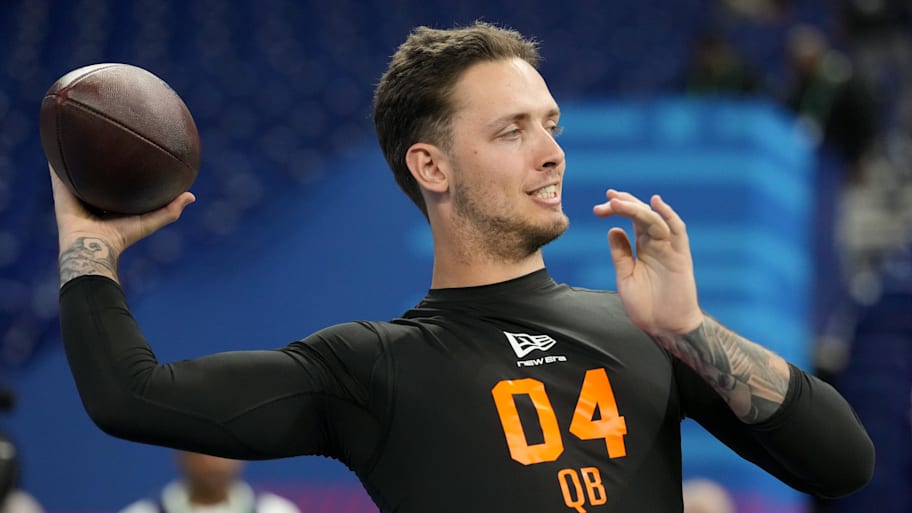
Carson Beck, Miami
Dimensions: 6'5", 233 pounds
Traits comp: A.J. McCarron
Beck’s had an interesting run. After his redshirt junior year at Georgia, scouts told him he had a shot to go in the first half of the first round of the 2024 draft. Instead, he returned to school for a fifth year, saw his completion percentage drop by eight points, his interception total double and his passer rating drop by more than 20 points. And that was before he tore his UCL in the SEC title game against Texas, prompting a transfer to Miami.
Of course, his arrival there was met with a Lamborghini and the Cavinder twins, which led some NFL folks to form preconceived notions as they began evaluating the tatted-up six-year college player. Which might be why what they saw on tape surprised some.
“He had a really good year,” said an AFC coordinator. “Big kid, very smart, another guy that’s well prepared from the neck up. He has a big enough arm. He’s a marginal athlete, but I think he’s got the ability to navigate the pocket, does a good job of mitigating bad plays, and his sack avoidance is good—the sacks he takes are minimized. He just plays within himself. He was asked to do more at Georgia, but he’s capable of all that stuff, as far as controlling what’s out there. Floor is a good backup, and I would be surprised if he’s a low-end starter.”
“He’s talented enough, smooth, on time, sees it well, he’s smart—probably the smartest kid in the class. But the personality is tough. I wouldn’t touch him.”NFC coordinator
The coach then added, “I follow college football loosely; there’s this sense that this guy is a villain. I don’t know where that comes from. Maybe it was leaving Georgia.” Some questions about his personality remain, with NFL teams hearing he was a bit of a loner, which doesn’t make him a bad guy, but isn’t what you’re looking for at the position.
“He’s talented enough, smooth, on time, sees it well, he’s smart—probably the smartest kid in the class,” said an NFC coordinator. “But the personality is tough. I wouldn’t touch him.”
The other thing coaches say will hold him back is the general lack of athleticism that can spill over in his play speed, which needs to improve, and may simply be what it is after six years in college and three full seasons as a starter at two different schools.
“He’s an interesting study,” said an NFC quarterbacks coach, before joking, “He was the least talented player on the most talented team in the country. Carson’s probably the next guy for me after Simpson. He played a lot of football; he has a good base and footwork. My problem is he’s an average athlete, his arm is average and there’s no quick-twitch. Everything is methodical. And the decision-making is inconsistent—he makes some boneheaded decisions that make you question his instincts and feel.”
He had nine games without a pick last year. He also had three multi-interception games, including a four-pick meltdown against Louisville. Bottom line, when Miami struggled last year, and it wasn’t all that often, Beck was primary among the culprits.
But on the whole, Beck’s ability to navigate all he did as a collegian—waiting his turn at Georgia, weathering the storm of a rough ending there and bouncing back at Miami—is generally seen as a plus by NFL folks, and evidence that he’ll last a while in the league.
“He knows how to play the position,” said a second NFC coordinator. “He’s had a ton of reps, and that shows up. I can see him as a middle-of-the-road backup. He’s another one whose ceiling is not that high because of mobility. But he knows how to play. … He’s a safer option, I think he can be a two, over guys like Nuss and Allar.”
Drew Allar, Penn State
Dimensions: 6'5", 228 pounds
Traits comp: Jacoby Brissett
A lot of the coaches beat Allar up pretty good.
For a guy with a big frame and big arm, from a blueblood program, the tape left those guys wanting a whole lot more than they got.
“I’m lukewarm on him,” said an NFC quarterbacks coach. “He’s not accurate enough as a passer. The film’s not great. When everything’s perfect around him, he looks good. But he has this weird arm action, because he’s so long, where he loses control of the ball. It’s an interesting throwing motion. He’s a project. I don’t think he'll be a starter in the next couple of years. But you meet with him, talk to him, you want him to be better. The tape doesn’t match the personality. He’s smart, conscientious. And you turn the tape on, and it’s hard to get excited.”
Allar is another prospect who probably would’ve gone much higher had he declared in 2025.
Instead, he decided to return to Penn State for his senior year, and the team—ranked No. 1 in the country in the preseason—came undone quickly, leading to James Franklin’s midseason firing. So things certainly weren’t perfect around Allar last year. But it’s not like his play wasn’t part of that equation.
“Really big kid, really big arm, smart, can talk it,” said an AFC coordinator. “But he doesn’t move great, and there’s just something missing in the production, in putting it all together. So it’s anyone’s guess what happens. He’s going to have to earn it in camp and make some plays in the preseason. He fits as a developmental guy, where you try to figure out what you gotta do to provide this guy what he needs to turn the tools into a more consistent player.”
And consistency is the one thing that came up over and over again.
“He looks like Drew Bledsoe. When they played real teams, they lost all of them, so you’d be betting on the come. Look, everyone’s a project to some degree, and he’s not a project I’d be scared of.”NFC coordinator
“He looks the part, but the ball just doesn’t come out clean, the accuracy comes and goes,” said an NFC coordinator. “When it looks right, and he’s sound with his footwork and fundamentals, you can see the talent. He’s just so up and down and inconsistent. He’s more, at this point, of a fringe two/three, and you hope he develops into a solid No. 2.”
Of course, there are ways to couch his struggles.
The receiver situation at Penn State was objectively bad while he was there. The offense that Andy Kotelnicki brought in two years ago from Kansas wasn’t a fit for Allar—and the blame for that lies at the feet of Franklin. All of which is how Allar played his way down into being seen as a Day 3 flyer for someone.
There are positives to work with here, though.
“He looks like Drew Bledsoe,” said another NFC coordinator. “When they played real teams, they lost all of them, so you’d be betting on the come. But you watch him play, and he can make all the throws. Just talking to him, you know he’s intelligent. Look, everyone’s a project to some degree, and he’s not a project I’d be scared of. The kind of kid he is gives me confidence that he’ll reach his potential.”
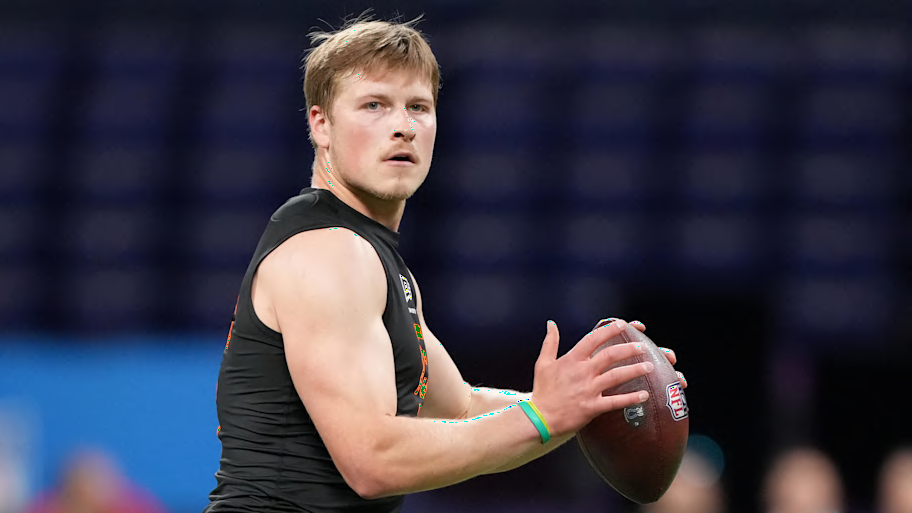
Cole Payton, North Dakota State
Dimensions: 6'3", 232 pounds
Traits comp: Poor man’s Jalen Hurts
Payton’s a fun one—built like an H-back, and with a 4.53 40, 40-inch vertical and 10-foot, 10-inch broad jump recorded in Indy, the southpaw started only 13 games at North Dakota State, all during his fifth season on campus. But, clearly, he was worth the wait for the Bison, completing 72% of his passes for 2,719 yards and 16 touchdowns, while rushing for another 777 and 13 scores for a 12–1 team (that was upset in its final year as an FCS team in the playoffs).
“He was fun to watch,” said an NFC quarterbacks coach. “I watched the combine workout, and it was like, Eh, I don’t know. But on tape, the more I watched, the more I liked him. He’s super interesting, despite the level of competition. The inaccuracy probably isn’t punished as it should be at that level, but the dude can just play football. He makes throws down the field. He’s from a good program, they’re well-coached and he’s a good kid. The NFL will be a dramatic jump for him, but I like his demeanor, personality and play style. He’d be best suited in a downfield, play-action system. There’s a loop to his delivery; it’s a little longer.
“But you can’t deny the tape. It’s pretty good.”
Payton would be the fifth NDSU quarterback of recent vintage to make it in the NFL, joining Carson Wentz, Easton Stick, Trey Lance and Cam Miller. And his challenges will be similar to theirs, which went back to the aforementioned level of competition, and also how the Bison’s dominance meant the quarterback didn’t always have to be great.
“I know everyone likes him. But to me, he’s a muscle-bound, all-arm passer. I don’t think he’s ever going to be accurate enough. He’s a hard watch, not really accurate, not fluid, but a big, strong, physical player.”NFC coordinator
“He’s a better athlete than full-on quarterback—he’s super smart and tough; he’s just not a great thrower,” said an AFC coordinator. “One-year guy, strong enough arm, long delivery. It’s a cheap comparison, because it’s too easy, but some of the Taysom Hill stuff might be real in that you can find different roles for him. There’s a lot of run production there; he’s big, sturdy as an ox with a good build. He’s just not gonna be a high-level NFL passer. I watch him throw, and I don’t see that. I think he’ll struggle to deliver in the tight quarters of an NFL pocket. But if you have a vision for him, there might be something there.”
“I know everyone likes him,” said an NFC coordinator. “But to me, he’s a muscle-bound, all-arm passer. I don’t think he’s ever going to be accurate enough. He’s a hard watch, not really accurate, not fluid, but a big, strong, physical player.
Which fuels the idea that part of the equation could be, as it was for Hill, special teams. “Taysom made it, because he earned the [game-day] helmet, because of the other things,” the coordinator added.
That, in turn, could buy him much-needed development time. The question is whether there’s actually enough there, as a passer, to develop.
“I just don’t see the arm talent,” said an NFC coordinator. “He’s an elite competitor, a great kid. I don’t see him layering throws like you need to at our level. Everything checks out otherwise. He’s tough; his teammates love him. He’ll maximize everything he is. He’s an elite person. But I don’t see it.”
“The tape is brutal,” added an NFC quarterbacks coach. “To me, he’s a camp player. A big athlete who can’t throw.”
So it’ll be interesting to see where he’s at in two or three years.
In the meantime, it sure sounds like he’d be the kind of guy you’d want around.
Others receiving votes
• Arkansas’s Taylen Green has tantalizing talent—he ran a 4.36 at the combine at a shade under 6'6" and 227 pounds—and 46 college starts under his belt (22 at Boise State, 24 with the Razorbacks). He’s also got good makeup for the position. But while he’s got a howitzer for an arm, he’s seen as a bit of a one-speed thrower with accuracy issues. “He’s an avatar, huge, can run, can throw it far,” said an NFC quarterbacks coach. “But if he throws 10 balls across the living room, he’ll miss on five of them.”
• Kansas’s Jalon Daniels is a playmaker of a prospect who was always good, but didn’t quite progress the way you’d have hoped. Built like a tailback, with good-not-great athleticism, Daniels could develop into a good backup in the right offense. “He’s got a big arm, he’s a high-energy kid,” said an AFC coordinator. “He can create, doesn’t have top-end speed, but he has some playmaker to him. He can launch it, too. He turns it over too much, he has too much panic to his play, but if he gets drafted, I won’t be shocked. He’s fun. He’ll run around in the preseason. And that’s not all he is; in the right offense, he can deliver from the pocket.
• Georgia Tech’s Haynes King is a little bit like Payton—A strong, tough kid who found a way to get it done over and over again in college. He spent six years in college, starting seven games over three years at Texas A&M before transferring and becoming a three-year starter for the Yellow Jackets. “The passing part is a struggle for him,” said another NFC quarterbacks coach. “As a football player, he’s tough and competitive. And for whatever reason, he reminds me of Sam Ehlinger. He has that moxie, he’s competitive, he has everything you want in makeup. It’s just the passing part of it that’s a problem.”
• Iowa’s Mark Gronowski has fans in the coaching community, despite not getting a combine invite. At 6'3" and 226 pounds, he ran a 4.6 40 and posted a 39" vertical at his pro day. Gronowski started 55 games and won back-to-back FCS national titles at South Dakota State before transferring and starting 13 games for the Hawkeyes last fall. “I’d draft him,” said the first NFC quarterbacks coach. “He’s big, athletic and can run the football. He has deficiencies. But he started four years at South Dakota State and won the FCS Player of Year. He’s solid, good size, you saw him against teams like USC, Oregon, Penn State and he played well.”
• Clemson’s Cade Klubnik, as we mentioned at the top, had a really disappointing final season. He arrived in 2022 as the nation’s top prep quarterback recruit, and started three years for Dabo Swinney—with the finish to 2024 bringing hope that he was turning the corner, and growing into what Trevor Lawrence and Deshaun Watson were as Tigers. That, obviously, didn’t happen. “He’s an interesting prospect,” said the second NFC quarterbacks coach. “There’s some talent there. He’s another guy where it’s like, Man, what’s missing? The top quarterback in the country starts three years. And he’s on the field for that long, and he just doesn’t affect the game. As a late pick or C.F.A. [college free agent], you might want to get a look.”
• Tennessee’s Joey Aguilar has a great story, starting with his time at two different junior colleges—City College of San Francisco and Diablo Valley. He then started for two years at Appalachian State before transferring to UCLA for his seventh and final year in college. But after Nico Iamaleava decided to leave Tennessee for UCLA three months later, Aguilar took his spot in Knoxville and started all 13 games last year for the Vols. There, the 6'3", 229-pounder showed himself to be a smooth, efficient thrower who might be worth a flier.
• Louisville’s Miller Moss had a really nice final season, after four years at USC, the last of which he played through as Caleb Williams’s successor. (He was replaced that November by current Trojans starter Jayden Maiava.) “I don’t know what the hype is,” said an NFC coordinator. “But he is very smart, he’s got a whippy delivery, plays with a good base. If he can get somewhere that gives him a real shot, he could stick. No one’s starting him, but wherever he goes, he’ll be competitive and good for the room.”
• Vanderbilt’s Diego Pavia clearly has some baller to him—and has played a lot of college football, starting 21 games at the junior college level, then another 49 across four FBS seasons (the first two at New Mexico State). The trouble for Pavia, who’s just 5'10" and 207 pounds, is that there’s no real defining trait, and his bravado could turn off teams that are just looking for a developmental backup.
More NFL Draft from Sports Illustrated
- Albert Breer’s Latest NFL Draft Buzz: Comparing the Top Wide Receivers
- Jets GM Explains Decision to Cancel Pre-Draft Visit With David Bailey
- NFL Makes Smart Move to Tighten Up Draft After Viral Shedeur Sanders Prank Call in 2025
- Conor Orr’s NFL Mock Draft 2026: A Bold Trade Up for Jeremiyah Love
- Why the Dexter Lawrence Trade Makes So Much Sense | MMQB
This article was originally published on www.si.com as NFL Coaches on Why a Once-Promising 2026 QB Draft Class Faded Fast in the Fall .