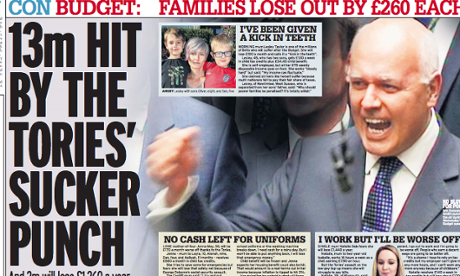
“What price the ‘One Nation’ Budget now?” asked the Independent on its front page. “Osborne took ‘much more’ from the poor”, said the Guardian’s splash headline while the Daily Mirror’s spread was headlined “13m hit by the Tories’ sucker punch”.
The three left-of-centre newspapers were reporting the budget analysis by the Institute for Fiscal Studies (IFS), which said it was “arithmetically impossible” for the rise in the minimum wage rise to compensate for cuts to tax credits and that some families would lose as much as £1,000 a year.
Their prominent coverage of the IFS analysis was matched by only one right-wing paper: the Daily Mail. It ran a full two-page spread, “Osborne and his 13 million budget losers”, plus a leading article based on its findings.
Elsewhere, the independent think tank’s report was down-played, despite the Daily Telegraph referring to the IFS in its news story as “a respected economic forecaster”.
Both the Telegraph, with a two-column article on page 4, and the Times (two columns on page 17) gave the report short shrift. The Sun buried mention of the IFS report in a short news item on page 2 headlined “A right state” that began by stating:
“George Osborne’s new public sector pay crackdown will still leave state employees better off than private sector staff, extraordinary figures revealed yesterday”.
Extraordinary indeed, given that the burden of the IFS report poured a bucket of cold water over Osborne’s budget.
At least the Times thought the report merited a leading article, which began by noting that the IFS had taken aim at the central pillar of Osborne’s economic blueprint: the national living wage and, in so doing had “made considerable noise”.
But the Times argued that the IFS had missed two vital points:
“The radical pruning of tax credits and the introduction of a living wage were never meant to cancel each other out. Each is part of a larger plan to cut spending, shrink the state and lift the worst-off out of welfare dependency not just for a few budgetary cycles, but for good”.
It contended that Osborne was seeking to tackle low pay and low productivity at the same time “by harnessing the power of the state as well as that of markets... a gamble that breaks the traditional boundaries of British politics, but... one worth taking”.
For the Times, the claim that 13m families will lose an average of £260 a year is merely a “tough decision” and it also regards the likely loss of jobs as “regrettable” but necessary.
It concluded: “Mr Osborne’s budget imposes costs but it accurately identifies where Britain’s weaknesses need to be remedied. Its ambition should be applauded”.
The Mail thought the IFS confirmed the paper’s own analysis: “for all the fine words about cutting taxes” it was a tax-raising budget, with the Treasury dragging in an extra £6.5bn of our money every year by 2020”. It continued:
“More controversially – and to the glee of the BBC – the IFS also predicted the chancellor’s welfare reforms will cost 13m families an average £260 each. It’s inevitable that – to restore some semblance of sanity to a tax credit regime that now costs £30bn a year – there will be losers.
And it’s true that many of the families whose child benefit will be frozen can’t expect to be compensated by Mr Osborne’s new politically astute £9 living wage (which has thrown Labour into complete disarray).
But the Mail remains convinced that the philosophy behind his budget reforms – to reduce reliance on handouts and rescue families from welfare dependency, so they can enjoy the dignity and rewards of employment – is deeply laudable”.
The Mirror, in an editorial headlined “War waged on the truth”, doesn’t agree. It argued that the IFS “has exposed a costly truth behind George Osborne’s deceitful £9 minimum wage”.
It spoke of it being a “Tory scam” and “an unfair budget raid” on the poor and a “Con trick” by Osborne:
“The fact is that his budget raised taxes and will cut the living standards of a large number of Britons who can ill-afford to lose the money he will be seizing from their pay packets”.
The Guardian was also unimpressed with the chancellor for being “architect of a budget as savvy as it was shameless” by recycling ideas from Ed Miliband’s manifesto.
With this chancellor, said the paper, “the substance is as slippery as the rhetoric is steadfast. Some think they can spot one deadly serious purpose: rolling back the state.
“But whereas before the election, Mr Osborne suggested that they could balance the books without any rise in taxes, this week he put them up by a net £6.5bn, which would be a betrayal for a small-state fundamentalist”.
Turning to the IFS report, which was “trying to find a pattern in tax reforms”, it concluded:
“Analysts always bemoan politicians’ disdain for evidence-based policy, but with Mr Osborne we are seeing something beyond that: disdain for consistent policy of any sort, save for that which yields political advantage”.
The Daily Express and the Sun could find nothing to criticise. The Express brushed aside “naysayers who oppose the chancellor’s changes” (without mentioning the IFS).
It said: “While there are always swings and roundabouts the country as a whole will be better off for years to come as a result of Mr Osborne’s ambitious reforms”.
And the Sun? It concentrated on Osborne’s pledge to launch “a major new building blitzkrieg” to solve the “acute nationwide homes shortage”.
Its editorial said: “The chancellor’s budget aimed to move the national mindset towards work from welfare. Now he must convince natural Tories that for the sake of the country, the economy and their own children’s futures they must accept that building homes is a priority... even in their back yard”.