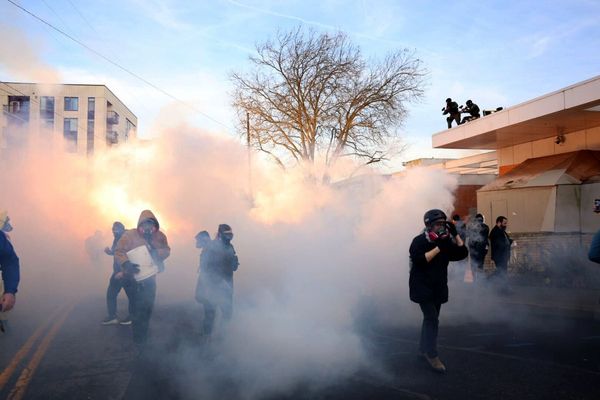
Someone decided the opening of the session on covering terrorism would be a really great moment for a pitch invasion, during which they started shouting and holding up a banner. The prime minister of Turkey is expected to attend so it wasn't much of a surprise, but needless to say - given that at least three investigative journalists were sat in the front row - someone is finding out what exactly they were protesting about. I filmed it and stuck it on YouTube, if anyone speaks Turkish? Someone said they were Stalinists...
Putting that video on YouTube (or GooTube - whatever we're calling it now) segues nicely into one of the main discussion points in this session: is covering terrorism supporting their cause, or is it essential journalism? As chair Richard Quest, CNN anchor, said when he kicked off the session "one man's terrorist is another man's freedom fighter".
Investigative journalist Yosri Fouda of Al-Jazeera talked about interviewing Bin Laden and members of al-Qaida in April 2002. "They probably wanted to send a few messages around and take credit for 9/11," he said. But was he being used? "Aren't we all? Whether we interview a head of state or a prostitute. I spent 48 hours with them, and they were very nice and very welcoming because they expected me to say nice things about them. But I don't say nice things about them, just as I don't say nice things about Rumsfeld or Bush." He said that the footage was not a live debate - it was taken back to Al-Jazeera and edited. Fouda said that when Peter Bergen interviewed Bin Laden he was hailed a hero, but when he interviewed him he was viewed a suspect - and that prompted applause. Quest managed to head off a spat about whether or not there had ever been a beheading broadcast on Al-Jazeera (they say no, others disagree).
Quest asked what the purpose of the interview was. "Ask the CIA," said Fouda. "In terms of journalism, it's the ultimate prize."
Eason Jordan, CEO of Praedict/IraqSafetyNet, quickly pulled him up on that and said wouldn't the ultimate prize be to bring in the man who personally beheaded Daniel Craig? "But I spoke as a journalist," said Fouda. "You spoke as an American."
So would the BBC's terrorism specialist Peter Taylor say 'yes' to The Interview if the call came through from Bin Laden? Yes. "My main concern would be as a Western journalist the chances of getting in to wherever Bin Laden is without being detected by the CIA is extremely remote. It would be putting oneself at risk and the people into whose hands I would be entrusted. That may be one of the reasons Bin Laden hasn't given an interview for 3 or 4 years."
Peter Bergen, CNN's terrorism analyst, also said he'd do The Interview. "I'd definitely do the interview and I would not get involved in anything to do with law enforcement or assisting in their capture." Journalists would be putting themselves in a great deal of danger if that precedent was set. "It's a public good talking to people whether they are a terrorist or a mass murderer, and terrorists are going to attack us whether we talk to them or not. When we interviewed Bin Laden in 1997 he laid out the reasons why he was going to attack the US and I felt that was a useful public service." If we talk to them, he said, at least when the attacks happen we know who the enemy is and what their motivations are.
Much of the debate was about the word 'terrorism' itself. Phil Harding, director of English network and news at BBC World Service, said that while it is BBC policy that no word is banned, the word is still best avoided because the term falls apart under scrutiny. "When people say 'are you on the side of the terrorist?', I immediately ask who we are including. If you asked me that question in South Africa in the 70s, you would have been talking about the ANC. Those who use the term want us not to report but to condemn, and that gets in the way of what we do." Harding said that if broadcasters were to stop reporting on terrorism, stop interviewing people, stop giving context - "would be then be serving our viewers and listeners in any way whatever?"
"Our main problem comes from the times that we don't use the word 'terrorism'," said John Cameron, director of news & current affairs at ABC Australia. "There's a very strong government lobby that wants us to use it when it suits them."
There is a rumour that we might get a Richard Quest special on that whole protest thing, but we'll have to wait and see.