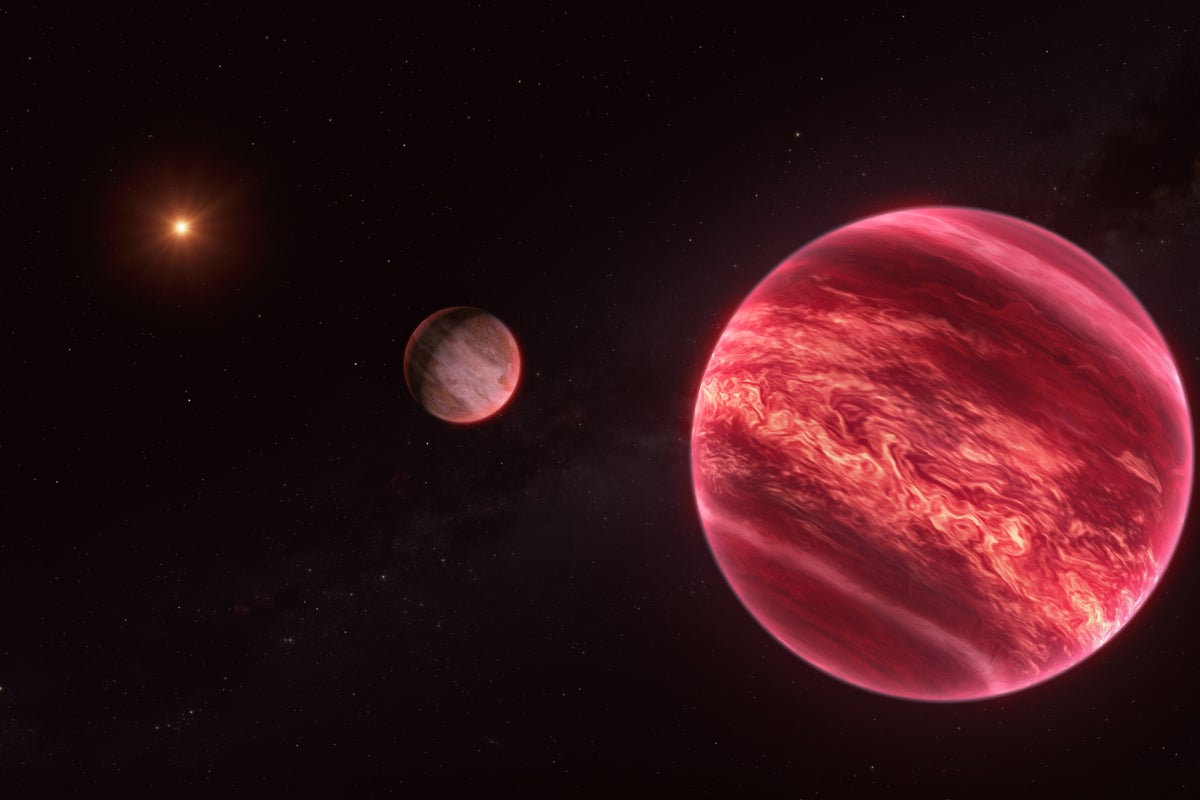
Astronomers have found a new world so strange that they don’t even know what to call it.
The object is in the “super weird” star system CD-35 2722 and might be the first moon seen outside of our own solar system. But astronomers say that it is so new that it is unlike anything we have seen before – among other things, the object does not orbit around a planet – and so it is not clear exactly what to call it.
“We have a clear delineation between the planets and the Sun in the Solar System, so defining things like moons is simple,” said Alice Zurlo, who worked on the new study. “In the CD-35 2722 system, where we are blurring the lines between stars, planets, and moons, the whole thing becomes more complicated to describe.”
As well as not orbiting a planet, like moons in our own solar system, it circles around a failed star known as a brown dwarf that itself orbits the star in the CD-35 2722. It was found using the European Southern Observatory’s Very Large Telescope.
For now, the team has decided to call the object an “exosatellite”.
“The exosatellite is clearly massive enough to be a planet, but it does not orbit a star, though it orbits an object that orbits a star," said Kevin Hoy, author on the new study. "Being the third wheel in this system makes us want to call it a moon, even if it is nothing like the small, rocky moons we have in our system.”
Astronomers have been trying to find moons outside of our solar system for years, but have not yet been able to confirm the existence of one. Despite finding more than 6,000 exoplanets – or worlds in other solar systems – none of them has yet been fully confirmed to actually exist.
To find the new object, researchers looked for small wobbles in the brown dwarf, which are caused by the object that orbits it. “As exotic as it is, this system is truly unique and represents a breakthrough: the first plausible detection of an exosatellite,” said Zurlo.
Finding moons in other planetary systems will help us understand how common they are, the ways they form, and how similar they are to each other. Scientists hope that they will be able to find more in the future with upcoming, even more powerful telescopes.
The discovery is reported in a new paper, ‘Planetary-Mass Exosatellite Detected Around a Star’s Substellar Companion’, published in the journal Nature.