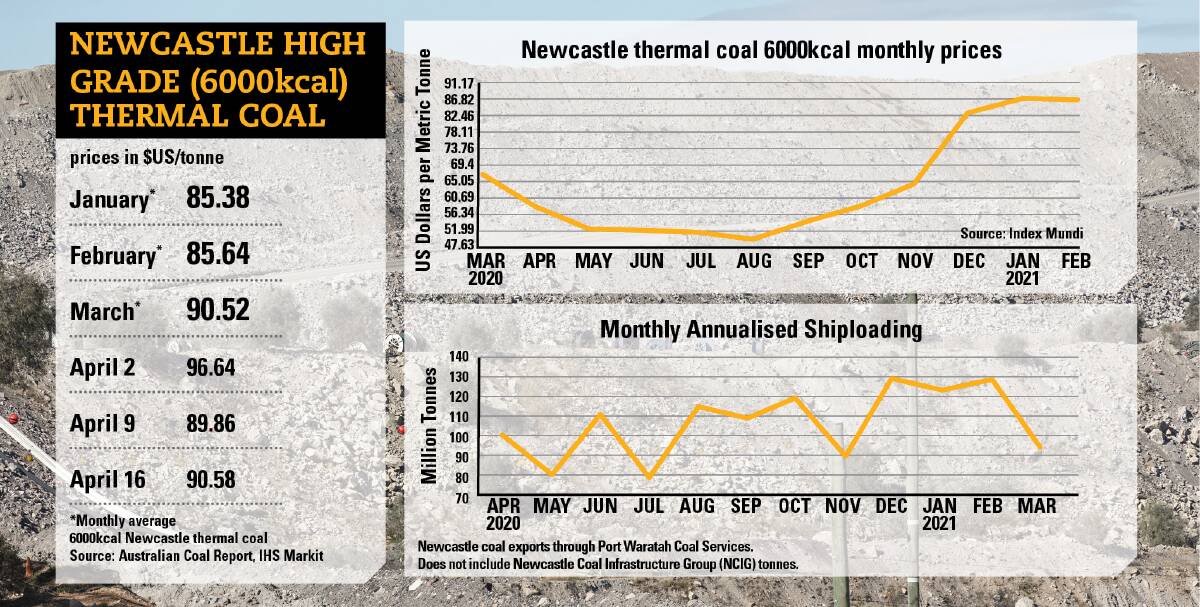
COAL prices have rebounded substantially from their lows of last year, although export volumes are down by almost 10 per cent in recent months, at least partly because of the Chinese ban on Australian coal.
The volume cuts are also likely to reflect the growing impact of "net zero emissions" targets, as well as the economic impact of COVID.
Iron ore prices hit record levels of more than $US190 a tonne recently and although coking coal prices are a moderate $120 or so a tonne, thermal coal for power stations - selling for as little as $50 a tonne last year - is back up to between $US85 and $US90 a tonne.
Although the interaction between resource prices and currency exchange rates is a complex one, sustained periods of high coal and iron ore prices - sold globally in $US - usually result in a strengthening of the Australian dollar.
Arguably because of record low interest rates and COVID influences, the Australian dollar has stayed at lower levels than during previous resources rallies, and has been trading at about $US0.77 for some time, locking in higher profits for those companies that report their returns in Australia.
The latest edition of the weekly Australian Coal Report said that China's ban on Australian coal continued to "play into the hands of other major coal producing countries, with sizeable rises in tonnage" from other countries, according to the latest Chinese customs data.
ACR said another 7 million tonnes of coal a month was going into China from other sources, with Russia and Indonesia benefiting the most.
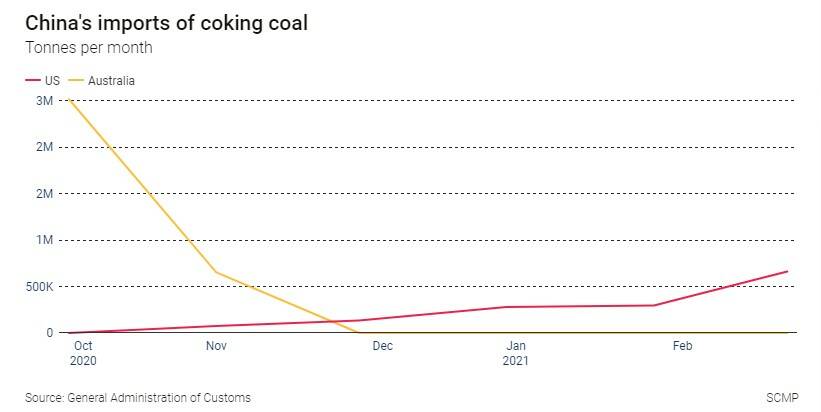
From the Chinese perspective, the South China Morning Post says the trade tensions between Australia and China have helped Beijing meet its "obligations" to the United States in trade deals, with US export "more than doubling" during February and March. Although Chinese restrictions on Australian coal have been reported sporadically since at least 2014, the Post says the present ban began in October 2020.
"US coal exports to China have risen steadily from virtually nothing in October, while Australian exports of the commodity have dropped to zero in the past four months," the paper reported.
Australian Bureau of Statistics figures show Australia exporting about 70 million tonnes of coal a year to China before the October ban.
By comparison, China mines between 300 million and 350 million tonnes of its own coal a month: its official 2020 output was 3.8 billion tonnes.
The ABS says Australia exported 370 million tonnes last year, with other official figures indicating domestic consumption of another 100 million tonnes.
N NEWS TODAY: