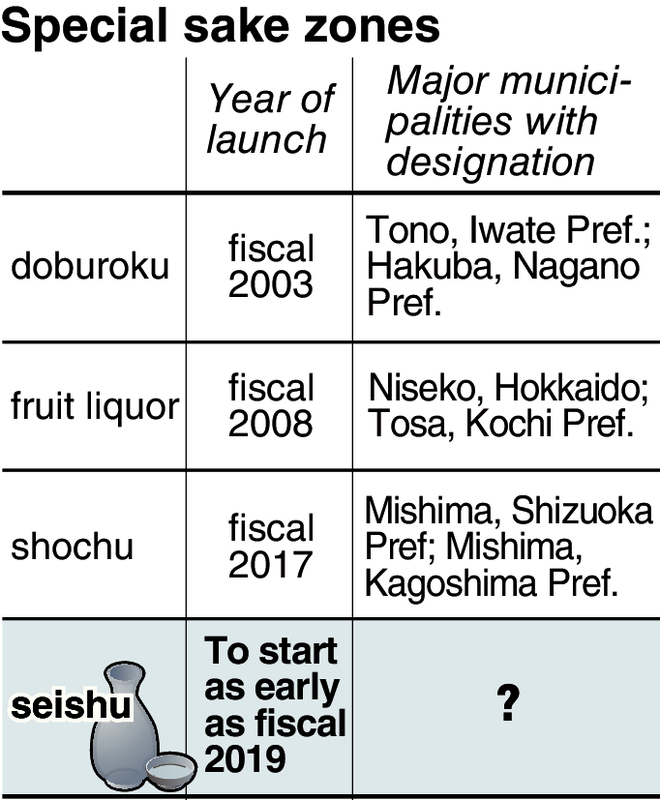
The government and the ruling parties will likely establish "seishu-tokku" special economic zones that allow brewers to make a small amount of seishu refined sake as early as fiscal 2019, according to sources.
The seishu special zone program aims to revitalize local areas and attract foreign tourists by allowing producers to build small sake breweries that can serve as local tourist spots.
The Liberal Democratic Party and its junior collation partner Komeito will incorporate the project into their outline for tax system revisions for fiscal 2019.
The Liquor Tax Law requires each individual brewery to obtain a license for each kind of sake it produces. For refined sake, producers have to brew at least 60 kiloliters annually to earn a license.
Such regulations will be loosened in seishu special zones. When a producer who already has a license to make seishu refined sake plans to build a separate brewery to promote local revitalization, the government will waive the production volume requirement and the requirement to obtain a new license.
The government and the ruling parties hope that small-sized breweries will be built at michi no eki roadside rest areas and other places where visitors can take tours and experience making seishu.
The government intends to make cities, towns and villages the basic unit for seishu special zones, and to discuss details such as the number of zones to designate.
Other special sake production zones have been established. The doburoku special zone project started in fiscal 2003 to allow farmers and minshuku guest houses to produce doburoku crude home-brewed sake. A fruit liquor special zone for producing liquor made with locally grown fruit and a shochu special zone have also been established.
About 270 areas had been designated sake-related special zones nationwide as of October 2018.
The city of Tono, Iwate Prefecture, the first municipality designated as a doburoku special zone, is now working to promote local revitalization through such projects as a package tour in which tourists can enjoy home-made doburoku at a traditional house.
The establishment of seishu special zones comes against the backdrop of seishu's popularity overseas.
According to Finance Ministry statistics, refined sake exports totaled about 18.7 billion yen in 2017, a record high for the eighth straight year. In the last 10 years, export volumes have increased by 100 percent and the value of exports by 150 percent.
Major export destinations include the United States, Hong Kong and China. The planned special zone program is expected to attract foreign tourists to local areas.
Meanwhile, the sake-brewing industry has increasingly been calling for a special zone for seishu.
Obata Sake Brewery Co., a long-established firm, built a sake brewery at a defunct elementary school, and began offering visitors the chance to try sake brewing using local brewer's rice four years ago.
Due to Liquor Tax Law regulations, the company has been unable to label its products as seishu. The firm and the city have been pinning their hopes on the establishment of special economic zones.
"There are attractive sake breweries throughout the nation. If special zones are created, I'm sure a variety of ideas will emerge and local areas will get a boost," said Obata Brewery President Ken Hirashima.
Read more from The Japan News at https://japannews.yomiuri.co.jp/