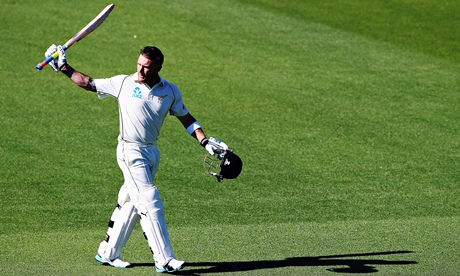
Brendon McCullum came within a shot of breaking the world record for the fastest Test double century as he bludgeoned Sri Lanka’s attack around Hagley Oval in Christchurch to lead New Zealand to 429 for seven on the first day of the first Test.
The captain had reached 195 from 134 balls when he was caught in the deep by Dimuth Karaunaratne off the debutant spinner Tharindu Kaushal in front of a capacity 8,000 crowd at the redeveloped stadium in the city’s first Test since the 2011 earthquake. Nathan Astle set the existing record in 2002, taking 153 balls to reach his double century against England at Lancaster Park, which fell victim to the earthquake. Don Bradman scored 200 in 214 minutes against England at Headingley in 1930, moreover; when McCullum was out in the 66th over he still had 12 minutes to eclipse that time.
McCullum hit 18 fours and 11 sixes and became the first New Zealand batsman to surpass 1,000 Test runs in a calendar year as he broke his own national record for the fastest century, which came off 74 balls. He said: “I’m not too statistically driven. I knew that [1,000 runs] was not too far away but you’ve still got to be respectful of the game and once we got away and I established a partnership with Kane [Williamson], runs sort of flew. It was nice to have a good solid day and put ourselves in front of the game and put some pressure back on Sri Lanka.”
Sri Lanka did not look penetrating despite the green wicket and bowler-friendly conditions, even though they asked New Zealand to bat and had them at 88 for three after lunch. Suranga Lakmal dropped a simple caught-and-bowled off Williamson with the score on 103 and the floodgates opened. McCullum punished anything short by slashing it to the cover-point boundary and when the bowlers pitched up, he belted it over their heads.
He shared in a 126-run partnership with Williamson (54) and put on 153 in 19.3 overs with the all-rounder Jimmy Neesham (85), when they scored at more than 5.3 runs an over. “I was trying to be a little aggressive when the ball was up to get them to back their length off and that would create a scoring opportunity,” McCullum said. “I think there is still something in the wicket for the bowlers if you bowl the fuller length, so hopefully when we do get the ball in hand we can create some opportunities.”
There were some teething problems for the redeveloped Hagley Oval, however with both opening bowlers losing their footing, but they were quickly amended.
McCullum’s innings also demonstrated, for the fourth time this year, how much he can, when the mood takes and circumstances allow, impose himself to shape a game’s outcome.
In the opening Test of 2014 against India and with the off-field antics of Jesse Ryder and Doug Bracewell overshadowing the team, McCullum came to the crease with his side 30 for three. By the time he was out, he had shared in big partnerships with Williamson and Corey Anderson and put on 105 runs with the bowlers to guide his side to 503, of which he scored 224. New Zealand won the game by 40 runs.
It was the second Test at Wellington, however, that truly fixed his name in the record books. Facing a 246-run first innings deficit, New Zealand were 52 for three when McCullum came to the wicket before they slumped further to 94 for five and were facing defeat inside three days.
McCullum, however, batted for 775 minutes before he became the first New Zealander to score a Test triple century. While he was dismissed shortly after, the game was saved and the two-match series won.
McCullum’s third Test performance, against Pakistan in the UAE last month, again showed how few other batsmen can change the momentum of a match. Pakistan had scored 351 in 125.4 overs on a slow Sharjah pitch before McCullum tore the Pakistani bowlers apart with 202 in a 297-run partnership with Williamson.
New Zealand eventually posted a total of 690 in 143.1 overs and then dismissed Pakistan for 259 to win the game by an innings and 80 runs inside four days and level the series.