It rained at Headingley in the morning, horrible persistent heavy drizzle glistening the streets and puddling the footpaths. Hardy souls still turned up first thing to sit swaddled optimistically in the stands but with never a hope of play until, around midday, the skies brightened, then cleared and the mopping up began.
By half past one, the sun now out, play was delayed not so much by the condition of the outfield away from the acreage of covers across the square itself as by the need to set up and calibrate the technology on which so much depends these days.
If play was necessarily shortened by 25 overs, to be made up over the remainder of the match, then it can scarcely be said that the entertainment was lessened proportionately.
There were wickets for Jimmy Anderson, two of them with the new ball, the first of which made him the eighth paceman, and the first England bowler, to reach 400 Test wickets.
There was a battling half-century from Tom Latham, who flayed anything off line, drove nicely, missed a few and, while riding his luck both with catching (he was missed twice, at first slip by Alastair Cook, who may have hurt his hand in the process, and at square leg) and with the umpire, generally held things steady until he drove once too often and edged to first slip for 84.
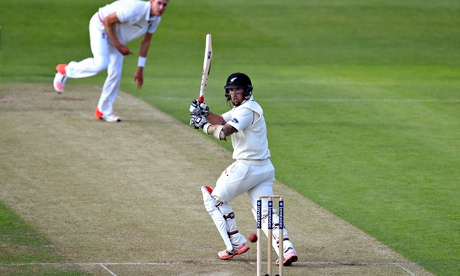
And of course there was another counter-punching cameo from Brendon McCullum, who followed his first ball duck at Lord’s by driving the first ball of his innings here thrillingly on the rise over extra cover for six and threw the bat as he might for Chennai Super Kings until he holed out to mid-off to the first ball after the tea interval.
McCullum had set the tone on a New Zealand innings that rattled along at five runs per over, a rate that even then picked up with the advent of Luke Ronchi, making his Test match debut as wicketkeeper, while the injured BJ Watling retained his place as a batsman only.
Ronchi is a limited-overs cricketer of some prowess, a striker of the ball in the McCullum mode, and Test matches clearly hold no terrors for him as he hammered his way merrily to a 37-ball half-century, a landmark reached with his second six.
Test cricket was once a game where as a spectator it was possible to dip in and out, go to the bar, picnic in the Coronation Garden at Lord’s and still pick up the pattern of play.
But not with this New Zealand team, for it would be a foolish person who takes his eyes off for a second. This was the fastest Test half-century seen on this ground and the second-fastest ever by a debutant anywhere (Tim Southee, curiously, the fastest, also against England, in Napier).
Nor did Ronchi stop there. Moeen Ali’s offspin was treated roughly, twice carted over midwicket for six and once over long-on; he was willing in going for the hook when Stuart Broad, trading blows, went on one of his short-pitched rampages; and he was finally caught by one of the three men posted out on the legside for 88, from 70 balls, with 13 fours and three sixes.
The Black Caps may have been defeated at Lord’s but they gained friends and they have lost none here.
By the day’s end New Zealand, at 297 for eight, had more than just shaded it, especially so given their start. If the cloud rolls in for the second day, or even if not, England may have their hands full.
It was probably a good toss for Cook to win. If the weather had perked up, and there was a stiffish breeze biffing across the ground, then the pitch had been under cover all night and throughout the morning and was given its final wash-and-brush-up only shortly before the toss.
There ought to have been some juice there for the England seamers, set up perhaps for Anderson, who responded thrillingly, having Martin Guptill well caught by Ian Bell above his head at second slip for a second consecutive duck and then, two balls later, finding the edge of Kane Williamson’s bat just as a heavy shower arrived. New Zealand were two for two and the third over of the day not yet done.
The boundaries began to flow, though, as Anderson and Broad started to pitch shorter than they might, not significantly but sufficient for the square areas to be yielding runs.
Latham and Ross Taylor raced along, until the latter chose not to play a shot at Broad and, with the ball keeping uncommonly low, was lbw.
McCullum did not allow England to seize the momentum and carry it on. His first delivery from Broad was perfectly respectable, on a decent length with perhaps just a little too much width so that McCullum, staying inside the line, played it perfectly, and with precision, over the extra-cover boundary, an extraordinary shot by any standard but remarkable for the first ball of an innings.
McCullum had made 41 from 28 balls and was promising something quite spectacular when his innings ended tamely, as he toe-poked the first ball after tea to mid off, turned and marched off smartly.
But he had set an example. England became ragged, the field spread and the gaps were found. Mark Wood disposed of Watling readily enough with a beautiful bail-trimmer but Latham and Ronchi added 120 for the sixth wicket, from only 146 balls, to take the day away from England.