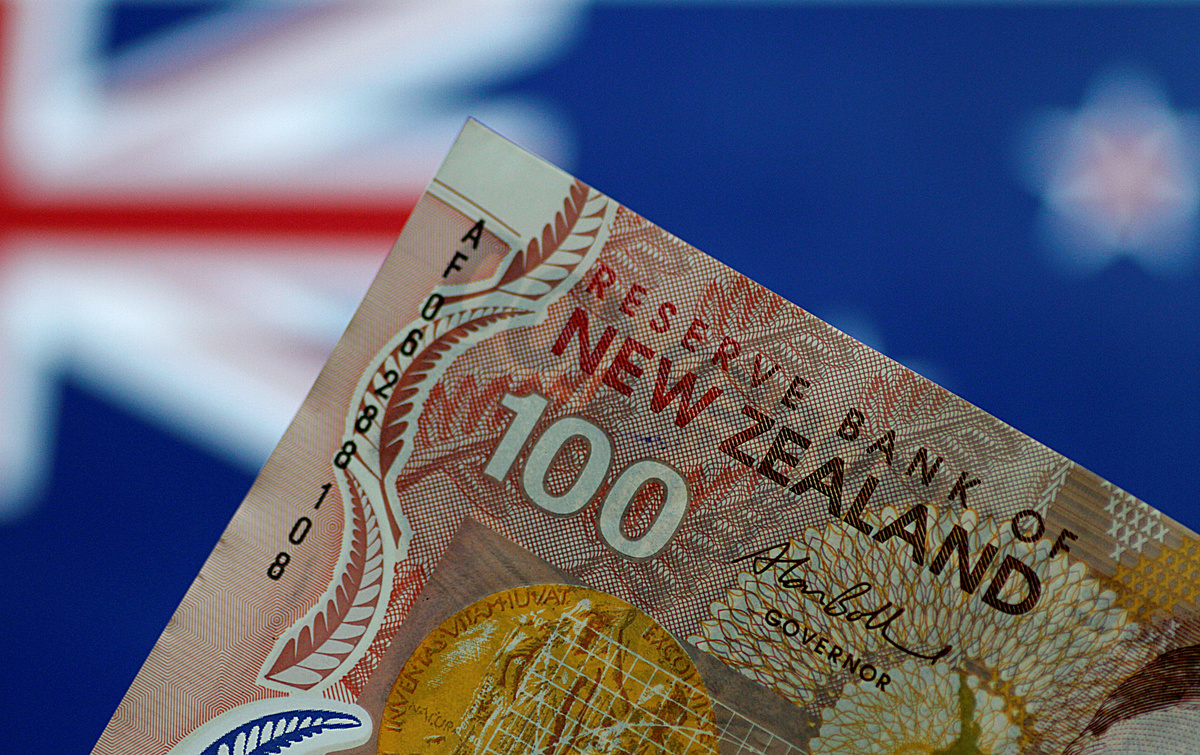
SYDNEY (Reuters) - The New Zealand dollar took a spill on Wednesday after disappointing jobs data only added to expectations that interest rates would have to be cut, perhaps as soon as this month.
The kiwi dollar was down 0.37 percent at $0.6648, having been as low as $0.6625 at one stage.
That helped the Australian dollar hop up 0.4 percent to NZ$1.0606 and away from important chart support at $1.0550.
The Aussie was also a fraction firmer on the U.S. dollar at $0.7053, though trade was very thin with much of Asia and Europe on holiday.
The kiwi's slip came after government data showed employment unexpectedly fell in the March quarter, even as the jobless rate eased a tick to 4.2 percent.
Wage growth also unexpectedly slowed to an annual 2.0 percent, suggesting the weakness seen in inflation during the March quarter might not be transitory.
Markets responded by further narrowing the odds on a rate cut from the Reserve Bank of New Zealand, which has already stated that the next move was likely to be down.
"The labour market is showing all the signs of a late cycle slowdown, but without rising wages growth," said Kiwibank chief economist Jarrod Kerr.
"With signs of a slowing economy, the RBNZ is unlikely to rest on its laurels," he added. "We expect a 25 basis point cut to 1.5 percent next week."
Bill futures rallied on the data while overnight index swap rates fell to imply around a 60 percent chance of a cut at the RBNZ meeting on May 8.
Yields on two-year government bonds likewise fell back to 1.42 percent, having been as high as 1.475 percent on Tuesday.
The RBNZ meeting happens to come a day after the Reserve Bank of Australia (RBA) holds its policy meeting for May. It is also under pressure to ease given inflation has proved surprisingly weak and the housing market continues to slide.
A report from property consultant CoreLogic out on Wednesday showed home prices nationally fell 0.5 percent in April from March, when they dropped 0.6 percent.
The only bright sport was that the pace of decline has been gradually slowing since December when prices slid 1.1 percent.
Investors are not convinced the RBA will be ready to move so soon, with futures implying a 36 percent chance of a quarter point cut on May 7. An easing to 1.25 percent is fully priced in for July.
A Reuters poll of 42 analysts found a majority expected rates to stay steady, but with a significant minority tipping an easing.
Australian government bond futures were unchanged as the market awaited the outcome of the U.S. Federal Reserve's policy meeting later in the day.
The three-year bond contract held at 98.745, with the 10-year contract at 98.2000.
(Editing by Kim Coghill)