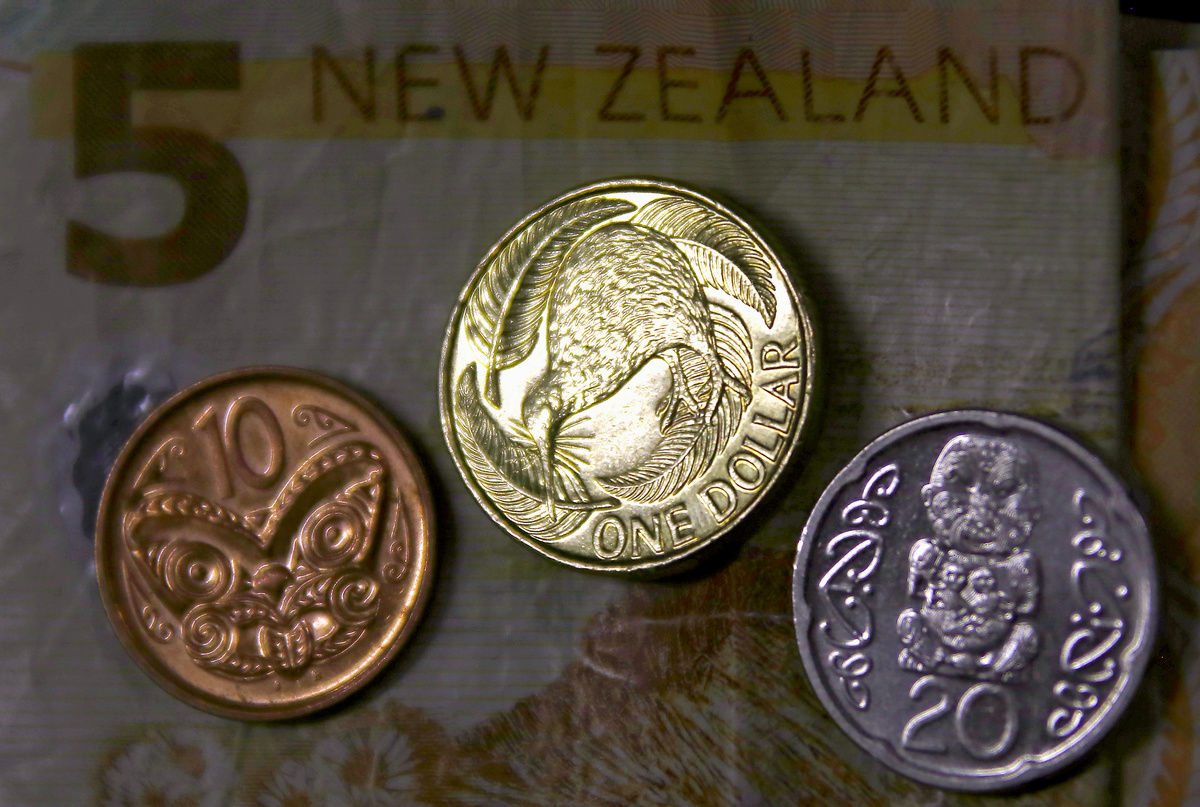
SYDNEY (Reuters) - The New Zealand dollar headed for a hefty weekly gain on Friday after bears were badly wrongfooted by the country's central bank, leaving its Australian counterpart near its lowest against the kiwi since early 2017.
The kiwi dollar was up 1.1 percent for the week at $0.6816, and a long way from a low of $0.6720 hit early in the week. The Aussie had shed 1 percent on the kiwi for the week so far to stand at NZ$1.0401, just above a trough of NZ$1.0366.
The New Zealand currency took off on Wednesday when the central bank surprised bears by being more balanced on the economic and policy outlook than many had expected.
Speculators had shorted the currency heavily in anticipation the Reserve Bank of New Zealand would turn ultra-dovish given a run of softer data at home and evidence of a slowdown globally.
Instead, RBNZ Governor Adrian Orr said the risks of a cut in interest rates had not increased recently, causing a sharp rise in bond yields as the market backed away from pricing in an easing, if only for now.
Yields on two-year paper shot back up to 1.725 percent having hit historic lows at 1.61 percent early in the week, leaving them more in line with the 1.75 percent cash rate.
"While the Bank pushed out the timing of future rate hikes, the risks around the outlook were 'symmetric', up and down," said Jarrod Kerr, chief economist at Kiwibank.
"Market participants had positioned for a significant shift in the RBNZ's bias. Without the delivery of an explicit easing bias, the kiwi shot higher."
The Aussie dollar trailed behind at $0.7093, almost unchanged for the week but off the recent five-week low of $0.7054. It had popped higher overnight when the U.S. dollar was hit by a dismal retail sales report, but failed to clear resistance at $0.7136.
U.S. sales suffered their sharpest drop since 2009 in December, a shock result that seemed to justify the Federal Reserve's decision to pause on rate hikes.
Yet the recent run of Australian data has not been particularly upbeat and investors continue to price in a better-than 70 percent chance of a cut in interest rates by year end.
Indeed, a top official from the Reserve Bank of Australia (RBA) on Friday welcomed the Aussie's decline given there was still slack in the labour market and inflation remained uncomfortably low.
Data due next week is expected to show wage growth stayed at a miserly 2.3 percent in the December quarter even as the labour market performed strongly.
Labour data for January is out on Thursday and analysts forecast the unemployment rate would hold at a 6-1/2 year low of 5.0 percent with around a net 15,000 jobs created.
At the end of next week, RBA Governor Philip Lowe appears before parliament for his semi-annual testimony and markets will be sensitive to any hint of dovishness.
Australian government bond futures followed Treasuries higher in the wake of the poor U.S. data. The three-year bond contract added 2.5 ticks to 98.340, while the 10-year contract rose 4 ticks to 97.8950.
(Editing by Sam Holmes)