
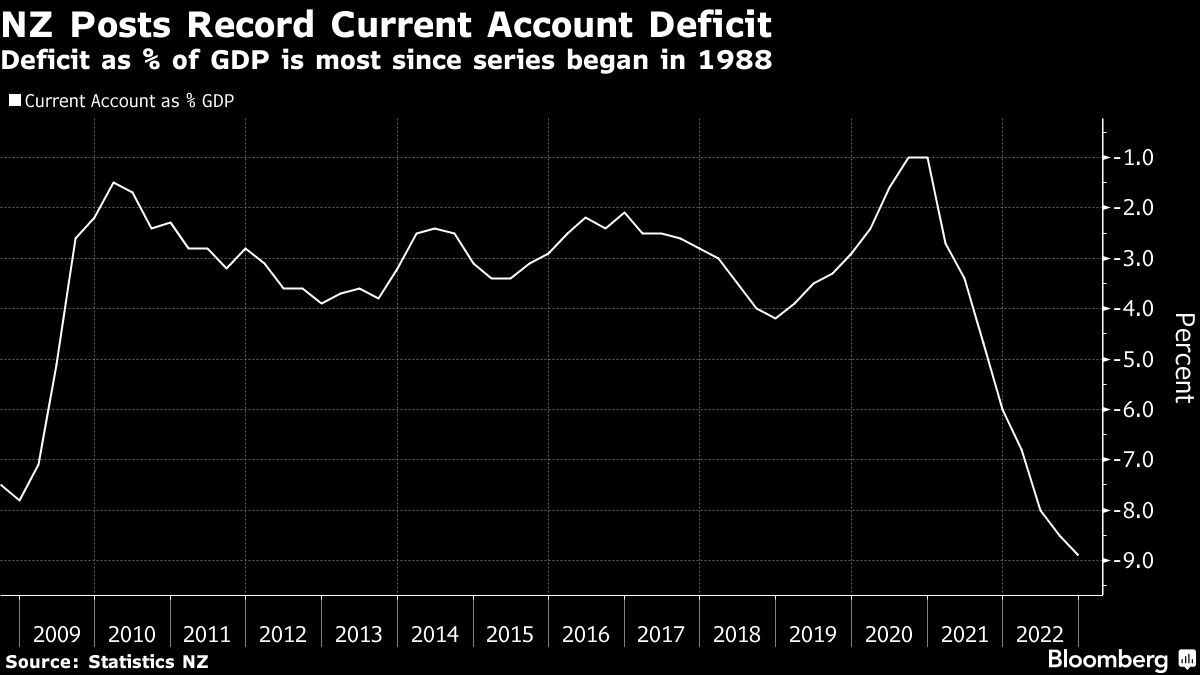
New Zealand’s credit grades with S&P Global Ratings could come under pressure if the nation’s current account deficit remains too big.
The deficit “is at an extremely high level at the moment,” and “much wider than we were expecting it to be,” said Anthony Walker, a director of sovereign ratings for Australia, New Zealand and the Pacific at S&P.
“It is catching our attention, the persistently weak and worsening current account position of the New Zealand sovereign, particularly given that it has been quite weak the last year or two and our forecasts are for it to narrow.”
New Zealand has AA+ foreign currency and AAA local currency ratings from S&P, but the agency has always pointed to the country’s external imbalances as a key risk. Data Wednesday showed the current account deficit blew out to 8.9% of gross domestic product in 2022 as the nation imported more goods and services than it exported.
S&P had forecast the deficit would be 6.7% in June last year and ease to 5.8% by mid-2023.
“This is an important forecast because we believe that the rating could come under pressure if the current account deficit is persistently weak, and it is actually weaker than we were expecting,” Walker said.
“We would need to see the current account deficit narrow over the next 12 to 18 months and if it doesn’t there is going to be increased pressure on the AA+ rating.”
A review of the foreign currency rating would also see the AAA local currency rating come under review, he said.

‘Even Bigger’
The New Zealand dollar fell after the comments were published, dropping to 62.42 US cents at 3:40 p.m. in Wellington from 62.59 beforehand.
“The external accounts have a habit of being ignored and not mattering — until they do,” said Doug Steel, senior economist at Bank of New Zealand in Wellington. “This is worth keeping a close eye on as we think the deficit will get even bigger this year before it starts to shrink.”
Walker said S&P usually reviews ratings after key data points and would be looking closely at the New Zealand government’s next budget in May, particularly as spending could increase due to the destruction caused by Cyclone Gabrielle.
When S&P upgraded New Zealand’s credit ratings in 2021, it was on the basis that the fiscal accounts would improve post-Covid, he said.
Walker said the rebuilding after the cyclone may not only add to budget pressure but also to the current account deficit, because many of the materials needed will be imported.
“New Zealand imports a lot of material and reconstruction work is going to mean more imports as well, so that could also play back to the weaker external position,” Walker said. “So there’s a few moving pieces here, we’re really interested in seeing what the budget is doing.”
©2023 Bloomberg L.P.