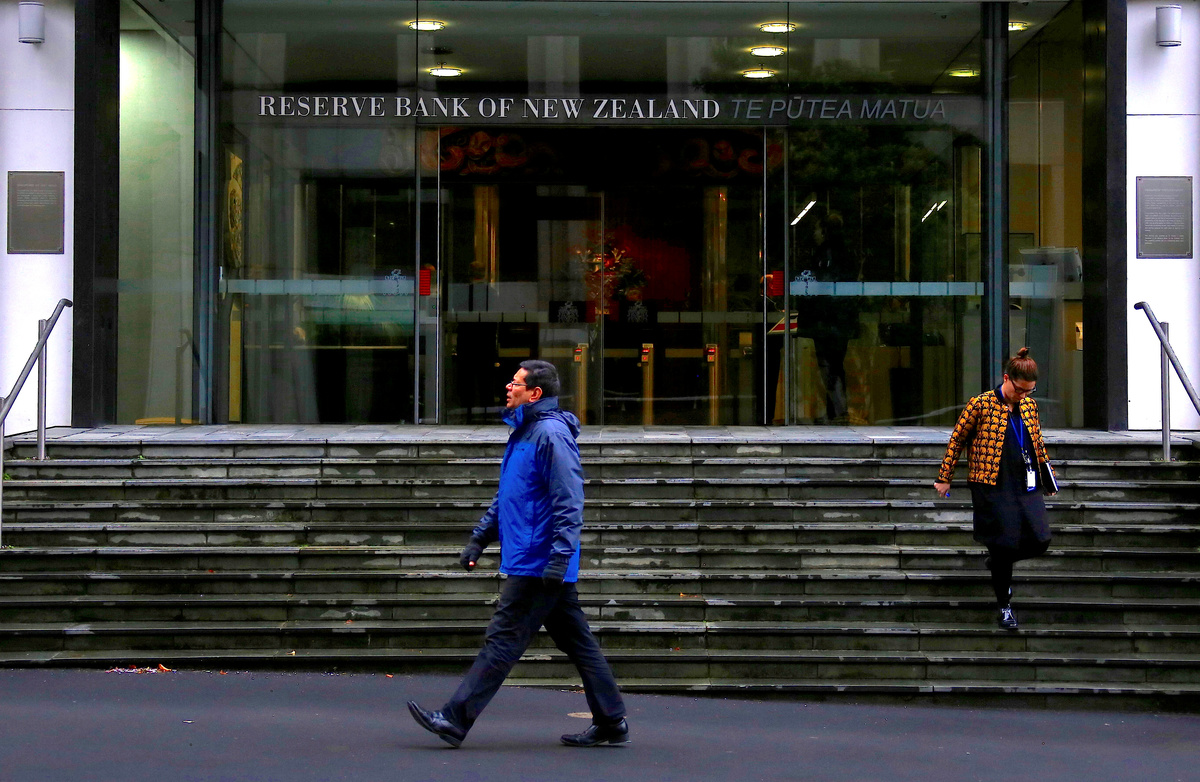
New Zealand's central bank is expected to stand pat at next week's monetary policy meeting, but markets will be alert for any clues on whether negative interest rates are on the cards as the coronavirus darkens the economic outlook.
The Reserve Bank of New Zealand (RBNZ) slashed the official cash rate (OCR) by 75 basis points to 0.25% in an emergency meeting in March to cushion the hit from the coronavirus pandemic, but pledged to keep it at that level for at least 12 months.
Governor Adrian Orr, however, said last month that negative rates were not off the table, after New Zealand enforced a strict one-month lockdown to limit the spread of the coronavirus that brought economic activity to a standstill.
"The RBNZ is highly likely to repeat that a negative OCR is an option for the future," said Westpac Chief Economist Dominick Stephens, who has forecast OCR to be cut to -0.5% in November.
"However, we also suspect that they will emphasise that the OCR will not go negative any time soon. Exactly how the RBNZ expresses this will help us determine the timing of our negative OCR call," he said.
Capital Economics forecast a 50 basis point cut in August and 25 basis point cuts in September and November, saying RBNZ would need to go into negative territory to meet its inflation target.
All economists in a Reuters poll saw rates steady at the next meeting on Wednesday, and most saw it staying that way for the rest of the year while RBNZ expands its quantitative easing (QE) programme to stimulate the economy.
RBNZ has already committed to buying NZ$30 billion ($18.29 billion) of government bonds and NZ$3 billion of local government bonds in its QE programme, but analysts expect this to be doubled to NZ$60 billion.
"We think QE will remain the tool of choice to up the ante, and in our view it is the right one," ANZ Chief Economist Sharon Zollner said in a note.
COVID-19 infections have dropped significantly in New Zealand and the government will decide next week on whether it would open most businesses and offices.
But economic growth has already taken a hit with RBNZ predicting quarterly GDP to have reduced by between 4% and 37% through different levels of restrictions.
The government has delivered more than NZ$20 billion of fiscal stimulus and is expected to announce more in the annual budget on May 14.
($1 = 1.6404 New Zealand dollars)
(Reporting by Praveen Menon; Editing by Sam Holmes)